The epic story of the 1910 battle to win the union at Pennsylvania’s Bethlehem Steel, both an accentuation and a departure from past struggle, creating new templates for the labor movement. It would be another 31 years before the C.I.O.’s Steel Workers’ Organizing Committee won a four day strike, and a union, in March, 1941.
‘The Bethlehem Strike: A Revolt of Slaves’ by Robert J. Wheeler from The International Socialist Review. Vol. 10 No. 10. April, 1910.
THIS little town is the scene of a bitter industrial conflict. Her one time peaceful streets are thronged daily with the striking wage slaves of the Bethlehem Steel Company. Sinister, brutal faced men, armed with riot clubs, patrol the highways. Heavily armed Cossacks, grim visaged and as merciless in action as
Capitalism, guard the gates of the steel plant, or in groups of two or three ride up and down. Business is paralyzed. The social life of the town is disrupted. Men’s faces show lines of care and apprehension. Women are becoming worn and pinched from want and worry. Little children go hungry to bed: All is turmoil, anxiety, dread.
Schwab is at war with his men. Schwab, the steel king, the pet of Carnegie of Homestead infamy. Schwab, the picturesque philanthropist, the debonair gambler, the owner of 10,000 men’s jobs, the master of 10,000 men’s lives. Schwab, backed by American capitalism and Cossacks is contending against 10,000 wage slaves supported only by their capacity to endure privation.

No, he has nothing to arbitrate. He had no complaint. His men suited him well. Were they not the most highly skilled in all the land? Did they not work the longest hours for the least wage? No, nothing to arbitrate. What master has?
For nearly a quarter of a century, Bethlehem has been a city of peace; the peace that exists where slaves are submissive and the master supreme.
Here was the ideal open shop. No union men were tolerated. “Union men,” said Schwab, “are all Socialists.” The lowest wage in the steel industry is paid here; 12 1/4 to 27 cents per hour. The hours were from 10 to 12 per day. Overtime, Sunday and holiday work for straight pay, the bonus system for bosses, these were the conditions. And coupled with this slave system was the church, enacting its historic role, “the ally of despotism,” collecting dues through the office and teaching “Servants obey your masters.”
The lords of America Industry gave a banquet in that modern Babylon—Chicago. There while they feasted and the wine flowed freely, they boasted of their greatness and riches. Schwab, more vainglorious than the rest, like some modern Belshazzar, praised himself as the most successful slave owner. “The best mechanics in the steel business at the lowest wage,” said he. The newspapers carried the boast to the men. It was the last straw. Resentment against the system now flamed into action. Three machinists refused to work overtime unless paid time and a half. They were discharged. Then 1,000 men threw down their tools and walked out, their foremen with them. The revolt had come at last.
Marx was right, there is a point below which the workers will rot be driven. This outburst is significant of that which is to come.
The capitalists are up against the “law of diminishing returns.” The rate of profit continues to fall in spite of most economical management in production. Dividends must be maintained somehow. They try to force the wage slave to accept less and less as his snare. Therefore outbreaks, strikes and in the end revolution.
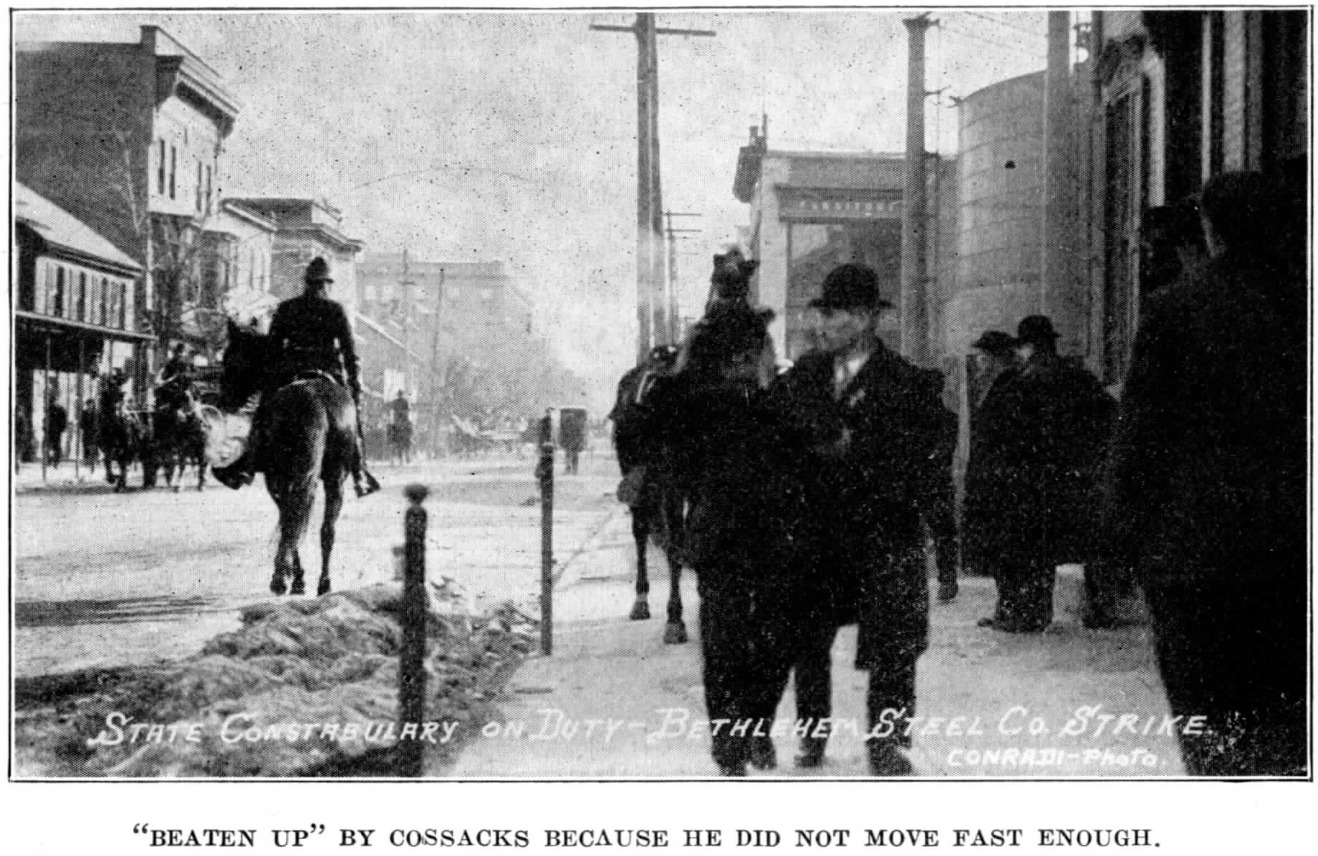
And they are drunken with power in Pennsylvania, these masters. They care not that the human machines have needs or unsatisfied longings. Schwab told Chairman Williams that he estimated the cost of production before he took a contract. He could not see why he should be expected to readjust his estimate of cost after the contract was made. “Why,” said he, “should I be obliged to pay more now for labor than for any other item in the estimate.” Chairman Williams replied: “‘You mean you buy labor power from us as you buy other commodities from the producers.” “You are on,” said Schwab. He and his kind have no other relation to the working class. Neither do they fear unarmed strikers. The brutal Cossack, fit representative of his ruthless owners, easily subdues them.
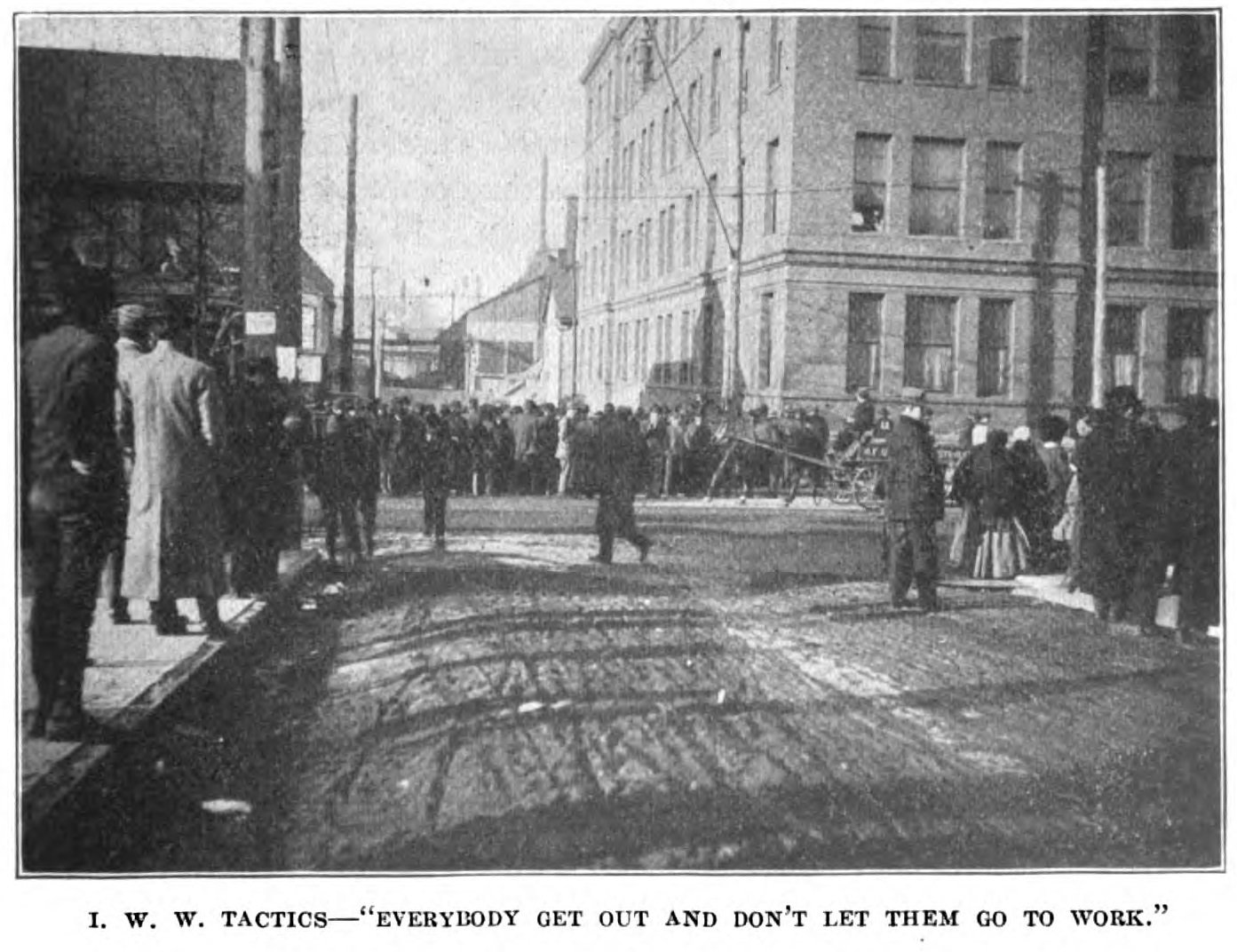
Two weeks of slow progress in organization, Chairman David Williams and Chief Organizer Jacob Tazlear, ably supported by their corps of assistants, worked night and day gathering the men into the unions, then Ettor and Schmit of the I.W.W. came to town. Their addresses on “Solidarity” aroused the fighting spirit of the men. Ettor advised the men to get up in the morning and do picket duty in a body. “Don’t let anyone go to work,” said he. When the leaders decided to act on this advice, sending more than 2,000 men on the picket line, the big plant closed down. Mass action cannot fail of success.
Schwab rested easy while the slaves passed resolutions, proclaiming the justice of their cause and their respect for “law and order,” but when they used the power of numbers to carry out their plans, he was aroused to action. He called on his servant, the Governor, for help. The Governor sent the Cossacks.
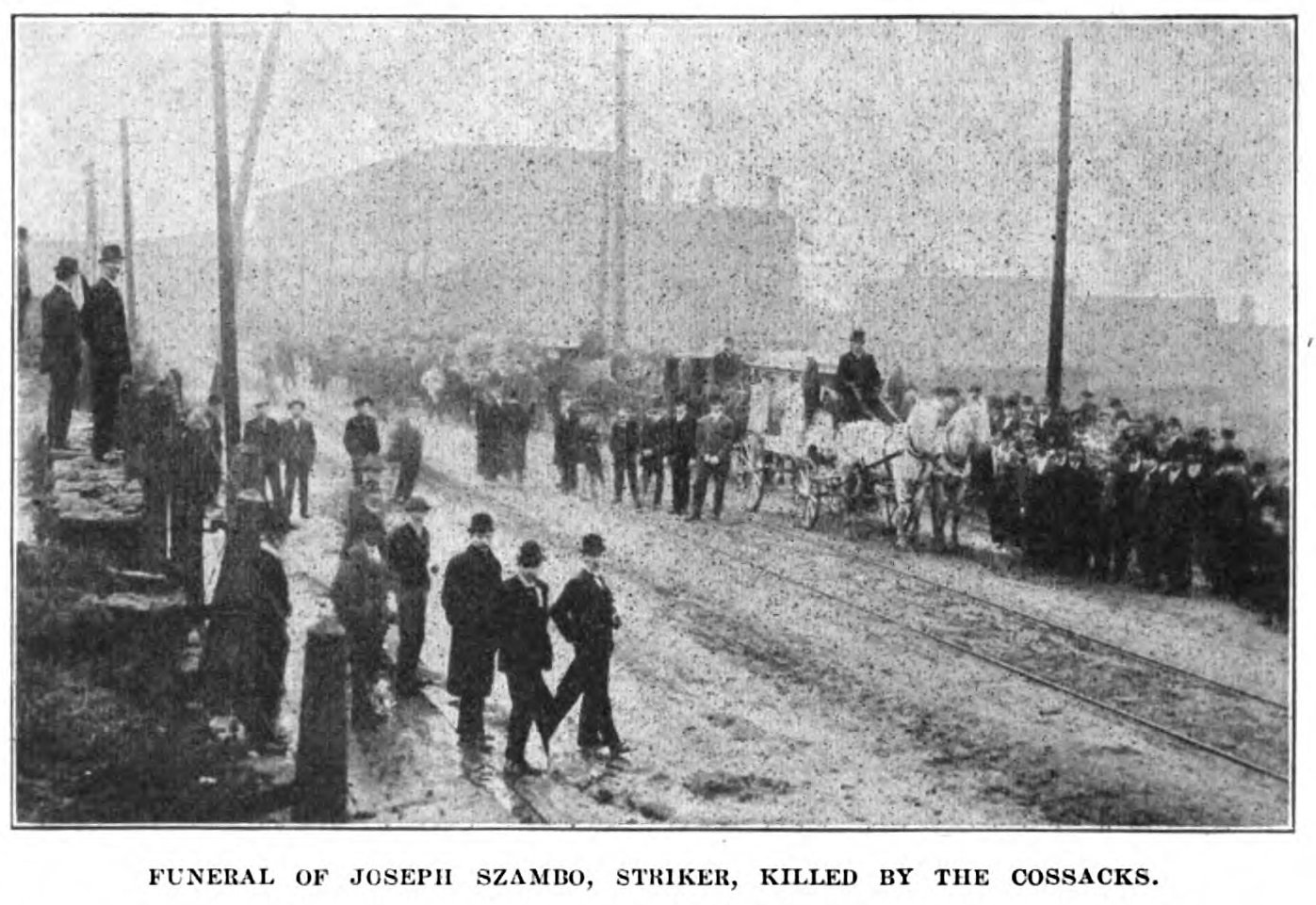
These thugs and gun men came to promote disorder and break the strike. Hardly had they detrained before they were clubbing and shooting. ’Ere they had gone the short distance from the train to the mill, they had murdered one striker and wounded another. The crowd aroused to fury, fearless now, assailed them with bricks and stones. By desperate fighting they forced their way through the thousands of furious strikers and reached the mill. The trooper said they had never faced such an angry crowd, not even at McKees Rocks. Had anyone urged the strikers, they would have killed the police before they could have reached the shelter of the plant. The fighting was renewed time and again during the day and night. Many were injured on both sides. Twenty arrests were made, including a member of the city police force. He had the temerity to order a Cossack off the sidewalk. The prisoners were jailed in a box car and on Monday were given a hearing in the company’s office. Several were remanded for trial under $1000 bail. The unsupported testimony of a Cossack was sufficient.

Since then the city has been under martial law without the formality of a proclamation. The municipal government is ignored. Peaceful people are clubbed on their own door step or walking the street. Men are held up after dark and searched. Some have been dragged from bed and given the choice of going to work or to jail. The city government is in sympathy with the strikers but is powerless to protect citizens against the Cossacks, who are above the law and backed by the state. Again Marx was right, the state is merely the executive of the business interests.
Still the strike goes on. The men are enduring patiently. The A.F. of L. is not giving much financial aid. President Gompers does not seem to take the strike very seriously. Waiting for the “psychological moment” perhaps.
No matter what the outcome of the struggle is to be, the people of this section have learned a needed lesson. Before the strike they believed they had liberties and rights and that the state would protect them in the enjoyment of the same. Now they know that the capitalist is the state and can violate all rights and destroy all liberties when he wills.
These people are a patient people, slow to change. But the club of the Cossack has quickened their faculties. Men beaten down on the street by a thug in the employ of their master, and being denied redress at law, become advocates of force thereafter. The multitude standing by, helpless to aid, because unarmed, and furious because of their impotence, becomes ripe material for the propaganda of revolution.
This fall, we shall make a determined effort to right these wrongs by the ballot. Failing, then, though we are a peace-loving people, no defense will remain to us but force against force.
We can retreat no further in this slave state. Our backs are as it were against the wall. The veneer of civilization seems slipping off. The primal instinct to give blow for blow in brutal combat is rising strong within us. We can endure no more. So listen——
“Masters and Rulers, take warning, we’re men; The blood in our veins came down from the past; We’ve hearts and they’re human, forgiving, but when Aroused to the Limit, resist to the last.”
The International Socialist Review (ISR) was published monthly in Chicago from 1900 until 1918 by Charles H. Kerr and critically loyal to the Socialist Party of America. It is one of the essential publications in U.S. left history. During the editorship of A.M. Simons it was largely theoretical and moderate. In 1908, Charles H. Kerr took over as editor with strong influence from Mary E Marcy. The magazine became the foremost proponent of the SP’s left wing growing to tens of thousands of subscribers. It remained revolutionary in outlook and anti-militarist during World War One. It liberally used photographs and images, with news, theory, arts and organizing in its pages. It articles, reports and essays are an invaluable record of the U.S. class struggle and the development of Marxism in the decades before the Soviet experience. It was closed down in government repression in 1918.
PDF of full issue: https://www.marxists.org/history/usa/pubs/isr/v10n10-apr-1910-ISR-gog-EP-cov.pdf
 Revolution's Newsstand