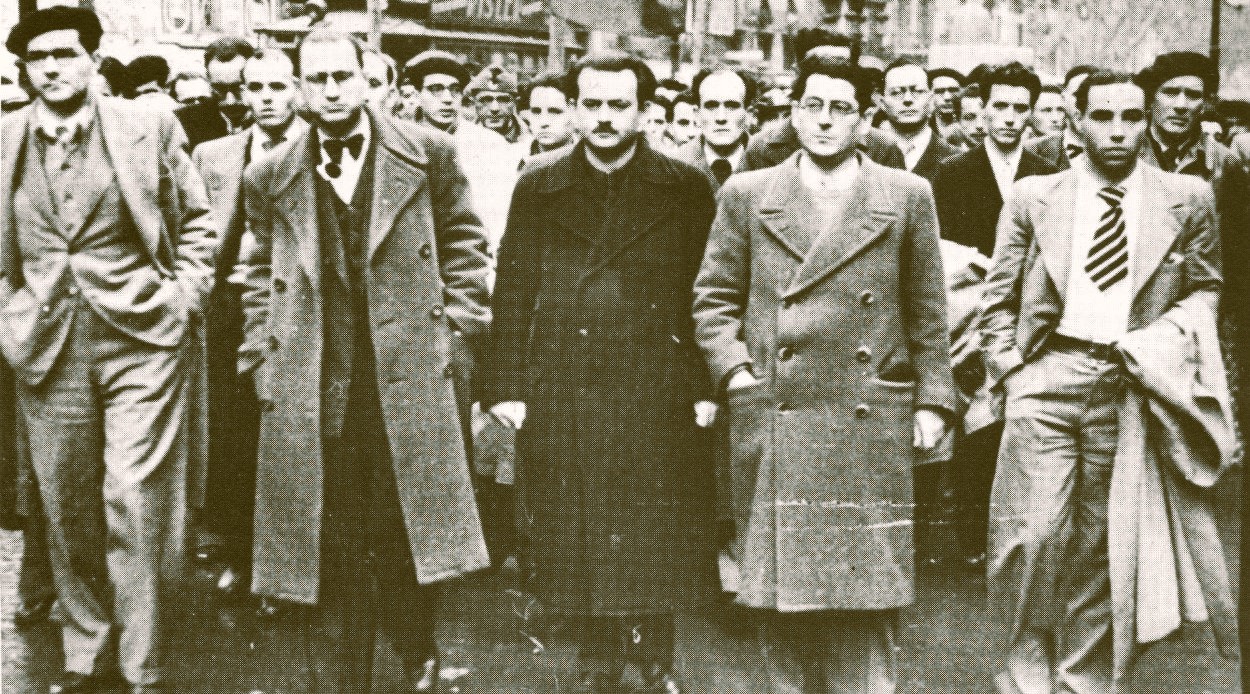
As soon as the Spanish (second) republic was established in 1931, monarchists, theocrats, and fascists set about to undermine and overthrow Spain’s new ‘democracy.’ Nin on the emerging threats.
‘The Fascist Danger and the Need for a United Front of the Proletariat’ by Andres Nin from The Militant. Vol. 5 Nos. 4-5 January 23-30, 1932.
When Azana became President of the Council of Ministers after the resignation of Maura and Alcala Zamora there were many who interpreted the change of ministry as an evolution to the Left. Maurin went so fur as to say that the new government was “typically petty bourgeois” and to put it on a level with the Kerensky government. We, on the contrary, from the first moment maintained that this solution of the crisis meant, a step forward in the direction of the big bourgeoisie and of its bloc with the socialists.
“In reality”, we said in the third number of El Soviet, which was confiscated by the governor of Barcelona, representing the so-called “Kerensky government”, “the real master of the situation is Lerroux, that is, the big bourgeoisie. Still the time has not yet come to take off the mask, to take over completely the reins of power in the name of those who see in Lerroux, as he said in his speech at Santander, ‘the lifebuoy in which the shipwrecked man sees the hope of salvation’.”
The facts have proven, and keep proving, that our evaluation was correct. On the adoption of the “law for the defense of the republic” there followed a policy, continually more aggressive, of repression against the working class and of systematic strangulation of the democratic revolution. Nourished by the weakness of the working-class organizations, the incapacity of the anarcho-syndicalist leaders of the C.N.T., who have learned nothing from experience, and the absence of a strong Communist party, the bourgeoisie keeps consolidating the ground which it has gained, and lying in wait for the opportune moment to upset the democratic cart and to install its unmasked dictatorship.
The Socialists and Democratic Illusions
Today this is not possible. Democratic illusions are still quite alive among the petty-bourgeoisie masses and a large part of the working class. The bourgeoisie finds it necessary to maintain these illusions temporarily, making use of a political force which is not completely discredited among the masses, and by its name at least, represents a guarantee of radicalism. This political force is the socialist party, whose leaders show themselves disposed as usual to serve as auxiliaries to the exploiting class.
Still, to form an exclusively socialist government would be a risky adventure. Inevitably it could do nothing else than continue the policies of the bourgeoisie, and the socialist party would discredit itself irretrievably in the eyes of the working masses. With it, the bourgeoisie would find itself deprived of one of its most important reserve weapons.
The socialists, who are fully aware of this, are horribly afraid of taking over the entire responsibility for the state power, and declare themselves for a concentration government, over which they should preside. Largo Caballero was in a hurry to state that such a government by its very composition, would be unable to realize the party program. Yet, according to the declaration of the Minister of Labor, “the party, having made greater renunciations than any other for the welfare of the republic, will accept this sacrifice too for the ‘national interest’.”
Under these circumstances the socialists, free of all responsibility for the policies of the government, will contribute to maintaining democratic illusions among the masses and will make it possible for the bourgeoisie to consolidate its position and to prepare, behind the socialist screen, a genuine Fascist dictatorship. The Azana government was the first step in this process; the government presided over by the socialists will be the second.
Lerroux, the Spanish Miliukov
The events of the last few days fully confirm this evaluation. While public opinion is being prepared for a Largo Caballero government, and the alertness of the masses is being put to sleep, Lerroux, in an interview given to the editor of the reactionary Madrid journal Ahora, expressed the opinion that the socialists in power, “far from being a difficulty” would be “prudent collaborators”. In a few truly classic words, stripped naked, without reserves – the class character of the regime; “I can assure you”, he said, “that I am realizing the prophecy which I made years ago when I said (too emphatically, as some thought), ‘I will govern’. Now I can say that I am governing, since one can have the power and not the government. One can have the government and not the power. I have the government and not the power.” Lerroux is the representative of the big bourgeoisie, the Spanish Miliukov; the workers must not forget this.
Let them not forget, too, that, the leader of the “radical” party is no platonic individual. When he entertains the masses on the tambourine of the “socialist government”, Lerroux is making serious preparations, not only to govern on the political stage, but to take over the power, to become the direct instrument of a bloody dictatorship of the Fascist type.
The constitution of the nationalist party, “Young Spain”, announced recently, is the first important step in this direction. Its organization, based on a militia of 500,000 men, who are to “wear a distinctive costume with the attributes of the legion, a gray-green shirt and a collar of the same color”, is modeled on Italian Fascism. The warning to abstain from joining, made to “the timorous and cowardly, and those who are not capable of facing all the dangers of a bloody battle”, show clearly what are the intentions of the promoters of this new organization.
The proletariat would commit an error which might have fatal consequences if it does not give this fact all the attention which it deserves and fails to see in the announced intention of this group more than a mere manifestation of boasting.
It is more than probable that “Young Spain” will fail to recruit the 500,000 men which it needs to put out the democratic revolution for good and to crush the proletariat. Still they can become an imposing force tomorrow. The worst thing we can do is to close our eyes to this incipient danger. In 1920, and even in 1921, the Italian revolutionists looked with disdain on the Fascists, whom they saw as nothing more than “bandit gangs” without real force. These “bandit gangs” took the power at the end of 1922 and dragged along with them the large petty-bourgeois masses, these same masses who had followed the socialists and who, disillusioned by the downfall of the proletarian revolution, threw themselves into the arms of Mussolini.
Are there factors in Spain which are capable of favoring the development of a strong Fascist, movement? There are beyond a doubt.
Whither, the Petty Bourgeoisie?
The first factor, and the most important, is the petty bourgeoisie. As in Italy, the urban and rural petty bourgeoisie constitutes the immense majority of the population. Because of the very role which it fulfills in the economic life of the country – dependence on big capital – this class is incapable of carrying out its own policies, and constantly vacillates between the big bourgeoisie and the proletariat. To win it over, or at least to neutralize it, is a task of fundamental importance for the cause of the revolution.
After the ruin of the great working class movement of 1917–1920 it supported in fact the dictatorship of Primo de Rivera. Still, since this experience did not free it from the burdensome load which weighed down on it, nor improve its situation, it developed toward republicanism. With the fall of monarchy and the proclamation of the republic, the petty bourgeoisie gave free rein to its democratic illusions and hopefully followed the demagogues of the left. Still the illusions are disappearing, and these great fluctuating and indecisive masses find themselves irresistibly drawn to that social class which offers a clear and concrete program, and has. the unshakable determination to put it into practice.
That class can only be the big bourgeoisie or the proletariat. The big bourgeoisie has this program: the crushing of workers’ organizations, the consolidation by fire and sword of the domination of capital. The instrument for the realization of this program is being forged by Lerroux and his “Young Spain”. Nothing is easier than to attract the disillusioned petty-bourgeois masses with this program, conveniently seasoned with a good dose of demagogy. Let us not forget that, at the beginning, Italian Fascism declared itself anti-capitalist and republican.
Still, there is a second factor, no less important: the proletariat, which has a unique opportunity to give definitive battle to the bourgeoisie and to take the power. The objective circumstances could not be more favorable to such an end. But subjectively it is disarmed. From a trade union point of view it is divided: the leaders of the U.G.T. collaborate openly with the bourgeoisie, and those of the C.N.T. either fall into a reformism which fully equals that of Largo Caballero and Co. (the Peiro-Pestana group) or into adventurism (the F.A.I.) which can only lead to a bloody and profitless putsch.
What is missing are mass organizations, such as the Soviets, which assemble the whole working class and become the instrument of the insurrection and of the seizure of power. Above all, there is missing a strong Communist party, without which victory is impossible. If the working class is conquered without a battle or after a heroic but ineffectual putsch, its defeat, its passivity will favor the evolution of the petty bourgeoisie to the Right and will permit the bourgeoisie to lean upon it in striking a death-blow against the proletariat. Under these circumstances, Fascism will find a magnificent basis for its development.
This perspective is possible, but not inevitable, far from it. The working class must keep it in mind in order to foresee all the dangers, and to attack the enemy more surely and more decisively. The situation is clearly a revolutionary one. The capitalist crisis is more aggravated from day to day. There is no solution. The bourgeoisie keeps consolidating its position in a desperate effort, but stumbles over unheard-of difficulties in trying to consolidate them definitely.
It tries to gain time by constituting a government presided over by socialists. The working class must take account of this and not give the bourgeoisie a moment’s breathing spell. In revolutionary periods such as those in which we are living, events develop with extraordinary speed. The revolutionary consciousness of the masses progresses similarly in geometric ratio. What is missing is a party to concretize this revolutionary consciousness into precise formulas and organize the masses for action. This party does not even exist, although there is potentially an intense Communist spirit in the country. The working class must be given this indispensable instrument for its emancipation. A great revolutionary proletarian party must be forged, unifying all the Communist forces which exist in the country, and giving it a clear and precise program. Only in this way can the Fascist danger be averted; and the Spanish proletariat, allied with the peasants, can advance with a firm and sure step on the road which leads to victory.
The possibilities of success in the struggle against the Fascist danger and in the constitution of a strong Communist party will depend principally on the ability to put an end to the trade union split which has torn apart the working class of our country.
In this sense, the Communist party is called upon to fulfill a role of the very first importance, by struggling implacably against the chronic splitters among the anarchists and the U.G.T., by proving in practice to the proletariat that it desires unity, and by an ardent struggle to attain unity.
Unfortunately, the Party in this field has followed a fundamentally false policy, which culminated in the famous Seville Conference and in the constitution of the Reconstruction Committee, which created a deserved unpopularity for the Communists in the C.N.T., and has deepened the split still further. Three or four months ago the Party, faced with the open collapse of its trade-union policy, announced a “turn”. It gave up the splitting tactics, which had produced such miserable results, and announced the transformation of the Reconstruction Committee into a Unity Committee.
The Spanish Communist Opposition greeted this “turn” with satisfaction, as it was the same thing as an implied recognition of the accuracy of its criticism; at the same time, it encouraged the Communists to prevent the turn announced by the party from remaining on paper, which there was reason to fear from the persistency with which the party stuck to some of its fundamental mistakes.
“As far as the trade union policy is concerned”, said the Central Committee of the Opposition in the open letter addressed, with this purpose, to all members of the party, “the symptoms are even more disturbing. Concrete propositions for a united front have been made to the C.N.T., but the Reconstruction Committee continues to function, and even after the circular of the Political Secretariat announcing the turn in the policies of the party, has published various manifestoes over its signatures. If the wishes of the Executive Committee are sincere, it must prove it in practice. The members of the party must impose their will in this direction on the leaders.”
Our fears were more than justified. The party, far from orientating itself sincerely toward unity, emphasized its policy of division. This is the reality, the more so as it tries to present itself on the outside, formally, as the most resolute defender of unity.
Its decision to call a so-called “Trade Union Unity Conference”, using as in 1925 (!) the Federation of Working Class Organizations of San Sebastian, can only lead to a second edition, revised and enlarged, of the Seville Reconstruction Committee, that is to say, to the creation, of a third central body.
It is evident beyond a doubt that only an insignificant minority of trade unionists will participate in this conference, and that the great organizations of the C.N.T. and the U.G.T. will not send delegates. Under these circumstances, can the conference produce any other result than a new split?
The experience of the last few years shows that this road is not the most desirable one to reach the unity so ardently desired; that with unity conferences and proposals for fusion congresses, absolutely nothing is accomplished. Unity must be achieved from below, after passing through the phase of the united front. The struggle against the bosses’ offensive, the problems presented by the revolution, have shown clearly before the eyes of the working class the necessity of coordinating and unifying its forces. Otherwise, it will be hopelessly crushed by the enemy, and the bourgeoisie, allied with the landlords, will accomplish once and for all the strangling of the revolution.
There is not a single worker, no matter how little conscious be is, who does not understand the necessity of forming a single front with the comrades who work with him in the same factory, in the same shop, in the same mine. The Factory Committee, elected by all workers of the same class without exception, whether or not organized in trade unions, or belonging to the C.N.T., or the U.G.T., or whatever their political affiliation may be, offers them the effective possibility of realizing their unity in action. The struggle for unity must therefore be begun from below, by undertaking an energetic campaign in favor of the constitution of Factory Committeees throughout the country.
Once unity has been achieved in this way from below, the working class, impelled by the very logic of the struggle, will reach the conclusion that it needs, not yet the united front, but unity from the viewpoint of organization, on a national scale. This road is apparently slower than that of the fusion congress which is favored as the first and last step, but in reality it is much faster, and above all, infinitely more effective.
The struggle for unity has, besides, other invaluable advantages pointed out already by us in the past in the first place, it offers the proletariat a magnificent occasion to counterpose the revolutionary control of production, exercised by these Committees, to the project for so-called “workers’ control” worked out by Largo Caballero, which is only a concealed form of class collaboration.
In the second place, in the course of development of revolutionary events in our country, the Factory Committees can serve as a powerful stimulus to the appearance of Soviets, those irreplaceable organs of the proletarian insurrection.
Let us therefore abandon the empty propaganda for trade union unity and those efforts which, like the conference planned by the party, only deepen the split, and let us work actively and resolutely for real and immediate unity in action of the working class, by driving forward with, the greatest energy the creation of Factory Committees.
Barcelona, Nov. 27, 1931.
The Militant was a weekly newspaper begun by supporters of the International Left Opposition recently expelled from the Communist Party in 1928 and published in New York City. Led by James P Cannon, Max Schacthman, Martin Abern, and others, the new organization called itself the Communist League of America (Opposition) and saw itself as an outside faction of both the Communist Party and the Comintern. After 1933, the group dropped ‘Opposition’ and advocated a new party and International. When the CLA fused with AJ Muste’s American Workers Party in late 1934, the paper became the New Militant as the organ of the newly formed Workers Party of the United States.
 Revolution's Newsstand