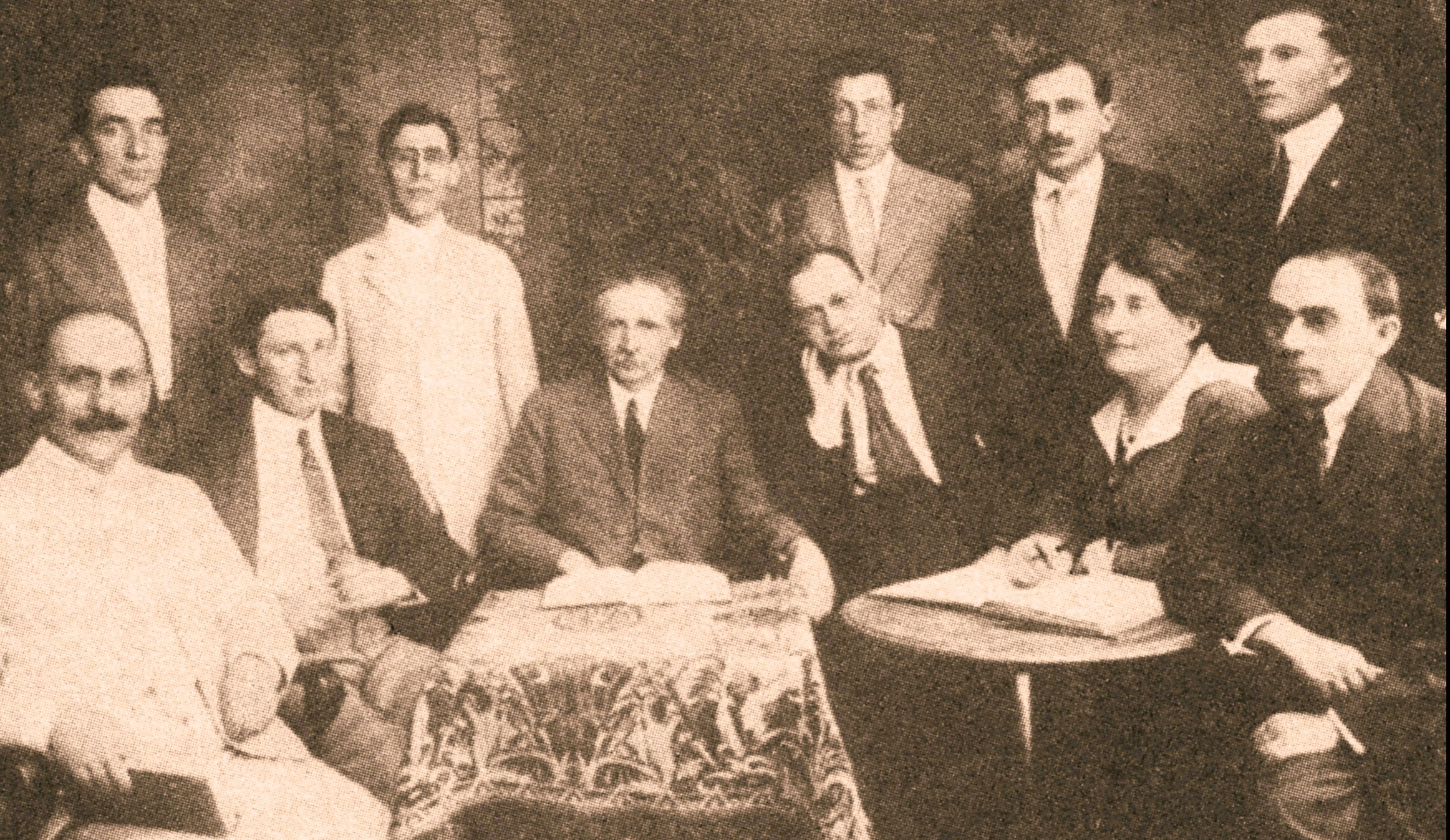
While the Socialist Party’s Jewish (Yiddish-speaking) Federation had split in 1919, with its Left Wing joining the Communist Party of America, in September, 1921 the majority of the Federation voted at its National Conference to leave the Socialist Party and join with the above-ground Communists to form the Workers Party in December of that year. The Jewish Federation was one of the strongholds of the Workers Council group and brought such leaders as Morris Winchevsky, Moissaye J. Olgin, and Paul Novick into the Communist Party. The minority would stay in the Socialist Party, and though diminished, continue with the influential Daily Forward newspaper. Below is a brief report of the meeting and a statement from the majority.
‘Jewish Federation Leaves Socialist Party’ from Workers Council. Vol. 1 No.7. September 15, 1921.
The Jewish Socialist Federation has withdrawn from the Socialist Party. The convention held in New York, September 3-5, called specifically to consider withdrawal from the party, showed 41 delegates against the party and 33 for it.
However, the attitude of the entire convention, that of both sides in it, constituted a convincing demonstration against the old organization of Morris Hillquit, Victor Berger, Gerber, Branstetter, Stedman, Germer, etc.
The debate on the main issue consumed fully five hours, evenly divided between the pro’s and the con’s. The defenders of “law and order,” of the status quo in the party, had not one word to say in favor of the party. Fear for the new, for the “jump into the unknown,” was all they could find in favor of remaining in the Socialist Party.
The loyalists organized into a Jewish Alliance. (Verband) within the party. The withdrawing federation retains its name, organization, membership, its weekly paper, the “Naye Welt” (New World), large book publishing plant and other valuable assets.
The 33 delegates who voted for the Socialist Party represented what is known in Gogol’s classic epic as “Dead Souls.” While still in session the convention continually received telegrams from the membership in the branches, whose delegates remained in the party, urgently requesting them to quit the ship that no longer sails under the revolutionary Socialist flag.
The Jewish Forward, the powerful daily in New York, with editions in half a dozen other cities, played a rather peculiarly interesting role in the proceeding.
Its circulation and advertising agents all over the country “delivered” the delegates with the votes for the Socialist Party. The publishing association that runs the daily placed an embargo on all and any criticism in the paper’s columns against the party.
Yet the entire editorial staff of the Forward went with the seceding Federation, the exception being the editor-in-chief, Abraham Cahan, who “gives a rap for the party,” and Business Manager Alderman Vladek, who “knows better.”
Thus the Federation lined up on its side such tried and proved Socialists as Morris Winchevsky (the Grandfather of Jewish Socialism); Moissaye J. Olgin; Dr. B. Hoffman (Zivien); Harry Rogoff, until the day of the convention the acting editor of the Daily Forward, Loliput, and P. Novick. All these people left the staff of the Forward.
It is not, however, the aligning of the leading Jewish Socialists on the side of the Federation that made its convention a red letter day in the Socialist movement of the country. The clear-cut position taken by the Federation on all the current issues of the day, its uncompromising and well-considered attitude toward the Third International, the problems of Political Action, Trade Union Tactics, Soviet Rule, Dictatorship of the Proletariat, and other questions, make for the importance of this step. The statement of withdrawal follows:
THESES ON WITHDRAWAL FROM THE S.P. ADOPTED AT THE CONVENTION
The Jewish Socialist Federation was organized as a central body of Jewish language branches of the party, with a sincere obligation to work in the party and through the party for the realization of the ideals of revolutionary Marxian Socialism.
The members and leaders of the Jewish Socialist Federation realized and have at several conventions pointed out that the party was far from being a revolutionary Socialist organization in many instances, both with regard to general formulation of principles as well as tactics. Our criticism was comradely. We sought to convince from the inside.
But the international revolutionary movement, which followed in the wake of the world-war, put the party to a test, along with the other sections of the world movement. The time came to speak in clear-cut Socialist terms. In this the party failed. It remained silent.
The crisis in the party followed. The split of 1919 was the first consequence of this failure. The formation of the left wing strengthened the reactionary element in the party. This we foresaw and we opposed the step from the outset. It was tactically wrong. The Left Wing was equally wrong in point of principle, and time has proven to us and to the left elements the correctness of our position. We remained in the party, giving the party membership the warning that the future would test the ability of the leaders to withstand the temptation to join the camp of the reactionaries.
They have not stood the test. They tried to deceive us. though for a short time only. They showed their colors a few months after the Chicago (1919) Convention. They took the position that they always had been and under all conditions would remain a non-militant party of law-abiding reform “Socialists,” although they were not opposed to coquetting at times with revolutionary phrases.
The Albany chapter of party history cannot be recalled too often, but we do not intend to repeat again in detail what transpired there. The whole conduct of the Albany trial aimed to show that the party is law-abiding before everything and is out for respectability at any cost.
The defense disavowed the Third International, shelved all pretense to party discipline, and convicted through its spokesmen the Soviet Government and the Soviet Regime. Yet the disgrace heaped upon the Socialist movement by the Albany trial cannot be measured alone by its betrayal of all Socialist principles. It remained for the New York (1920) Convention to complete the infamy, this being the theoretical approval of the actual betrayal of Socialism. Even Comrade Debs felt obliged to state that the party looked more like a party of politicians than a party of workers.
The 1920 election proved the actual demoralization of the party from the point of view of membership, influence and activity. It showed that no more could there be any hope that the Socialist Party would survive, that it could be resurrected in the Socialist sense. It became impossible for a serious Socialist to remain in the party.
We decided to put the party to a test on the issue of the Third International, its spirit, its principles, its aspirations. This is why we remained thru the Detroit Convention. in June. The convention there refused to take a positive stand on any question except that dealing with political fusion, adopting the tactics of discredited, bankrupt politicians.
But all Socialist fundamentals were deserted at Detroit
It put the Third International, the Department of Justice and American capitalism on the same basis. The party that was already dead now received its spiritual burial. Under these circumstances the convention declares that the Jewish Socialist Federation can no longer remain in the Socialist Party and is withdrawing from it, individually and collectively.
The Worker’ Council purpose was to win the Socialist Party of America to the Third, Communist, International and later to win locals and individuals. Published (mostly) weekly by the International Education Association in New York City, Workers Council included important members of the SP, mainly from its Jewish Federation like. J. Louis Engdahl, Benjamin Glassberg, William Kruse, Moissaye J. Olgin, and J. B. Salutsky, editor of the radical Jewish weekly, Naye Welt. They constituted the Left Wing that remained in the Socialist Party after the splits of 1919 and were organized as The Committee for the Third International. Most would leave the SP after its1921 Convention, joining the Workers (Communist) Party after a short independent existence later that year.
PDF of full issue: https://www.marxists.org/history/usa/pubs/workers-council/07-workers-council-1921.pdf
 Revolution's Newsstand