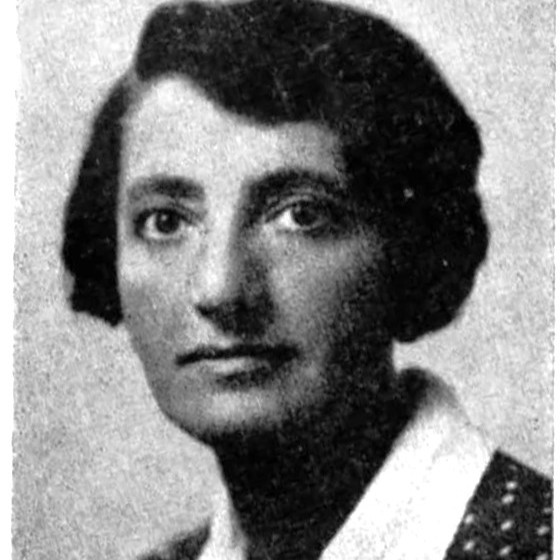
Rose Wortis was a factory-floor Communist working in the needle trades who became a leader of the International Ladies Garment Workers Union left. Here, as a delegate to the Second Profintern congress she visits several Soviet textile factories in different states of condition and technology.
‘Through the Russian Clothing Factories’ by Rose Wortis from Labor Herald. Vol. 2 No. 4. July, 1923.
WE saw the clothing factories of the Workers’ Republic during the time of the Second World Congress of the Red International. Our group consisted of clothing workers from all over the world. With us was the secretary of the clothing workers’ union of France (C.G.T.U.), the secretary of the Lithuanian clothing workers, one delegate each from Germany, Jugo-Slavia, Bulgaria, Java, the T.U.E.L. of America, and the secretary of the All-Russian Union of Needle Workers.
Our tour began with the Aboromiaya, an old-fashioned military factory, which evidently had been built without any concern for the health of the workers that were to spend the best part of their lives there. It is old-fashioned in structure as well as equipment. The ceiling is low, ventilation and light very poor. Cutting of heavy material for military clothing is being done by hand. Special machines are not to be found. Pressing is being done by iron heated on a large stove, etc. By comparing this factory to the new ones organized since the revolution, the workers measure progress they have made in reorganizing the industry. How is it that this factory, which is admitted by all to be unfit as a factory, is operated at full speed in a country, where the government is in the hands of the workers and is greatly concerned about their welfare? The answer is simple. A building could be found easily enough, but the transfer of the old worn out machinery to a new building would result in a great loss of machinery which cannot be substituted at the present time in Russia.
In spite of the oldness of the factory the new spirit has penetrated even these thick walls. The house which in the days of old, had been occupied by the director of the factory, has now been converted into a club house where the workers gather during lunch hour to read newspapers and discuss the events of the day.
After work hours the club house is used for educational purposes such as reading, dramatic and music circles, etc. A great deal of attention is being devoted to the liquidation of illiteracy amongst the workers of this factory, many of whom are village women, who had been drawn into industry during the war. The educational director who is at the same time a member of the shop committee, related with pride that during the last six months almost every worker in the factory has learned how to read.
Another part of the building was occupied by a nursery organized and supported by the factory administration; such nurseries are to be found in every factory where women workers are employed. It is difficult to describe the feelings that surged through me as I watched the little tots joyfully running about under the tender care of a nurse and smiling doctor. The latter, a man of about forty, had for years been active in the revolutionary movement, and is now devoting special care to these nurseries. He seemed to take extreme joy in explaining the diet of the children. It was touching indeed to see little babes bubbling with new life, almost in the very midst of these dreary factory walls.
When leaving this nursery, I thought of the many mothers in “The Land of the Free” who are compelled to leave their infants under the care of a younger child, or in one of the charitable nurseries, where both mother and child are held in contempt. I also thought of the almost divine courage and idealism of the Russian people, who in the midst of such great difficulties as they are now confronted with in trying to rebuild the shattered structure of their economic life, never fail to turn their eyes to the future. If they had been able to accomplish so much while being compelled to fight the whole world single handed, how much more would they have accomplished, had they been given a helping hand by other nations, or at least left in peace to build their new life as they best saw fit.
From the Aboromiaya, we went to factory No. 16, a large building occupying a square block. It looked more like an office building than a factory. It was a white goods and ladies dress factory now running at full speed. To a person not acquainted with the needle industry, it might have made the impression of a fully equipped factory, but the trained eye of a needle worker would immediately notice that in this factory too-thick flannel was being cut with great difficulty by hand. The sewing machines, though in running order, are all in need of repairs which cannot be done in Russia as yet.
The manager, a young woman of about thirty, slender, with bright dark eyes that seemed to look nowhere and see everything, took us through the factory. This young woman the same as many other workers of the trade had known other service. During the height of the civil war many of these young women forgot their sex and fought side by side with their men comrades, to drive back the white guards supported by the reactionaries of the world. She explained the difficulties under which they had worked to raise the factory to its present condition. In parting she said “comrades we shall not reproach you for the little help you have given us in the past, but we appeal to you to do your best in helping us to build our industry, so that we may not be compelled to sew clothing for our great nation with our bare fingers.”
The next factory we visited was the Opituaya, or Experimental factory, under the directorship of Comrade Bograchoff, who had worked in the men’s clothing industry in Cleveland and is very well known amongst the workers of that city. Having been a political exile from Russia he returned at the first news of the revolution and has been in active service since. He is a man of short stature, black smiling eyes that express both intelligence and good humor. He more than any other comrade is responsible for the organizing of the clothing trust, which is considered one of the best industrial institutions amongst the government trusts.
Beginning his work in Petrograd, he has now been transferred to Moscow where he is serving as chairman of the trust as well as director of the Opituaya factory. The factory is fully equipped with modern machinery, thanks to the Amalgamated Clothing Workers, who have presented it with set of gas irons and other machines. It is a modern factory in the real sense of the word. The building had been intended as a store house, but had never been used at all until taken possession of by the Clothing Trust. It is spacious, light, clean and generally very pleasant. Many of our American workers would consider themselves fortunate to secure employment in a factory with such pleasant surroundings. It is the direct antithesis of the Aboromiaya.
This factory is attempting to establish the industry on a scientific basis. They produce models (samples), figure out the amount of material necessary for every style of garment, the amount of labor, the intensity of labor, the arrangement of the pattern, etc. The results obtained are printed in diagram and circulated through every government factory in the country.
We came to the factory unexpectedly at closing time. However, in Russia the workers do not consider the factory a prison in which they are compelled to spend 8 hours daily to earn their means of existence. Neither is there any need for imposing fines on the workers for not attending shop meetings, since all take a lively interest in the affairs of the administration which reports. regularly on the conditions of the factory as well as the affairs of the workers. It is interesting indeed for an American worker to listen to a report of a manager to a shop meeting and to the discussion which follows, the workers in many instances expressing severe criticism about the inefficiency of the management.
The large hall, which during lunch hour is used as a restaurant, and under the able management of Bograchoff can afford to sell the workers a good meal at a quarter of the regular price, is arranged as an auditorium, where this particular evening some lecture on history was to take place. The main office was now occupied by the dramatic club rehearsing one of Ostrowskys plays under the direction of one of the best artists of the Moscow Art Theatre. From a distant corner where the show room is situated could be heard the voices of singing men and women of the music club. When all available rooms had been occupied the education member of the shop committee politely asked us to vacate the room where we had been received by the director, for the Marxian Club was scheduled to meet in that room, the comrades had already been waiting for about 15 minutes. In addition to all these activities there is also a class in physical training. The Russians have learned to appreciate the value of physical strength. They attribute a great part of their ability to survive the terrible famine, to their sound physical make up. They are by no means one sided in their cultural development.
My visits through the clothing and other factories has convinced me that the Russian workers have seriously taken up the work of reconstruction. It is true there is still a great deal of inefficiency, but they are learning gradually, painful though it may be. It is true the conditions of the workers are as yet far from ideal, but there is one difference between the Russian and other European workers. They are now looking forward to better times. The improvement gained during the last year justifies such optimism.
The Russians have worked and are working under, unprecedented difficulties. Are we, the Needle Workers of America going to remain indifferent to their hardship? The best way of assisting the reconstruction of the Russian Clothing Industry, is to support the Russian-American Industrial Corporation. Not a single worker to whom the Russian revolution is dear and who sees in Russia the hope of a better world to come, must remain without a bond from the Russian-American Industrial Corporation.
Particularly is this appeal addressed to the workers of the International Ladies Garment Workers Union. We must exert ourselves to the utmost to redeem the promises made and broken by our former President to the Russian Needle Workers during the period of their greatest distress. We can do this by giving enthusiastic and effective support to the Russian-American Industrial Corporation.
The Labor Herald was the monthly publication of the Trade Union Educational League (TUEL), in immensely important link between the IWW of the 1910s and the CIO of the 1930s. It was begun by veteran labor organizer and Communist leader William Z. Foster in 1920 as an attempt to unite militants within various unions while continuing the industrial unionism tradition of the IWW, though it was opposed to “dual unionism” and favored the formation of a Labor Party. Although it would become financially supported by the Communist International and Communist Party of America, it remained autonomous, was a network and not a membership organization, and included many radicals outside the Communist Party. In 1924 Labor Herald was folded into Workers Monthly, an explicitly Party organ and in 1927 ‘Labor Unity’ became the organ of a now CP dominated TUEL. In 1929 and the turn towards Red Unions in the Third Period, TUEL was wound up and replaced by the Trade Union Unity League, a section of the Red International of Labor Unions (Profitern) and continued to publish Labor Unity until 1935. Labor Herald remains an important labor-orientated journal by revolutionaries in US left history and would be referenced by activists, along with TUEL, along after it’s heyday.
PDF of full issue: https://www.marxists.org/history/usa/pubs/laborherald/v2n04-jun-1923.pdf
 Revolution's Newsstand