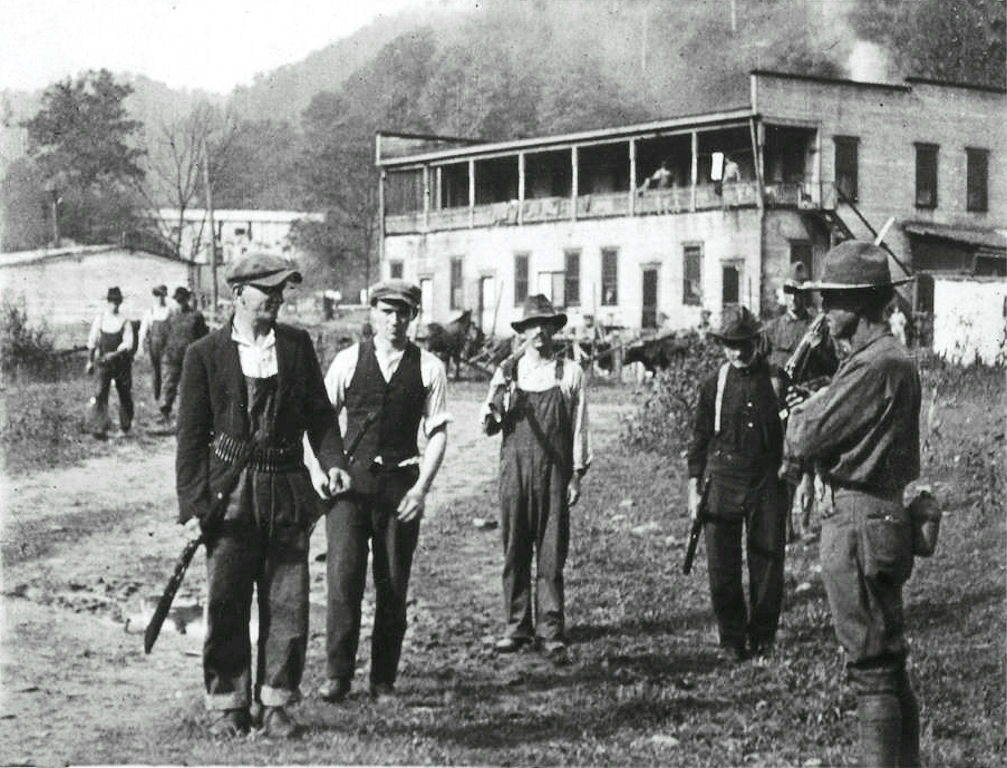
A ‘Toiler’ editorial on the meaning of what is today known as the Battle of Blair Mountain, the largest armed working class rebellion in U.S. history.
‘The Miners’ March in Mingo’ from The Toiler. No. 190. October 1, 1921.
In West Virginia there are about one hundred thousand miners of whom less than half are unionized. For over twenty years West Virginia has been the scene of a bitter struggle between the miners and the big business interests which periodically breaks out into open, armed conflict. The issue of the struggle is the right to organize against inhuman working conditions and torturing exploitation.
The mines, the stores, churches, schools, hospitals, homes, press, and the entire governmental machinery are owned outright by the coal barons. The salaries of deputy sheriffs are paid by the operators, and the State Constabulary is picked from lists prepared by them. All of the mining area is under the domination of the Baldwin-Felts Detective Agency’s gangmen and murderers. These armed guards watch the payrolls, collect rents, evict workers, run miners out of town, and serve as general thugs and hangmen for the capitalists.
The workers are robbed going and coming. A raise in wages is immediately followed by a rise in prices at the company stores. Whatever slight improvement in their conditions of life these miners have won is due to the wholesome terror the union has struck into the hearts of the operators. The latter will therefore leave nothing undone to thwart the workers’ desire for a genuine union. The mines and workers’ organizations are honeycombed with spies. Under a vicious agreement, aptly called the “yellow dog contract,” the corporations starve the miners into submission and terrorize them into fear of working side by side with union men. The employers use every device to insure the maintenance of this closed scab-shop system. Any defiance of this system of slavery, any sign of workers’ resistance, is met with club, bayonet, and machine gun. Jails, evictions, injunctions, and murder play no small part in the enslavement of the miners.
The Struggle
The last march on Mingo is only a repetition of the 1919 episode. Time and again have the workers been driven to revolt despite their “pacifying” leaders. In the last dispute everything that could possibly have been done to secure a compromise was attempted by the miners. The Governor was asked to arrange for a conference between operators and workers. But the Governor refused to bite the hand that feeds him. Such a conference would imply, in some measure, a recognition of the union. Hence the Governor flatly rejected the miners’ plea on this very ground. Then came a request for a special session of the legislature to consider the evils arising from the system of private armies. Of course this proposal was found “unnecessary and impracticable.” Finally Harding was appealed to for a conference. In reply to this appeal came Federal troops, airplanes, gas bombs and machine guns to crush the workers.
The natural outcome of military intervention was the disarming and dispersal of the miners. The threat of gas bombs, airplanes, and artillery was cruelly effective. And now Justice will have her way. Hundreds of workers have been rushed to prison and indicted for murder.
Behind the Scenes
The fight at Mingo is not a mere strike. The fight at Mingo marks a crucial moment in the capitalist offensive against the American working class. Here the United Mine Workers of America, a powerful workers’ organization, confronts the United States Steel Corporation, a ruthless anti-union junta, holding hundreds of thousands of workingmen in slavery. At this moment, when the entire working class is waging a panicky defensive, when the smallest gains of the workers are in danger, recognition of the miners’ union even in the slightest degree, would be a victory for the whole working class. Of this the capitalists are fully aware. Hence the ferocity with which their bloodhounds were unleashed upon the workers. Hence the class solidarity of the exploiters as evidenced by the tone of their press, the swift “justice” of their courts, and the demonstration of force.
Behind the din of the battle, behind the Presidential proclamations, the real, directing forces of the capitalist tyranny are at work. Mingo affords overwhelming proof of the unity of the capitalist executive power and the stock exchange. No less illustrious figures than U.S. Solicitor General James M. Beck and Secretary of the U.S. Treasury A.W. Mellon have direct financial interests in the hell-hole of West Virginia.
An Urgent Need
There is a lull in the battle of Mingo. The opposing forces are preparing for new struggles. At the United Mine Workers’ Convention Mingo will undoubtedly hold its own. But what is the way out?
The workers must challenge the vicious arrogance of the West Virginia mine owners. They must force the Government to disarm the Baldwin-Felts thugs and drive them out of the State. This can only be realized through the concerted, unified pressure of the organized worker The trade union bureaucracy must be driven into the struggle.
The march to Mingo is a magnificent episode in the history of the miners, a remarkable evidence of their courage and solidarity. The American working class must stand by the miners of Mingo. Let every union local, every workingman, rally to the defense of the miners of West Virginia. A victory for the miners will be the signal for greater victories of the working class. A lasting defeat for the miners will pave the way for more ruthless capitalist oppression and its hideous aftermath for the whole working class.
The Toiler was a significant regional, later national, newspaper of the early Communist movement published weekly between 1919 and 1921. It grew out of the Socialist Party’s ‘The Ohio Socialist’, leading paper of the Party’s left wing and northern Ohio’s militant IWW base and became the national voice of the forces that would become The Communist Labor Party. The Toiler was first published in Cleveland, Ohio, its volume number continuing on from The Ohio Socialist, in the fall of 1919 as the paper of the Communist Labor Party of Ohio. The Toiler moved to New York City in early 1920 and with its union focus served as the labor paper of the CLP and the legal Workers Party of America. Editors included Elmer Allison and James P Cannon. The original English language and/or US publication of key texts of the international revolutionary movement are prominent features of the Toiler. In January 1922, The Toiler merged with The Workers Council to form The Worker, becoming the Communist Party’s main paper continuing as The Daily Worker in January, 1924.
PDF of full issue: https://www.marxists.org/history/usa/pubs/thetoiler/n190-oct-01-1921-Toil-nyplmf.pdf
 Revolution's Newsstand