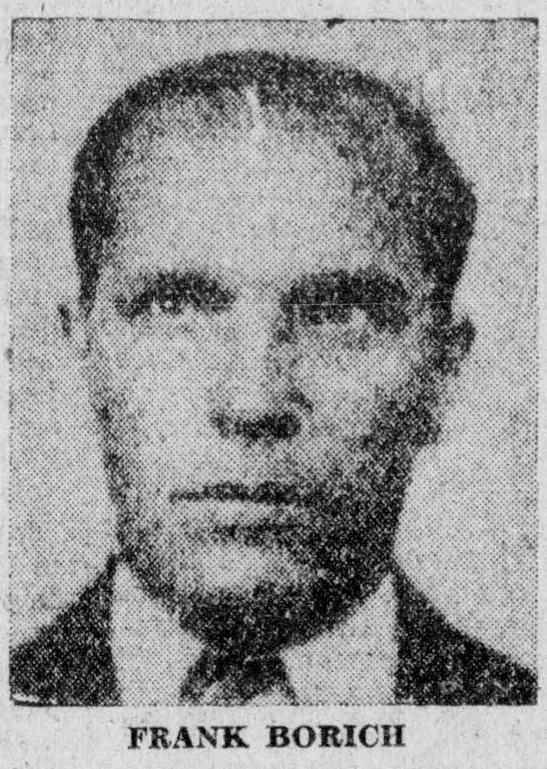
Pennsylvania mine workers’ leader, born in Yugoslavia who came as a child with his family to the U.S., is threatened with deportation to the far-right regime and the real possibility of torture and death.
‘Save Frank Borich from Deportation’ by Sender Garlin from Labor Defender. Vol. 9 No. 8. August, 1933.
Twenty years ago Frank Borich came to this country from Yugo-Slavia. He landed in a mining town called Keister, Pa., near Uniontown, in the soft coal section of Fayette County. He began to work at once, side by side with his father, even though he was only 13 years old. He loaded coal, the heaviest work in mining, digging solid coal by hand with only a pick and shovel. There was no machinery for shooting coal in those days. Frank Borich and his father worked 16 hours a day. They would get into the mine at a quarter to five in the morning and come out at 6, 7, sometimes 8 o’clock at night. They made about $50 every two weeks between the two of them.
In 1919 Borich joined the United Mine Workers of America. In 1922, during the great general mine strike that lasted from April until January 1923 more than 100,000 unorganized miners of Fayette County were involved. John L. Lewis was already president of the U.M.W.A. and William Green, now president of the A. F. of L. was getting his training as a labor faker as secretary of this union.
These 110,000 unorganized miners of Fayette County were betrayed along with the organized. In fact they got such a lesson that the U.M.W.A. has never since attempted to organize them. Borich, 22 years old at the time, was active in this strike.
In 1925, after 13 years of work down in the mines, Borich became an organizer of the Save the Union Committee. He helped prepare and lead the strike which began in April 1927 and lasted until January 1928.
In July 1930, Frank Borich became secretary of the National Miners Union. In the course of his work Frank Borich was arrested more than a score of times for strike activities, unemployed activities, and once in Chicago on a framed up charge of “robbery with gun and sedition.” During the 1931 strike there was a notice posted up all over Harlan, Kentucky, putting a $1,000 reward on his head–dead or alive.
The arrest on which the present deportation action against him is based, took place on March 21, 1932. On March 17th to 20th the National Miners Union in Pittsburgh called a conference to prepare for a strike. On March 21, one day after the conference, Deportation Doak, then Secretary of Labor, issued a warrant for his arrest.
Seven men, 4 county detectives and 3 immigration officers, broke in on a meeting of the national board of the N.M.U., without a warrant and dragged Borich off to the county jail after he refused to answer questions at the Immigration office.
The officials refused to accept property bail. They demanded $5,000 cash which was to represent $25,000 in property. When this was raised they refused to accept it. Borich’s fellow workers together with the Pittsburgh section of the I.L.D. collected $4,000 in Liberty Bonds, and $1,000 in Federal government Baby bonds. They refused to accept the U.S. government bonds. Borich was finally released on $5,000 Liberty bond bail.
Borich was bullied and brow beaten at 5 different Immigration hearings. What were they trying to prove? That the N.M.U. was a “proscribed” organization, that it believed and advocated the violent overthrow of the government of the United States and that therefore Borich, an alien who belonged to such an organization had no right to stay in this country and receive the blessings that come with this privilege (hunger, terror, misery) and must be sent back to Yugoslavia where he came from.
Frank Borich’s case is only one example of what awaits workers who, under the National Recovery Act, will try to carry out that section which says they may belong to organizations of their own choosing. What this clause means is–if you choose to belong to a fighting industrial union led by rank-and-file workers you must take the consequences. Deportation, if you are a foreign-born worker, clubbing, jailing, terror, if you are native-born.
But workers have another alternative. They can fight against the National Slavery Act and its right arm the Perkins, Roosevelt deportations drive.
Join the locals of the N.M.U., fighting locals of the UMWA, 500 language organizations that have already adopted and sent resolutions to the Department of Labor demanding the immediate release of Borich and 8 other miners held for deportation.
The wives and children of these miners are native born. Their homes are being broken up. The heads of their families are threatened with deportation to fascist Yugo-Slavia, where the white terror endangers their lives.
Our militant comrade Frank Borich and the other miners must not be taken from our ranks. Organize to fight the deportation drive!
Labor Defender was published monthly from 1926 until 1937 by the International Labor Defense (ILD), a Workers Party of America, and later Communist Party-led, non-partisan defense organization founded by James Cannon and William Haywood while in Moscow, 1925 to support prisoners of the class war, victims of racism and imperialism, and the struggle against fascism. It included, poetry, letters from prisoners, and was heavily illustrated with photos, images, and cartoons. Labor Defender was the central organ of the Scottsboro and Sacco and Vanzetti defense campaigns. Editors included T. J. O’ Flaherty, Max Shactman, Karl Reeve, J. Louis Engdahl, William L. Patterson, Sasha Small, and Sender Garlin.
PDF of full issue: https://www.marxists.org/history/usa/pubs/labordefender/1933/v09n08-aug-1933-lab-def.pdf
 Revolution's Newsstand