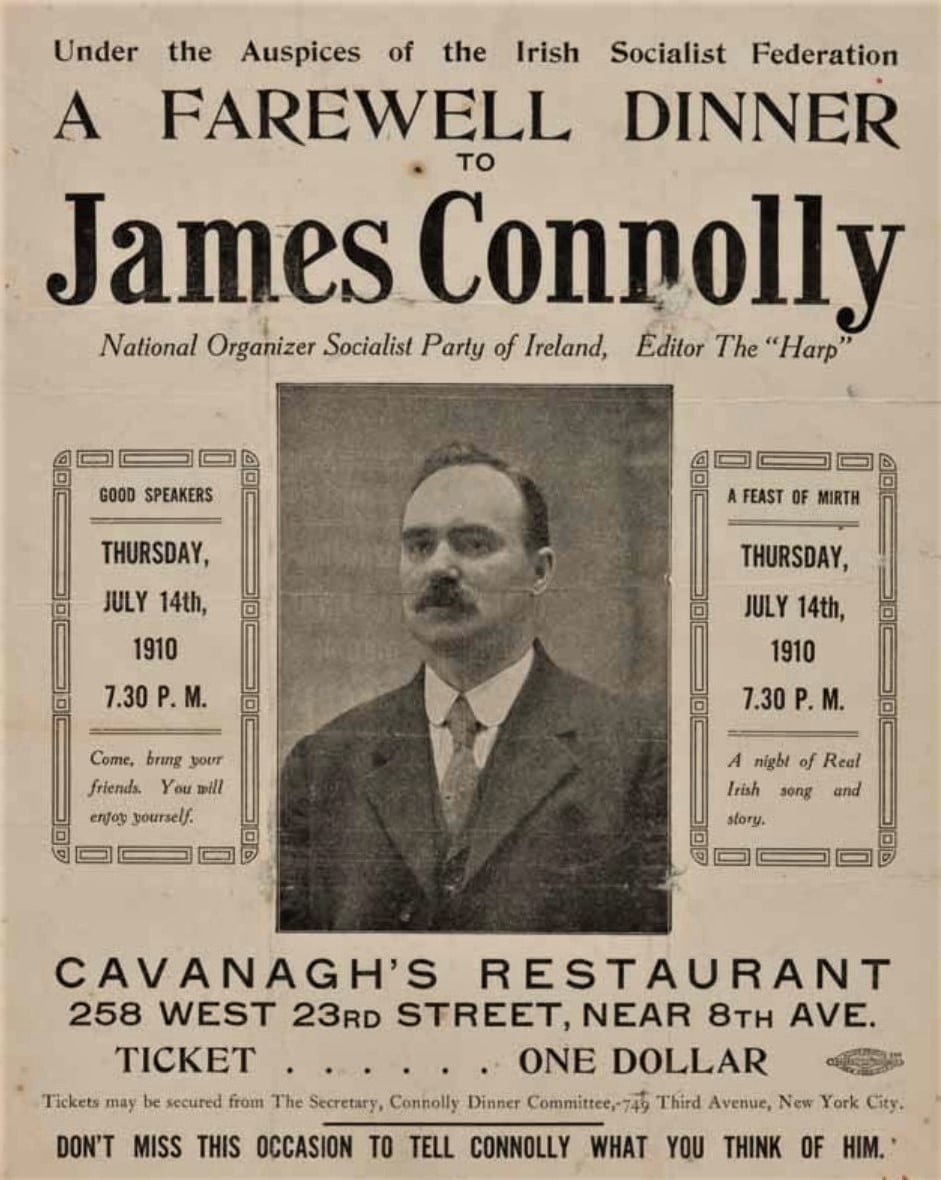
When James Connolly returned to Ireland in July, 1910 he had been a militant of the US class struggle for nearly a decade and was widely known and respected, even loved, in radical working-class circles here. He had been a leading member of the Socialist Labor Party and public rival of De Leon’s. He a founder of the IWW in 1905, learning new languages to do the work. He started the Socialist Party’s Irish Socialist Federation in 1907 and was editor of its paper, the Harp. He had been involved in a half dozen strikes and visited dozens of cities, town, and labor camps across the country on lecture tours throughout the years. He had stumped for Debs in Irish social halls and Yiddish-speaking neighborhoods. His ‘Socialism Made Easy’, published in 1908, sold 40,000 copies and was one of the most widely known socialist texts of its day. With Patrick Quinlan and a teenage Elizabeth Gurley Flynn he founded the Irish Socialist Federation in 1907. At the time of he returned to Ireland, James Connolly was working for the Socialist Party of America as full time National Organizer for the Midwest Region. His return to Dublin would see him elected National Organizer of the Socialist Party of Ireland and this farewell dinner Cavanagh’s Restaurant on West 23rd in New York City July 14, 1910 was to see him off, an occasion to tell this beloved comrade ‘what you think of him.’
‘Connolly to Unite Sons of Ould Sod’ from The New York Call. Vol. 3 No. 196. July 15, 1910.
Irish Agitator Tells Why He Goes Back to Erin at Farewell Dinner.
A jolly crowd of more than a hundred Irish men and women gathered at Cavanagh’s restaurant in West 23d street last night to bid James Connolly, editor of The Harp and well known agitator, farewell. Connolly sails Saturday to assume the duties of national organizer for the Socialist party of Ireland, and the dinner in his honor was arranged by the Irish Socialist Federation of this city of which Connolly was one of the leading spirits.
William S. Bredin, witty and with a gift of blarney, was the toastmaster. Although several speeches were made by Irishmen and some Germans, only one toast was drunk. The crowd stood and drank “To Ireland, not as she is, but as she ought to be, free and independent.”

Mrs. J.W. Gates, who was introduced as “the nightingale of the Socialist movement,” sang “The Marseillaise” and “Where the River Shannon Flows,” and she was encored several times.
The speakers were Edward F. Cassidy, organizer of Local New York of the Socialist party: Frank Bohn, Patrick Donohue, Justus Ebert and James Connolly himself.
Cassidy said that the Socialist movement needs the Irish, and needs them badly. A Tammany politician had told him the other day. Cassidy declared that he would rather have one Irishman than a score of Germans, for the Irishman will not only vote for the party, but he will be an agitator for it.
The East Side is bereft of Irishmen, but an Irishman, Tim Sullivan, controls the district just the same, Cassidy pointed out. In the trade union movement the same is true, said Cassidy, the Irishmen hold offices out of all proportion to their numbers.
Connolly said that he had studied Irish history and that when once the Irish spirit of rebellion and revolution is awakened the Irish will make others seem conservative by comparison.
Speaking of conditions in Ireland, he said that the English invaded Ireland under direct authority of Pope Adrian and for four hundred years all the forces of the church were used to repress the Irish spirit. The priests only became rebellious after the English lined up with Protestantism, he said.
Connolly declared that his purpose in returning to Ireland is to try to blend the two streams of Irish Socialism, the green and the orange, to try to get Irishmen to lay aside religious bigotry and intolerance, to forget all their differences and join in common cause for the betterment of their economic conditions, and the ultimate emancipation of Ireland from the rule of England.
The New York Call was the first English-language Socialist daily paper in New York City and the second in the US after the Chicago Daily Socialist. The paper was the center of the Socialist Party and under the influence of Morris Hillquit, Charles Ervin, Julius Gerber, and William Butscher. The paper was opposed to World War One, and, unsurprising given the era’s fluidity, ambivalent on the Russian Revolution even after the expulsion of the SP’s Left Wing. The paper is an invaluable resource for information on the city’s workers movement and history and one of the most important papers in the history of US socialism. The paper ran from 1908 until 1923.
PDF of full issue: https://www.marxists.org/history/usa/pubs/the-new-york-call/1910/100715-newyorkcall-v03n196.pdf
 Revolution's Newsstand