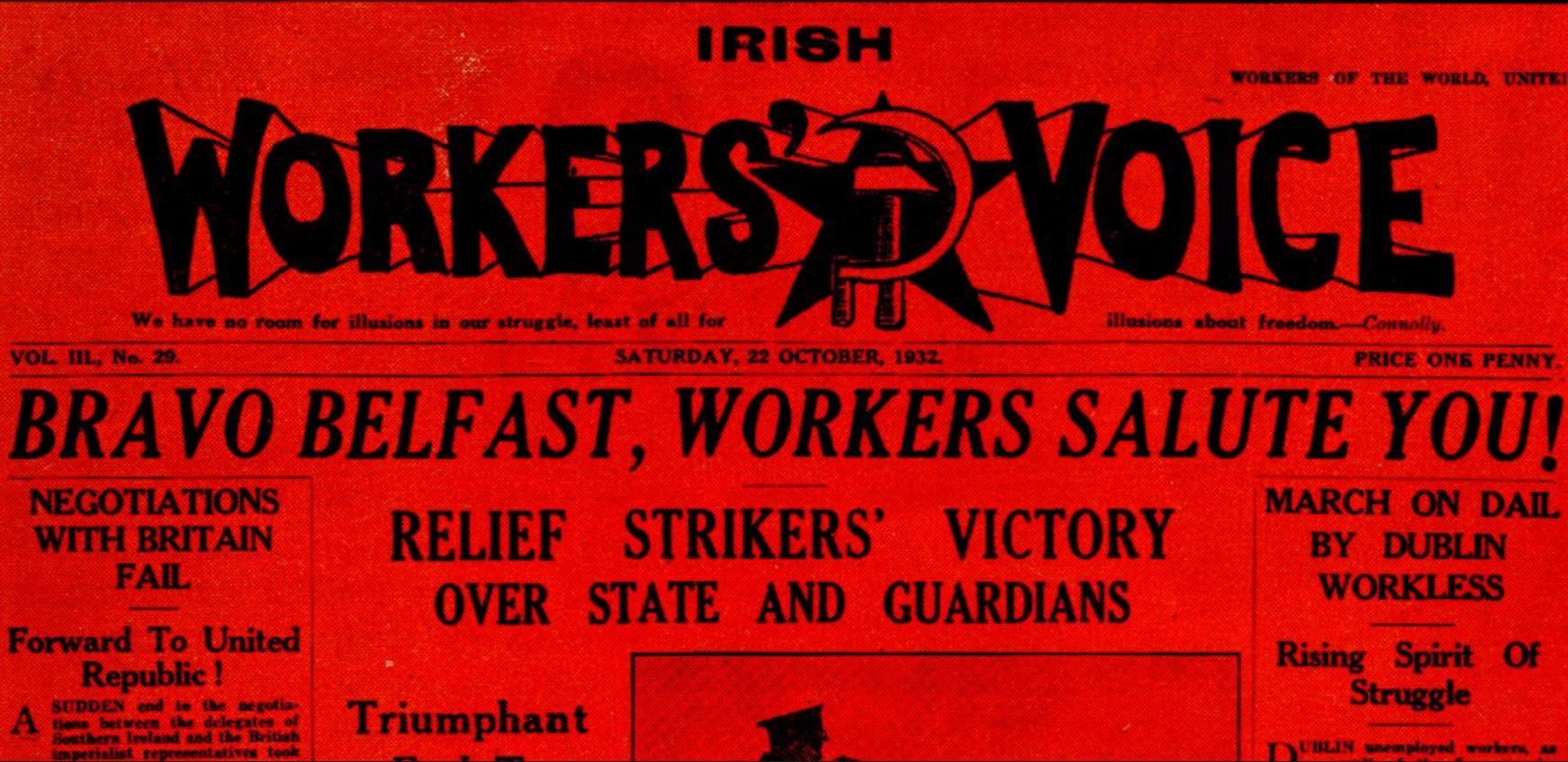
Replacing Jim Larkin’s Irish Workers League as the Comintern’s Irish affiliate in 1930, the Revolutionary Workers Groups would emerge from illegality shortly after this article with the election of De Valera’s Fianna Fail government to become the Communist Party of Ireland in 1933. Here, a perspectives and tasks document.
‘Situation in Ireland and the Tasks of the Revolutionary Movement’ from International Press Correspondence. Vol. 12 No. 5. February 4, 1932.
Resolution Adopted by the Conference of Revolutionary Workers’ Groups (Ireland).
The Revolutionary Workers’ Groups in Ireland (Imitiatory Groups for the formation of the Communist Party in Ireland), in December last, after the passing of the terror legislation by the Irish Free State Government, which rendered their organisation an illegal association, held an illegal conference, which was highly successful and at which the following resolution was passed.
The Free State bourgeoisie has moved to a more open form of dictatorship in the struggle against the toiling masses. This is the capitalist reply to the increasing sharpness of the class struggle and the general ferment among the toiling masses, arising from the economic crisis.
The economic crisis in Ireland develops as part of the general world crisis of capitalism, whose effects are most forcibly illustrated in regard to the following:
a) The heavy fall in external trade, which is changing for the worse the Free State’s relation to foreign capitalist economy. For the first time since 1926, the adverse trade balance this year shows an increase of 25% over that of 1930.
b) The crisis in Britain is resulting in a heavy decline in the export of agricultural products from the Free State (in cattle alone a fall in exports of 2 million pounds for the first nine months of 1931).
c) The accentuation of the unemployment problem by the cessation of emigration to the United States; the cessation of remittances to relatives from Irish workers in the States and the return of large numbers to Ireland, consequent upon the crisis in the U.S.A.
d) The world crisis is felt severely in the linen and ship-building industries of Ulster, almost wholly dependent upon the world market.
The slump in the American market and the increase in competition from the continent has had disastrous results upon the linen industry, where unemployment reaches as high as 50%. The crisis in linen directly aggravates the agricultural crisis, through the collapse of the market for home grown flax.
Sixty per cent. of the workers in the shipbuilding industry are idle and one yard has been closed down altogether.
At the same time, the Governments are pursuing a drive for economy in social services, in the running of State services (teachers and civil servants), and the imposition of fresh burdens of taxation on the working masses in order to balance the capitalist budget.
The economic crisis has special severity for the toiling masses by reason of a number of specific economic, political and historical factors, which characterise the present situation in Ireland:
Firstly: The preponderating role of the agrarian crisis in the general economic crisis in the Free State. The preponderating role of peasant economy in Irish agriculture. The fall in agricultural prices is much more severe than in the prices in industry.
Secondly: The crisis now develops after years of a ruthless application of the capitalist solution of economy at the expense of the workers and peasants in the domain of wage reductions, attacks on social services, tariffs, and considerable rationalisation of a direct and brutal character.
Thirdly: The masses are bearing the burden of the attempts of a “nationally emancipated bourgeoisie” to develop economic independence by establishing new industries in the midst of the general crisis of capitalism, and under the conditions of a relatively backward peasant economy.
Fourthly: The crisis develops in the Free State following years of internal conflict during and after the civil war. The imposition of “Free State national freedom” upon the toiling masses necessitated a armed conflict for two years.
During the stabilisation epoch of the second period of post-war capitalism, the Free State bourgeoisie were without the co-operation of all the bourgeois political forces. Reformist nationalism (DeValera) did not enter into positive co-operation’ with the bourgeois State until 1927.
Finally: The crisis develops in a country torn by the contradictions of imperialism, with two governments, and a tariff wall dividing a small population. In this historic and economic situation, after years of economy at the masses’ expense; budget balancing, trade balancing, tariffs, attacks on social services, etc., the Free State bourgeoisie finds itself called upon to face a growingly acute economic crisis. This explains this terror legislation, the dictatorial regime outlawing the class organisations of the workers and peasants.
The conditions under which the dictatorship is established reveal the growing sharpness of the class struggle, and the differentiation among the masses. Important factors in estimating the character of the present drive along the path of fascist terror by the bourgeoisie, are:
1. The dictatorship has been essential to the bourgeoisie in the fight against the toiling masses, despite the constitutional parliamentary orientation of Fianna Fail and its legal co-operation with the Free State Government.
2. The existence of the reformist Labour Party and the most naked sabotage of all working class action by the trade union bureaucracy.
3. The virtual collapse of Larkinism as a fighting force, resulting in corresponding leaderlessness among an important section of the proletariat.
4. With religion more consciously and organisationally linked with the bourgeoisie, a native catholic government is able to utilise this instrument against the toiling masses on a much more effective scale than its British Imperial predecessors.
The change in the relation of class forces has thus revealed the bankruptcy of the old leadership and organisation, within both the national and labour movements. At the same time, the masses have not yet found the alternative to republicanism, reformism and left-labour radicalism. The present dictatorship is therefore being directed against the toiling masses, in the absence of a well-organised Communist Party.
All these factors taken together are an indication of the developing depths of the crisis and the sharpness of the class struggle.
The bourgeoisie, the priests and the national and labour reformists are united against the working masses, under the cry of the “communist menace”. The Labour reformists have outdone all other political parties, even the Government party, in their anti-Communist propaganda. (Two Labour T.D.’s. voted with the Government for the Terror Act.)
The shifting in class relations is shown in the more openly imperialist orientation of the Government (O’Sullivan’s speech re danger of wrecking the Empire), the swallowing up by the Government party of the old Nationalist group (Redmond, Byrne etc.), and its open championship of the Unionists. Fianna Fail takes the place vacated by the Government Party and now occupies a position in its political propaganda, of, the Free State party in 1922 (Griffithism)…Fianna Fail, armed with its new daily paper, endeavours to obtain the hegemony of the anti-Government forces and to find a basis within the trade unions and the working class by advances to the Labour Party and Larkin; while its tactics and propaganda are directed to draw the I.R.A. republicans into its constitutional net, and away from Communist influence.
The faith of the peasantry and semi-proletarians in the parties of national and labour reformism, and also the tactics of petty-bourgeois terrorism, is so far shaken as to cause them to attempt to put forward their own policy and organise independently. Saor Eire represents the attempt of the peasantry to find an independent line of advance, but under the leadership of the revolutionary republican petty bourgeoisie. It also represents the attempt of the latter to head the developing movement on a line alternative to that of Communism. But the sharpness of the class issues, the sledge-hammer blows of the entire bourgeois forces, the frantic anti-communist, anti-Soviet propaganda, has spread disintegration in the leadership of this group: the left trade union officials’ capitulation to the reformist bureaucracy; the petty bourgeois radicals to the priests; and the workers and peasants moving closer to the Revolutionary Workers’ Groups and Communism. The line of the Communists: Despite the undoubted obstacles presented by the bourgeois dictatorship, the situation gives favourable ground for the class organisation of the workers and peasants under communist leadership. The work of the moment is to push forward with the organisation of the class conscious forces in the Communist Party. This must be the reply of the Irish workers and peasants to the Cosgrave Terror Act.
The Groups must push forward with the work of extending the main basis of the revolutionary workers’ movement and thus bring the proletariat to the leadership of the revolutionary rural elements. This necessitates intensified work along the following lines:
1. To carry the fight against the trade union bureaucracy beyond the propaganda stage by organised opposition around concrete issues within the T.U. branches. Progress in this work has been weak and tendencies to capitulation to the laws of the Reformist apparatus are much in evidence among party members.
2. Increasing attention to the factories, yards, and docks around, particularly, the issues of rationalisation, and dismissals. The Groups, have, even in propaganda, been weak on the issues of rationalisation, now a dominant factor in the capitalist offensive against the workers (Drumm battery on railways, elevators at Docks, Shannon Scheme).
3. The organisation of the unemployed around a specific programme (extension of unemployment insurance, Labour Exchange grievances, relief, etc.). This programme to be launched at the all-in Conference in Dublin.
4. To strengthen the united front now developing with the Workers’ Union of Ireland membership, by drawing the lower ranks into active leadership of the mass movement.
5. To intensify the work in preparation for the United Front Conference; ensure election of delegates from T.U. branches, factories, etc. Preparation of Programme of Action.
6. To increase the work of securing a strong proletarian base in Ulster.
7. To enter the impending General Election in the Free State with Communist candidates, fighting on the basis of the united front programme and standing for the organisation of the Communist Party.
8. To combat the anti-Soviet campaign by wide popularisation of the achievements of the U.S.S.R. in the liberation of subject peoples, and the Five-Year Plan, as a contrast to the crisis in the capitalist world; and reply to the present campaign by the organisation of a strong delegation of workers from both parts of the country to U.S.S.R.
9. The immediate issuance of literature.
10. To take immediate steps for the organisation of the Irish workers abroad around the policy of the Anti-Imperialist League; the organisation of delegations to the Soviet Union, and in general to bring the foreign Irish workers into the international struggle against imperialism.
On the success of our work on these lines will depend the extent to which the workers will be won to Communism and the hegemony of the proletariat over the revolutionary peasant forces in the country brought into being.
International Press Correspondence, widely known as”Inprecor” was published by the Executive Committee of the Communist International (ECCI) regularly in German and English, occasionally in many other languages, beginning in 1921 and lasting in English until 1938. Inprecor’s role was to supply translated articles to the English-speaking press of the International from the Comintern’s different sections, as well as news and statements from the ECCI. Many ‘Daily Worker’ and ‘Communist’ articles originated in Inprecor, and it also published articles by American comrades for use in other countries. It was published at least weekly, and often thrice weekly.
PDF of full issue: https://www.marxists.org/history/international/comintern/inprecor/1932/v12n05-feb-04-1932-Inprecor-opf.pdf
 Revolution's Newsstand