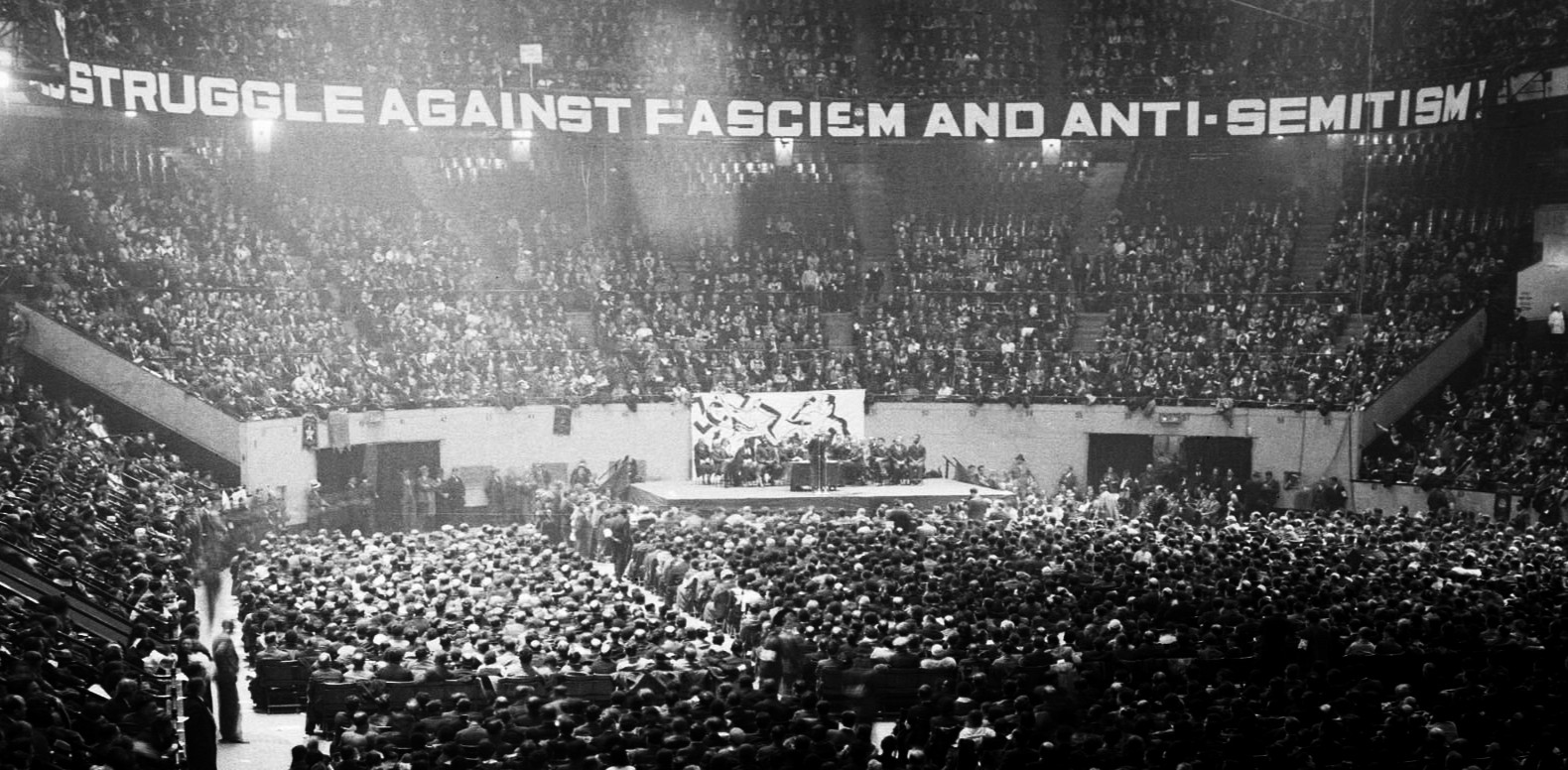
A major analytical article from Freeman written just as the Nazis assumed full power in early 1933, later to be published as a Workers Library pamphlet.
‘The Background of German Fascism’ by Joseph Freeman from New Masses. Vol. 8 No. 8. April, 1933.
Germany’s defeat in the world war had certain disastrous consequences for German capitalism. It lost its colonies. These were not of primary economic importance. But they played an important role in Germany’s international policy, particularly in so far as they cut across Great Britain’s African possessions.
In Europe, the defeat and breakup of the Austro-Hungarian empire deprived Germany of its only ally. Germany was isolated. The military and political losses were accompanied by loss of territory. This severely reduced Germany’s industrial resources and output. There were heavy losses in iron and steel which passed largely into the hands of French capitalists. In addition, it is estimated that German capitalism lost between 25 and 40 billion marks invested abroad. It was no longer able to export capital which, before the war, greatly assisted German industry in its battle for foreign markets.
The costs of the war were tremendous. For four years millions of men were unproductive. They were in the army living on Germany’s rapidly declining national economy. They were supported by the population in the rear while they exploded billions of dollars worth of ammunition at the front. The population which was productive was engaged chiefly in the production of goods for war purposes. Economically that was pure waste. Hence the end of the war found German economy greatly below the 1913 level. Industry, agriculture, and transport were in a state of neglect. The national wealth had shrunk considerably.
Some one had to pay for these enormous losses. From the beginning, German capitalism (like capitalism everywhere else) shifted the financial burdens of the war to the masses. The imperial government financed the war by floating loans with the promise that after the victory the conquered enemy would repay them. As long as the war lasted the government paid interest promptly on these loans. But the war ended in Germany’s defeat. The enemy was not going to pay back the loans. On the contrary, it demanded reparations. Who was to pay for the war losses? More precisely, what social-economic classes of the German population would bear the burdens of the defeat? In the very nature of capitalism, it was inevitable that these enormous burdens should be shifted to the masses of workers and middle class groups. The technique whereby these classes were compelled to pay the war costs was one with which we are today becoming familiar in the United States. The currency was inflated. Inflation made the war bonds almost worthless. Those patriotic citizens who had loaned the imperial government their savings for the conduct of the war were now expropriated of their money by a republican government with a social-democrat at its head. The majority of those who had purchased the German equivalent of Liberty bonds were workers and middle class people. Those members of the propertied classes, Junkers and industrialists, who had purchased war bonds, cashed in on them before the war ended. It was the proletariat and the middle classes which were the victims of the complete collapse of the war bonds, of expropriation through inflation.
Inflation aided German capitalism in restoring its damaged national economy, particularly its industry. As a result of the war Germany’s industrial apparatus was thoroughly shaken. Its positions on the world market were gone. It had to compete against tariff walls erected by new states established under the Versailles treaty. These states were unfriendly to German capitalism because they were vassals of Allied capitalism. The restoration of industry meant the increased exploitation of the German workers. It also involved the further expropriation of the German middle classes which still had some money left. With the vast profits thus obtained, German capitalism planned to get on its feet again for a renewed participation in the struggle of the imperialist powers for markets.
The inflation period lasted for five years, from 1919 to 1924. Long before it ended, German capitalists did business in gold but paid the workers in paper. This meant a drastic reduction of real wages. The capitalists made a profit estimated between 24 and 28 billion gold marks which represented unpaid wages. The workers had to reduce their living standards.
The effect of inflation upon the middle classes was also severe. The period of the upward climb of capitalism in Germany (as in other countries) created a large middle class between the capitalists and the proletariat. This middle class now constitutes about one half of the entire population. Before the war, during the upward climb of German capitalism, the living standard of these 30 million middle class people steadily improved. They acquired some wealth. It was this wealth, in so far as did not consist of land actively used for agricultural purposes, which was robbed via inflation. The middle classes lost the money which they had invested in national and local government loans. They lost their savings in the bank. In order to exist they were compelled to sell their securities and their houses at heavy losses. Members of these classes who before the war had lived upon small incomes from investments were now expropriated of these incomes. They were forced once more to enter the process of production, to work for a living.
By the fall of 1923 inflation was ended. It was no longer profitable to the big capitalists. The payment of wages in inflated currency and the expropriation of the middle classes could no longer bring any great income when you could get several billion marks for one dollar. The workers, whose living standards had been pushed so low that life under inflation conditions became impossible, demanded wages in gold. They were able to enforce the demand, thereby destroying the gap between gold and paper money so profitable for the capitalist.
While inflation meant acute losses for the workers and middle classes, it was a boon to other classes of German society. With the huge monies amassed in the inflation period, the industrialists were able to restore industrial production to the prewar level. In addition, the Junkers (the big landowners) and even the small peasants gained something through inflation. The credits which agriculture obtained before inflation were invested in tangible things like livestock, machinery, and construction. These credits were paid back in worthless paper money.
From 1924 to 1928 German capitalism extended and consolidated the gains made during the inflation period. The total output of industry increased considerably. Plants were reconstructed and modernized. Labor was “rationalized”, i.e. exploited with the most modern scientific methods of long hours, the speedup, etc. In this period of the temporary and relative stabilization of capitalism new investments were made in German economy. Certain industrial groups were especially strengthened, notably the electrical industries, the chemical industries, the machine industries, iron, steel, and coal. This meant not only an increase in the total production of industry (about 40 percent between 1924 and 1928); but also a considerable increase in the productivity of labor and an intense concentration of capital.
As production increased, German foreign trade increased, both in regard to exports and imports. But the foreign trade balance was unfavorable. The pressing problem thus arose: how could Germany pay reparations to the Allies when its imports exceeded its exports? This was the subject of numerous conferences following Versailles. In practice Allied capitalists came to the aid of German capitalism. These capitalists were ready to invest in Germany, to speculate on the rise of German industry and the fluctuations of the mark. From 1924 to 1929 German capitalism borrowed 25 billion marks abroad and invested some 10 billion marks abroad. The surplus of 15 billion marks was used toward reparations payments. Foreign loans to Germany, mostly by American bankers and industrialists, supplied money for reparations payments laid down by the Dawes Plan and later by the Young Plan. British capital also invested in Germany. But interest and principle have to be paid on foreign loans. The German workers paid these through taxes, through long and hard labor at low wages.
On the eve of the world economic crisis (1928), German capitalism seemed to be doing well by itself. Yet even during the period of increasing production and expanding foreign trade the real wages of the German workers did not return to the prewar level. Living standards were worse in 1923 than in 1913. They improved a little in 1925 as compared with 1923 but declined again in 1926. Since 1929 they have become progressively worse. Behind these abstract statements is the fact that since the war the German working class has been not only brutally exploited but literally starved.
Exploitation and starvation have gone hand in hand with constantly increasing unemployment. Before the war there was a rapid increase of the number of wage-earners employed because German capitalism was on the upgrade. During the reconstruction period (1924-1929) the number of those employed grew very slowly. Since 1929 the number of employees has steadily decreased, while the number of unemployed has increased tremendously. Millions of workers have been fired from their jobs. In addition a new generation has grown up which German capitalist economy in its moribund state has been unable to absorb.
The curse of unemployment has affected not only the proletariat but also the middle classes. Since 1925 the number of such people who must work for a living has increased still further. Before the war the various middle class groups were beneficiaries of the upward development of German capitalism. After the war their real wages dropped. Even during the period of stabilization (1924-28) they were paid less than before the war. Some of them were paid less than skilled workers. Furthermore, middle class families, expropriated by inflation, were no longer able to assist their sons and daughters working on small salaries in executive, commercial or clerical jobs. Between 1924 and 1928 the number of white collar workers increased, but their wages decreased. Their prospects of economic independence became slimmer and slimmer. For millions the hope of work itself died out. The white collar worker, the middle class technical and executive employee has been booted out of his former privileged social position. He faces unemployment, insecurity, starvation. He is pushed into the last place he wants to be, into that cast of “untouchables” which he most fears and despises—the proletariat. His economic distress arouses in him a vague desire for change. He does not like his social-economic status in the republic jointly administered by Junkers, industrialists, old regime generals and social-democratic politicians.
The Disgruntled Farmer
Another disgruntled class are the farmers. They identify their interests with those of the big landowners. As debtors, farm owners big and little benefitted from inflation to some extent. But there came the morning after. The period of stabilization increased their debts, their taxes and the interest they had to pay on loans. These loans were not used to improve agriculture; they were used chiefly for personal consumption. By its policy of tariffs and subsidies the Junkerindustrialist-socialist government supported the backwardness of German agriculture. To mechanize and reorganize agriculture meant to convert many petty farmers into farm laborers and to drive farm laborers into the towns and cities. There they would be compelled to join the vast army of unemployed hopelessly looking for work. The farmer wants to remain on his land. But his position gets worse and worse. His debts increase; taxes and interests rise higher; the prices he has to pay for industrial products go up; the prices he receives for farm products go down.
At the end of the stabilization period German economy presents, in part, the following picture: Production and foreign trade have increased; the wages of workers and middle class employees are below the 1913 level; large sections of the urban middle classes have been proletarianized ; the debts of the farmers have increased; the total German foreign indebtedness has increased; reparations have been paid on paper so that the position of German capital on the world money market grows increasingly precarious.
The world crisis of capitalism which set in during 1928 swept the entire capitalist system. It affected all forms of economic life. In every capitalist country production declined drastically; foreign trade fell off; unemployment increased by the millions from year to year; wages were cut more extensively than in any previous crisis; prices collapsed; large sections of the middle class were proletarianized; the poverty and misery of the masses of the population in every capitalist country increased.
The timing of the crisis and its specific affects vary from capitalist country to country. In Germany, the weakest link in the present system of advanced capitalist states, the crisis came with unusual force. By the spring of 1932 production was about one half what it was in 1928. Prices declined more slowly than either in France or in Britain, so that the real wages of the German worker fell sharply. At the same time the number of unemployed increased from 1,914,000 in 1929 to 7,000,000 in the winter of 1932. In 1929 about 14.5 percent of the trade union members were unemployed and 9.4 percent partially employed; by the spring of 1932 about 48 percent were totally unemployed and 24,2 percent partially employed. During the winter of 1931-32 only one-third of the trade union members were employed full time. These figures are especially significant when it is remembered what a large part of the German working class is organized in trade unions.
The existence of a huge “reserve army” of unemployed gave the German employers the opportunity to slash wages, to increase the percentage of part-time workers, to cut unemployment relief. Never in the history of capitalist crises in the past fifty years—the Institute fuer Konjunkturforschung reported—had the national income declined so universally. The decline spared neither the income of government employees nor the income from rents nor the income from agriculture. But the worst sufferers of all in this economic catastrophe were the workers. In the autumn of 1931 the income of the working class as a whole was 40 percent below the 1929 level; living standards were 13 percent lower. Industrial workers suffered especially. Wage agreements were ruthlessly broken. Wages were slashed down to the 1925 level which means down to the level of 1900. And, with 7,000,000 unemployed starving, the employers, for all practical purposes, abolished unemployment insurance. The German working class was hurled back into the abyss of exploitation and misery which marked the primitive stages of capitalism.
The attack on wages and living standards affected the middle class employee, too. About 500,000 middle class employees are out of work. The wages of those still employed in 1932 was down to half of the 1929 level; they were now receiving the same pay as workers. Many farmers have also been proletarianized. The present crisis has still further increased the difference between industrial and agricultural prices. The tariffs and subsidies, as was to be for seen, were chiefly to the advantage of the Junkers; while the wage cuts in the cities have so reduced the purchasing power of the urban population that the prices of many farm products have collapsed. The alliance of the financial and industrial capitalists with the Junkers has resulted in adding millions of urban and rural petit bourgeois to the elements proletarianized by the crisis.
The acute misery of the German masses during the past fifteen years opened the way for a workers revolution, for a dictatorship of the proletariat. Such a revolution broke out after the war. German capitalism crushed it in alliance with the Social Democracy which influenced the majority of the workers. The figureheads of the Weimar republic were social-democratic politicians. These spared the Junkers, the dukes, the barons, the generals, the officials of the old empire. At the same time they directed a ruthless terror against the revolutionary workers. The bloody work of Noske and Scheideman is notorious.
Social Democracy—reformism—saved German capitalism in 1918. It helped pave the way for fascism.
The betrayal of the working class by the social democracy did not begin in 1918. For years before the war the social democratic leaders were busy revising revolutionary Marxism. They collected statistics on production, foreign trade, profits, wages, crises, unemployment and the growth of the middle class. These figures were intended to prove that capitalism had a long and glorious future ahead of it. The bourgeois economists maintained that capitalism was eternal. The social-democratic pundits argued that it was not eternal. Some day, in a vague undefined future, capitalism would peacefully evolve into socialism. But that day was so far distant that nothing could or should be done about it. These ideas were, of course, garnished with suitable “quotations” from Marx. Often the revisionists were not afraid to admit that Marx was wrong. It was “obvious” for instance, that the accumulation of capital had not resulted in an increase of misery for the masses. Crises did not cover shorter and shorter periods, each time dealing a more serious blow than before to capitalism. On the contrary, the span between crises was becoming longer and longer.
Prior to the war reformism or revisionism was the dominant ideology of the German working class movement. The social democratic leaders preached reformism not because they “misunderstood” Marx. They “misunderstood” Marx because of their privileged position in prewar capitalism. The mass of workers followed them for the same reason. In both cases, “existence determined consciousness.” Before the war German capitalism was on the upgrade. Out of the exploitation of its colonies and foreign markets it was able to increase wages. It was this economic fact which led to the reformist illusion that by a revolution the workers had more to lose than their chains. It led to the great social democratic betrayal signalized by the voting of war credits on August 4, 1914.
A Stake in Capitalism
Reformism argued that revolutionary opposition to the world war was utopian because the war was the inevitable result of the economic, political and social conditions prevailing at that time. They concluded a peace pact with the capitalists in the name of a fatalistic “Marxism” which “proved” that socialism will come no matter what we may think or do about it. But if the social-democrats and the workers whom they influenced accepted such a philosophy it was because they were, for the time being, beneficiaries to some extent of the capitalist system. They had a stake in it. The alliance with capitalism which the social democratic workers supported after the war was based on the reformist illusion that they were defending this stake, that they were fighting for their prewar gains under an expanding capitalism. For these prewar gains and for these social democratic illusions the German proletariat paid with millions of lives on the battlefield. This lesson was learned by the most advanced workers in all countries who split off from the Second International and joined the Third. Yet even after its betrayal of the working class during the war and after it crushed the revolution, the social democracy continued to influence wide masses of the German working class. This was partly (but only partly) due to the fact that real wages after the war did not sink in a steady line, but fluctuated up and down until the world crisis set in. The fluctuations aroused false hopes. At the same time the reformist leaders deliberately fostered the illusion that the sufferings of the German workers was due chiefly to the losses and the reparation payments entailed by defeat in the war. Not German capitalism or capitalism as a system but the Allies were guilty.
In this respect the reformist leaders served German capitalism as they did in 1914. They echoed the nationalist twaddle that the entire German “nation” had to bear the costs of the war. They deluded the workers into accepting the burdens of inflation, pointing out that even in victorious countries like Britain and the United States the war was followed by an economic crisis. When conditions improved somewhat after inflation, the reformist trotted out their old “Marxist” hocus-pocus to “prove” how strong capitalism really is. The acute crisis starting in 1928 intensified social democratic support of capitalism because it increased the gulf between the social-democratic apparatus and the rank and file workers. The masses were unemployed, underpaid, starved. The reformist leaders enjoyed good wages and high living standards as members of the national, the state and the local coalition governments and of the reformist apparatus itself. Economically, socially, politically the social democratic leaders are the tail of the bourgeoisie. As a matter of self interest they seek to preserve the capitalist state, whose beneficiaries they are and which they serve by deluding the workers. They tell the workers that postwar capitalism makes peace possible because (this was Hilferding’s argument) of the formation of international cartels. They propagate illusions about the League of Nations, disarmament, Pan-Europa. They support the republic giving it a social-democratic coat of paint. They act as the direct agents of the capitalist class in disseminating democratic illusions among the masses.
The “Lesser Evil”
But the capitalists are not interested in democracy. They are interested in profit. When profit is threatened they are ready to drop the democratic mask and to resort to dictatorial measures. Besides, the crisis by deepening the gulf between the well-paid apparatus and the starving mass lessens the usefulness of the reformist bureaucrats. The worker is beginning to see the truth. The bureaucrats know this and the capitalists know this. The time will come when capital will dispense with the social-democrats and rule through fascism. But on the road to fascism the reformists are still useful. The misleaders of the workers who supported the imperialist war now support dictatorial measures. They defend the Von Schleicher regime. If we do not agree to a “legal” dictatorship, they tell the workers, we shall get something worse. Like Green and Woll in the United States, they deny that this crisis is deeper than all previous crises; they cooperate in the destruction of democratic forms on the ground that they are imperative and temporary expedients on the road to economic recovery. When the crisis becomes too acute, they transmit to the workers the bourgeois notion that it is all due to the war, forgetting to add that war is an integral part of capitalist economy.
The passivity of the workers, their blind acquiescence in their own exploitation by their masters is the central point in the social democratic program. This leads even to the abandonment of economic actions, such as strikes. The reformist leaders realize that economic actions may lead to political actions dangerous to the capitalist state, Social-democratic leaders have in so many words said that there is nothing the workers can do to overcome the crisis, a repetition of the fatalistic ideas of August 4. But this passivity is accompanied by energetic activity against the revolutionary sections of the working class. The social-democrats supported Hindenburg as against the Communists on the “theory” that the Kaiser’s military chieftain was the “lesser evil.” The social-democratic police chief Zergieble, the social-democratic Minister of the interior Severing violently attack the Communist Party. The government, with reformist support, weakens the trade unions. The unions in turn, prevent struggles against wage-cuts and lowered living standards. The social-democratic Reichstag fraction, the reformist trade unions became allies of Bruening.
The leaders of German capitalism did not, of course, share the illusions which their social democratic henchmen were spreading among the masses. They realized the full meaning of the economic crisis. They knew that it could easily become a political crisis menacing the capitalist system. The increasing opposition of the masses, the growing influence of the Communist Party made it necessary for capitalism to dispense with democratic mummeries and to go over to the mailed fist of fascism. Force masked by fraud had to be replaced by naked force. The transition to naked force was the “legal” dictatorship of the Junkers and industrialists through the von Schleicher and von Papen government. Bruening with the aid of the social-democrats prepared the way for the von Schleicher and von Papen dictatorship which represented the most reactionary Junkers, bankers, industrialists, and generals of the old regime.
This “legal” dictatorship with a republican facade ruthlessly persecuted the working class organizations. But fascism requires a mass base, and capitalism found that mass base in Hitler’s Nazis. The secret of Hitler’s rise is partly to be found in the steady deterioration of the middle classes.
In the cities, handicraft workers, petty tradesmen, officials, white collar workers, intellectuals; in the rural districts, farm workers and petty farmers suffered acutely from the crisis. If the proletarianized middle classes joined the proletariat in a struggle against capitalism, the latter would be done for. It was necessary to split the middle classes off from the proletariat and to convert them into staunch allies of monopoly capital.
Hitler’s Promises
This political task, so necessary for the continued existence of German capitalism, was facilitated by the political immaturity of the middle classes, and their peculiar position in the social scheme which prevents them from playing an independent role. Furthermore, the proletarianized petit bourgeois is unwilling to accept his new status. He is reactionary, romantic, often monarchistic. He dreams of the good old days under the Kaiser when, because of the upward trend of German capitalism, his position was infinitely better than it is today. Instead of taking his proletarianization as a basis for a political alliance with the working class against the common foe which exploits them both, the impoverished petit bourgeois seeks to forget his social demotion or at least to conceal it. He seeks to fight his way out of the proletariat by aligning himself with the capitalist who pushed him there. His role in the process of production—as small peasant, artisan, commercial employee, tradesmen—makes it difficult for him to grasp the economic process as a whole. Hence he cannot see his real enemy—big capital—except during acute crises and then only in an abstract and unreal manner. He wants a change, but one which shall restore him to his favored position before the war. To him Hitler said in effect: The capitalist system is destroying you as a class; the Marxists approve of this process; they seek a society where there shall be no classes. We promise you that in the Third Reich there will be classes and you will be in a class superior to the proletariat.
At the same time the Nazis appealed to the most elementary needs of the small farmers. They promised that in the Third Reich the tariff would be increased, raising the price of the farmers product. Interest would be reduced, alleviating debt burdens. The small farmer is too backward politically to realize that he cannot be liberated from interest until he is liberated from capitalism. He cannot see that a high tariff intensifies the crisis making his conditions worse. He does not grasp the connection between his own low living standards and the wage cuts of the workers and employees in the urban centers. He is ready to follow that party which promises him that he can remain on his land, that his prices will go up, that his expenses will go down. All this and more Hitler is willing to promise.
The small businessman, like the small farmer, does not grasp his place in the whole economic scheme of capitalism. Inflation and the crisis have destroyed him. But in his daily life he sees no further than his nose. It seems to him that his foe is not capitalism but the big commercial trust, the gigantic department store—especially the one conducted by a Jew. Various bourgeois parties have promised him relief, but they have had their turn at office and have done nothing. There remains Hitler.
The Nazis are actually carrying out the policies of monopoly capital and the Junkers. But they gain a mass following by appealing to the impoverished middle classes. To their economic program, they add appeals to the basest national and racial passions. There is a great ballyhoo about the German race, the Aryan’s leadership in the culture of humanity, Teutonic blood, the Jewish menace, and above all the “horrors” of Marxism that seeks to destroy the “individual”, the “race”, the “nation”, religion, the home, and, naturally, “culture”.
For the purpose of winning mass support among the middle classes and even among the workers, Hitler is ready to make any promises. He will liberate the German nation from the burdens of the war; he will tear up the Versailles treaty; he will annul the Lausanne pact; he will gain back Alsace-Lorraine; Danzig and Memel, the Polish Corridor, Upper Silesia; he will “break the bonds of interest slavery”; he will nationalize the banks and trusts; he will abolish “predatory capital”; he will halt speculation in land. Whether Hitler will—or can—carry out these promises remains unknown to the masses as long as he has not yet come to power. Meantime, long before he assumes the chancellorship, his brown shirts carry out one of the main tasks of fascism — a ruthless armed war against Marxism, especially against the vanguard of the revolutionary working class, the Communist Party. A civil war on a small scale has been going on in Germany for several years between the Communists and Nazis. In this conflict the social-democrats supported the “lesser evil”. The prevented a real united front of all workers against fascism.
Since the Hitler-von Papen-Hugenburg regime came into power the German masses have known the full meaning of fascist terror. But they will look in vain for the fulfillment of Hitler’s promises to them. Wilhelm Frick, the Nazi minister of the interior has announced that the Hitler cabinet desires “peace and friendship” with all other states. It seems the treaty of Versailles will not be torn up. Nor has the Hitler cabinet uttered a word about “breaking the bonds of interest slavery.” No official of the new government talks of nationalizing the banks and trusts or of abolishing “predatory capital.” Not a word has been said about unemployment relief. But the Hitler government has begun to scrap the social insurance system and is preparing to institute forced labor. There have been further reductions in wages and further increases in food prices. Terror is no substitute for economic problems. The superb technical equipment of German industry rests upon a precarious foundation. The German workers, even those under social democratic influence, and the middle classes can find no relief in a government acting as an agent for the Junkers and industrialists. Capitalism resorts to fascism when it is most desperate, when its prospects are blackest, when the forces making for social revolution are strongest. Hitler may give monopoly Capital a praetorian guard; he cannot furnish it with a way out of the crisis. He will not be able to reconcile the irreconcilable differences between the big capitalists whom he serves and the masses who follow him. Nor will the violent persecution of the Communist Party prevent it from organizing the masses in a powerful struggle against fascism, against capitalism. On the contrary: the bitter experience of the terror will only steel the masses to greater and more effective combat.
The Fascist Terror
The fascist terror against the German working class did not begin with Hitler’s assumption of the chancellorship. The Nazis have persistently carried on armed warfare against the Marxists, particularly against the Communists.
On June 18, 1932, for instance, the government lifted the ban on Hitler’s storm troops. This was the signal for armed conflicts with workers. In less than six weeks 183 were killed and 2,000 wounded in battles between workers and Nazi gangs. A civil war on a small scale went on steadily until the Nazi-Nationalist cabinet came into power.
The present terror is directed against Jews, liberals, pacifists, social-democrats, as well as Communists. But its main object is to disarm and destroy the revolutionary working class organizations. Monopoly capital and the Junkers, acting through the Hitler cabinet, seek to prevent what cannot be prevented—the working class revolution. In order to extend its base in the middle classes, the Nazis play upon the worst national and racial prejudices. They have gone back to the middle ages for their ideas. The Jew is the convenient scapegoat.
“Our hatred for the Jew”, says Hitler’s official organ Der Angriff, “is no passing fancy but rather the logical consequence of our love for the German people. The Jews brought international capitalism, which recklessly threw the chains of slavery around Germany; and they also brought Marxism. Germans have a gigantic fight against Marxism, and especially against Communism, the spiritual crime of one Jew (Karl Marx).”
These words tell the story. “Germans” (i.e. the Nazis) have “a gigantic fight against Communism”, but obviously not against capitalism. The Jews are supposed to have brought international capitalism (what history!) but the Nazis have nothing against the leading capitalists, the Hugenburgs and the Junkers.
The workers must protest against the persecution of Jews as against the persecution of all oppressed races, but they must remember that the chief victims of the fascist terror conducted by German capitalists are German and Jewish workers. They must do this all the more vigorously since the Jewish capitalists who are protesting the outrages against their co-religionists will not raise a finger against fascism as such. They will not say a word about the murder of revolutionary workers, German or Jewish. They will not attack Hitlerism as the mailed fist of capitalism.
Yet it must be clear to every worker that violence, barbarism, anti-semitism are inevitable under a rotting system of force and fraud which is desperately trying to stave off the social revolution.
The Nazi-Nationalist terror reveals once more that capitalism thrives on racial hatred. In Germany it incites the Jewish pogroms; in the United States it lynches the Negro. The profit system rends society into antagonistic social classes. The profiteers divide and conquer. They pit race against race; they conceal the war of class against class. Only one country in the world has succeeded in eliminating racial hatred, anti-semitism included. Only in the Soviet Union, where capitalism has been abolished, does there exist full social equality for all races.
But anti-semitism is only a factor in the Nazi terror. The Hitler-Hindenburg regime has let loose a barbarous war against culture which must make the surviving Romanoffs green with envy. Intellectuals, whether Jews or non- Jews, have been ruthlessly persecuted for the mildest liberal opinions. Writers and artists, scientists and musicians, editors and publishers, physicians and surgeons have been beaten up, fired from their jobs, deported or made so miserable that they have been compelled to flee. Hitler’s hooligans raid the home of Germany’s greatest scientist searching for arms. The victims of the terror include the finest names in the history of modern German culture.
Lion Feuchtwanger, the noted novelist, is in Berne, afraid to return. Nazis invade his home and destroy a manuscript. His crime is twofold: he is a Jew; he has criticized Hitler’s literary style. Yet in describing the terror for the New York Times Mr. Feuchtwanger exonerates Hindenburg, Hitler and Goering. He says, “Hindenburg has no idea of the outrages”; probably Hitler, too, “has had nothing to do with these things personally”; and “Minister Goering can scarcely be suspected of complicity.”
You must be joking, Mr. Feuchtwanger. Hindenburg signed the emergency decree! Hitler as chancellor personally ordered his troops over the radio to “annihilate Marxism”! Goering officially ordered the police to kill Communists! Surely, you know this. But you think your subtle irony will conciliate the bandits who run the German state. You are mistaken. It will not stop them from their campaign of murder. Your irony only serves to confuse and deceive those who do not yet realize that behind the assassins stand the bankers, the industrialists, the landowners, the generals. By sowing such confusion you lend moral support to the criminals. By “greatly praying” to the fascist government you assist in whitewashing them.
Not the storm troopers alone are guilty. The blood of the terror victims—Jews, liberals, Communists, social-democrats, pacifists, intellectuals—is upon the heads of Hindenburg and Hitler, von Papen and Hugenburg, and the entire crew of profiteers and exploiters whose agents they are.
On March 23, the Reichstag, chosen by a terror election passed the “enabling act” granting the Hitler cabinet dictatorial powers. But it would be a mistake to consider this as a triumph confined to Hitler personally or to the Nazi movement.
Only three men in the fascist cabinet are Nazis—Hitler, Frick and Goering. The others are Nationalists or personal appointees of Hindenburg. The leaders of the majority are von Papan and Hugenburg. The cabinet is dominated by the direct representatives of the Junkers and the industrialists. The Hitlerites are their middle class allies and more specifically their condotierri. The violent war against the working; class is the policy not of Hitler alone but of organized capital. It is no wonder that the executive of the Reichs Federation of Industry, at a meeting on March 23 presided over by Gustav Krupp, unanimously agreed that the basis for stable government has been established by the fascist cabinet. The industrialists promised the “fullest support” to the politicians who represent them.
The program of German capitalism was announced by Hitler in his addresses at the opening session of the Reichstag. The central point is ruthless war against Communism. “Treason to the nation and the people” (that is, struggle against fascism, against capitalism) “will be stamped out with ruthless barbarity.” Capitalism, Hitler declared in so many words, is the “economic servant of the people.” The Nazi chancellor frankly announces policies supporting the industrialists and Junkers. At the same time he makes promises of relief and improved conditions for the peasantry and the working class. These promises are pure demagogy. A man cannot serve two masters; Hitler will not be able to reconcile the irreconcilable differences between capital and labor, between Junkerdom and peasantry. He will not even try to do so. He has set himself “the positive task of winning over the German workers to the National State.” The Nazis will take over the social democratic role of effecting class collaboration. That is the meaning of Hitler’s contemptuous shout to the social-democratic leader Otto Weis: “We do not need you any longer in molding the fate of the nation!”
But the “fate of the nation” is of little concern to the social democrats. “Take our liberty, take our lives,” Weis said in the Nazi-Nationalist Reichstag addressing his degrading plea to Hitler, “but leave us with honor.”
The Social-democrats lost their “honor” when they betrayed the working class. The shameful betrayal cost them liberty and lives, and what is more important, cost the lives and liberties of the working class.
But the working class does not care for some vague idiotic abstraction which Weis calls “honor”. It wants life and liberty; and the atrocities of the fascist regime will teach it more and more that life and liberty are impossible under capitalism. They can see even amidst the protests of Jewish capitalists, of liberal groups that the life of a worker is of less consequence to the capitalists than the life of a dog. They can see in New York that a Jewish worker-soldier has not even the right to participate in a demonstration against fascism if he happens to be a fighter against the capitalist system.
There is one point in the Hitler program which should be of special interest to intellectuals, especially those who still harbor the illusion that culture is dissociated from social forces. Hitler has announced a program of “sweeping moral sanitation” for which the entire educational system, the theatre, the movies, the press and the radio will be used. “Blood and race”, Hitler said, “will again become the source of artistic inspiration…Reverence for great men must again be hammered into German youth.” Naturally, “great men” are exclusively reactionaries—imperial generals, big bankers and manufacturers, Junkers, the chieftains of bloodthirsty fascist gangs, and the ideologues who will spin out millions of words giving “philosophic” justification to the fascist regime. The schools, the movies, the theatre, literature are not to mistake an Einstein for a great man.
The fight against fascism must be conducted with the full realization that fascism is capitalism in military uniform. Those who are silent against the crimes of the fascists are in effect their supporters. Every worker, every honest intellectual, must raise his voice and exert his strength against the monster. We must do all that lies in our power to halt the persecution of intellectuals, the pogroms on Jews, the assassination of workers. And we must not forget for a single moment—or let anyone else forget it—that the fascist terror is directed first and foremost against the revolutionary vanguard of the working class, against the Communist Party. We must demand the release of all the political prisoners of fascism, the Communists and social-democrats, the pacifists and liberals, Jew or gentile, rotting in the jails and concentration camps of the Third Reich.
The New Masses was the continuation of Workers Monthly which began publishing in 1924 as a merger of the ‘Liberator’, the Trade Union Educational League magazine ‘Labor Herald’, and Friends of Soviet Russia’s monthly ‘Soviet Russia Pictorial’ as an explicitly Communist Party publication, but drawing in a wide range of contributors and sympathizers. In 1927 Workers Monthly ceased and The New Masses began. A major left cultural magazine of the late 1920s and early 1940s, the early editors of The New Masses included Hugo Gellert, John F. Sloan, Max Eastman, Mike Gold, and Joseph Freeman. Writers included William Carlos Williams, Theodore Dreiser, John Dos Passos, Upton Sinclair, Richard Wright, Ralph Ellison, Dorothy Parker, Dorothy Day, John Breecher, Langston Hughes, Eugene O’Neill, Rex Stout and Ernest Hemingway. Artists included Hugo Gellert, Stuart Davis, Boardman Robinson, Wanda Gag, William Gropper and Otto Soglow. Over time, the New Masses became narrower politically and the articles more commentary than comment. However, particularly in it first years, New Masses was the epitome of the era’s finest revolutionary cultural and artistic traditions.
PDF of full issue: https://www.marxists.org/history/usa/pubs/new-masses/1933/v08n08-apr-1933-New-Masses.pdf
 Revolution's Newsstand