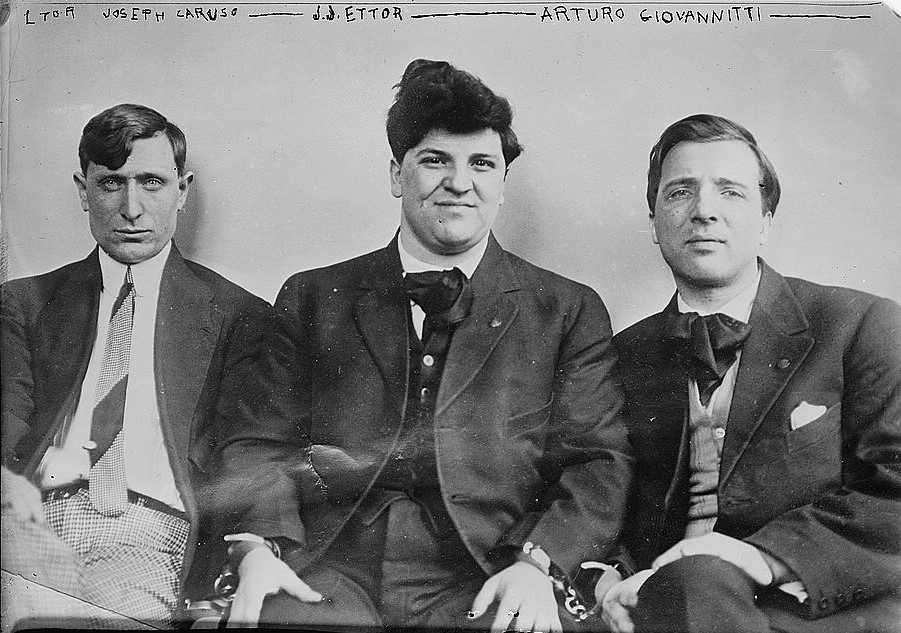
Joseph J. Ettor, Arturo Giovannitti, and Joseph Caruso are acquitted of the ludicrous charge of the murder of Lawrence striker Anna LoPizzo, shot by police during a confrontation on the picket line. Includes closing statements from Ettor and Giovanniti.
‘Acquitted!’ from Solidarity. Vol. 3 No. 49. November 30, 1912.
Jury’s Verdict in Salem Trial Tallies with that of the Working Class. Eloquent Plea of Prisoners.
(Telegram to Solidarity) Salem, Mass., Nov. 26. Jury out six hours and all three acquitted. Great enthusiasm here. HESELWOOD.
Salem, Mass., Nov. 24. The week just passed in the trial of Ettor, Giovannitti and Caruso will prove a week of vast social significance. During this period the trial has been taken out of the criminal court and raised onto a higher plane into the social arena. The world struggle between the old order and the new was once more re-enacted, with the results in favor of the new.
This most extraordinary achievement was due to the bitter attack of District Attorney Atwill upon the principles and ideals of the I.W.W. and the brave, eloquent defense made by both Ettor and Giovannitti. The occasion, while significant of social tragedy or progress, was impressive and inspiring. The atmosphere of the court room was tense and breathless; women sobbed, the jurors wept and even the ashen hue of the prosecutor reflected a realization of the profound meaning of the occurrence.
District Attorney Atwill assailed the I.W.W. as seditious, treasonable, subversive of law and order; an attack upon organized society and the rights of property. He invoked the Massachusetts constitution and bill of rights, its customs and traditions, and urged the jury to choke the I.W.W. in its inception before it got too big and powerful to control. He unsparingly denounced Ettor as the proponent of the I.W.W. and its principles, called him brilliant, clever, daring, and referred to him as “the little general whose intelligence and brain bad conceived and organized the Lawrence strike and carried it on in defiance of the state.” Atwill called on the jury to assert the sovereignty of the state over the mob, as represented by the defendants, at any and all costs. “This,” he cried, “must be a reign of government under the stars and stripes, and not under the red flag of socialism and anarchism.” Poetry on the blue and gray was quoted and patriotism was invoked in condemnation of “this militant, revolutionary organization,” and the lives of its leaders were demanded, in order that it might be silenced forever.
Ettor’s defense was eloquent, unflinching. He declared: “I am being tried for my social ideals; not for my acts.
Social views can not be tried in a court room. History sits in judgment on these, and decides either for or against them. The social crimes of one age become the religion of the next. You may indict ideas; you may demand that they be choked; but ideas grow and flourish in proportion as they are prosecuted. Kill me and my comrade Giovannitti, and the day you do it a thousand will take our places.
“I have nothing to defend; nothing to extenuate, and ask no privilege, no favor, no pardon. I went to Lawrence to help my starving sisters and brothers I did all that I could for them, and no man could do more. If you believe that I should die for this, well and good; I shall accept the penalty; I shall go the chair with my head erect, and so will my comrade Giovannitti. It is preposterous to think that I should desire the death of one of my own sisters; but if you believe I went to Lawrence to murder or incite to murder, then kill me; I will pay the penalty; I will pay the price. Don’t blame this boy, Caruso; blame me.”
“The district attorney has said much about outsiders coming to Massachusetts and about the traditions of Massachusetts. I would remind him that when Massachusetts and the nation were struggling to establish themselves in the revolutionary war, it was two outsiders, Koskiuski and Pulaski, two Polacks, who came to their assistance. I was born in this country and I have a constitutional right to move about it as I please. Seventy years ago well dressed, respectable mob of Boston dragged Lloyd Garrison, the abolitionist through the streets with a rope around bis neck. Today he is one of the traditions of Massachusetts; and men of Massachusetts are proud to be counted among his descendants.
“The district attorney accuses me of wanting to destroy property. He knows that is not true. I stated that the workers should own collectively the property they use collectively; and that if they destroy any of that property they will only have so much to reproduce when they come in possession of it.
“The district attorney represents wealth as an individual creation, that should therefore be individually owned. This is a conception of wealth that is discarded and no longer applies to modern conditions. Today wealth is a social creation and should be owned by its social creators, the workers. Today social wealth is a social necessity and should not therefore be owned by private individuals.
“I am accused of subverting law and order I told the workers at Lawrence that the mill owners had violated the spirit of the 54-hour law. I told them that it was the mill owners who planted the dynamite and did the car smashing; that I believe it was their agents who started the riot in which Annie La Pizza was killed. Is this inconceivable? Is it not possible that men who will conspire to defeat the intent of a good law and will plant dynamite to discredit strikers will not also smash cars and provoke riots? Do not their interests demand it? It is the capitalists who subvert the law and order.”
“Gentlemen of the jury, ever since I was a boy capable of understanding, I have raised my voice in behalf of labor; of my class. I was conscious, while so doing that I was baring my breast to the bayonets and the shafts of the opposition. I have sang the songs of labor and I shall continue to sing them. If you believe that I had a hand, a suggestion or a voice in the killing of Annie LaPizza send me to the electric chair. If you believe that Joseph J. Ettor and Arturo Giovannitti became murderers because of their social ideals; and they should there- fore be killed, it is up to you to kill them. We will both die with a song on our lips. If you should decide to free us, we will both carry the flag of labor as before, until our class, the working class, is free from wage slavery.”
Giovannatti spoke along the same lines. He said: “This is not a question of property, but of humanity. As of old the apostles of a new faith must be crucified to appease the old.” But especially touching was Giovannitti’s appeal for Caruso, whom he pictured as unlettered and unable to comprehend the situation. Giovannitti cried out: “Let this poor simple young man Caruso go back to his wife and child. Kill us and let him go. If we are responsible we are responsible for everything.” Caruso offered no appeal.
Both Giovannitti and Ettor begged that they be either acquitted or killed. They protested against imprisonment and declared death preferable.
The most widely read of I.W.W. newspapers, Solidarity was published by the Industrial Workers of the World from 1909 until 1917. First produced in New Castle, Pennsylvania, and born during the McKees Rocks strike, Solidarity later moved to Cleveland, Ohio until 1917 then spent its last months in Chicago. With a circulation of around 12,000 and a readership many times that, Solidarity was instrumental in defining the Wobbly world-view at the height of their influence in the working class. It was edited over its life by A.M. Stirton, H.A. Goff, Ben H. Williams, Ralph Chaplin who also provided much of the paper’s color, and others. Like nearly all the left press it fell victim to federal repression in 1917.
PDF of full issue: https://www.marxists.org/history/usa/pubs/solidarity-iww/1912/v03n49-w153-nov-30-1912-Solidarity.pdf
 Revolution's Newsstand