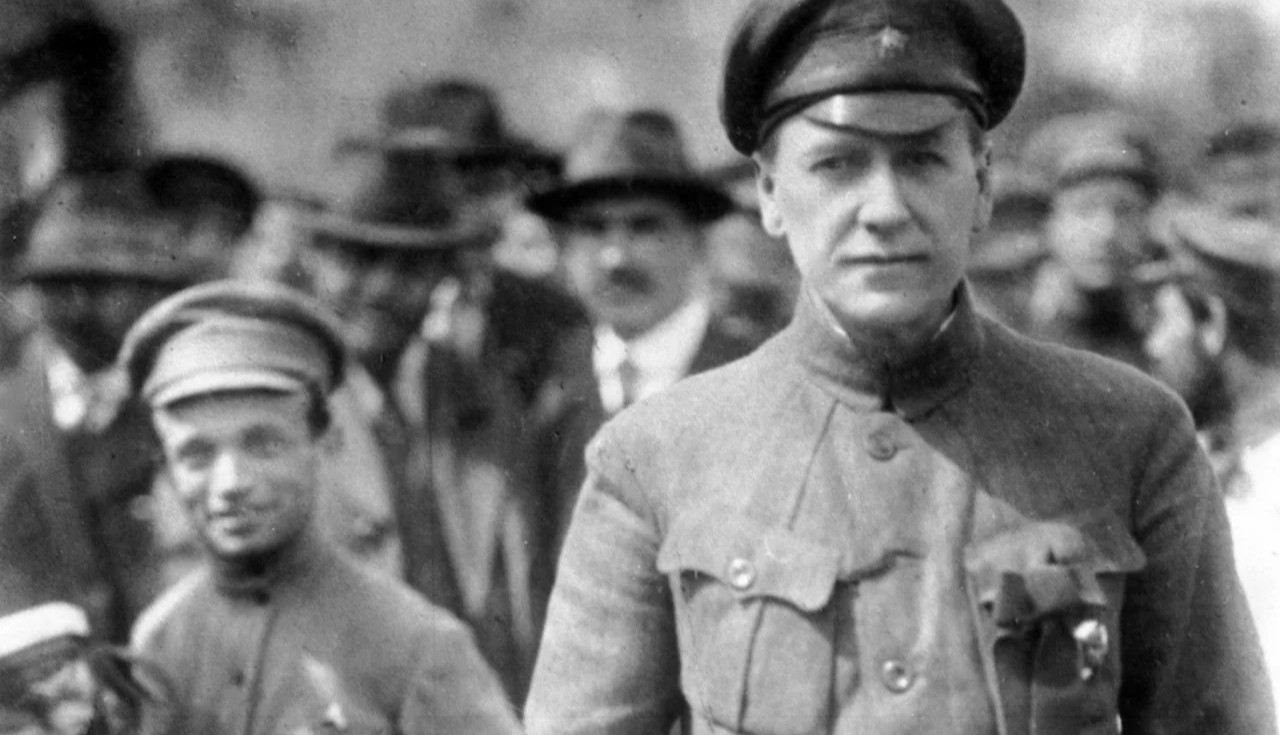
One of Reed’s portraits of revolutionary leaders, this of the Bulgarian/Romanian/Ukrainian/Russian internationalist Christian Rakovsky, then head of Soviet Ukraine.
‘Christian Rakovsky: A Pen Picture’ by John Reed from the Revolutionary Age. Vol. 1 No. 15. January 25, 1919.
For two months in the Commissariat of Foreign Affairs of the Soviet Government at Petrograd I worked side by side with Rakovsky. He was editing a daily paper in Rumanian, Jnainte, which was distributed not only in the ranks of the Rumanian army but also to the Transylvanian soldiers of the Austrian army. He made frequent trips to the south of Russia, where he secretly crossed the Rumanian lines and traveled incognito through his own country, spreading revolutionary doctrines at the risk of his life.
In December 1917, when the Soviet Government signed an armistice with Germany and Austria, Rumania refused to participate. The Russian troops on the Rumanian front obeyed orders from Petrograd and entertained at headquarters a German and Austrian delegation. The Rumanian Government arrested this delegation, and upon the protest of the Russians, surrounded them with Rumanian troops and fired on them with artillery The Russian soldiers had to cut their way by force through the Rumanian lines back to Russia, losing many men.
The consequences were swift. Trotsky ordered the immediate arrest of the Rumanian minister at Petrograd. The next day Allied and neutral ambassadors demanded his liberation. This was granted, but the Soviet government ordered that the Rumanian diplomatic mission should leave Russia within ten hours.
That afternoon I was in the office of Zalkind, Assistant Commissaire of Foreign Affairs. In one corner were five or six red guards and sailors drinking tea around a battered samovar. At the side of the room Rakovsky sat at table, writing furiously. Entered a vetzar in the old-time resplendent livery of the czar. He has a card. It read: Mr. A—, first secretary of the Rumanian Embassy to Russia. “Show him in,” said Zalkind. There appeared, a dapper youth in frock coat, silk hat, gloves and stick. He surveyed the room with uneasiness mingled with contempt. Zalkind, wearing peasant boots and an old uniform without insignia, came forward to meet him. “What can I do for you, sir?” he asked courteously. “This is the Ministry of Foreign Affairs?” asked the secretary. “We have received an order emanating from somewhere that the Rumanian Embassy must leave Russia within ten hours. My dear sir, that is impossible. We have much to do. Our officials are scattered over Russia. It will take at least three days –” Zalkind smiled in the friendliest way. “With that, Mr. Secretary, I have nothing to do. You must address yourself to our Commissaire for Rumanian Affairs. Allow me, comrade Rakovky.”
Rakovsky rose from his seat, dignified and suave. He bowed. The Secretary went pale and dropped his gloves.
“I am extremely sorry to be unable to accommodate you, Mr. Secretary”, said Rakovsky very politely. “The last time I was officially in your country I was compelled to leave in two hours and a half. We give the ambassador ten hours and by that we recognize that he is four times as important as I. Good afternoon!”
The Revolutionary Age (not to be confused with the 1930s Lovestone group paper of the same name) was a weekly first for the Socialist Party’s Boston Local begun in November, 1918. Under the editorship of early US Communist Louis C. Fraina, and writers like Scott Nearing and John Reed, the paper became the national organ of the SP’s Left Wing Section, embracing the Bolshevik Revolution and a new International. In June 1919, the paper moved to New York City and became the most important publication of the developing communist movement. In August, 1919, it changed its name to ‘The Communist’ (one of a dozen or more so-named papers at the time) as a paper of the newly formed Communist Party of America and ran until 1921.
For a PDF of the full issue: https://www.marxists.org/history/usa/pubs/revolutionaryage/v1n15-jan-25-1919.pdf
 Revolution's Newsstand