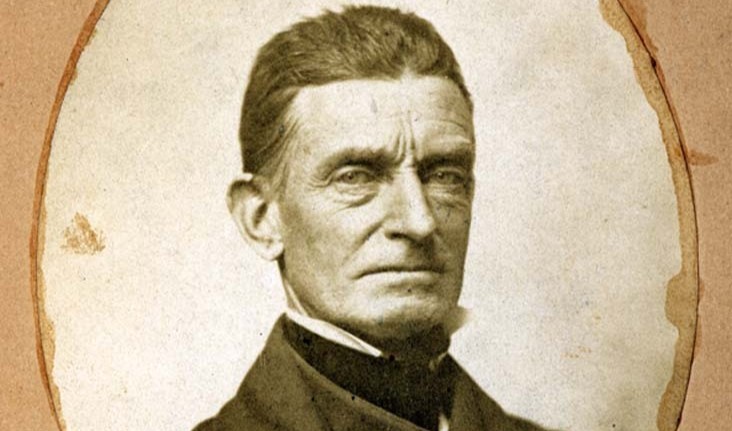
Refusing to back down in face of reaction, a leading Black abolitionist, and comrade of John Browns, brilliantly issues his own ‘card of denial’ in the aftermath of the Brown’s raid on Harper’s Ferry, throwing down a challenge to both the slave power and fearful ‘abolitionists’. Langston Hughes’ revolutionary ancestors shaped his world and identity. He was named after his grandfather Charles H. Langston, a leading Black abolitionist of the most militant stripe tried for his part in 1858’s Oberlin–Wellington Rescue. A co-worker of John Brown’s in Oberlin who helped to gather volunteers for the Provisional Army, Langston would marry the mother Lewis Leary, one of five Black raiders who went with Brown to Harper’s Ferry in October, 1859. Langston inherited, by family tradition, the shawl claimed to be worn by Leary when he died, citing it as his most treasured possession.
‘John Brown: A Card of Denial’ by Charles H. Langston from The Anti-Slavery Bugle. Vol. 15 No. 17. December 10, 1859.
MR. EDITOR: Card writing seems to be the order of the day, particularly with reference to Capt. John Brown and his insurrectionary movements at Harper’s Ferry. We have heard through the public journals from many of the great men and some of the great women too who are said to be connected with the “bloody attempt to dissolve the Union,” “to subvert and overturn the Government,” “to push forward the irrepressible conflict,” “and to incite the slaves of Virginia and Maryland to cut their masters” throats.” Giddings, Hale, Smith, the Plumbs, and others have denied any knowledge of, or connection with the “mad scheme or its crazy perpetrators.” Why this hasty denial? Why all this hot haste to throw off the imaginary disgrace or danger, which may grow out of complicity with this daring friend of Liberty and lover of mercy? Were the noble old hero and his brave and faithful followers, engaged in a mean, selfish, and dastardly work? Were they “plotting crime” against the rights or liberties of any human being? Were they in Virginia to take the property or lives of men who respect the rights of life, liberty or property in others?–Capt. Brown was engaged in no vile, base, sordid, malicious or selfish enterprise. His aims and ends were lofty, noble, generous, benevolent, humane and Godlike. His actions were in perfect harmony with, and resulted from the teaching of the Bible, of our Revolutionary fathers and of every free and faithful anti-slavery man in this country and the world.
Does not the holy Bible teach that it is the duty of the strong and powerful to assist the weak and helpless, that the rich should succor the poor and needy? Does it not command us to remember those in bonds as being bound with them? Does not the Bible plainly say, “whatsoever ye would that men shall do to you, do ye even so to them?” and further: “he that stealeth a man and selleth him or if he be found in his hand, he shall surely be put to death.”
Did not Capt. Brown act in consonance with these Biblical principles and injunctions? He went into Virginia to aid the afflicted and the helpless, to assist the weak and to relieve the poor and needy. To undo the heavy burdens, to let the oppressed go free, to do to others us he would have them do to him. And above all to put to death, as the papers tell us, those who steal men and sell them, and in whose hands stolen men are found. His actions then are only the results of his faithfulness to the plain teaching of the word of God.
The renowned fathers of our celebrated revolution taught the world that “resistance to tyrants is obedience to God,” that all men are created equal and have the inalienable right to life and liberty. They proclaim death but not slavery, or rather “give me liberty or give me death.” They also ordained and established a constitution to secure the blessings of liberty to themselves and their posterity. (It is to be remembered that they have a large colored posterity in the Southern States.) And they further declared that when any government becomes destructive if these ends, namely, life, liberty, justice and happiness, it is the right of the people to abolish it and institute a new government. On these pure and holy principles they fearlessly entered into a seven years war against the most powerful nation of the earth, relying on a just God, whom they believed would raise up friends to fight their battles for them. Their belief was more than realized. The friends of freedom came to their assistance.
Did not Capt. Brown act in accordance with the foregoing revolutionary principles? Did he not obey God by resisting tyrants? Did he not in all things show his implicit faith in the equality of all men and their inalienable right to life and liberty. When he saw that the governments of the South were destructive of these ends, did he not aim to abolish them and to institute a new government laying its foundation on such principles as to him seemed most likely to secure the happiness and safety of the people?
Some will say no doubt that the teaching of the renowned fathers had no reference to negroes, for, says Judge Taney, the prevalent opinion at the time of the revolution was that “black men had no rights which white men were bound to respect.” In sober earnestness did the “great and good” men of those days which tried men’s souls, have no higher ideals of liberty and the rights of man than that. Did they believe in a one-sided, selfish, partial, sectarian freedom? Liberty for proud “Anglo Saxons” and chains and fetters for all the world and the rest of mankind. I think they must have had a higher, a nobler idea of man and his inalienable rights? But be this as it may, the Abolitionists, the true friends of God and humanity, are applying both the doctrines of the Bible and the teaching of the fathers to every human being, whether white or black, bond or free. We Abolitionists profess to propagate no new doctrines in politics or morals, but to urge all men to practice the old well-defined and immutable principles of the fatherhood of God and the universal brotherhood of man. Liberty and equality belong naturally to the entire brotherhood; and the man who takes from his brother his liberty, becomes a tyrant and thus forfeits his right to live.
Now it is plain to be seen that Capt. Brown only carried out in his actions the principles emanating from these three sources, viz: First–The Bible. Second–The Revolutionary Fathers. Third–All good Abolitionists.
If, then, Brown acted on these pure and righteous principles, why are the friends of justice, liberty and right so hasty in denying all connection with him or sympathy with bis ends and aims. Perhaps they see the bloody gallows of the “affrighted chivalry” rising before them in awful horror. Or more probably they see a political grave yawning to receive them.
But to speak of myself, I have no political prospects and therefore no political fears! for my black face and curly hair doom me in this land of equality to political damnation and that beyond the possibility of redemption. But I have a neck as dear to me as Smith’s, Hale’s, or Giddings’, and therefore I must like them publish a card of denial. So here it is. But what shall I deny? I cannot deny that I feel the very deepest sympathy with the immortal John Brown in his heroic and daring efforts to free the slaves. To do this would be in my opinion more criminal than to urge the slaves to open rebellion. To deny any connection with the “dark and fiendish plot” would be worse than nonsense. The fearless chivalry of the Old Dominion would prove me guilty without the least difficulty. For their heroic imaginations now convert every harmless pillow into an infernal machine, behold the veritable Capt. Brown in every peaceable non-resistant northern abolitionist, and see in every colored man the dusky ghost of Gen. Nat Turner, the hero of Southampton. So their testimony against me would be imaginary, their trial a farce, but their rope halter would be a stern and binding reality.
But there is one thing which I must deny. The man who “Floods” the National Democrat of Cleveland with faussete to the infinite disgrace of the city, but to the great gratification of the Custom House clique, says that “Langston seems to be the most sensible of the whole party.” This I positively deny. With these explanations and denials, I hope the Marshal of the Northern District of Ohio, the Federal Administration generally, and all slave holders, and particularly all official “smelling committees” will be fully satisfied. C. H. LANGSTON.
Cleveland, Nov. 1859,
From the Cleveland Plain Dealer.
Access to PDF: https://tile.loc.gov/storage-services/service/ndnp/ohi/batch_ohi_ariel_ver02/data/sn83035487/00211100497/1859121001/1126.pdf
 Revolution's Newsstand