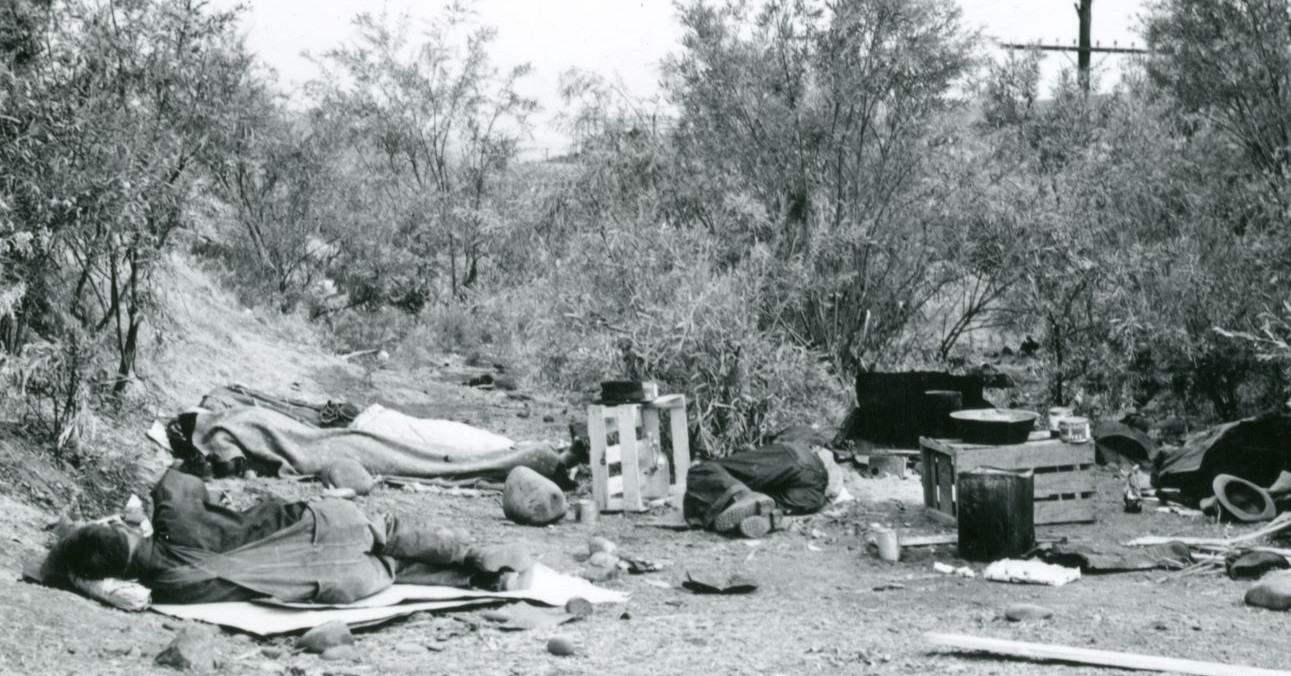
A denizen of California’s jungles–an itinerant worker living rough–on the reality of life on the road and some proposed rules to make life in homeless camps at the edge of town more livable.
‘The Jungles in California’ by E.F. Lefferts from Industrial Worker. Vol. 1 No. 8. May 6, 1909.
Imperial valley is a tract of about 3,000,000 acres below sea level. There are about 300,000 acres under irrigation. There are five towns in the valley ranging in size from 500 to 2,000 inhabitants. The winter climate is several degrees warmer than any other part of southern California. It rarely goes below the freezing point and the average rainfall is about two inches.
The temperature from the first of June to the first of November ranges from 100 to 140 in the shade. So you see that the climatic conditions in the winter time are ideal for the sojourner who may be a little light in the pocketbook; while the same man will shun the place in the summer time. The knights of the road, the hoboes, the fellow that works a little while at a time, and who will not work unless he gets the best of wages, and who does not try to do a little more than his fellow worker for fear he will be the first to get fired or laid off, and who is not afraid to speak his mind on any subject to the boss or anybody else who will refuse to hitch up or unhitch the buggy horse for the boss, and who will answer when, asked to do so, that “he did not hire out for a coachman;” all such men as that generally leave the valley between the first of May and the first of June. I write these few remarks to explain the circumstances which prompts the following spasm which might have been written by a real-estate man here:
The time is now ripe for the knights of the road to make their annual exit from Imperial Valley. Imperial Valley has been honored by its share of brake-beans and tomato can tourists ever since it began to be settled. Whatever may be the drawbacks and disadvantages of poverty, in some things the man with nothing has the advantage of the man with property. While the ranchers and property holders have to stay (or think they have to stay) here in the summer time and suffer and pant for breath when it is 130 in the shade, the knights of the road can go where the oranges grow the sweetest, and the breezes blow the coolest; when they get tired of resting under the orange trees and eating the luscious fruit, they can go to the ocean and find some sandy seclude ed spot on the seashore, and undress and let the cool waves of the peaceful Pacific lave their sturdy bodies. As they are not oppressed or worried with business cares, and as time is no object to them, they can spend as much time as they like under the shade trees, reading the news or exchanging ideas as to the best way to get to New Orleans or Chi. or Denver or Frisco or any other of the various places which they may at some future time wish to go. Without doubt, there are times when they think (perhaps with pleasure and perhaps with pity) of the property holders, the respectable, those who believe in law and order, the inner circle of the four hundred, the silk stocking brigalle, sweltering and suffering in the awful heat of the valley, keeping the shade trees growing so that there will be shade for the hoboes next winter. They seem to think that there is no use for the ranchers to keep the valley up without the tramps get the advantage of it in the winter! Several of these tramps have told me personally, that as long as the moneyed men and ranchers were heroic and ambitious enough to stay here in the summer, they would always show that they appreciated such heroism by coming here to spend their winters. They proceeded to outline methods by which the number of the sons of rest who make this place their regular winter quarters could be increased.
Resolutions:
First. The planting of orange groves near the railroad every two miles, the varieties to be the largest and sweetest of navels.
Second. The planting of groves of gum trees alongside the orange groves for fuel for the exclusive use of the knights, and several acres of corn to furnish stalks for fuel until the trees are large enough.
Third. The absolute assurance on the part of the town and county officials that there will be no bulls or bull-dogs to annoy the tourists while in the jungles.
Fourth. That in case they cannot get work at wages to suit them they will be allowed to help themselves to chickens, small fat pigs, vegetables, fruits, and other provisions in such quantities as their needs may call for!
The above resolutions have been passed upon and accepted by the Imperial Valley branch of the southwestern branch of the international organization of tomato-can tourists, Holtville, California.
The Industrial Union Bulletin, and the Industrial Worker were newspapers published by the Industrial Workers of the World (IWW) from 1907 until 1913. First printed in Joliet, Illinois, IUB incorporated The Voice of Labor, the newspaper of the American Labor Union which had joined the IWW, and another IWW affiliate, International Metal Worker.The Trautmann-DeLeon faction issued its weekly from March 1907. Soon after, De Leon would be expelled and Trautmann would continue IUB until March 1909. It was edited by A. S. Edwards. 1909, production moved to Spokane, Washington and became The Industrial Worker, “the voice of revolutionary industrial unionism.”
PDF of full issue: https://www.marxists.org/history/usa/pubs/industrialworker/iw/v1n08-may-06-1909-IW.pdf
 Revolution's Newsstand