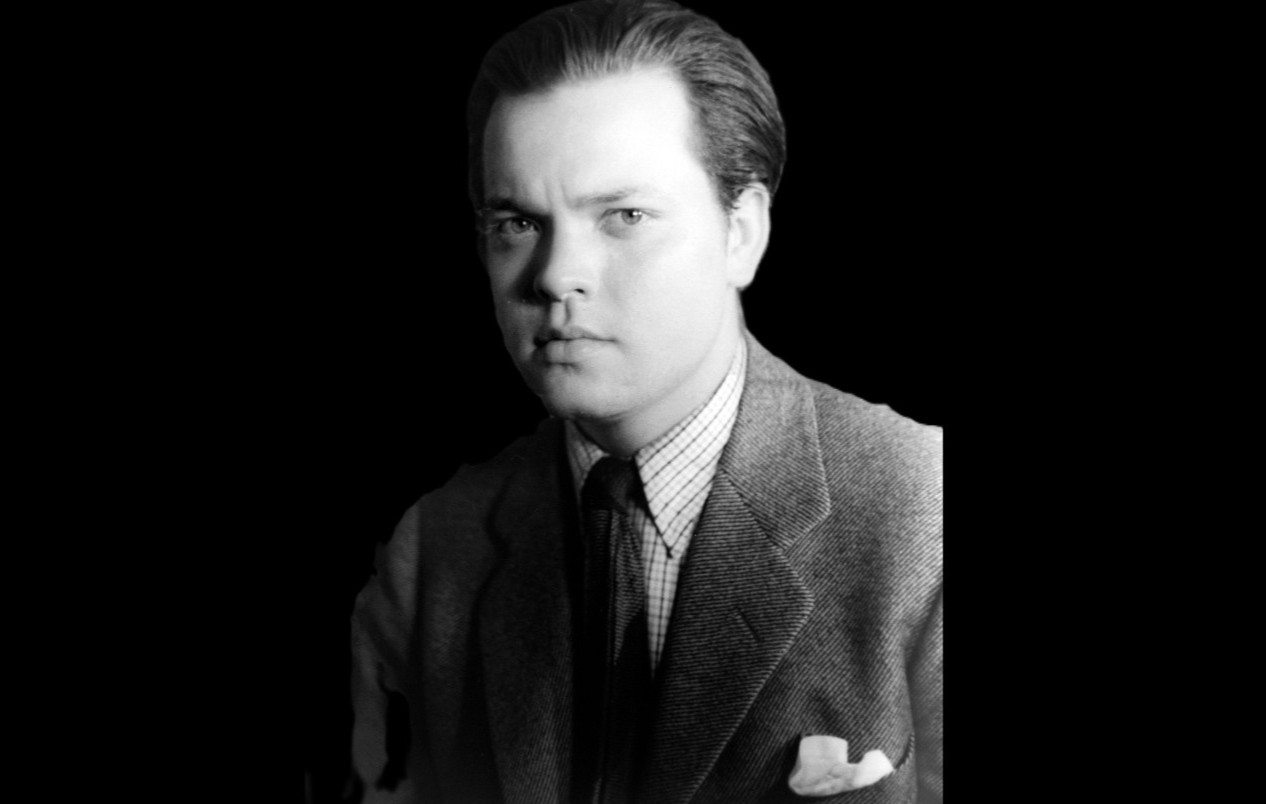
Orson Welles was one of the greatest artists the U.S. has ever produced, and as such was virtually unemployable here, spending much of his working life in a kind of exile. Here the 23-year-old genius gets profiled in the Young Communists’ Popular Front-era magazine. Welles, also a U.S. rarity, being very much the genuine (bourgeois) intellectual radical the Front was meant to incorporate.
‘Broadway Whizz Orson Welles’ from Champion of Youth. Vol. 2 No. 10. April-May, 1927.
At Twenty-three, Orson Welles Has Achieved Success on the Stage—Is Ace of W.P.A. Theatre Projects
THE theatre is a precarious place for new ideas.
Either novelties in material, acting or production are sought after with a kind of craze, or else they are completely discouraged. Unfortunately, the latter situation seems to be the case most of the time. There is a fear of something new that is outrageously difficult to shake off. In almost every field young newcomers have faced this problem; in the theatre probably more than anywhere else.
Broadway and Hollywood are bitter places for young people to break into. After a long apprenticeship to, mediocrity in technique and production, those who have had the courage to stick it through become completely absorbed by the kind of work they have been doing and refuse to do anything new, content with the achievement of a success in terms of dollars. One must not be unnecessarily hopeless about this, because there have been and there still are men and women in the theatre with genius and the means of seeing that genius realize its dreams. The sad part is that they all seem to get their chance so late in life that, of necessity, a certain amount of their vital spontaneity and passionate devotion to the integrity of the theatre art is lost in the fear of not producing a success.
That is perhaps why the career of Orson Welles is in a measure inspirational. This talented actor-director is 23 years old. In his work lies a world of meaning not only because of his achievements as an artist—but because he is a representative of what youth can do in the theatre if given the opportunity.
Applause rocks the house each night when the curtain falls on Christopher Marlowe’s “Tragical History of Dr. Faustus,” the successful W.P.A. production. It is as much for Orson Welles, the star and director, as for what he represents in the theatre: young vigor that can put a new punch into ageless masterpieces. Producers go wild each season searching for “box office hits.” Too late they wake up and find neglected masterpieces becoming just those “smash hits” when placed in enterprising, creative hands.
Orson Welles’ first experiment in “revivals” proved that courageous production would draw the crowds to the W.P.A. Theatre Project. Last spring, when he produced Shakespeare’s “Macbeth” with an all-Negro cast and a South Sea island atmosphere, it brought down the house throughout the country. Now he has done it again with “Dr. Faustus,” while a slightly bewildered Broadway looks on amazed at “Standing Room Only” signs at the box office. The conclusion is obvious. Audiences like a good thing and when they get it they will flock to see it in preference to stale comedies or leg shows.
Orson’s career has filled his twenty-three years very fully. He started early in the theatre when, as a child, he played animal roles in the Christmas festivals of Chicago department stores and walk-on parts in opera. Educated in America, England and China, his parents sent him to Ireland and Scotland to study painting. Announcing himself to the famous Abbey Players as a “great American artist,” he became the first non-Irish player to be admitted to their ranks. He was fifteen then. At seventeen, this amazing boy was already directing. A movie in England followed, then travels on the Continent. In 1934 he returned to Chicago. A chance meeting with Thornton Wilder brought him to the attention of Katherine Cornell, who was looking for a Marchbanks for Shaw’s “Candida.” He remained with Miss Cornell for her production of “Romeo and Juliet.” Then followed the role of the banker in Archibald MacLeish’s “Panic.” Last year he met John Housman, managing director of the W.P.A. Theatre, and the result—“Macbeth.” He began the current season with “Horse Eats Hat,” a hilarious French farce in which he figured as adapter, director and actor. Next came the leading role in “Ten Million Ghosts,” by Sidney Kingsley.
Successful in the Broadway theatre as well as in the W.P.A. theatre, Mr. Welles says:
“Right now, the W.P.A. seems to be the most vital part of the American theatre. No backing could be got from Broadway producers for ‘Macbeth’ or for ‘Dr. Faustus.’ They insisted that people weren’t interested in such plays. When each turned out to be a success, offers from Broadway were waiting. We had three for ‘Macbeth’ and two for ‘Faustus.’”
Orson, himself, has turned down numerous Broadway offers. Recently he rejected a movie contract offer from Metro-Goldwyn-Mayer, which would have netted him a considerable sum.
Orson has great faith in the W.P.A. productions. It is his hope to build a permanent National Theatre from these productions. Realizing the tremendous role which young people play in the theatre, he says, “The success or failure of the Federal Theatre lies at the doors of Youth.”
Immediate plans for himself and the W.P.A. Theatre center about the revival of significant plays at prices within the range of the average person. Orson Welles has a great future ahead of him. His work has already received the necessary approbation of the public and in his success lies the hope that young people will at last be given the chance they so richly deserve before they are swallowed up by years of discouragement or complacency.
Champion of Youth and Champion Labor Monthly were the Popular Front-era publications of the Young Communist League published from 1936-1939 and as such played down its Communist affiliations and included many writers from Socialist, liberal, and radical traditions as well as the Communist Party. It ceased with the Soviet-German Non-aggression Pact.
PDF of full issue: https://www.marxists.org/history/usa/pubs/champion-of-youth/v02n10-apr-may-1937-Champion.pdf
 Revolution's Newsstand