
Amicus Most, of the S.P.’s Militant faction, defends the campaign to break the blockade and send people to fight fascism in Spain as the Eugene V. Debs Column. With both the political-military situation changing and the challenge of raising, equipping, and transporting hundreds of volunteers, illegally, to fight in Spain meant that the Debs Column never fully developed, dozens comrades were sent, most of whom would find themselves serving in the International Brigades, a number like Paul Niepold killed in the fight, others working behind the lines as nursing and support staff.
‘Men to Spain—The Eugene V. Debs Column’ by Amicus Most from American Socialist Monthly. Vol. 5 No. 9. February, 1937.
“In its struggle for a new society, the Socialist Party seeks to obtain its objectives by peaceful and orderly means. Recognizing (however) the increasing resort by a crumbling capitalist order to fascism to preserve its integrity and dominance, the Socialist Party intends not to be deceived by fascist propaganda or overwhelmed by fascist force. It will do all in its power to fight fascism of every kind all the time and everywhere in the world, until fascism is dead. It will rely upon the organization of a disciplined labor movement.”—Declaration of Principles, Socialist Party, U.S.A.
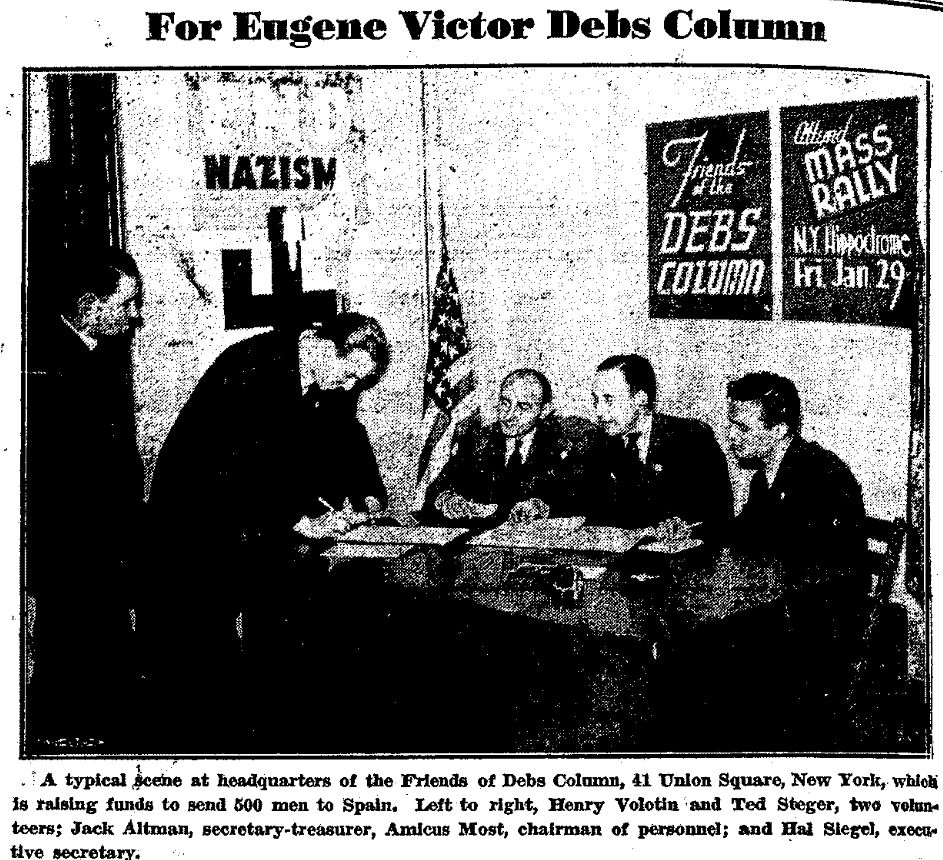
AT Detroit in 1934, the Socialist Party adopted a Declaration of Principles that marked the beginning of the party’s break with reformism and its emergence as a revolutionary organization. Many non-socialist radicals thought and stated that the Declaration consisted merely of words, used in order to appease the leftward surge of the party’s rank and files. Since that time the party has increasingly demonstrated in action that it was ready to assume its revolutionary role seriously. The latest illustration of this is when it initiated the “Friends of the Debs Column” which is helping to furnish transportation for a group of 500 men and women volunteers with medical, military and technical experience who are going to Spain to form the Eugene V. Debs column as part of the International Column fighting against Franco,
Although the Socialist Party initiated and is giving its hearty support to the Friends of the Debs Column, that organization is entirely separate from the party. Its sponsors include such well-known people as: Upton Sinclair, Doothy Kenyon, James T. Farrell, Sidney Hook, Leroy Bowman, Louis Boudin, Roger Baldwin, Carlo Tresca, V. F. Calverton, Norman Thomas, F. Philip Randolph, Isidore Laderman, Lillian Symes, Roy Burt, Tucker P. Smith, Murray Baron, Max Delson and many others representing all shades of political opinion and labor, literary and liberal circles.
The announcement of the Debs Column brought immediate attacks from all sides. Hearst, the Roosevelt administration, some leading pacifists, the old-guard New Leader, the Communist Daily Worker—all joined the chorus. Socialists were not surprised, but understood clearly that the philosophies and tactics represented by each of these forces would of necessity lead them to an attack on any really revolutionary act.
The attack of Hearst, the leading self-avowed defender of fascism in America, is easily understandable. He will fight with all his demagogy and power against any action undertaken on behalf of the working class.
The administration had no legal grounds that it could use to stop the Debs Brigade. The Friends of the Debs Column are not recruiting or soliciting volunteers. They are merely furnishing transportation to class-conscious men of character and training who, of their own free will and with no remuneration whatsoever, desire to go to Spain. These people will not swear allegiance to the Spanish government or join the Spanish army. They will make arrangements in Spain to form the Debs Column and to join the International Column. Having no legal grounds, the government, therefore, attempted to prevent these working men from going by various “scare” devices. It issued a series of statements in the press announcing Department of Justice investigations and passport restrictions. It sent G-men to various Socialist Party headquarters. It widely publicized its questioning of the flyer, Bert Acosta, upon his return from Spain and Senator Pittman and Representative Dickstein called for new laws to prevent the action of the Friends of the Debs Column. The government attempted to use bluff, but when the Friends of the Debs Column insisted on carrying on work, the government was forced to admit that it had no legal ground.
The government’s acts again illustrate what socialists have always pointed out—that a capitalist government, no matter how liberal it might pretend to be, in a crucial struggle between the working class and the owning class will line up with that side with whose economic interests it is identified. Americans have not been prevented from fighting for every would-be South American dictator, or from joining the Chinese Army, French Foreign Legion, Mussolini’s army in Ethiopia, and every European army before America entered the World War. The recent hysterically passed “neutrality” legislation, together with the official frown upon the Debs Column, clearly shows the administration’s bias in favor of the fascist Franco, for these acts can only help him by hurting the legally elected Spanish Government. Franco can obtain all the help he wants from Hitler and Mussolini while the great “democracies” of the world block aid to the workers of Spain.
John Haynes Holmes and the Fellowship of Reconciliation led the pacifists’ attack. They argued for conscientious objection to participation in any form of violent conflict—be it international war, civil war, or class war. They stated that we must keep the United States out of war by strict “neutrality,” and that this act was in violation of the socialists’ historic anti-war position. The Socialist Party has always been and still is opposed to war and violence per se, but it is not opposed to using force when it is necessary in order to defend the working class against the violence of the capitalist class. The Socialist Party fervently wants peace, but it knows that peace can never be achieved under capitalism. Therefore, every victory for Socialism and every defeat of fascism is a victory for peace. A victory for Franco will be a victory for Hitler and Mussolini. It will raise their prestige at home and abroad, help defeat the underground movement in Germany and Italy, and create a new center for world fascist aggression. After Spain comes Czechoslovakia, and after Czechoslovakia—France, and having thus destroyed the last vestige of the limited form of capitalist democracy the united fascist powers will turn upon the Soviet Union. Socialists are opposed to every capitalist imperialist war but are not neutral in the class war. We are definitely on the side of the worker—when our comrades are on the barricades in Russia, or Austria, or Spain—we, too, are on the barricades. As Herbert L. Matthews, the New York Times Madrid correspondent, quoted one of the members of the International Column saying, “the main battlefield of the international war against fascism is at the present moment in front of Madrid.”
What alternatives do the pacifists offer? Should the Spanish workers throw away their arms, or lie down in the streets and refuse to fight? Should they all join the Red Cross, who would be left to do the fighting, and besides, is that not as much a form of participation in the war as those who go to the trenches? The German workers failed to fight and now they are enjoying the peace of Hitler. No, the Spanish workers had no choice but to fight, and the duty of socialists and all enemies of fascism is to assist in that fight.
The Debs Column cannot possibly involve the United States in any war. Workers do not rely upon the capitalist government to fight their battles, but upon their own strength and organization. When the bankers need protection for their foreign investments the bankers government will send the Marine Corps. But the courageous workers who will join the Debs Column know that the capitalist American government has no interest in defending the Spanish workers and any interference on its part can only be on the side of Franco.
The old-guard socialists and the communists agree with us that aid must be given to the Loyalists, but they want this to be done secretly. They want men to be sent by some sort of subterfuge, such as—sending “carpenters, engineers, etc.” If it is done openly, they argue, it will encourage reactionaries to press for prohibitive legislation and it will make the fascists send more aid to the other side. They accuse the Socialist Party and all those who are supporting the Friends of the Debs Column of being publicity hounds. Has the neutrality of France and England stopped Hitler from sending aid? On the contrary, it has encouraged him. Is publicity about helping the workers a bad thing? Of course not! These are not the real reasons for their attacks—they are afraid it might embarrass their liberal front and show up Roosevelt. It might illustrate the falseness of a People’s Front that includes liberals and non-working class elements. The communists want to avoid anything that might disturb the possibility of an open or an implied alliance of the United States with England and France in a “security pact” with Russia. Neither of them wishes to hurt their alliance with “respectability.”

Those who argue for secrecy forget the very essence of Marxism. Modern Socialism is not a Blanquist secret conspiratorial movement. Only in fascist countries, where it is impossible to do otherwise, must it resort to secret, underground work. The achievement of Socialism requires the widest mass support. The masses must know what is being done if they are ever to be brought into action against capitalism. The workers will follow that party which shows that it is capable of leading in the fight for their demands. Immediate widespread and enthusiastic response to the announcement of the Debs Column proves that the class-conscious American workers want real help to go to Spain. The workers have -learned through the bitter experiences of the German and Austrian working class that fascism can only be fought with its own weapon. When the fight against fascism in this country reaches the critical stage it will rally around that party which has shown by its past activities that it means business and knows how to fight.
It is true that 500 men in the ranks of the Loyalist forces cannot win the war, but 500 American workers will have a tremendous moral and psychological effect upon the Spanish Loyalist forces.
Louis Fischer, in the Nation writing from Spain, recently explained how a few thousand members of the International Column were able to inspire the whole of Spain and to turn the tide of the war. The American working class must: show its solidarity with their Spanish comrades by its physical presence in the ranks of the International Column. It must join the fighters sent by the British Independent Labor Party, by the Swiss, Belgian and French Socialist and Communist Parties and by every section in the international working class movement. It must follow the great traditions of the fighters for liberty through the ages. Lafayette, Pilsudski, and Steuben joined the American Revolution. Marx in his “Revolution and Counter Revolution” describes how in 1848 Robert Blum of the Frankfort Assembly became one of the leaders of, and later died on the barricades in the Vienna insurrection. John Reed and many other Americans went to help in the Russian Revolution. Countless thousands of others have not hesitated to give their lives for the cause of liberty and Socialism. The Socialist Party of the United States, in line with its historic role, joins the ranks of these fighters and in the words of Eugene Debs says, “I refuse to obey any command to fight for the ruling class, but I will not wait to be commanded to fight for the working class.”
Socialist Review began as American Socialist Quarterly in 1932. The name changed to Socialist Review in September 1937. The journal reflected Norman Thomas’ supporters “Militant” tendency of the ‘center’ leadership. Beginning in 1936, there were also Fourth Internationalists lead by James P. Cannon as well as the right-wing tendency around the New Leader magazine also contributing. The articles reflect these ideological divisions, and for a time, the journal hosted important debates. The magazine continued as the SP official organ through the 1940s.
PDF of full issue: https://www.marxists.org/history/usa/pubs/socialist-review/v05-n09-feb-1937-soc-rev.pdf
 Revolution's Newsstand