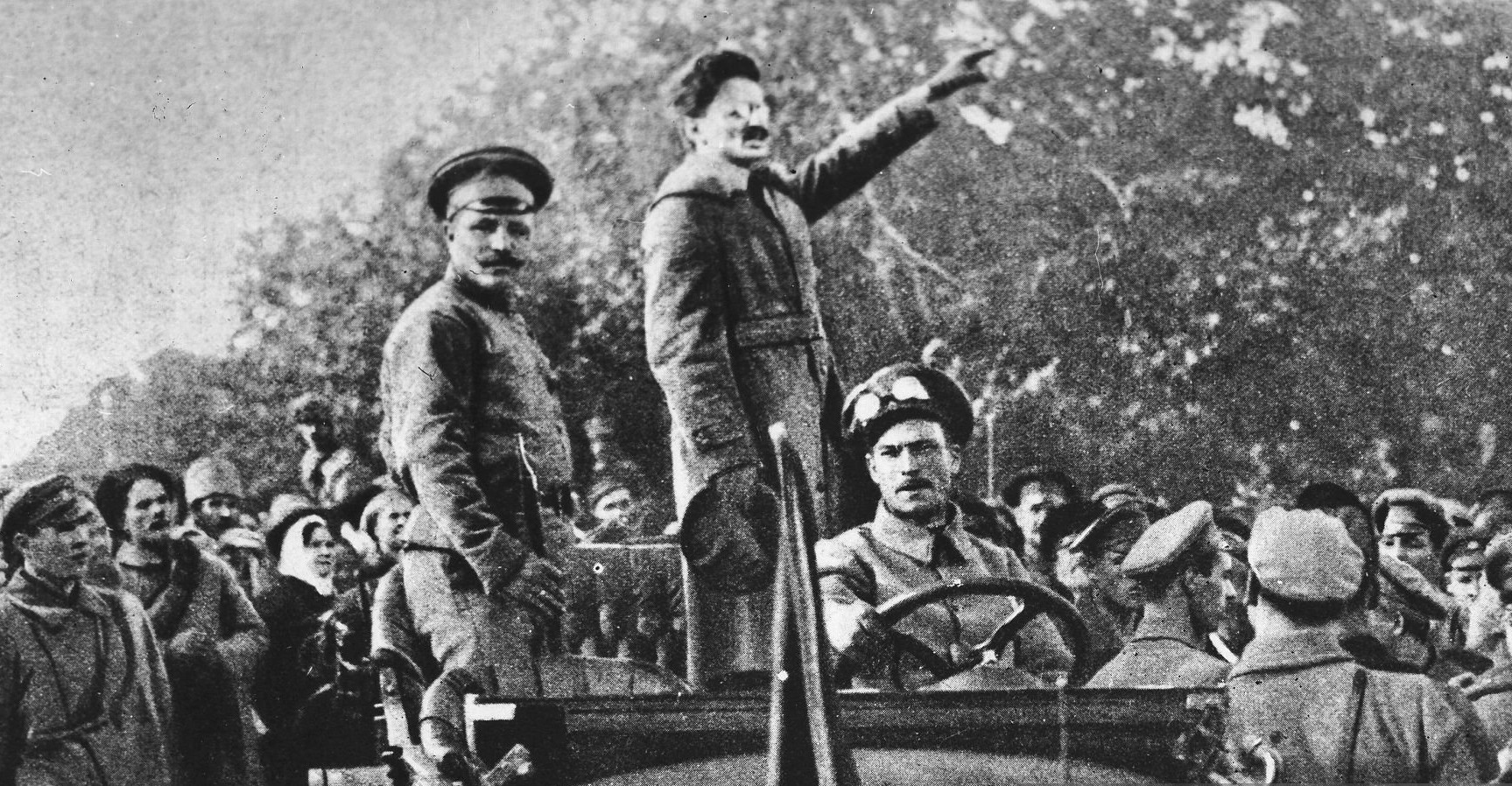
Written in June, 1933–several months after the Nazis assumed full power in March–and published as ‘German Perspectives’ in the magazine of Albert Weisbord’s organization.
‘How Long Can Hitler Stay?’ by Leon Trotsky from Class Struggle (C.L.S.). Vol. 3 Nos. 9 & 10. September-November, 1933.
After a conflagration it is difficult to settle down again; it is still harder to determine your new path after a great political downfall. A political party admits its defeat unwillingly, especially when it is itself in great part responsible to that defeat. The greater the defeat, the harder it is for the political mind to adjust itself, to establish a new perspective in order to work out the direction and tempo for further activity.
The history of wars and revolutionary struggles contains numerous examples of unnecessary defeats that were caused by the leadership not recognizing the seriousness of a fundamental defeat, but instead trying to cover it with temporary, futile attacks. In war new attacks often lead to the destruction of active military forces who have already been demoralized from past failures. In the revolutionary struggle the most vigorous and eager elements who have already been torn from the masses through past defeats, are sacrificed to adventurism.
The decision and determination to carry through an attack to the very end- the ability to recognize a defeat at the right time and to prepare the defense, these are two inseparable parts of a correct and mature strategy. Such a combination is seldom found. After every great defeat of the Revolution at least a part of the leadership continued to call for the attack in spite of the changed situation. After the revolution of 1848 Marx and Engels cut themselves loose from those immigrants who looked upon the defeat merely as an accidental episode. After the 1905 Revolution Lenin was forced to break with those comrades who continued to call for the armed uprising. The quality of the Marxist school of revolutionary realism consists mainly in the ability to prepare for every turn of events.
The present catastrophe in Germany is doubtless the most significant defeat in the history of the working class. There is a pressing need for a sharp change of strategy but the Stalinist bureaucracy persists along the same course. It calls “defeatists” not those who brought about the defeat, but those who from the established fact of the defeat draw the necessary conclusions. The fight over the perspectives of the political development of Germany contains extraordinary significance for the fate of Europe and the whole world.
In this connection we may leave the Social Democracy aside. Its treachery doesn’t even leave it the possibility of maneuvering for bureaucratic prestige. Its leaders never dared to do that which they had planned. After losing their heads politically they are now mainly worried about saving them physically. They have prepared their disgraceful defeat with their entire political course since the beginning of the Imperialist War. The attempt of the withering directorate to rescue the party from abroad, is doomed in advance: in the dangerous underground struggle no revolutionary will want to work under the leadership of exposed bankrupts. Once aroused, the political mind in the ranks of the Social Democracy will break new pathways. But for the time being this is music of the future.
Political interests now demand a free orientation to the Communist Party; As a mass organization it is completely destroyed. Still the Central apparatus maintains itself, distributes illegal and immigrant literature, calls Anti-Fascist Congresses and produces plans for the struggle against Nazi dictatorship. All the crimes of the defeated staffs find an unrivaled expression in this apparatus.
“The Fascists are kings for a day”, writes the official organ of the Comintern, “their victory is a short measured one, and in its wake will follow the proletarian revolution – the struggle for the dictatorship of the proletariat stands in Germany on the order of the day.” Continually drawing back, giving up all positions, losing their own followers – notwithstanding all this the Apparatus announces that the Anti-Fascist wave is rising, that voices are being raised, that it is necessary to prepare for the insurrection – if not tomorrow, in a few months. By this optimistic Phraseology the defeated leading staff encourages itself. The danger of this false optimism becomes all the greater the more the inner life of the German Proletariat is submerged in darkness. Neither facts nor statistics control the false political conclusions or disturb the peace of the Stalinist bureaucracy.
For proof of their comforting prognosis the Stalinists rely on the fact that Hitler “will not keep his promises”. As if Mussolini had to fulfill his fantastic program in order to maintain power for over ten years! The Revolution is no automatic punishment of deceivers, but a complicated phenomenon which comes about only through the existence of a series of definite historic conditions. We know them well enough: no way out for and dismemberment of the ruling classes, rebellion of the petit bourgeoisie which has lost faith in the existing order, growing rebelliousness on the part of the working class, and last, a correct policy of the revolutionary party – these are the necessary political prerequisites for the Revolution. Are they present?
The possessing classes of Germany found themselves, during the last year, in a condition of the sharpest dissension. Today they all support even though with heavy hearts – Fascism. The antagonisms between the different industrial elements, as well as between the different industrials groups, is not settled; but it is a good example of the dictatorship which rules all antagonisms.
During the last period the German petit bourgeoisie steamed like a kettle. But at the same time there was an element of social danger in the fact that it was demoniacally possessed of a spirit of nationalism. Today it has gathered itself around a regime that has risen on its back; it is held in check by a military force which comes our of its very heart. The middle classes are to be the main mercenaries of the regime. The conclusion is clear: as far as the great and petit bourgeoisie are concerned the preconditions for a revolutionary outburst no longer exist.
In the case of the working class the catastrophe is no less significant. In the course of a few months it showed itself, because of the blunders of the leadership, incompetent to defend its powerful legal position before the attack of the Counter-Revolution. Now, on the day after the breakdown, it is still less ready for an attack on the powerful legal position of National Socialism. The material and moral factors have changed sharply, completely – and unfavorably – the strength of the proletariat. Must one still prove this? The Communist Mass Party is no longer in existence; its leadership is exiled, jailed or killed; and the Apparatus stifles all criticism. What, therefore, does it mean that, “the struggle for the dictatorship of the proletariat is on the order of the day”? What can one understand here by the term “day”?
It is not difficult to foresee the sincere as well as the hypocritical “unmasking” of our pessimism: lack of faith in the creative strength of the Revolution, etc. Cheap approaches! We know as well as anybody that Fascism represents a historically lost cause. Its methods can bring about only unstable results. One can overthrow dead classes only with the help of force. But the proletariat is the main productive force of society. For a time it can be defeated. Forever to enslave it is impossible. Hitler promised to “train” the workers. But he is forced to introduced a pedagogical dexterity which is worthless even for the training of dogs. Against the irreconcilable enmity of the workers Fascism will unavoidable break its head. But how and when? A general historical perspective does not answer the burning question on the political horizon: what are we to do now – and especially what are we to discontinue doing – in order to prepare and accelerate the smashing of National Socialism.
Counting upon the immediate revolutionary effect of Fascist repressions and material privations presents a very good example of vulgar historical materialism. Of course, “existence determines consciousness”. But that does not mean the mechanical and immediate dependence of the consciousness upon superficial circumstances. Being changes into consciousness following the laws of consciousness. Similar objective facts can produce different, and often contradictory, results – depending upon general conditions and preceding events. So in the course of human development repressions often call forth revolutionary uprisings. But after a victory of the Counter-Revolution repressions often blow out the last flickering of protest. A domestic crisis is capable of accelerating the revolutionary explosion, and this has happened in history more than once; but should it break out after a severe political defeat of the proletariat, then the crisis can only strengthen the phenomena of decay. Concretely expressed: we cannot expect immediate revolutionary conclusions for Germany because of the deepening and sharpening of the industrial crisis. Indeed it can give a longer life and preponderance to the opportunist streams within the proletariat. But after a long period of crisis and reaction the contradictions can mount to such a Konjunctur which will arouse the workers to action and push them on the road to struggles. We hold such a variant to be more likely from many points of view.
However, the difficulty does not lie in the prognosis of this Konjunktur. Ponderous psychological changes of the masses require a great deal of time; this must be our starting point. A sudden change of Konjunktur, a collision between the ruling classes; international developments–all of these can and will not fail to have their effect upon the workers. But the external events alone do not prepare the Proletariat to surmount with one jump the disastrous consequences of the defeat. Even if, thanks to unusually favorable coincidences of external and internal conditions, the beginning of the changes should take place in an unusually short time–say in a year or two–there still remains completely open the question of our politics during the remaining 12 or 24 months, in which the counter-revolution will make still further conquests. A realistic tactic cannot be established, if we do not understand, that in Germany today it is not the Proletarian revolution which is advancing, but on the contrary, the Fascist Counter-revolution which is deepening and consolidating itself. And that is certainly not one and the same thing.
The bureaucracy–as well as many revolutionaries–forget all too easily that the proletariat is not only the object, but also the subject of politics. The Nazis want, with blows on the head, to change the workers into one artificial people. The leadership of the Comintern figures, on the contrary, that Hitler’s blows against the workers will cause them to become docile Communists. But the workers are not clay in the potter’s hands. Not every time do they seize history at the beginning. Despite all their hate and contempt for the Nazis, they are still least of all inclined to return to that policy which shoves them into Hitler’s snare. The workers feel themselves deceived and betrayed by their own leadership. They don’t know what to do, but they know very well what must not be repeated. Their torment is beyond all description. They want to tear themselves loose from the devil’s circle of complications, threats, lies, and boastings. They want to shake off necessity and difficult questions which are beyond their strength. They need time in which to heal their wounds of disillusion. The general expression of such a condition is: political indifference. The masses fall into an embittered passivity. One part–and not a small one–seeks refuge in Fascist organizations. It is of course inadmissable to put into the same category the going over of several politicians to the side of Fascism and the entrance of nameless workers into the compulsory organizations of the dictatorship; the first case is one of place-hunting, the second, one of defence-coloring, an embittered subjugation to the “Master of the House.” But in spite of this, the fact of a mass desertion of the workers to the Swastika is an irrefutable sign of the spirit of evasion and passivity which has caused this desertion. The reaction has forced itself deep into the marrow of the revolutionary class. And this not only for a day.
The party bureaucracy, which has forgotten nothing and learned nothing, is building a glaring political anachronism in this general condition of affairs. The workers lie prostrate before the official infallibility. The void around the apparatus is growing. The worker resents the fact that besides Hitler’s knout he is also being driven by the knout of false optimism. He wants the truth. The crying contradiction between the official perspective and the real state of affairs can result only in further demoralization in the ranks of the advanced workers.
That which is called the radicalization of the masses is a complex molecular process of collective consciousness. In order to come forward again, the workers must, above all, understand what has happened. Radicalization is out of the question, unless the masses have assimilated their own defeat, unless at least the vanguard critically surveys the past and rises above it to a new stage.
At the present time this process hasn’t even begun. The press of the Apparatus is itself forced to recognize, between its optimistic outbursts, that not only are the Nazis further consolidating their position in the country, persecuting the Communists, inflaming the hatred of the peasants against the workers to the point of white heat, but that also in the industrial centers– without the least bit of resistance–the Communist workers are being crushed. In all of this there is nothing unexpected. Whoever allows himself to be beaten, must bear the consequences.
In the face of these facts, the bureaucracy–in its search for something to bolster up its optimistic perspective–precipitates itself into a subjective condition of complete fatalism. Even should the voice of the masses be submerged, National socialism will be shattered into bits through the forces of its own contradictions. Only yesterday the bureaucrats proclaimed that all the other parties of Germany–from the Nazis to the Social Democracy–merely seek to establish some form of Fascism in order to carry through a common program. Today, all hope of opposition to the government’s policy has been destroyed. The conflict between Hitler and Hindenburg takes the place of what not entirely inconsiderable antagonism between Hitler and Wels which was not taken advantage of it its day. A crash between the SA and the SNBO on the one hand and the Hitler Regime on the other hand is not only unavoidable but also is claimed to be close on the horizon. The reckoning can only be extended a few weeks. Yesterday, Reformist and Fascist were twins; but today the disillusioned Fascist and the Fascist who is in power are Antipodes.
The new errors in political calculation are no less gross than the old. The “opposition” of the old capitalist parties against the National Socialism is no greater than the instinctive opposition of an old sick man who is having a tooth pulled. Events follow the line of march. Hindenberg’s conflict with Hitler appears merely as an episode in the course of the concentration of all power in the hands of Hitler. In order to consummate its destiny Fascism must identify itself with the State Apparatus.
It is quite possible that many of the peasant followers of Fascism are already dissatisfied; they have not been allowed to plunder what is rightfully their own. But no matter what sharp forms this discontent may take on, it cannot be a decisive or determining factor. The apparatus of the ruling regime will crush the disobedient rebels one after another, will build up anew the unreliable divisions and patch up the ragged edges. The disenchantment of the broad masses of the petty-bourgeoisie is–generally speaking–entirely unavoidable. But it will take place irregularly and in different forms. Outbursts of dissatisfaction can, in certain cases, very well lead to a condition of decay among the layers that are disillusioned with and drawing back from Fascism. But in no case should one expect independent, revolutionary initiative to arise from all this.
The Factory Councils of National Socialism are much less dependent on the workers than were the Factory Councils of Reforms. Indeed it is possible in an atmosphere of temporary economic upturn that the Fascist Factory Councils can act as a fulcrum for the attack of the workers; as for example the Tsarist Ochrans workers organization of January 9, 1905, which became the lever of the Revolution. But today, when the German working class is experiencing the most anguishing disillusionments and defeats, it is nonsensical to expect that it will unleash itself into desperate struggle under the leadership of Nazi dignitaries. The Factory Councils are consolidated from above, as agents of betrayal, to keep the workers in check.
Let us not deceive ourselves. It is suicide to cover up defeats with illusions. The way out is through clearness. Only a merciless criticism of one’s own mistakes and blunders can pave the road towards retaliation.
From past experiences we can see that German Fascism is developing along the lines of Italian Fascism at an accelerated speed; not only because Hitler is learning from Mussolini, but above all because of the hither industrial development of Germany, and the greater sharpness of its inner contradictions. From this we can draw the conclusions that National Socialism will more quickly ruin itself through mismanaged power than will its Italian predecessor. But still, when it degenerates and disintegrates, National Socialism cannot bring about its own downfall. It must be overthrown. A change in the present political regime in Germany is unthinkable without an uprising. Certainly at present there is no direct and immediate road to an uprising. Still, whatever crooked paths developments may beat out, these will inevitably lead to the insurrection.
It is understood that the petty bourgeoisie is incapable of an independent, revolutionary policy. But the politics and humor of the petty bourgeoisie are not unimportant in determining the fact of a regime which it helped to establish. The disillusionment and dissatisfaction of the middle classes–as has already happened in Italy –will change National Socialism from a people’s movement into a police apparatus. But no matter how strong this apparatus may be, it will not be able to turn back the living stream of revolution which will force itself into every pore of society. The bureaucratic degeneration of Fascism means, therefore, the beginning of its end.
But at this point a new difficulty arises. The weight of the defeat has come down with tremendous force upon the proletariat. The workers become careful, mistrustful, watchful. Even though the volcanic outbreak of the reaction may be at an end, the cold lava of the Fascist State reminds them only too strongly of their tragic experiences. Such is the political situation in Italy today. The lessons of Political Economy teach us: the disillusionment and dissatisfaction of the petty-bourgeois reaction prepare the moment when the depression in the workers movement passes away and makes room for a revival. Now to discover how, when and under what circumstances the revival will take place, would be an empty beginning; if the stopping places in public inns always have an “unexpected” character–how much more so the stopping places on the political road!
For an organism that is convalescing from a very severe illness a good nurse is absolutely essential. In the case of the worker who has been rolled underground to the waltzes of Fascism, every adventurist tactic must produce a relapse into apathy. Premature speculation on the stock exchange very often results in a renewal of the crisis.
The example of Italy shows us that the existence of a political depression, especially through a false opposition leadership, can drag along for many years. A correct policy does not pounce upon the proletariat with a magic line of march, but on the contrary bases its perspectives and conditions of struggle upon the actual march of events. Favorable outer conditions can shorten various sections of the process considerably: it is not preordained that the depression must last as many years as it has in Italy! Still the masses cannot jump over the necessary, organic stopping points. To expedite, to pass over without unnecessary risk–therein lies the entire strategy of a realistic leadership. When the workers movement is able to pull itself out once from the lead coffin lid of Fascism it will be able in a relatively short time to take a broad upswing. Only through and only under the leadership of the proletariat will the dissatisfaction of the petty- bourgeoisie take on a politically progressive character; only then will the basis again be laid for the revolutionary struggle.
The ruling classes will have to deal with the reverse side of this process: as soon as the Fascist State loses the support of the petty-bourgeoisie it will prove itself an obviously unreliable apparatus of oppression. The capitalist politicians will be forced to seek a new orientation. The conflicts within the ruling classes will have to break out into the open. Faced with a solid front of attracting masses Hitler will find the inland provinces unreliable. In such a manner will develop the revolutionary situation, during which will be sounded the death knell of National Socialism.
But before the proletariat can set itself great tasks again, it must draw the balance of the past. Its main formula: the old parties are lost. A small nucleus of workers already understands: a new party must be formed. The characterless Social Democracy and the irresponsible Stalinist bureaucracy will be burnt to ashes in the fire of struggle. The gentlemen Nazis never cease to boast about the “Race of Fighters.” The day is coming when Fascism will join issue with the unexterminable race of revolutionary fighters.
The Communist League of Struggle was formed in March, 1931 by C.P. veterans Albert Weisbord, Vera Buch, Sam Fisher and co-thinkers after briefly being members of the Communist League of America led by James P. Cannon. In addition to leaflets and pamphlets, the C.L.S. had a mostly monthly magazine, Class Struggle, and issued a shipyard workers shop paper,The Red Dreadnaught. Always a small organization, the C.L.S. did not grow in the 1930s and disbanded in 1937.
PDF of full issue: https://archive.org/download/the-class-struggle_1933-09_3_9/the-class-struggle_1933-09_3_9.pdf
PDF of issue 2: https://archive.org/download/the-class-struggle_1933-11_3_10/the-class-struggle_1933-11_3_10.pdf
 Revolution's Newsstand