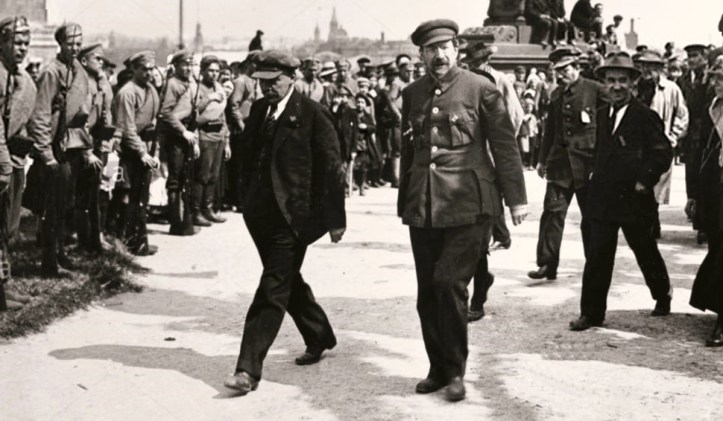
Lunacharsky remembers discussions with Lenin over a 1918-19 campaign to erect public monuments, many temporary, dedicated to past revolutionaries, artists, and historical figures.
‘Lenin on Propaganda Through Monuments’ (1933) by Anatoly Lunacharsky from International Literature. No. 1. January, 1939.
A decision of the Council of Peoples Commissars, signed by V. I. Lenin, chairman, which appeared in Izvestia August 2, 1918, declared that, “having considered the list drawn up by the Peoples Commissariat of Education of monuments to great people who have been active in the advancement of Socialism, revolution, etc.,” the Council had decided to give first place to the erection of monuments to the greatest of those active in the advancement of revolution, namely, Marx and Engels,” and “to include in the list of writers and poets the greatest of foreigners, such as Heine.”
The list as approved included, among outstanding revolutionaries, writers, poets, philosophers, savants, artists, composers and actors, the following: Spartacus, Liberius Gracchus, Brutus, Babeuf, Bebel, Lassalle, Jaurés, Lafargue, Marat, Robespierre, Danton, Garibaldi, Stepan Razin, Hertzen, Plekhanov, Fourier, Saint Simon, Robert Owen, Tolstoy, Dostoyevsky, Lermontov, Pushkin, Gogol, Belinsky, Chernyshevsky, Nekrasov, Shevchenko, Lomonosov, Mendeleyev, Kiprensky, Wrubel, Moussorgsky, Scriabin, Chopin, Mochalov and Komissarjevskaya.
Not many of Lenin’s statements, either direct or indirect, on the role to be played by art in the work of Socialist cultural construction and on the practical measures that might be taken in this field, have come down to us.
That is why I should like to call to mind the wonderful initiative shown by Lenin in the winter–if I am not mistaken–of 1918-19, initiative that produced fairly widespread results at the time, but was, unfortunately, afterwards neglected.
I take the greater pleasure in doing this since we are approaching times and conditions when the idea given us by Lenin then may be carried out with much greater success and on a far larger scale than during those first years of cold and famine the years of the Civil War. I cannot recall now on exactly what day it was (but this, no doubt, can be ascertained from the records) that Vladimir Ilyich sent for me. I shall endeavor to give the gist of our conversation in dialogue, though, of course, I cannot guarantee the accuracy of every word–there can be no question of this now–but I can answer for the general line of the conversation and the sense of it. “Anatoli Vassilyevich,” said Lenin, “we have probably a fair number of artists who are able to produce something and who are, no doubt, in extremely poor circumstances.”
“Of course,” I agreed, “both in Moscow and in Leningrad there is no lack of artists of that kind.”
“I am talking of sculptors,” Vladimir Ilyich went on, “and to a certain extent, perhaps, of poets and writers. The idea I am about to explain to you has been in my mind for some time. You remember that Campanella says in his City of the Sun that the frescoes which decorate the walls of his imaginary Socialist city serve as an object lesson to youth in natural science and history, rouse their sense of citizenship and, in short, play a part in educating and bringing up the younger generation. It seems to me that this notion is far from naive and might, with certain modifications, be adopted by us and put into practice now.”
To tell the truth, these introductory remarks of Vladimir Ilyich’s appealed to me immensely. In the first place, the question of Socialist commissions for artists was one in which I took an acute interest. Funds there were none, and my arguments to convince the artists of the gain to them if they were to cease working for a private market and work for the State naturally remained to be proved.
And the idea of directing and using art for such a lofty purpose as the propaganda of our great ideas struck me at once as extraordinarily tempting.
“This, that I am thinking of,” Vladimir Ilyich continued, “I would call propaganda through monuments. For this you would have to come to an agreement first of all with the Moscow and Leningrad Soviets, and at the same time organize your artists and select suitable sites in the public squares. Our climate will hardly permit us the frescoes of which Campanella dreamed. That is why I speak, for the most part, of sculptors and poets. On suitable sites, on walls that lend themselves to the purpose, or buildings specially designed for it, we might have brief but telling inscriptions expressing the root principles and slogans of Marxism, and also, perhaps, well-knit formulae, summing up great historical events. But please do not think that I have in mind just now marble, granite and gilt lettering. At present we must do things in a modest way. Let us have concrete slabs with the clearest possible inscriptions on them. I am not thinking yet of eternity, or even of any great length of time. Let it all be temporary.
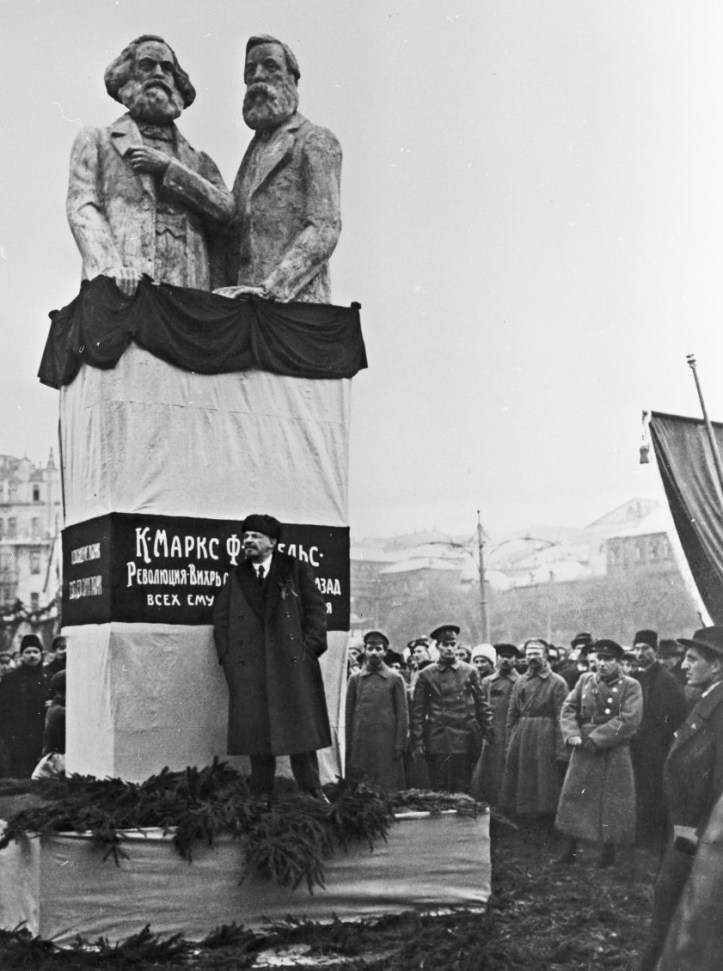
“I regard monuments as still more important than inscriptions: We might have busts, figures, and, perhaps, bas-reliefs and groups.
“Lists should be drawn up of those forerunners of Socialism, or of those theoreticians of Socialism and those who struggled for it, and also of those lights of philosophic thought, science, art and so on, who, though they may have had no direct bearing on Socialism itself, were, nevertheless, genuine heroes of culture.
“Take a list like this and commission the sculptor to make temporary monuments of plaster, even, or of concrete. The important thing is that they be understandable to the masses, that they catch the eye. It is important, too, that they be durable enough to stand our climate, that they should not be liable to be spoiled by frost and rain. Of course, there should be short inscriptions on the pedestals explaining who and what is represented.
“Particular attention should be paid to the unveiling of these monuments. This is where we might come in and other comrades and, perhaps, important specialists–to make speeches. Let every unveiling be a piece of propaganda, a small holiday, and, afterwards, at jubilees, there might be a repetition, a reminder of the great person in question; always, of course, showing clearly the connection between him and our Revolution and its tasks.”
This project appealed to me immensely. We got to work at once upon carrying it into practice.
(From Literaturnaya Gazeta, Jannary 29, 1933.)
Literature of the World Revolution/International Literature was the journal of the International Union of Revolutionary Writers, founded in 1927, that began publishing in the aftermath of 1931’s international conference of revolutionary writers held in Kharkov, Ukraine. Produced in Moscow in Russian, German, English, and French, the name changed to International Literature in 1932. In 1935 and the Popular Front, the Writers for the Defense of Culture became the sponsoring organization. It published until 1945 and hosted the most important Communist writers and critics of the time.
PDF of full issue: https://www.marxists.org/subject/art/literature/international-literature/1939-n01-IL.pdf
 Revolution's Newsstand