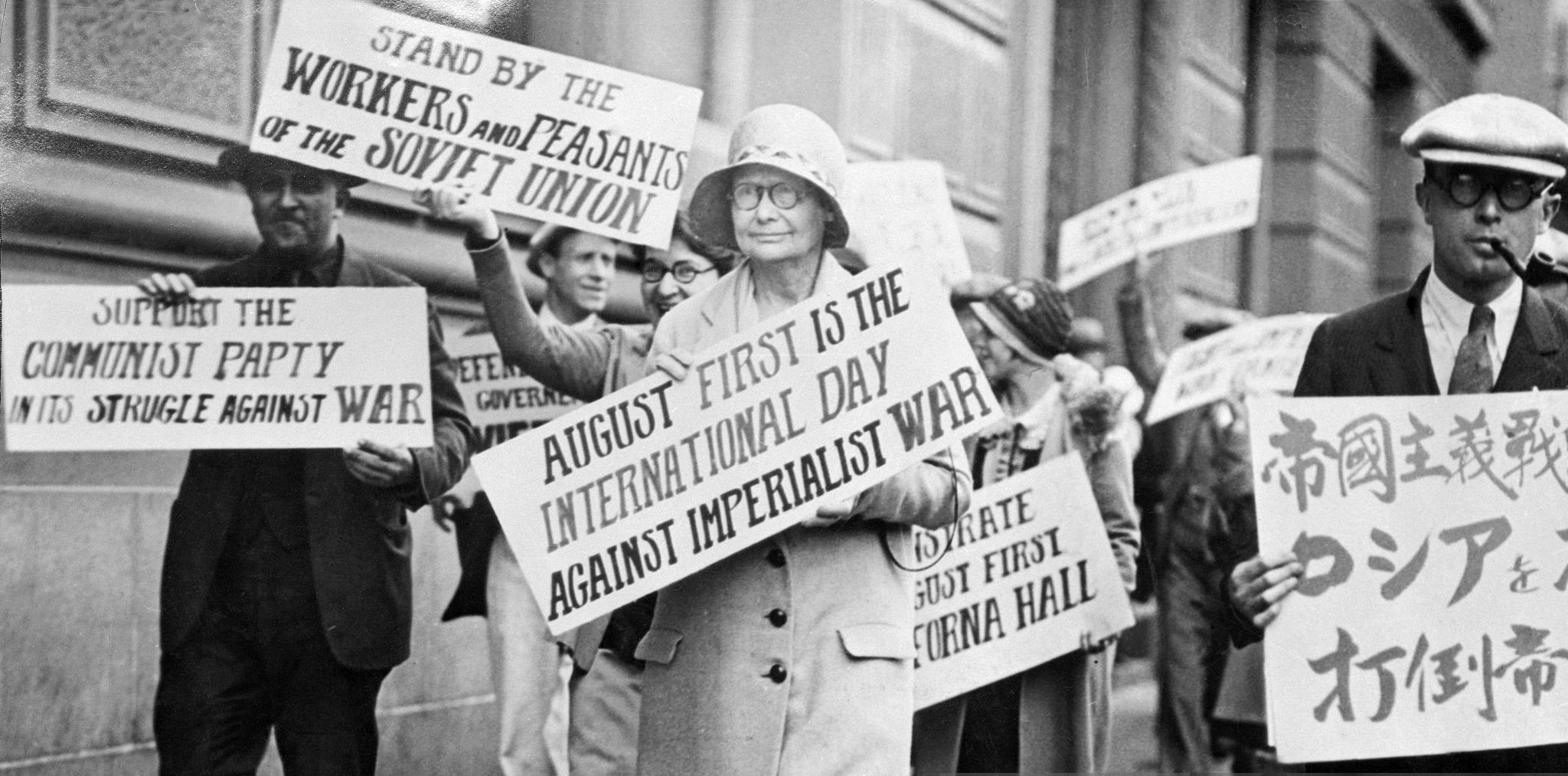
After nearly a decade, Whitney loses in court–but will soon win politically. Charlotte Anita Whitney was born into the Bay Area bourgeoisie in 1867 with a Supreme Court Justice in the family. Increasingly radicalized in her life, she joined the Socialist Party at the outbreak of World War One and was a key supporter of persecuted wobblies in California, and below she refuses to separate her case from theirs. In 1919 she became a founding member of the Communist Labor Party for which she was California state organizer. Arrested for ‘criminal syndicalism’ in 1919, she was convicted and sentenced to 14 years in prison. The appeals process went to the Supreme Court which took until 1927 to uphold the verdict. Then 60-years-old and a popular activist, Whitney was given an unconditional pardon by the California governor. Continuing her Communist activities, she was a founder of the San Francisco Workers School in 1934, ran for state office a number of times (receiving upwards of 100,000 votes), was arrested again in 1935, and in 1936 became State Chair of the Communist Party of California. Anita Whitney, class traitor, lived a remarkable life and died in 1955 at 87.
‘Anita Whitney Sentenced to San Quentin’ from Labor Defender. Vol. 1 No. 1. January, 1926.
California’s famous bastille, San Quentin, opened its jaws to receive another victim of the criminal syndicalism laws of the “Golden State” when the United States supreme court refused to accept jurisdiction in the appeal of Charlotte Anita Whitney, who was sentenced to serve from one to fourteen years imprisonment on a charge of membership in the Communist Labor Party.
Miss Whitney was convicted in 1920. The state supreme court upheld the decision of the lower court and the august body presided over by Mr. William Howard Taft concurred by evading the issue.
When the news of the supreme court decision reached the public, telegrams of encouragement began to pour into Miss Whitney’s home. Men and women prominent in bourgeois circles, who until now took a neutral position on the syndicalist law, see in the imprisonment of one of the most prominent women in California an incident that will bring widespread publicity unfavorable to the state.
Though the latest victim of the syndicalist law of California could avail herself of her social position to seek relief from the imposed sentence she refused to do so, but courageously takes her place with the scores of propertyless workers who are languishing in California’s dungeons.
Efforts were made in some circles to induce comrade Whitney to seek a separate pardon for herself arid to separate her case from those of the I.W.W. victims of the criminal syndicalist law. The International Labor Defense, which bases its activity on the class struggle, opposed this policy. We declared that the attempt to get special consideration for comrade Whitney because of her prominence and influential friends would blur the real issue involved and weaken the struggle for the repeal of the criminal syndicalist law and the release of its victims.
On November 3 the National Office of the I.L.D. sent out the following circulars on the question:
November 3, 1925. TO ALL SECRETARIES IN CALIFORNIA:
Policy on Anita Whitney Case.
Dear Comrades:
The refusal of the Supreme Court to overrule the conviction of Comrade Anita Whitney has provided a basis for a new campaign against the California criminal syndicalist law, and for the release of its victims. A number of our locals have recognized this fact and have commenced agitation on this ground.
The proposals which have been made for Comrade Whitney to seek individual pardon because of her prominent and influential friends has raised the question of policy which must be settled. The policy of the I.L.D. is set forth in the following telegram to Comrade Manya Reiss, secretary of the I.L.D. local of Los Angeles:
“Our policy on Whitney case to use it as basis for agitation unconditional release Whitney and all other victims criminal syndicalist law and for repeal this law. Not opposed in principle asking for pardons but would be wrong to make special appeal for Whitney and make distinction between her and I.W.W.s. because she has prominent influential friends. On contrary we should take these advantages in her case to help I.W.W. All demands for release Whitney should be coupled with demand for release I.W.W.’S.”
The I.L.D. is a class struggle organization and is decidedly opposed to a line of action which would obscure the fact that the criminal syndicalist law is aimed at the workers’ movement, or which would draw in a line between Comrade Whitney and the members of the I.W.W. who languish in California prisons as victims of this law.
On the contrary, we believe that the case of Anita Whitney could be directly connected with them, and that we should take advantage of the prominence and publicity given to her conviction to again bring the case of the I.W.W. prisoners before the workers of California, and arouse them to protest in their behalf.
Comrade Whitney herself has taken this stand. She has endeared herself to the class-conscious workers by her refusal to separate herself from the working men in the California prisons who had been convicted under the criminal syndicalist law.
In her first public declaration after the action of the Supreme Court, she said,
“Let the governor release those men from prison and not concern himself with a woman who has the thousands of influential friends that I have. He has had a longtime to pardon the others, the poor men without influence, who are in San Quentin on the same charges that I am guilty of.”
The I.L.D. believes that Comrade Whitney has taken the right stand, and that her action will inspire the class-conscious workers of California to a renewed struggle against persecution on the basis of the class struggle.
The branches and members of the I.L.D. in California should put all their energy into the work of organizing a campaign of protest and publicity, utilizing the prominence given to the case of Comrade Whitney. They should conduct a campaign by means of mass meetings, demonstrations, publicity, and resolutions from labor organizations under the slogan of:
“UNCONDITIONAL RELEASE OP ANITA WHITNEY AND ALL OTHER VICTIMS OF THE CRIMINAL SYNDICALIST LAW”
and
“REPEAL OF THE CRIMINAL SYNDICALIST LAW” Fraternally yours,
James P. Cannon. Executive Secretary.
Telegrams requesting a pardon for Miss Whitney have poured into to Governor Richardson from many organizations and prominent individuals. A delegation from the American Civil Liberties Bureau sought an interview with Richardson but he refused to discuss the case
Labor Defender was published monthly from 1926 until 1937 by the International Labor Defense (ILD), a Workers Party of America, and later Communist Party-led, non-partisan defense organization founded by James Cannon and William Haywood while in Moscow, 1925 to support prisoners of the class war, victims of racism and imperialism, and the struggle against fascism. It included, poetry, letters from prisoners, and was heavily illustrated with photos, images, and cartoons. Labor Defender was the central organ of the Scottsboro and Sacco and Vanzetti defense campaigns. Editors included T. J. O’ Flaherty, Max Shactman, Karl Reeve, J. Louis Engdahl, William L. Patterson, Sasha Small, and Sender Garlin.
PDF of full issue: https://www.marxists.org/history/usa/pubs/labordefender/1926/v01n01-jan-1926-LD.pdf
 Revolution's Newsstand