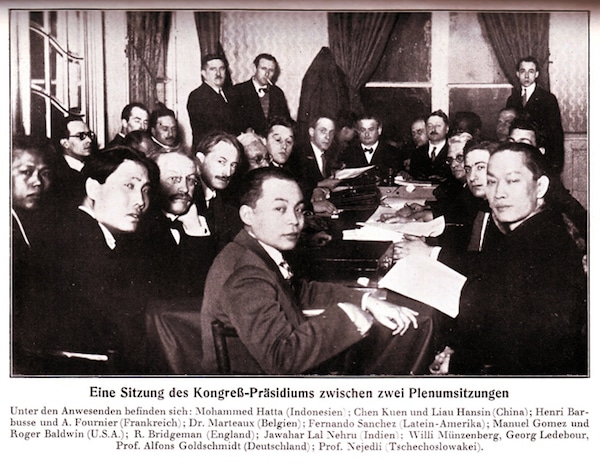
Manuel Gomez, delegate from the All-American Anti-Imperialist League begins his series of reports from the founding conference of the League Against Imperialism held in Brussels on February 10, 1927. Called by the Communist International, the meeting gathered 175 delegates, the majority from the colonial world and its liberation movement. Aside from Communists, representatives from the Kuomintang (soon to violently leave the alliance with the CCP), The Indian National Congress (including Nehru), the African National Congress (by its President, Josiah Tshangana Gumede), and Albert Einstein. The role of Zionism was a major debate, with Poale Zion being expelled from the Congress as having politics incompatible with anti-imperialism. The League never attained its aspirations and did not survive the Popular Front, however its efforts remain a milestone in the international struggle against imperialism. Additional reports to follow.
‘Delegates from Subject Nations and Brussels Planned Freedom’ by Manuel Gomez from The Daily Worker. Vol. 4 No. 48. March 10, 1927.
The article printed below is part of a series written by the delegate of the All-America Anti-Imperialist League to the Brussels Congress Against Colonial Oppression and Imperialism. The congress was made up of delegates from anti-imperialist organizations, peace societies and labor unions in the European, American arid other imperialist nations, from labor bodies and nationalist organizations in the colonial countries, and from subjugated races even in countries with full sovereignty.
Important resolutions were passed, for the practical carrying on of the work of freeing conquered peoples from their slavery. A survey of the work of the congress and the personalities attending, which have made it one of the great events of this era, will be found in these articles.
BRUSSELS, Feb. 11 (By mail, delayed). The long-hoped-for and long-dreaded coming together of oppressed peoples with workers of the oppressing nations has become a world-wide reality.
Upwards of 180 delegates—white, yellow, black and brown—from no less than 40 different countries, make up the first world congress against imperialism, which opened its sessions here last night in the Egmont Palace. The overwhelming majority of the delegates come from colonial and semi-colonial countries. Some have left the field of battle to be present here.
Invited Crowds.
Although admission was strictly by invitation, the great hall of the palace as crowded with spectators as S.O. Davies, of the executive committee of the Miners’ Federation of Great Britain, rose to call the congress to order. In the seats reserved for delegates the yellow race was especially in evidence, the impressive Chinese delegation of 30 being flanked on either side by the delegation from Korea and from French Indo-China. Behind them were the delegates from the Dutch Indies, Persia, the Riff, Holland, Germany and France. Across the aisle were the representatives from India, Egypt, Senegal, South Africa, Latin America, Great Britain, France and the United States.
Barbusse Greets Fighters.
After a brief welcome by Dr. Marteax of the Belgium Chamber of Deputies, Henry Barburse took the revolutionary floor amid a tremendous outburst of applause.
“In extending a fraternal salute,” began the famous French author, “to all those who have come here from the far corners of the earth, representing uncounted multitudes of human beings, I say to you: you are not men who come here only to fraternize with each other, to clasp hands; you are also fighters who come to organize for struggle. You are going to carry forward in the world the old cry of freedom, the cry of emancipation of all races, peoples and classes of the oppressed.”
Fight Imperialism.
Barbusse, who left his sick-bed to attend this congress, was applauded tumultuously throughout his long speech. He dwelt with particular emphasis upon the heroic struggle of the Chinese people against imperialism. The Chinese situation, indeed. sets the keynote for the entire congress. Telegrams of greeting were read from Mrs. Sun Yat Sen, from the central committee of the Kuo Min Tang party and from the Chinese revolutionary armies. Liao, the delegate of the Kuo Min Tang, then rose to speak.
Till Victory Comes.
Liao affirmed the determination of the Chinese people to fight until complete victory is won.
“The overthrow of imperialism.” he declared, “is a task to which all oppressed groups must set themselves. The significance of this congress is that it brings us together, enables us to pave the way for fruitful collaboration against our common enemy. I am especially glad to see represented here organizations of workers in the imperialist countries. If the workers are content to serve the aims of imperialism they will unconsciously, play into the hands of their own oppressors, for it is not the workers who rule in the imperialist countries but the enemies of the workers.
Protest Helps Chinese.
“I want to thank the European working class,” he went on, “for their magnificent campaigns of protest behalf of the Chinese people. I thank especially the workers of England and of Australia, and also the nationalist movement of India for its stand against the use of Indian troops in China. Lastly, I want to pay homage to the workers’ and peasants’ government of Soviet Russia, which has shown itself the true friend of oppressed peoples throughout the world.”
Oppressed Asia Speaks.
Other speakers included Jawahar Lal Nehru, representing the Indian National Congress; Sen Katayama, the famous Japanese revolutionist; Kin Fa Lin, of Korea; Carlos Quijano, representing the Revolutionary Nationalist Party of Venezuela, South America; and A. Fenner Brockway, secretary of the Independent Labor Party of Great Britain.
Brockway Promises New Policy.
Brockway, who spoke last, expressed discontent with the colonial policy of Great Britain during the MacDonald government and declared. that large numbers of his party’s members are determined that when labor next comes to power in Britain it will follow a different policy. “I am particularly ashamed.” he said, “of the Bengal ordinances.” He stated explicitly that his party. which he is representing officially at this congress, is opposed to the British war maneuvers against China and is in favor of immediate recognition of the Cantonese government. In conclusion he pledged his party to insistence upon the immediate recall of British military forces from Shanghai, militant and unyielding opposition to any attempt at war and consistent support of the Chinese struggle for freedom. “If war breaks out,” he said, “we shall be on the side of China, and against England.” He shook hands with the Kuo Min Tang representative, Liao, greeting the entire congress in the name of the I.L.P.
It is expected that the congress will last four or five days. The agenda is as follows:
Agenda.
1. Opening addresses.
2. Imperialism and its consequences in the colonial and semi-colonial countries.
3. Imperialism and the danger of wars.
4. Co-operation between the national liberation movements in oppressed countries and the labor and the labor and anti-imperialist movements in the imperialist countries.
5. Co-ordination of the national emancipation movements with the labor movements of all countries, colonial as well as imperialist.
6. Establishment of a permanent world-wide organization linking up all forces against imperialism and colonial oppression.
Committees have been named to deal, respectively, with the problems of struggle against British, French, American and Japanese imperialism. Each of these committees includes representatives from the imperialist countries as well as from the colonies and semi-colonies.
The presiding committee of the congress, as finally selected, is made up as follows:
Honorary chairmen: George Lansbury, M.P.; Professor Albert Einstein, Romain Rolland and Mrs. Sun Yat Sen.
Chairman: Edo Fimmen, secretary of the International Federation of Transport Workers.
Committeemen: China–Liao, Kuo Min Tang; Chen Kuen, All-China Federation of Trade Unions. Mexico–Julio A. Mella, representing the National Peasants’ League; Ismael Martinez, Tampico central labor body. Porto Rico–Jose Vasconcelos (former Minister of Education in Mexico, who has credentials from the Nationalist Party of Porto Rico). Japan–Sen Katayama. Egypt–Mohammed Hafiz Ramadan Bey. South Africa–Daniel Colraine, vice-president of the South African Trade Union Congress. Dutch East Indies–Mohammed Hatta and Semaoen, of Srakat Rayat. India–J.I. Nehru. North Africa–Messali, of Algeria. Persia–Achmed Assadoff, of the Persian Revolutionary Republican Party. Korea–Kin Fa Ling. France–Madame Duchene, Women’s League for Peace and, Freedom; Albert Fournier. Senegal Lamine Senghor, Great Britain–S.O. Davies; A.F. Brockway; Harry Pollitt, of the Minority Movement; R. Bridgeman. United States– Roger Baldwin, representing the Urban League and the American Civil Liberties Union; Manuel Gomez, All-America Anti-Imperialist League, Germany–Prof. Theodor Lessing; Prof. Alfons Goldschmidt; George Ledebour; Willi Munzenberg; Dr. Helene Stocker. Italy–Verri; Miglioli. Holland Henrietta Roland-Holst. Czechoslovakia–Prof. Nejedly. Belgium–Georges Gerard; Dr. Marteax; P.H. Spaak.
The Daily Worker began in 1924 and was published in New York City by the Communist Party US and its predecessor organizations. Among the most long-lasting and important left publications in US history, it had a circulation of 35,000 at its peak. The Daily Worker came from The Ohio Socialist, published by the Left Wing-dominated Socialist Party of Ohio in Cleveland from 1917 to November 1919, when it became became The Toiler, paper of the Communist Labor Party. In December 1921 the above-ground Workers Party of America merged the Toiler with the paper Workers Council to found The Worker, which became The Daily Worker beginning January 13, 1924.
PDF of full issue: https://www.marxists.org/history/usa/pubs/dailyworker/1927/1927-ny/v04-n048-NY-mar-10-1927-DW-LOC.pdf
 Revolution's Newsstand