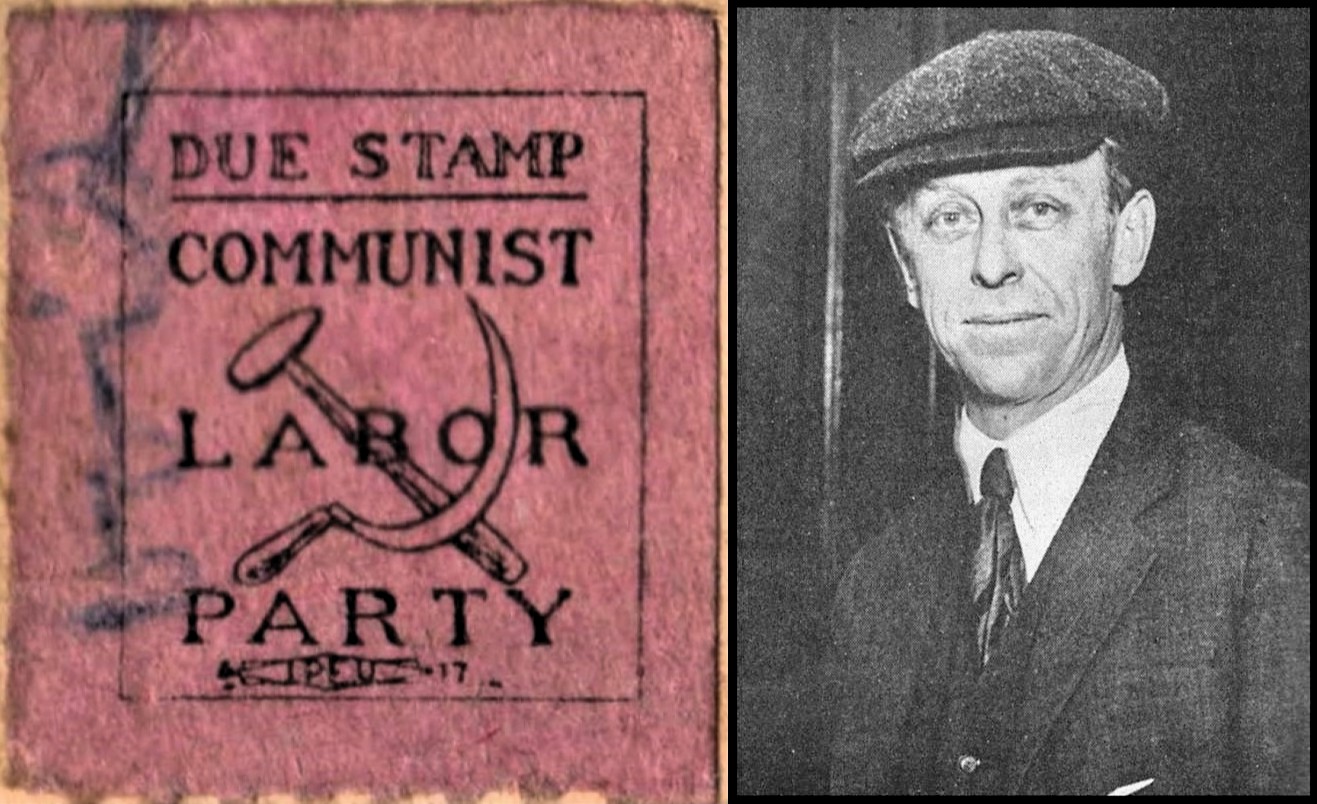
William Bross Lloyd’s first-person account of the formation of the Communist Labor Party will be of interest to all students of the U.S. left. The split in the nascent U.S. Communist was consummated even before its launch, with the large majority, mainly grouped around the Language Federations and led by Louis Fraina held no hope for the Socialist Party and wished to constitute itself immediately. While those grouped around John Reed and Alfred Wagenknecht favored an attempt to win the Socialist Party for Communism, where a majority of activists had recently voted for the Left Wing. After failing to win the leadership of the stacked and undemocratic 1919 Emergency Convention, the C.L.P. tendency, leaning syndicalist and Midwestern, withdrew and held a rival conference to both the S.P. and the Communist Party of America. The C.L.P. only lasted eight months before joining with Charles Ruthernberg’s C.P.A. dissidents to form the United Communist Party. It would not be until late 1921 that the majority of Third Internationalist would find themselves in a common, officially recognized Communist Party.
‘Convention Impressions’ by William Bross Lloyd from The Class Struggle. Vol. 3 No. 4. November, 1919.
On the morning of August 30th, as I came into the building where the Socialist Party Emergency Convention was to be held, I met a crowd of delegates coming down from the convention hall. They were the left wing delegates thrown out of the hall by the police acting under order of Adolph Germer and Julius Gerber. They were nearly all contested on one flimsy pretext or another with Adolph Germer as chief detective in charge of frame-ups, prosecuting attorney, court bailiff, Judge, Jury, jailor, and hangman. For instance, in the case of Minnesota, Germer made a special trip to Minneapolis to direct the State Executive Committee in arranging a delegation to contest the seats of those elected by membership referendum and Germer, making up the roster of delegates, seated the contesting delegation he created. No delegate could get into the convention hall on credentials signed by his state officials. A special card of admission had to be procured from Germer’s minions in the National Office. The card was white, historically symbolic of the work of Finland’s White Guard and her bloody fields and streets, of Berlin’s streets red with workers’ blood spilled by our “comrades” Scheidemann, Ebert, and Noske; symbolically prophetic of the part for which the Socialist Party of America has cast itself. Later, in the convention, in response to a question I could not hear, the chairman, “Comrade” “Seymour Stedman Noske,” raised his impassioned voice above the tumult: “Chief of Police Garrity has his orders and when the time comes, he will obey them.” One cannot help wondering whether the police who shortly before beat up the striking I.W.W. restaurant workers were also following Comrade “Noske’s” orders. Truly, when the police cooperate with our “comrades” and take their orders, the revolution must have come to pass. It behooves all revolutionary Socialists to watch for and extirpate all efforts at counter-revolution.
This use of and co-operation with the police is a notable instance of “socialist” participation in the class struggle. But under which flag? The dozens of handsome, expensive flags of the capitalist government of the United States decorating the convention hall, put there by those in charge of the convention, not those owning the hall, the two scanty strips of cheap red cloth so stretched as to be almost hidden, gave eloquent answer.
California’s delegates were contested. The State Executive Committee had voted unanimously to take the vote of the expelled federations, tabulating that vote separately. A scheme of preferential voting was also adopted, which caused some confusion, some marking their ballot simply with a cross instead of properly with numbers. But excluding all federation and other improperly marked ballots, the delegates were overwhelmingly elected. No contesting delegates were present, the contest resulting from a letter from two members of the State Executive Committee defeated in the election for delegates. The contest committee, with a Judge for chairman, its members mainly lawyers, was hostile. Its queries were like an examination before the Bureau of Investigation, Department of Justice, or government cross-examination of a defendant in an espionage law trial. Do you believe; do you think; will you be bound by the acts of the convention? Note what was done. The vote tabulation showed votes from the Russian branch of San Francisco regularly counted. Ha! Contempt of the National Executive Committee and its order expelling the Federations and ground for exclusion. But no, it developed the branch had a regular branch charter nearly twenty years old. California’s delegates were Left Wing delegates. The committee therefore needed no grounds to justify its vote to exclude. True, the convention overturned the committee; true, the convention seated Minnesota—three hours before adjournment—when the delegates had worked for a week in the two other conventions.
Such matters do not alter the fact that the convention was packed. Packed by a process of eliminating all known left wing delegates, packed by delegations from Massachusetts, New York, and Michigan, which had delegates proportioned to a membership, most of whom had been expelled. The Michigan case is the most glaring example. Its seven delegates, the quota due its thirty-five hundred expelled members, represented actually one hundred and thirty-nine.
The resolutions, platform, and other documents I have not seen. It is not necessary. Any good scholar can write revolutionary phrases. As Boudin wittily remarked, “The convention will give you Moscow, so that they may keep control of Chicago.” The membership of the Socialist Party voted more than ten to one to join the Third International the convention refused. In spite of that the convention did not give Moscow, so absolute was the control of a little group of men bent on perpetuating their control and keeping their jobs. Reckless of aught else, they have killed the Socialist Party as a working class organization. Not that it will disappear. Controlled by its ruling clique, financed by capitalism, it will remain an interesting, well preserved mummy.
Of the Communist Convention, I saw nothing, nor have I seen its program. With the Left Wing Program as a model, with Ferguson and Fraina to write it, beyond doubt the program will be excellent. More than that is needed to make a revolutionary Socialist Party. What went into the making of the Communist Party eliminates it from that category.
The party is controlled by the Russian Language Federations, with a membership of thirty-five thousand out of a total of fifty-eight thousand party members—accepting their own figures. I admit it ill becomes an internationalist, a revolutionary Socialist, to complain of foreign control. That is not the point at all. If those Russian comrades scattered through the branches, mixed with the other members and acting through the branches, controlled the party, no one would, I think, object. Such is not the case. The control lies in the hands of Executive Committees through whom go the only avenues of communication. The Executive Committees to all intents and purposes are the Federation. They are a machine just as pernicious as the old S.P. National Executive Committee. That is the situation which is the fundamental cause of disunion today.
The other main elements of the Communist Party are the expelled state organization of Michigan and the followers of the National Council of the Left Wing. That council came out of the Left Wing Conference in June in which both Michigan and the Federations participated. This conference was called to formulate a statement of Left Wing principles, to form a council “for propaganda, securing and spreading information,” and to discuss “the crisis in the party and action thereon; the conquest of the party, for revolutionary socialism.” Not a word expressed or implied about forming a new party. As the Communists say in a communication to the Communist Labor Party Convention, “our convention is absolutely bound by the joint call.” Up to the assembling of the Conference, no one had thought of forming a new party. And yet the Michigan Federation crowd made a continuous persistent effort to stampede the convention for a new party. This, in spite of the fact that over a hundred delegates had come long distances, some twenty-five hundred miles, to consider something quite different. Bound? Bound by nothing except their imperious will to power. Defeated on the new party, nevertheless, the Federation-Michigan delegates remained in the conference ’til defeated on a question more important to them.
The conference seated the delegates elected by the Federation branches. Then the Federation Executive Committee demanded and secured the seating of delegates from their bodies. Later, when the National Council was being elected, the Federations, although doubly represented by delegates participating in the election, demanded that nine members to be elected by the Federation Executive Committees be added to the Council. Beaten on this proposition, they withdrew from further participation in the conference. It would seem these Russian gentlemen will only play when they can load the dice.
These Russian Federationists openly regard themselves as the only simon-pure “Bolsheviks” in the world—not even excluding Russia. Yet they broke from the Conference on a question not of principle but one of clique control. Yet they united with Michigan, a purely political parliamentarian non-Bolshevik organization, disbelieving in industrial unionism, industrial organization of working class political power, and in mass action. All through July the Federations were maligning the Left Wing Council as centrists, as a fetid swamp. Meanwhile, the Council was maligning Michigan as parliamentarian and non-Bolshevik and both Michigan and the Federations as petty political intriguers.
The National Council was elected under carefully drawn instructions which made it an administrative, ministerial body and in no sense an Executive Committee with power to act on questions of policy. Those instructions were to organize to capture the S.P. at the Emergency Convention, and, failing that, afterwards to organize a Communist Party. The Council advertised for money to carry on that work. And in August, the Council publicly renounced the struggle to control the S.P. and joined with Michigan and the Federations in calling the Communist Convention. In so doing it violated its instructions and exceeded its authority and if any unexpended funds so secured by advertisement were expended in the Council’s new venture, these funds were misapplied.
That is the Communist Party: a faction of non-Bolsheviks, parliamentarians; a faction, the “only real Bolsheviks,” systematically seeking clique control by undemocratic methods; the Left Wing Council, violators of instructions and betrayers of the Left Wing Movement, the whole crowd petty political intriguers without principle, seeking simply power and the control of organization expenditure.

The first thing the Left Wing delegates to the Emergency Convention did was to appoint a committee of five to meet the Organization Committee of the Communist Party and later a like committee of the Communist convention for the purpose of seeking unity. Bound by the call of their convention—this time they wanted to be—the Communists could only admit delegates on a very narrow basis, which many of the Left Wing delegates, though elected by a referendum in their states, could not fulfill. The “Communists” would examine our roster of delegates and admit them as individuals whenever proper—just like Germer et al. Their communications cheerfully admitted that they were always and perfectly right, that they alone know anything, especially Communist principles and tactics. Their game was perfectly simple and perfectly apparent. They would have been only too glad to secure a considerable number of Communist Labor Party delegates to camouflage their gang-controlled convention with the semblance of being representative. But on no terms nor whatever be the cost—even to the splitting of American Communist elements—would they for one moment peril their control. So with a standing invitation for unity—not only to the Communists but to all other class-conscious, revolutionary working class bodies, the Communist Labor Party left that branch of their work. And rest assured, if unity comes, it will come because self-seeking politicians and their power of control have been eliminated.
I would be glad to represent the Communist Labor Party Convention as perfect. It was far from that. Often the longest way round through interminable debate was the shortest way out for it. Often it made mistakes, some of them glaring mistakes such as, for instance, when, having adopted a Communist platform, it elected an executive committee with a large non-Communist element upon it and had to go back and elect all over again. But, like all bodies controlled by the rank and file, no matter how inefficient, how ignorant, unwise, or mistaken they seem to be, the C.L.P. got to the right end at last. We had our disagreements, our personalities, our underhand attempts by parliamentary tricks to make the convention do something it didn’t believe in and would be sorry for.
There was at least one delegate—he actually got on the committee on International relations—who doubted the wisdom of affiliating with the Third International. He was also one of another and much larger group who made a fight against the Report of the Committee on Program and Labor and who actually succeeded inn postponing action on that report until a committee on platform had reported, as instructed, a “terse,” short platform in simple language suited to the worker and the platform had been acted on. This platform was so terse as to quite omit the Communist idea of political action and the necessity for the Dictatorship of the Proletariat to overthrow Capitalist power and accomplish the Socialist transformation of society. Many of the delegates were none too clear on the distinction between parliamentarism and revolutionary political action. The convention spent nearly half a day in debate. Those trying for a terseness so extreme as to cloud the issues were both vociferous and adroit, but in the end the Convention, by an overwhelming vote, amended the platform with a clear-cut, uncompromising statement of Communist principles and tactics. The politicians subsided or went home, and the Report of the Committee on Program and Labor quickly and quietly went through subject to the careful consideration it merited. The report was based on the Left Wing Program and Manifesto, improved both by the Committee and the Convention. Shortly, it will speak for itself to the workers of America.
I may be wrong in my opinion that the C.L.P. convention did good work. I may be wrong in my feeling that that party is the only one in America where the working class of America—the rank and file—can get a run for their money. But in this I am surely right: All this storm and stress in the Socialist or Communist—call it what you like—movement are nothing but labor pains. A new soul, a new life is coming into this world, the life and soul of the real revolutionary proletarian movement in America—a life and soul so strong and lusty that its first cry strikes terror to the heart of our ruling class.
The Class Struggle and The Socialist Publication Society produced some of the earliest US versions of the revolutionary texts of First World War and the upheavals that followed. A project of Louis Fraina’s, the Society also published The Class Struggle. The Class Struggle is considered the first pro-Bolshevik journal in the United States and began in the aftermath of Russia’s February Revolution. A bi-monthly published between May 1917 and November 1919 in New York City by the Socialist Publication Society, its original editors were Ludwig Lore, Louis B. Boudin, and Louis C. Fraina. The Class Struggle became the primary English-language paper of the Socialist Party’s left wing and emerging Communist movement. Its last issue was published by the Communist Labor Party of America. ‘In the two years of its existence thus far, this magazine has presented the best interpretations of world events from the pens of American and Foreign Socialists. Among those who have contributed articles to its pages are: Nikolai Lenin, Leon Trotzky, Franz Mehring, Karl Liebknecht, Rosa Luxemburg, Lunacharsky, Bukharin, Hoglund, Karl Island, Friedrich Adler, and many others. The pages of this magazine will continue to print only the best and most class-conscious socialist material, and should be read by all who wish to be in contact with the living thought of the most uncompromising section of the Socialist Party.’
PDF of full issue: https://www.marxists.org/history/usa/pubs/class-struggle/v3n4nov1919.pdf
 Revolution's Newsstand