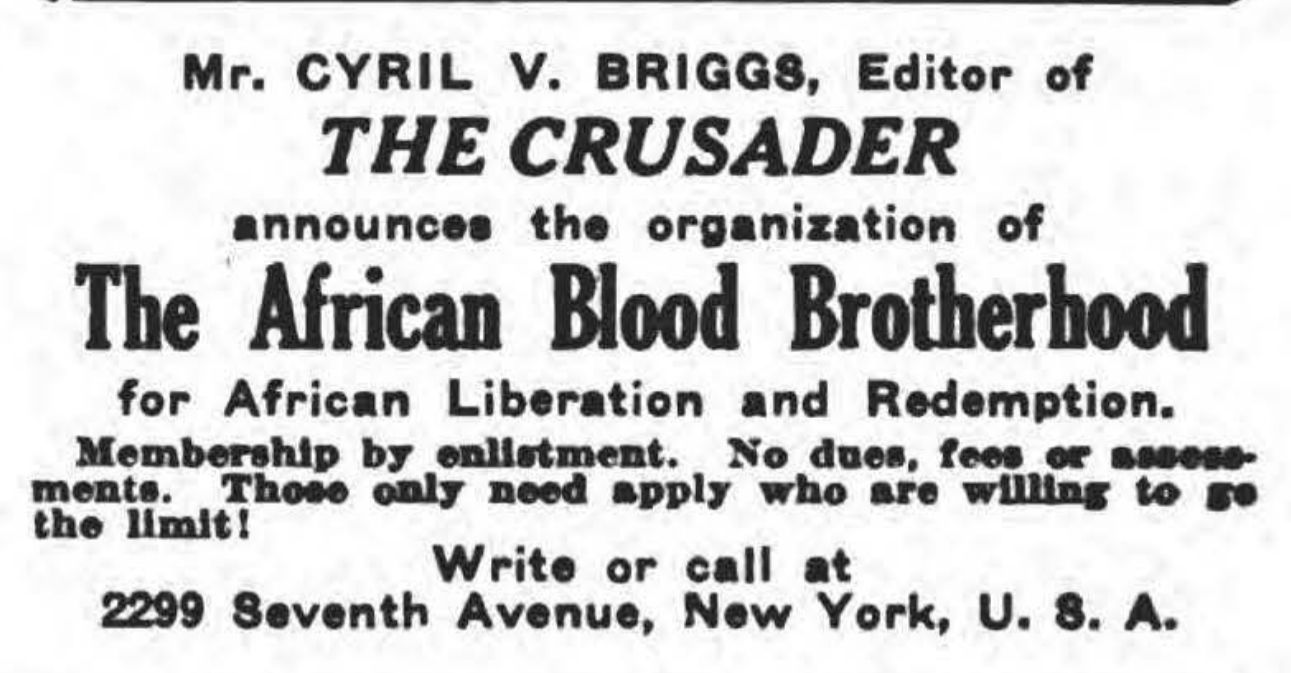
Cyril Briggs and the A.B.B. would move closer and closer to the Communist movement until formally joining when the above-ground Workers Party was formed in late 1921.
‘Bolshevism’s Menace: To Whom and to What’ by Cyril V. Briggs from The Crusader. Vol. 2 No. 6. February, 1920.
Of a truth, Bolshevism is a menace. That much is conceded alike by friend, foe and neutral. That is the chief motif of the tune that is constantly dinned into the ears of the Negro and the world in general. But just whom and what does Bolshevism menace? Is it not vital that we should know exactly against whom and what is directed this alleged threat of Bolshevism? Against the Negro and the rest of the workers, or against those who are exploiting the workers of the world and robbing the Negro group both of its labor and of its fatherland? If against us, should we not fight it, and if against the imperialist thieves of Europe, who are our foes, should we not be glad of its spread?
England and France and the rest of the piratical crew claim that Bolshevism is a menace to “democracy.” What “democracy”? The “democracy” in which an autocratic minority living in France and England rule and oppress “subject peoples” against their known wishes and legitimate aspirations and solely for the benefit of home industries and manufactures? The “democracy” which imposes its will upon weaker peoples by force and murders them when this alien superimposed will is questioned, as “democratic” England is doing today in Egypt, India, Persia, Mesopotamia, the West Indies and many other unfortunate countries, as “democratic” France is now doing in Morocco, West Africa and Indo-China? The “democracy” which exploits, under the murderous capitalist system, its own people, its weak women and young children? Is this the “democracy” to which the spread of Bolshevism is a menace? Then may God advance the spread of Bolshevism throughout Europe, Asia and Africa, and in every country where oppression stalks!
On the other hand, what is Bolshevism? Regarding it there are myriad lies, tales and rumors, but from what one can deduct from the testimony of impartial witnesses like Col. Robins and Mr. Bullitt it appears to be a system of government of the people, by the people and for the people, and under which the resources of the country, like the mines, the coal fields and water power, are owned and operated, as they ought to be, by the State. Under Bolshevism all persons are producers. There are no classes. All are workers. We are told that Bolshevism’s success in forcing the parasites to work lies in the fact that preference in rationing is given, and rightly, to those who produce, after, of course, the wants of the mothers, children and sick have been attended to. But this is the domestic side of Bolshevism and while a study of this side will do much to explain the phenomena now taking place in Russia, it is in the international side in which we are especially interested. What is Russian Bolshevism’s attitude toward the people of other countries, especially oppressed people like the Africans, Indians, and Irish?
Bolshevism in its international phase is feared by the capitalist-imperialist powers even more than they fear Bolshevism in its domestic operations.
Bolshevism, from the international standpoint, is totally different from, and wholly opposed to imperialism. In fact, one of the first acts of Soviet Russia was the renunciation of the imperialistic claims of Czarist Russia on the territory and destiny of the people of Persia, thus repudiating the part played by old Russia with Great Britain in the strangling of Persia. Soviet Russia has gladly and promptly recognized the right of self-determination of the peoples of Finland, Poland, the Ukraine and other parts of the former Russian Empire. The right to self-determination of even certain weak and so-called “backward” peoples in Asiatic Russia has been recognized by the Bolshevists.
Bolshevism so far, then, is in direct opposition and contradiction of the “principles” of “democracy” as those principles are applied by England in India, Africa, Ireland, and elsewhere, and by France in Africa and Indo-China. And it is to these “principles,” to this “democracy,” that Bolshevism is a menace. Like Wilson’s mistake in talking about the rights of “peoples great and small,” Bolshevism is setting a bad example to the enslaved populations under British and French rule. It is putting ideas extremely injurious to the masters in the heads of the African, Indian and Irish peoples. That Bolshevism is a direct menace (and is seen as such) to the lying wickedness of European eminent domain under guise of carrying “the white man’s burden,” is demonstrated by the following statement from a capitalist source:
“…and the triumph of Russian Bolshevism, as now constituted, means the victory of the doctrine of their allies, the I.W.W. in America, and the destruction of Great Britain’s power in India, in all other parts of Asia and in the Dark Continent.”
If Bolshevism will free the “subject races,” what should be the attitude of these races towards Bolshevism?
The New York Sun, in an editorial comment on the overwhelming defeat of Kolchak, Denikine and other anti-Bolshevists, also lets the cat out of the bag in these two paragraphs:
“And so now Lenine and his disciples are turning their faces eastward as to the land of promise. Mohammedan hostility against the European rulers that hold so much of Islam in bondage is to be the great means of spreading Bolshevism throughout Asia.
“Already Great Britain becomes anxious. She realizes that the new Russia offers a menace to her power in the East not less than that of the former Czar. But what means she will take to prevent the threatened overflow of radicalism from the north into Persia and India remains to be seen. That she must act at once, however, is becoming evident to all.”
And in these confessions and indiscreet comments of the capitalist press, in this anxiety of the chief enslaving powers, we have the answer and the truth as to who and what Bolshevism menaces.
The Crusader was published in New York City between 1918 and 1922, becoming the paper of the The African Blood Brotherhood for African Liberation and Redemption and the earliest Black Communist publication in the US. Founded by Cyril V Briggs, who had arrived to the city from the Caribbean in 1905, at first it was the journal of the Hamitic League of the World, a Pan-African group led by George Well Parker. Increasingly in sympathy with the Russian Revolution and new Communist International, in October 1919 the paper announced the African Blood Brotherhood and its adherence to Marxism. In June 1921, The Crusader officially became the journal of the ABB and the Black publication of the US Communist movement. Antipathy with Marcus Garvey’s movement led the Communist Party, at the insistence of Claude McKay, to withdraw support and Its last issue was in January, 1922. The African Blood Brotherhood with dissolve into the Workers Party of America with many activists joining the American Negro Labor Congress in 1925.
PDF of full Issue: https://www.marxists.org/history/usa/pubs/crusader/v2n06-feb-1920-crusader-r.pdf#page=5&zoom=140,-171,650
 Revolution's Newsstand