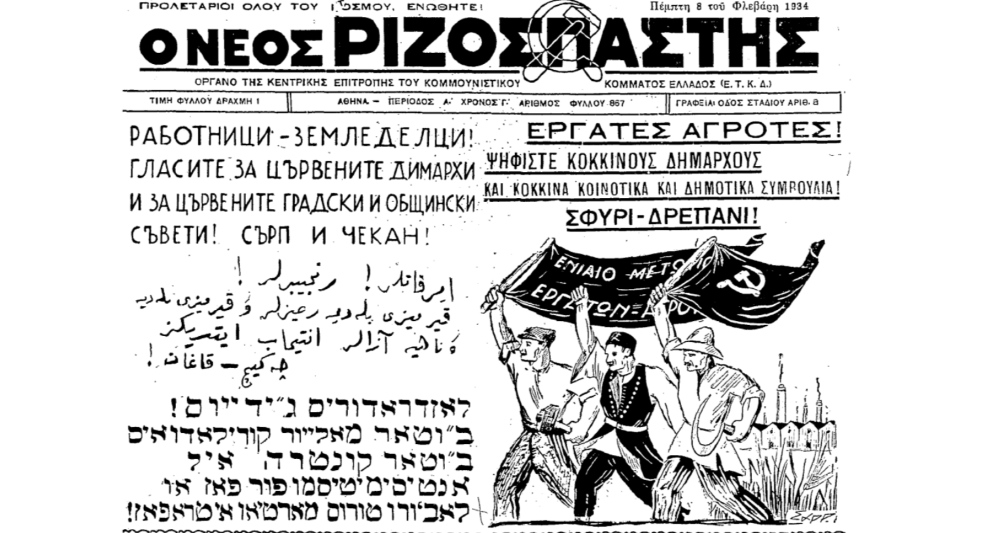
A precursor to Greece’s Civil War, the 1930s fights between right and left and the role of the government are explained by a major figure in early Greek Communism, editor of Rizospastis, Karagiorgis would later play a central role as Communist military leader in the anti-Nazi Resistance and Civil War.
‘Fascism and Anti-Fascism in Greece’ by Kostas Grypos (Karagiorgis) from International Press Correspondence. Vol. 14 No. 42. August 3, 1934.
Throughout the whole post-war period in Greece there has never been a purely parliamentary democracy in existence because both the army and the navy were always more or less directly a weapon in party politics, whilst the beginnings of fascism in the State apparatus accompanied the Greek Republic from the moment it left its cradle in 1924.
Greek democracy managed to keep its feet, though uncertainly, but this modicum of success was purchased at the price of democracy. Venisélos developed his parliamentary power into a five-year parliamentary dictatorship and encouraged the development of fascism in the State apparatus with his notorious anti-Communist law, the legal gagging of the State officials, the active support of the fascist bands, etc. The successor of Venisélos, the government of the people’s party of Tsaldaris, of General Kondylis, General Metaxas and Admiral Chadyikyriakos, did its utmost to further this development of fascism in the State apparatus at an intensified speed.
Under Tsaldaris the anti-Communist law was used energetically and its provisions were made even more rigorous by a series of amendments facilitating the banishment of revolutionaries, practically abolishing the possibility of appeal against the sentence of banishment, placing all the banished men and women in a single concentration camp on a small island, concentrating all the banished Communists in one special fortress prison, stifling still further the revolutionary working-class press, and prohibiting all the revolutionary trade unions and all revolutionary organisations with the exception of the Communist Party itself, which is permitted at least to maintain its legal name, as this freedom is expressly provided for in the Greek Constitution. The working class and the State officials have had their wages and salaries still further reduced and their constitutional rights still further cut down.
Under Tsaldaris the fascist bands found the same protection and encouragement as they had been accustomed to under Venisélos. The fascist organisation E.E.E. (National Union of Greece), which was founded in 1928 by former officers, ex-soldiers and intellectuals, tried a march on Athens in July, 1933, and for this purpose the government supplied them with railway facilities. The failure of the march was due to the action of the working class of Athens, which lost two dead and suffered many wounded in the resultant fighting. The upshot of the struggle buried the hopes of the fascists to make their organisation into a mass one.
However, the intense economic crisis which affects all branches of the economic system and the State finances, the internal antagonisms in the camp of the bourgeoisie and the energetic resistance of the working masses under the leadership of its revolutionary advance guard, are compelling the regime of the capitalists and rich landowners in Greece to adopt an open fascist dictatorship. The efforts in this direction have taken two forms: on the one hand the preparations for a military fascist dictatorship connected with one group of the bourgeoisie or the other, and secondly, the attempts to found a mass fascist movement along Mussolini or Hitler lines to overthrow the old political world and create a new “non-party” national front.
The military fascist dictatorship has many sympathisers in Greece as in all other Balkan countries, because this form is the safest and is not likely to indulge in dangerous demagogic experiments, because it does not provoke the working masses to the same extent as open fascism, and because it facilitates the struggle of the capitalist groups behind it against their competitors. Thus we observe that both the government under Tsaldaris and the opposition under Venisélos are feverishly preparing their own brands of the military fascist dictatorship. The leaders of the Tsaldaris brand are to be Generals Kondylis and Metaxas, whilst the proposed leader of the Venisélos brand of the military fascist dictatorship is General Plastiras, who at the moment is in banishment. The officers corps in the army, navy and air force are ranging themselves around these two opposing camps. Amongst the masses, and particularly amongst the fugitive colonies, fighting organisations are already being formed and even armed to a certain extent, such as the royalist “Political Association” of Tsaldaris, and the “Democratic Guards” of Venisélos, etc. At least once a week Tsaldaris and General Kondylis threaten their enemies with the “dictatorship,” whilst in the press and in the senate the Venisélos supporters, who have boycotted parliament for weeks now, answer with the threat of civil war, should the dictatorship be proclaimed.
However, a one-sided military fascist dictatorship has the disadvantage that it does not set up any united bourgeois front against the masses of the working people and that as a result of the disruption in the camp of the ruling classes more and more toilers tend to go over to the camp of the Communists. For this reason serious bourgeois circles are beginning to call for an entirely new fascist mass movement to open up a new era of salvation for the Greek capitalists and rich landowners. About six months ago this desire was loudly expressed in the columns of the capitalist newspaper “Hestia.” Big bankers like Koryzis, Loverdos (the brother of the Finance Minister), high military officers like General Masarakis, the Greek Professor Dr. Luros, and many others, form the backbone of this movement and have already contributed ten million drachmas to a fund for the purpose. It is reported that the special shirts to be worn by the supporters of this new movement have already been ordered, but what the colour is to be is not yet known. An interesting factor is that the newspaper “Hestia” maintains the closest and most friendly relations to the British Embassy in Athens. It is well known that the British government is urgently interested in securing order and internal stability in Greece, and as its direct connections with the Venisélos party are not sufficient to obtain this aim, it is also supporting the foundation of this new fascist mass movement.
All these fascist and military-fascist attempts express the wish of the capitalists of Greece, but the final word of the working masses of Greece has not yet been spoken and the anti-fascist movement is spreading amongst the masses of the people. The Committee against Fascism and War founded at the initiative of the Communist Party (Amsterdam movement), together with the All-Greek Youth and Women’s Committee, succeeded within a few months in founding a strong anti-fascist mass movement. Not only all the left-wing unions, but many of the reformist unions, against the will of their leaders, a number of small tradesmen’s organisations, and almost all the organisations of the State officials, are taking an active part in the anti-fascist movement. Hundreds of intellectuals, including many doctors, lawyers and whole groups of students have openly signed the anti-fascist programme, a circumstance which caused the “Hestia ” to remark that the intellectuals of Greece seemed to have more to do with the police (as victims) than with the intelligentzia (the fascist capitalist brand).
The first anti-fascist congress was an alarm signal and mobilised tens of thousands of toilers all over the country, but at the last moment it was prohibited by the authorities. In defiance of the prohibition 2,500 delegates to the congress attempted to hold the congress. Fierce street fighting which lasted for hours took place and 400 delegates were arrested. A group of 210 delegates held a skeleton congress in a wood near Athens. Later on a number of them were arrested in Volo and Salonika on their return from Athens. The Youth Committee succeeded in holding its congress illegally, although the women’s conference was prohibited. The anti-fascist weekly newspaper “Anti-Fascistiko Metopo” and the illustrated anti-fascist newspaper “Anti-Fascistas” have both reached very large editions.
Although a series of strikes has been carried out with anti-fascist slogans, for instance, the strike of 1,400 boot and shoe workers in Athens, which was definitely a political and anti-fascist protest strike, the anti-fascist work in the factories is still insufficient and is not in accordance with the other anti-fascist activities. The Communist Party and the Committee against Fascism and War are therefore concentrating their efforts on improving the situation in the factories.
This growth and popularisation of the anti-fascist struggle has compelled a number of the big capitalist newspapers, such as the “Akropolis,” the “Anexartitos” and others which have worked up large circulations by anti-capitalist demagogy, to take up an anti-fascist line in order not to lose their subscribers. As a result these newspapers contained extremely sharp criticisms of the happenings of June 30. In general the happenings in Germany have made a deep impression on Greek public opinion and it is already clear that Greek fascism, if not killed, has at least been very seriously damaged as a result. Big governmental newspapers like the “Proia” wrote of “mediæval barbarism in Germany,” etc., whilst in a leading article the biggest oppositional newspaper “Elephtheron Vima” strongly advised the Greek people to keep clear of any such catastrophe as has been brought over Germany by Hitler fascism.
It is already possible to say that as a result of the development of the anti-fascist movement and as a result of the contradictions in the capitalist camp itself, the chances for a mass fascist movement in Greece have been considerably reduced if not completely destroyed. The fascist bands of the E.E.E., the monarchist yellow-shirts, and the Pangalos “Iron Peace” clique, are already in a state of disintegration, and the movement sponsored by the “Hestia” has not dared to show its face for months.
On the other hand, the danger of a military fascist dictatorship is growing. It is made all the more dangerous by the fact that its agents speak of everything, “the maintenance of law and order and the State authority” and so on, but never about fascism unless to condemn it. The anti-fascist working-class movement, under the leadership of the Communist Party, is opposing military fascism as it opposes fascism in general. It exposes the fascist nature of many of the “anti-fascist” slogans which are put forward particularly by the reformist, agrarian and Trotskyist leaders, and it popularises the slogan, “Fascism will not be permitted to succeed!” together with the slogan, “General Strike against military fascism!”
International Press Correspondence, widely known as”Inprecorr” was published by the Executive Committee of the Communist International (ECCI) regularly in German and English, occasionally in many other languages, beginning in 1921 and lasting in English until 1938. Inprecorr’s role was to supply translated articles to the English-speaking press of the International from the Comintern’s different sections, as well as news and statements from the ECCI. Many ‘Daily Worker’ and ‘Communist’ articles originated in Inprecorr, and it also published articles by American comrades for use in other countries. It was published at least weekly, and often thrice weekly.
PDF of full issue: https://www.marxists.org/history/international/comintern/inprecor/1934/v14n42-aug-03-1934-Inprecor-op.pdf
 Revolution's Newsstand