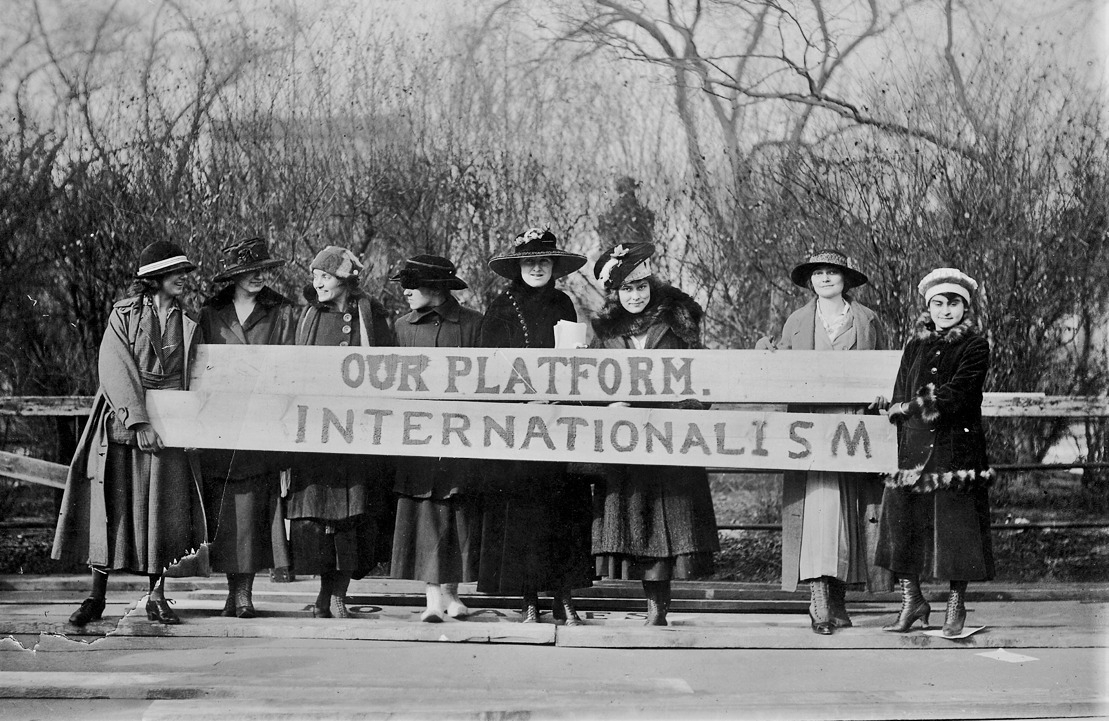
A statement by Eastman read at the First Feminist Congress in the United States held in New York on March 1, 1919. Sister of Max, Crystal Eastman was a writers, a feminist, editor of the Masses, founder and editor of the Liberator, President of the American Union Against Militarism, a left wing Socialist Party activist, founder of the Women’s Peace Party, and co-founder of the American Civil Liberties Union.
‘Feminism’ by Crystal Eastman from The Liberator. Vol. 2 No. 5. May, 1919.
FOR two years the whole western world has been talking about freedom and democracy. Now that the war is over and it is possible to think calmly once more, we must examine these popular abstractions, and consider (especially here in America where the boasting has been loudest)–how much freedom and democracy we actually have. Above all it behooves women to determine frankly what their status is in this republic.–
Four-fifths of us are still denied the elementary political right of voting.
Only one women has held a seat in the United States Congress. Only twenty-one women are sitting in our 48 state legislatures. With rare exceptions all the higher executive offices in both state and federal governments are, by law or rigid precedent, open only to men.
In only six states do women sit on juries. With half a dozen exceptions in the lower courts, there are no women judges.
In all government work, federal, state, county and city,–(notoriously in public school teaching),–women are paid much less than men for the same work.
In private industry, where it is estimated that twelve million women are now employed, the wages of women both skilled and unskilled (except in a few trades) are on a scale of their own, materially lower than the wages of men, even at work where their productive capacity is equal or greater.
Most of the strong labor unions, except in trades where women are in the majority, still close their doors to women workers.
Marriage laws in many states (including the guardianship of children) are designed to perpetuate the economic dependence of a wife on her husband. And nothing has been done in this country by way of maternity insurance or by giving to a wife a legal right to a share of her husband’s earnings in recognition of her services as houseworker and nurse, to modify that dependence. And the vital importance of potential economic independence has yet to become a recognized principle of modern education for girls.
Voluntary motherhood is an ideal unrealized in this country. Women are still denied by law the right to that scientific knowledge necessary to control the size of their families, which means that among the poor where the law is effective, marriage can become virtual slavery for women.
Laws, judges, courts, police, and social custom still disgrace, punish and regulate” the woman prostitute and leave uncensured the man who trades with her,–though in case of all other forbidden vices the buyer as well as the seller suffers if caught.
From this brief statement of facts it is fairly clear that women in America today not only share the wholesale denial of civil liberty which came with the war and remains to bless our victory, but carry a special burden of restrictive legislation and repressive social custom,–(not in any way relieved by the war for freedom nor affected by the two years’ crusade of democratic eloquence)–a burden which halts them in almost every field of endeavor, and effectually marks them as an inferior class. This This is stated without any bitterness and with full recognition of the fact that women by their passivity have made these things possible. But it is stated for a purpose.
It is my hope that this first Woman’s Freedom Conference, held in New York City, will see the birth of a new spirit in American women–a spirit of humane and intelligent self-interest–a spirit of determined pride–which will lead them to declare:
“We will not wait for the Social Revolution to bring us the freedom we should have won in the 19th century.”
The Liberator was published monthly from 1918, first established by Max Eastman and his sister Crystal Eastman continuing The Masses, was shut down by the US Government during World War One. Like The Masses, The Liberator contained some of the best radical journalism of its, or any, day. It combined political coverage with the arts, culture, and a commitment to revolutionary politics. Increasingly, The Liberator oriented to the Communist movement and by late 1922 was a de facto publication of the Party. In 1924, The Liberator merged with Labor Herald and Soviet Russia Pictorial into Workers Monthly. An essential magazine of the US left.
PDF of full issue: https://www.marxists.org/history/usa/culture/pubs/liberator/1919/05/v2n05-may-1919-liberator-hr.pdf
 Revolution's Newsstand