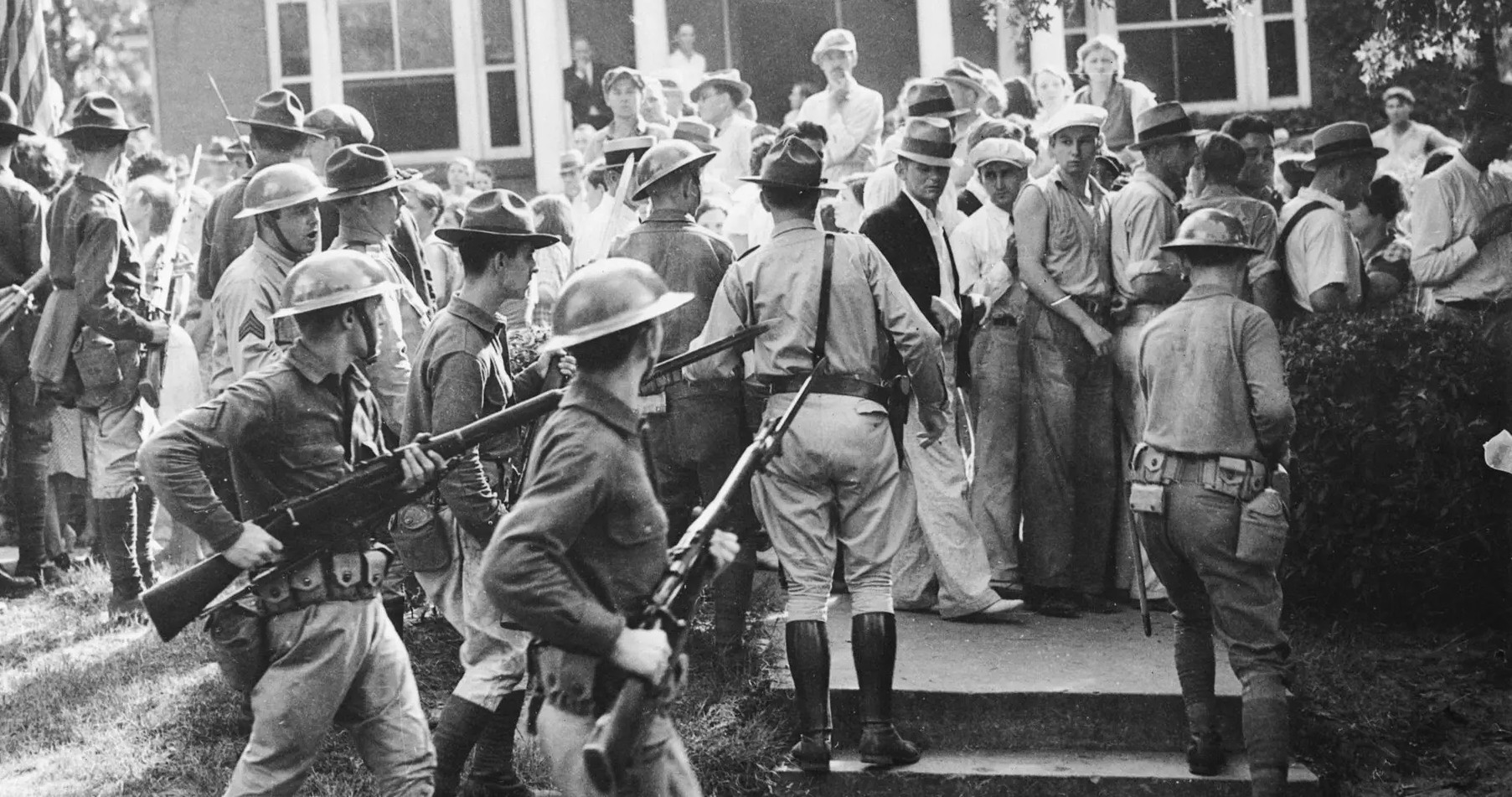
The Uprising of ’34. a mass, national textile workers strike, was both one of the largest U.S. labor mobilizations, with upwards of a million involved, and largest military mobilizations, with tens of thousands of National Guard troops ordered against civilian populations. Dozens were killed by police and guardsman in a struggle to unionize unorganized workers–largely in the south–the failure of which we are still paying for. A small glimpse into a corner of the three-week long fight from North Carolina.
‘New Guard Units Ordered To Battle North Carolina Strikers’ by Harry Raymond from The Daily Worker. Vol. 11 No. 223. September 17, 1934.
CHARLOTTE, N.C. Sept. 16. The calling of four additional National Guard units into the Gastonia, Belmont and Concord areas, the most militant centers of the textile strike in North Carolina, and the denial of a permit for the Communist Party to hold a mass meeting tomorrow in support of the strike on the Court House steps in Charlotte—these were the chief moves made over the weekend by the Southern mill owners against 250,000 textile strikers in these districts.
For the past two days the front pages of the local newspapers and the editorial columns have been sizzling with high-pitched hysterical attacks against the Communist Party. The Communist Party has announced it would hold a mass meeting on the Court House steps on Monday evening to protest against the use of troops and armed deputies against the strikers. Today the Charlotte News, in a two-column front page story, announces that local police will be used to stop the meeting.
Threatens Violence
“Communistic agitation and Mecklenburgian conservatism will face each other for a show-down on the Court House steps Monday evening at 7:30 o’clock, when the Reds announce they will speak there and the county government announces they will not,” says the “News.”
Threatening violence to the workers if they dare to exert their legal rights to hold the meeting, the “News” article continues: “Perhaps the rural police squad will turn the crowd back at the sidewalk, and in that case, of course, however much speaking there will be elsewhere, it will not be on the Court House steps.”
Permit for Meeting Denied
The permit to hold the meeting was denied by Henry B. Fowler, chairman of the County Commission. Paul Crouch, Communist Party organizer, in denouncing this flagrant refusal of the right of free speech and assemblage to the Communist Party, issued an appeal to workers through the country to wire protests to Commissioner Fowler in Charlotte and demand that the right to meet be granted to the workers of Charlotte.
“The Communist Party criticizes the action of the commissioners in refusing the Court House as being an action definitely placing them on the side of the mill owners against the striking textile workers and sympathizers,” Crouch told the press yesterday.
Determined to Meet
“The Communist Party will hold the meeting and will introduce a resolution against the use of National Guardsmen, and the reinforcements ordered out yesterday, and will demand that the funds which are being spent on the National Guard be used for relief of the striking textile workers.” Crouch charged that Howard Payne, assistant secretary of the North Carolina Strike Committee, was the first to denounce the flying squadrons and to “raise the red herring.”
“In doing so,” Crouch declared, “he is only trying to cover up his own reactionary policies. The red herring is used only by some who wish to have something to hide behind. An effort to split the ranks of the strikers on the basis of Party membership is an effort to weaken the strike.”
Troops Attack Pickets
During the weekend I made a tour of the strike front from Concord, N.C. to Greenville, S.C. I arrived in Concord shortly after the troops attacked a mass picket line in front of the Gibson Mill on Friday and arrested four strikers and held them on charges of inciting to riot.
Strikers in the union hall on South Union St. said that the attack started when workers marched from the hall to the Gibson mill, which was surrounded by guardsmen who had refused to allow a picket line to be formed.
“The fight lasted 30 minutes,” a striker explained.
Threw Bombs Back
“Soldiers led by Sergeant Flemmings put on their gas masks and rushed at us with their bayonets stickin’ out. Another one of the yellow dogs got down behind a machine gun and turned it toward us. Just then the yellow dogs began throwing gas bombs, but we got right smart ball players in our union and we caught the bombs and threw them back.
“The first gas candle that one of our men threw back landed in front of the machine gunner. He left the gun and ran like a blue streak, three others dropped their guns and followed him. Then one of our boys sat down behind the machine gun and hollered at us to go at ’em. And we sure did. We pushed the soldiers back and Sergeant Flemmings backed into one of the bayonets and was taken to the hospital.”
Tells How Women Fought
Another striker told how the women fought. “We’ve got women in this town with more guts than the men,” he asserted proudly. “You ought to see them grabbin’ those bombs and throwin’ them back.” The Daily Worker was everywhere in the strike hall. In every corner I saw strikers with the paper. A young textile worker, member of the Young Communist League, distributed 200 Daily Workers every day on the picket lines and in the hall.
All Gaffney Mills Shut Down
At the southern end of the strike-front, in Gaffney, S.C., where the once swanky Chamber of Commerce sign of “Welcome to Gaffney” has given up the ghost and collapsed at the southern entrance to the town, every mill is shut down. Pickets working in six-hour shifts patrol every entrance to the plants both day and night. “Net even a louse can get through these lines,” an overalled picket explained.
The only break in the whole strike-front came yesterday at Union, S.C., where U.T.W. leaders urged the workers to call off the strike and return to work on Monday. This section, which is commanded by John Peel, third vice-president of the U.T.W., is the weakest in the South, due to Peel’s efforts to halt all militant picketing and flying squadron activities.
Peel Balks at Unity
Yesterday Peel announced that he had refused an offer of the local Communist Party for united front action to strengthen the strike. Peel’s statement to the press said–
“In keeping with the policy defined by the National Strike Committee, this office has today declined an offer of assistance from a representative of the Communist Party.”
A huge mass-meeting was held in Gastonia this afternoon and was attended by workers from the Belmont area, which is struck 100 percent. Plans were worked out there for an intensification of mass picketing to meet increased efforts of the mill owners to open the mills on Monday.
The Daily Worker began in 1924 and was published in New York City by the Communist Party US and its predecessor organizations. Among the most long-lasting and important left publications in US history, it had a circulation of 35,000 at its peak. The Daily Worker came from The Ohio Socialist, published by the Left Wing-dominated Socialist Party of Ohio in Cleveland from 1917 to November 1919, when it became became The Toiler, paper of the Communist Labor Party. In December 1921 the above-ground Workers Party of America merged the Toiler with the paper Workers Council to found The Worker, which became The Daily Worker beginning January 13, 1924.
PDF of full issue: https://www.marxists.org/history/usa/pubs/dailyworker/1934/v11-n223-sep-17-1934-DW-LOC.pdf
 Revolution's Newsstand