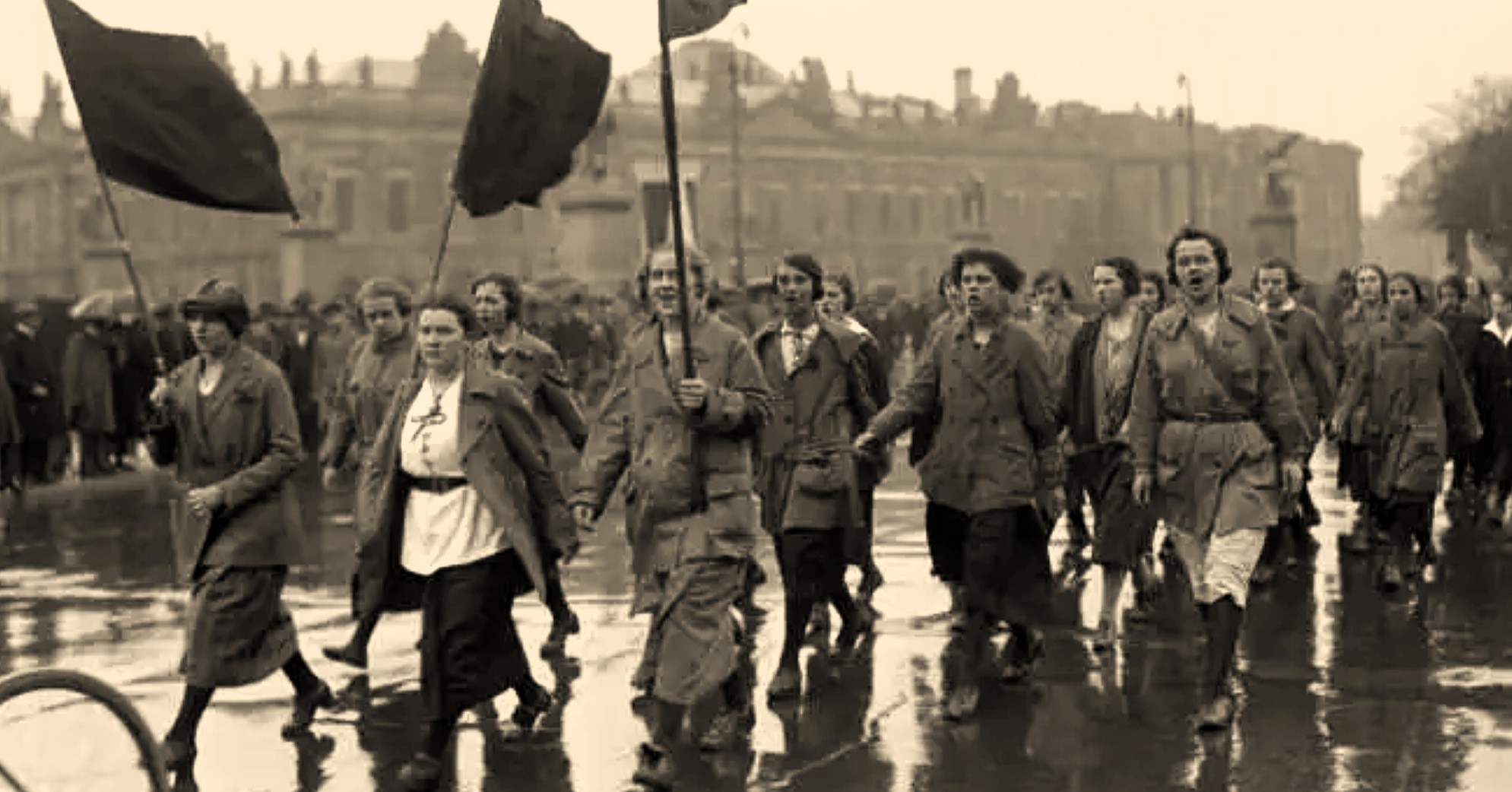
A document that will be of interest to all students of the Communist women’s movement. The full text of the main speech from the Chair of the International Women’s Secretariat to the Fourth Communist Women’s Congress in June, 1926, the final genuine one to be held. A central figure in the proletarian women’s movement both before and after the creation of the Third International, Hertha Sturm’s contributions were enormous, and deserving of much greater recognition and understanding. Born in 1883 as Edith Fischer, she became a schoolteacher at 19. After several years of teaching, she left for Leipzig University in 1911, the same year she joined the Social Democratic Party, to pursue higher education. A rarity, Sturm received her doctorate in Social Economy in 1914. Taking a leading role in the Party’s women’s work, she worked closely with Clara Zetkin and others. On the internationalist left, Sturm was an original member German C.P. 1919 and was imprisoned for activities with the Bavarian workers’ republic. A German delegate to the 2nd Comintern Congress in 1920, she became a leading force in the emerging Communist Women’s movement. Strurm organized its first international gatherings as member of the Comintern’s International Women’s Secretariat. She led the Western European Bureau based in Berlin from 1921-24. Though she would lose her positions in the German Communist Party as a ‘rightist’ in 1924, she relocated to Moscow and continue here work under Clara Zetkin in the International Women’s Secretariat, organizing and leading its conference and work. By October, 1928 changes in the Comintern made Sturm’s ‘rightist’ associations incompatible with the new Third Period and she returned to Germany, where she lost Party positions but remained a member. Sturm (also known by her married name Edith Schumann) was arrested immediately on the Nazi’s taking power in March, 1933. After her release she began work with the anti-fascist left Socialists in the Neu Beginnen underground group. Arrested against September, 1935, she was tortured and reportedly attempted suicide. March,1936 she was sentenced to five-year prison, after which the historical record of this pioneering and leading Communist who helped define a proletarian women’s politics and led antifascist resistance, ends. She likely perished in jail or in the war’s mass bombings.
‘Report of the International Women’s Secretariat’ by Hertha Sturm from International Press Correspondence. Vol. 7 No. 38. July 6, 1927.
Reporter Comrade STURM:
Comrades, according to the announcements sent to the sections my report was to embrace: work in the West, in the East and in the Soviet Union. But as the final agenda contains full reports on work in the Soviet Union and the East, I will limit myself to our work and our tasks in Western countries.
Precisely the present situation, the strike in Great Britain, events in Poland and the big economic and political crises in a number of the most important countries show us clearly how acute class differences have become and how revolutionary the mood of the masses is. Mobilisation of women masses becomes therefore imperative. In fact, lately these masses have been roused from their apathy. At present, when it is of the utmost importance to concentrate all forces at the fighting front, our opponents are making great efforts with the object of drawing the women masses into the front of the bourgeoisie. An example of this is the growth of the Fascist women’s organisations not only in Italy but also in France, Great Britain and Germany, in the latter particularly in peasant districts.
Men and women comrades of the Soviet Union will be able to contribute rich and important material based on experience for the clarification of the tasks and problems in question. Before millions of women could participate here in Socialist construction, hundreds of thousands of then had to struggle against tsarist and capitalist oppression. These hundreds of thousands had to be awakened out of a four centuries long passivity and ignorance. They had to be organised and educated. Such a fact stimulates and serves as a guidance, it lends courage and confidence for action. I say again and again: Let us profit by it! This must be the leitmotif of the conference. Let us profit by the Russian Revolution, let us profit by the present struggles.
The work of the Conference must not be limited to giving its participants a number of decisions, theses, instructions, and suggestions which they carry home on paper. It must be a bubbling source of revolutionary passion and strength, from which life-giving streams must flow. We cannot make the toiling female masses ready for the fray unless we ourselves are ready. Exploitation, consolidation and intensification of our work among the millions of toiling women is part and parcel and very important and indispensable part of the revolutionary self-education and self-training of the Sections. This process of growth and development must not be delayed.
What has the Communist International and what have particularly the International Women’s Secretariat and the Women’s Departments of the Sections hitherto done in this sphere, and what remains still to be done?
If we consider the outward success of the work of our Communist Parties, we are compelled to admit: There is a small minority of working women in the Communist camp. Although from time to time, on the occasion of big struggles and movements we have had masses of women behind us, we did not succeed in bringing these sections of the population under our permanent leadership and influence. If we compare the number of women in our camp with the number of women following our opponents, this comparison is highly unfavourable to us.
At the general elections in Great Britain the majority of the women voted for the Conservatives. We can also prove that at the presidential elections in Germany large sections of women voted for the national and clerical parties, and also that the Social Democrats polled more women’s votes than we. In Cologne the poll of the centre Party was: to every 100 men’s votes 143 women’s votes, and the poll of the Communist Party 46 women’s votes to every 100 men’s votes. In Spandau, a big industrial centre close to Berlin, there were 122 women’s votes to every 100 men’s votes in the German Nationalist Party, 144 in the Centre (clerical) Party and only 68 women’s votes in the Communist Party.
Let us also compare the number of women in the Communist Parties with their number in the Social Democratic parties. In Great Britain the Women’s Sections of the Labour Party have 200,000 individually affiliated women members, the Communist Party only 600. In Austria the Social Democratic Party has 170,000 women members, the Communists only 700, In Germany 154,000 women are organised in Social Democratic ranks, and only 20,000 in Communist ranks. In Belgium the Social Democratic Party has 89,000 women members, and the Communist Party, may be, 100 or 200.
Were our Parties and their apparatuses such as to enable us to rally the women masses to us? The Parties have certainly made considerable progress since the V. World Congress. They have come to the conclusion that one cannot get hold of large sections of women without a special apparatus and special methods. With the exception of Belgium, all the important European Parties have a special Party apparatus for work among women in the form of Women’s Departments, Women’s committees, etc. In the North and South American Parties, we are making the first steps towards this. Important sections, such as those of Great Britain, France and Italy which two years ago had only a central apparatus, have since then established women’s departments in many important districts. Moreover, the quality of the apparatus has improved. Up to the V. World Congress we still suffered from strong Social Democratic traditions in regard to women’s dissociation from the political and organisational life of the Party. In many countries we have successfully liquidated these tendencies. Very remarkable is the progress made in this direction by our Czecho-Slovakian brother section which took in hand’ reorganisation very energetically after the Party Congress held last Autumn.
But throughout the working class and even in our own ranks there are still strong relics of petty-bourgeois ideology in regard to women’s role in politics. This ideology is less strong in Germany and Great Britain which have a strong industrial proletariat and a well developed labour movement; it is stronger in France and Italy where industrialisation and hence women’s role as wage earners set in much later, where strong religious traditions hold women in their grip. This is particularly felt in the East where women are still completely dissociated from public life.
What then is the effect of this attitude on practical work? On the one hand our parties are passive in regard to the capture of women masses, and in some cases they even practise sabotage. We have, for instance, to fight hard for a simple thing such as a women’s page in the organ of our Party. The usual excuse is that the newspaper has not enough space. But in reality it means that the editorial boards have not yet realised that work among women is an important component part of the work carried on for the capture of the proletariat as a whole. It is not often that men Party comrades take a serious interest in work among women. Only from Switzerland and Norway we get information that men comrades are doing active, practical work in the women’s departments. As a rule, this work is left entirely to women. Because of this women’s work is somewhat dissociated from the work of the Party as a whole, and it happens that feminist tendencies creep in, when important tasks of the Party among women have to be forced through against the wish of the Party Executives.
An opposite and not less dangerous theory has made its appearance in the form of retrogression to the old Social Democratic tendencies of dissociating work among women from general Party work. It was very prominent in Germany, less prominent in Czecho-Slovakia and a little of this tendency is also noticeable in the last Swedish report.
In Germany prior to the Frankfurt Party Congress, the Women’s Department was not closely linked up with the life of the Party as a whole. It therefore took upon itself to issue the slogan that among women work should be more closely connected with the general Party work, that it must be given a stronger political character. This slogan was wrongly interpreted by big circles of the Party: as if all special political or organisational measures for the capture of women masses are superfluous, nay, even harmful, because they encourage feminist and Social Democratic tendencies. The result was that existing women’s commissions in the Party were liquidated on a large scale without being replaced by anything else. It was only after the E.C.C.I. letter in connection with the revival of the slogan “To the masses” that a beginning was made to reconstruct systematically the Party apparatus for work among women.
In Czecho-Slovakia a number of leading women comrades advocated, after the V. World Congress, in the National Women’s Agitation Commission in Prague the dissolution of all women’s commissions. In the meantime these tendencies have been practically liquidated.
The Swedish report shows progress, in as far as women’s clubs, a separate organisation of women Party members, no longer exist.
However, to us the Party apparatus is only a means to an end–to get the mass of women interested in the struggle of the working class and to mobilise them for it. To what extent have the Parties succeeded in this? There is no doubt whatever that also in this respect we have made progress in many countries during the past period.
In the campaign for the confiscation without compensation of the estates of the ex-ruling houses, we were able in Germany to rally around the communist slogans not only big sections of the working class but also of the petty-bourgeoisie. For the first time, in some places women took an even more active part in the voting than men. For instance in Gera, a centre of the textile industry in Thüringia, 14,636 women recorded their vote on the plebiscite lists against 13,606 men.
In France Communist influence among women was weak up to quite recently. The main campaign there was that against the Moroccan war. Successful efforts were made to induce a considerable percentage of working women, working men’s wives and peasant women to participate in the big Workers’ and Peasants’ Congresses against the war in Morocco. This is a remarkable success considering the mentality of French women, who, as a rule, take little interest in politics and are badly organised even as far as the Social Democratic Party is concerned. Then there was also the Working Women’s Conference in Paris which was attended by 556 delegates including 345 industrial women workers, 301 of them non-Party. At the municipal elections the Communists launched at the right moment the slogan of women’s franchise. They put up women as candidates of the Workers’ and Peasants’ Bloc and at the same time called upon women to exercise their electoral rights.
In Great Britain we have had the best organised work in mass organisations. This is noticeable even now in the coal strike. Already a long time ago the Party was at its post. Through their activity in the Women’s Sections of the Labour Party, in the Trade Union Minority Movement and in Women’s Co-operative Guilds, our women comrades have been able to arouse the interest of large sections of working women for this strike. We know from the as yet scanty information that already prior to the strike Women Delegate Meetings were organised attended by representatives of the various proletarian organisations. These meetings dealt with practical tasks connected with the struggle, such as children’s care, looking after the welfare of the strikers etc. We are convinced that through this action our British brother Party has taken a firm footing among the masses.
In Czecho-Slovakia, the biggest movement since the V. World Congress was the campaign against high prices in the beginning of 1925. At that time masses of women. filled the streets and markets, they were in despair about the prohibitive prices and were trying to find a way out. The Party carried on a big campaign, but not systematically enough. In Prague, Brünn, Reichenberg and Slovakia, etc., a few active women comrades put themselves at the head of the movement and led the women masses in the struggle against high prices. I am sure that we would have derived even more benefit from this movement, if the Party crisis had not paralysed to a considerable extent the activity of the women’s Departments. The National Women’s Agitation Commission in Prague was very much under the influence of the Bubnik opposition, chairman, Grimmichova, left the Party soon after–and taken up with the struggle within the Party, it did not pay sufficient attention to the important work of leading the masses in their action.
In Italy our women comrades were always among the masses shoulder to shoulder with the men comrades. If this is not very noticable we must put it down to the difficult illegal conditions of the Party. For instance, in spite of illegality and Fascist terror, the Party held during the Women’s Day campaign, working women’s meetings at factory gates in a series of towns, and distributed an enormous number of leaflets among working women.
Just a few words about Poland, which together with Great Britain, is the centre of interest. Throughout the whole period which preceded Pilsudski’s coup d’etat there was terrible unemployment in Poland. In some districts where women labour predominates, as for instance in the textile centre Lodz, the majority of the unemployed women receive no unemployment dole because, according to the recent Polish legislation, only one member of each family is entitled to relief. Women were to the fore in the actions of the unemployed. In textile districts the unemployed working women themselves and in other places the wives of the unemployed organised monster demonstrations, demanding doles, release of political prisoners and protesting against the terrorist measures of the police during strikes and demonstrations. Again and again women came into collision with the police.
I will deal now with the weak points of our work. Our greatest defect was: failure to make full use of favourable political situations. A characteristic example of this is the Hindenburg election in Germany. The campaign for the presidential elections coincided with the International Women’s Day. The Women’s Department of the C.P.G. had elaborated an excellent plan for the conduct of this Women’s Day Campaign. But the entire campaign was a failure because the Party held the view that women’s campaigns must take a back seat when high politics comes along. The Party lacked the political acumen to realise that these elections, which were an encounter between the nationalist gang on the one side and the working class on the other, were precisely the best opportunity of the German Nationalists over the working women. Thus the German Nationalists decidedly owe their success to women’s votes, and the Communist Party suffered a crushing defeat which showed clearly what serious mistakes had been made. Such experiences should be a lesson to the Parties for the future; they must learn to recognise in good time what their tasks are, in order to be able to do justice to them.
In regard to methods by which we can get at the women masses, we have gained considerable practical experience. That our Parties have learned something is shown for instance by the fact that women were drawn into the Workers’ and Peasants’ Congresses in France and into the Unity Committees for the Expropriation of the ex-ruling Houses in Germany. Satisfactory methods and good leadership in this work are noticeable in Great Britain within the Trade Union Minority Movement. In the centre and also in some district Women’s Departments were formed in the Executive Committees as organs for the activisation of women within the framework of the movement as a whole. Not only representatives of working women organised in trade unions, but also representatives of the Co-operative Women’s Guilds and of other proletarian organisations in which women are organised as for instance the Railwaymen’s Women’s Guild, are affiliated to these organs. Owing to this amalgamation of different organisations it has been possible to co-ordinate, during many actions, the struggles of various sections of women.
A very interesting method of work in this sphere which must receive our special attention in the near future was the method of Women Delegate Meetings. These meetings were given a trial during the last two years in Germany, Great Britain and Finland. As far as Germany is concerned there was only one Women’s Delegate Meeting in Gera (Thüringia) where the Party had a strong organisation and considerable political influence. In October 1924 women workers from 23 enterprises were elected to the Delegate Meeting in Gera. This was, to all intents and purpose, a united front of working women who drew up a programme of wage questions, protection of women labour etc. But the movement died down because support in the enterprises and active leadership for the continuation of the campaign were lacking.
In Finland, several women delegates meetings were held in Helsingfors. Not all the delegates had been elected in enterprises. They were given definite practical tasks, such as making women Otake an interest in Parliamentary elections, but one cannot say that these meetings have led to regular continuous work.
In Great Britain the first Women Delegate Meeting was held last summer shortly before the threatening lockout of the miners. More meetings were held in textile districts at the time of the strike, which shows that they were an outcome of the struggle. These Women Delegate Meetings, of which 14 were held up to last September, have been systematised to a certain extent. On March 25, that is to say shortly before the outbreak of the general strike in Great Britain, took place the first Women Delegate Meeting which really represented the masses. In Mansfield over 300 delegates from 55 organisations were present. They discussed preparations for the expected offensive of the coal magnates against the miners. These Delegate Meetings dealt with every newly arisen situation in the struggle, gave proof of their solidarity with the working class, supported the action for the Soviet Union and did propaganda for it. In some places reporters from the British Women Trade Union Delegation spoke at these meetings and told the wholly backward women the truth about Russia, helping thereby to strengthen the solidarity and sympathy of the British workers with Soviet Union.
But we are compelled to say that various other attempts to establish a practical united front failed signally.
The speaker gave three examples in connection with the International Women’s Day in Switzerland and Czecho-Slovakia on the one hand, and Great Britain on the other hand, showing that a united front “from above” can only be successful if it be preceded by thorough preliminary work for the mobilisation of the m masses from below.
In Great Britain we had an interesting example of a political united front at the National Women’s Conference of the Labour Party in May 1925. This conference, which represented 200,000 women was attended by 862 delegates with only 10 women Communists among them. These delegates were elected in their local groups of the Women’s Sections of the Labour Party although, formally, Communists are expelled from the Labour Party. These 10 women Communists managed to get a number of our proposals placed on the agenda and also to have a very important proposal adopted unanimously, which created enormous enthusiasm. This proposal was: Women’s Sections should do their utmost to get Russian women comrades invited to the next International Women’s Conference, to have a united front established with the working women of the Soviet Union and the East regardless of the colour of their skin. This example shows that purposeful fraction work and adequate political preparation can lead to great results.

When we consider the weak points of our work, we can come always to the conclusion that an inadequate ideological attitude is at the bottom of them. Frequently the Parties do not go the right way about in their efforts to draw women into the struggle of the working class, they do not seem to be able to hit on the right questions to arouse women’s interest. For instance, the report of the C.P. of Sweden for our Conference contains the following answer to the question “Are special women’s questions dealt with at the courses of the Party?”:
“No, no special women’s questions are dealt with at the courses. On the contrary, solidarity of all comrades with the Party and the class is emphasised.”
Similar pseudo-radical tendencies made their appearance also in Czecho-Slovakia at the Parliamentary elections last autumn. In the election address of the Party there was not a single specific slogan for the mobilisation of the women masses. For fear of feminism such a slogan was rejected. Those who approach these questions in this manner show that they have not understood the meaning of the slogan: “To the masses. In contra-distinction to such an abstract attitude it is rather interesting to study the practical methods adopted by our opponents. I will give a Norwegian illustration of this. Preparately to the Parliamentary elections in 1924, the bourgeois Liberal Women’s Leagues established, together with the Social Democrats, a women’s united front for the defence of their interests. This united front brought forward a programme appealing directly to women’s interests and particularly to the interests of housewives whose ideology is notoriously petty-bourgeois: questions of protection for motherhood and childhood and particularly household questions, whereas the demands of industrial women workers and women wage earners in general were ignored. With this election programme the women’s united front joined in the fray and captured quite a number of women.
What should our Communist Parties do in such a case? It is as clear as daylight that it would be utterly erroneous to ignore such a united front of bourgeois women. On the whole, our Communist Parties pay far too little attention to what Social Democrats, Clericals, Nationalists, etc., are doing. The answers to questionnaires sent out in connection with our Conference are a convincing proof that there is a gap in our work. Our Women’s Departments do not know what organisations exist, what sections of women they embrace and by what methods they work. And yet we must know this, if we are to remove the women who belong to us, from the influence of our opponents. For instance, what was the attitude taken up by the Communist Parties to the Women’s Day slogans of the Social Democrats or of the Marseilles International Women’s Conference? They hardly took notice of them at all. And yet programmes were elaborated there which contain slogans with which we can to a certain extent solidarise. By identifying ourselves with such demands we could show to the workers to what extent Social Democrats betray in practice their own programmes, etc.
I would like to mention one more thing in connection with so-called specific women’s questions. When Communist Parties carry on campaigns for political slogans which women do not understand, it is the duty of our Women’s Departments to find the link, by which we can get hold of the whole chain. This can be done by explaining in how far these general questions are connected also with seemingly “specific” women’s interests.
There is a consensus of opinion among us that there are no specific women’s demands in the sense that an antagonism exist between the men and women of the working class. We know that every struggle carried on by working women for their interests is part and parcel of the class struggle, the aim of which is the liberation of the working class. We must identify the small immediate interests of the women with the big ultimate aim. On the other hand we must also be able to explain the political importance to the working class as a whole of the so-called specific women’s demands, in order to arouse the interest of the working class in the struggle for these demands.
Let us take for instance the slogan “equal pay for equal work”. As long as working men do not understand that because of the difference of pay between men and women the men are thrown into the street whenever there is an economic crisis, women taking their place, that is to say, that women’s low wages are harmful to men, they will be indifferent to the wage struggles of women workers.
Or let us take the demand for protection of childhood in France. The question of the depopulation of France was already discussed prior to the world war. The falling birth rate is alarming the entire bourgeoisie. Bourgeois newspapers publish twice a week leading articles on this subject and bewail the fact that although France was victorious in the war it will perish because of depopulation. A gigantic propaganda is carried on for an increase of the working population. It was a brilliant idea on the part of the Communist Party to take advantage of this and to introduce in the Chamber a comprehensive mother and child protection Bill, the only effective means to counter-act the disinclination of the working and peasant women to bring children into the world.
The absence of ideological clarity within our Parties implies sometimes great risks. Some comrades interpret the slogan “To the masses” as if one should limit oneself to every-day questions. The international women’s press has one thing in common: it deals very seldom with the fundamental questions and ultimate aims of Communism. They get lost sight of in the effort to link up, as concretely and practically as possible, with women’s immediate interests. This cannot be tolerated.
To follow up these general arguments, I would like to deal with a few special points which are the be all and end all and at the same time the most sore point of our work: capture of women workers in factories and trade unions. The International Conference of Women Communists held at the time of the V. World Congress issued the slogan that in the present period we must concentrate our attention on capturing the most important sections of the female proletariat that is to say, the women workers in factories and trade unions. Our Parties have begun to reorganise themselves on a factory nucleus basis. But this reorganisation has not yet shown itself sufficiently in our work among women. What is the cause of this? We have to contend with great objective difficulties,
Above all: The majority of the women members of our Parties are housewives. Unfortunately Czecho-Slovakia is the only country where definite statistics about our membership exist. One-third of its 25,000 women members are wage-earners, two-thirds being housewives. This state of affairs makes it all the more necessary for us to endeavour to make factory nuclei interested in the capture of women workers, and to mobilise them for this work. But work in this direction has been very inadequate. There are no women’s organisers either in trade union factions or in the factory nuclei to judge by the reports we received from most sections. In Germany we have certainly a considerable number of districts Saxony, Thuringia and Berlin which carry on successful work in the enterprises. On the other hand in such an important highly industrialised district as Rhineland-Westphalia where woman labour prevails in the textile and metal industries nothing has as vet been done for the capture of women workers. And what about trade union work? Our question in regard to Trade Union Women’s Commissions is answered by the German report quite frankly as follows: “There are Women’s Commissions almost in all Trade Unions, but we have no influence anywhere”.
The very interesting report of the Swedish Party gives us the following information: “Work in trade unions and factories is the task of the Party as a whole. There are no women organisers”. This suggests not only failure to do practical organisational work, but even an altogether wrong attitude to this question. The Party as a whole, what does this mean? Surely women members and women’s departments are part and parcel of the Party. They should take the initiative in the matter of appointing women’s organisers in factories employing large numbers of women. We cannot indulge in the luxury of sitting still and doing nothing until the reorganisation of the Party on a factory nucleus basis has been accomplished. We cannot tolerate such a passive tendency. We must make a definite beginning with this work, and for this purpose we must first of all concentrate our attention on a few important points wherever premises are favourable.
There are some glaring symptoms of the small success of our work in trade unions and factories. The Women’s Day was observed in 16 western countries, and mass meetings were held. But we did not penetrate into the factories and trade unions. If we turn our attention to the Workers’ Delegations to Russia we notice, for instance, that there was not a single working woman in the German Workers’ Delegation. There is also the fact that women, and particularly women employed in industry, constitute only an infinitesimal percentage of the membership of our Communist Parties. If we had done effective work in factories and trade unions, we should have been able to produce better results in the course of the last two years. Hardly any letter was sent out by the International Women’s Secretariat, without drawing attention to work in factories and trade unions as our most important task. If in spite of this we have achieved so little we must increase our efforts tenfold in order to make up for lost opportunities. We have hardly made any progress in trade unions except in Great Britain where the General Trades Union Council has begun to organise a special recruiting campaign among working women, which was effectively utilised by the C.P. and the Minority Movement.
Generally speaking, we have now fully realised that our work must not be limited to the narrow circle of the Party, but that our main task is the capture of the masses outside the Party. In this respect we have had a certain amount of success in the big mass organisations particularly in the I.C.W.P.A. and in the I.W.R. The I.C.W.P.A. particularly was a favourable ground for the mobilisation of working women. On the other hand, except in Great Britain, we have not taken a firm footing in the co-operatives. This sphere of work is of particular importance to us in connection with our struggle against high prices, inflation, taxes, protective tariffs, a struggle which is the order of the day in many countries.
We have had a few interesting experiences in regard to new methods for the capture of wider circles outside the Party. The resolution of the Org. Bureau (May 1925) contained the instruction to bring certain circles of sympathisers in contact with the Party in order to carry the slogans of the Party into the masses. Such groups and circles exist in a number of countries: in Italy groups of sympathisers in enterprises, street nuclei and even in some villages; in France the “Amies de l’Ouvrière” and the “Committees of Widows and Mothers for Struggle against the Morocco war”; a broader form of organisation a new and rather disputed form: the non-Party women sympathizers’ organisations. In this connection characteristic examples are the Housewives Leagues in Norway and the Red Women’s and Girls’ League in Germany. We know that these organisations have helped to strengthen the Party. For instance, in France many members of these groups have joined the Party. The same applies to Norway and Germany.
As a result of our experiences in the period of work which lies behind us, we must now bring forward the most pressing and important tasks of the near future. On the whole, we can say that the policy laid down by the III. International Conference of Women Communists and amplified in the May resolution of the Org. Bureau was correct and commensurate with the requirements of our work. However, it was not applied by the sections with the required energy and purposefulness, and we must make up now for lost time and opportunities. Our foremost task is the inclusion of working women into the united front of the proletariat for struggle against capitalism, and the question confronting us is: by what forms and methods can we do justice to this task. From this viewpoint we want to bring forward three main tasks on which our sections should concentrate in the immediate future and which are to be the policy underlying our future work.
First of all we must make the Party and the working class realise that work among women is not only the business of women comrades but an important component part of the work of the Communist Parties, one of the tasks of the entire working class. As long as we cannot make this idea prevail, we will not be able to solve the tasks which are confronting us.
The second central task consists in concentrating our attention on the capture of women in factories and trade unions. The third task is: Preparation and organisation of Women Delegate Meetings as a specific method for the establishment of contact with the mass of working women for the purpose of drawing them into the class struggle.
The first task implies that work among women be linked up with the work of the Party as a whole. The Parties must be able to find ways and means for approaching women in connection with all their political campaigns. What does this mean? We must of course popularise all the general political demands of the proletariat among large sections of working women. Special so-called women’s questions are to help us to arouse women’s interest in our other slogans which go much further.
The general slogans, which are binding for all our Sections, are drawn up by the Communist International. Among them the slogan “National and International Trade Union Unity” is of particular importance because it means the united front of the working class in regard to a whole series of everyday demands. But we will not be able to make this slogan popular among working women unless we make them understand how much depends on it in their own struggle against unemployment, for higher wages, protection of women’s labour, etc. The other group of slogans has reference to struggle against Fascism, war and white terror, all of them questions of international importance. Then there is the question of solidarity with the oppressed peoples of the East.
Questions which are today of direct interest to large sections of women should be brought forward in connection with these main slogans. It will be the business of every individual Section to draw up a concrete programme of action. In connection with this, I should like to touch upon a few very specific points, as for instance the housing problem, and the question of unemployment which are of special interest to women. In Germany the Government has decided to grade the unemployment dole; the lower the wage, the smaller the unemployment dole. This means that women workers who are already living on the border of starvation because of their low wages, will be exposed to even greater misery because of the reduced unemployed dole. Then there is the question of double existence which plays an important role in all countries where reduction of civil servant and teaching staffs is the order of the day, as for instance, in Germany, Great Britain, Czecho-Slovakia, Austria, Scandinavia, etc. In these countries, women are the first to be dismissed.
Our Parties should be able to turn their attention to the burning questions in the individual countries. In all these campaigns we should not limit ourselves to mere agitation, but must endeavour to achieve palpable organisational results.
The influence we gain must be consolidated. One of the most important results of every campaign should consist in capturing for the Party the more advanced of the working women, particularly from the ranks of women factory workers.
In regard to the capture of women working in factories and belonging to trade unions I should like to draw attention to something which, on the strength of the experiences of the French Party, should be taken into consideration. The C.G.T.U. has initiated systematic activity among women workers. Up till now no great results have been achieved. There were cases when it was possible to secure sympathy for the Party and the trade union during the powerful and frequently spontaneous strike movements of working men and women. But if in localities where such success has been achieved, the latter is not followed up by systematic trade union work, if we neglect the work which was initiated and turn our attention to other spheres of activity, we will not be able to achieve permanent results, but will, on the contrary, exhaust our strength by Sysiphus labour which always begins anew and is never accomplished.
We should rather organise our work in a manner that wherever a certain amount of success has been achieved, a cadre of adequate forces be trained capable of making these successes secure, and developing them still further. In Douarnenez where in January, 1925, we had 1800 women workers organised in trade unions, this number has dwindled to 600. This fact shows that in regard to factory and trade union work one must proceed systematically, that is to say, one must concentrate one’s forces in the most important localities and meetings.
In conclusion, I should like to deal with Women Delegate Meetings. As this question is one the agenda as a special item, I will confine myself to saying that a foundation has been laid by us in factories on which the Parties can develop a systematic, ideological and organisational campaign for the creation of delegate meetings, utilising for this all, and particularly Russian, experiences. These first successes and failures in the individual Western countries will help us to develop and improve our future work in this sphere.
Just one more remark in regard to the last item on our agenda, a question which hitherto had to take a back seat and has been thoroughly neglected: Party education.
Many defects in our work were due to lack of ideological clarity in the Party as a whole and to inadequate theoretical-political education among our men and women comrades, which made it impossible for them to do justice to their tasks.
In view of this state of affairs we must energetically take in hand the business of creating a staff of Party workers for activity among women, well grounded in theoretical and practical work. Then we should also endeavour to make the Party as a whole adopt a clearly defined attitude to work among women by energetic political educational work within the Party. This is the only guarantee that the strength of women comrades will not be exhausted in a useless struggle against deliberate apathy and lack of understanding on the part of the Party as a whole. In practice this means that questions concerning women’s role in political life and methods of work among them be included into the programme of general Party-education work, and that these questions should be explained not only from a purely theoretical but also from a practical viewpoint with the help of examples and experiences from our everyday work.
Part of this education is, of course, utilisation of the experiences in all the Eastern and Western countries, first and foremost, of the experiences of our Russian brother section. In this respect we, the Women’s Department of the E.C.C.I., must confess a sin of omission. We have certainly supported energetically the individual Parties in their work in accordance with the resolution of the Orgbureau and the decisions of the Third International Conference of Communist Women. But this support was inadequate. We were compelled to limit ourselves to thoroughly discussing with the sections their individual affairs, and to giving them hints re the development of their work. But we have not yet been able to systematically utilise on an international scale the experiences of the individual countries.
One of our most important tasks in the near future will be: to communicate to the Sections systematically and on an international scale through the press and through international informatory reports, the results of the work of our Parties, i.e. the political situation, the tasks as well as the practical methods of work, successes and non-successes, errors, new phenomena, existing problems, etc. Still closer collaboration between the Sections and us is possible and essential. But it cannot materialise if the Sections do not keep us regularly and fully informed about their work. We need the collaboration of the Sections in order to get a clear insight into their work, and we will be able to give better support to the Sections through the creation of an international bulletin.
Sections should express themselves on our report in order that we should know that the lines on which have worked and which are laid down in our theses and resolutions are commensurate with the requirements of work among women and in order that this expression of opinion might serve us as guidance in our further work (Applause).
International Press Correspondence, widely known as”Inprecorr” was published by the Executive Committee of the Communist International (ECCI) regularly in German and English, occasionally in many other languages, beginning in 1921 and lasting in English until 1938. Inprecorr’s role was to supply translated articles to the English-speaking press of the International from the Comintern’s different sections, as well as news and statements from the ECCI. Many ‘Daily Worker’ and ‘Communist’ articles originated in Inprecorr, and it also published articles by American comrades for use in other countries. It was published at least weekly, and often thrice weekly. A major contributor to the Communist press in the U.S., Inprecorr is an invaluable English-language source on the history of the Communist International and its sections.
PDF of full issue: https://www.marxists.org/history/international/comintern/inprecor/1927/v07n38-jul-06-1927-inprecor-op.pdf
 Revolution's Newsstand