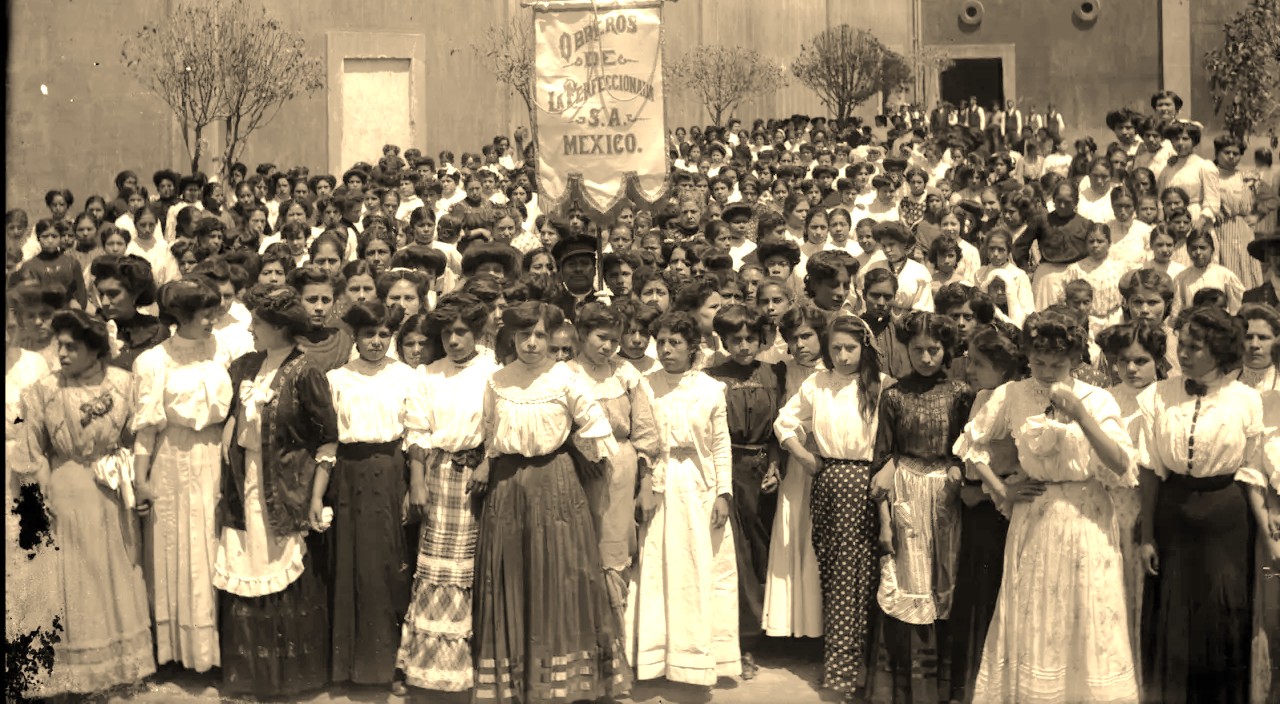
Valuable reporting as the working class and landless rural poor make themselves felt in a Revolution still in motion. Carleton Beals was among the most important of the U.S. chroniclers of the Mexican Revolution, with his articles informing a generation of U.S. activists on the history-making events next door.
‘Mexican Labor and the Mexican Government’ by Carleton Beals and Robert Haberman from The Liberator. Vol. 3 No. 10. October, 1920.
BLOOD!!! Red drops of it, trailing beneath monstrous flaring headlines across the front page of “El Universal,” Mexico’s leading, respectable daily–her New York Times. Thus Bolshevism, like Poe’s Red Death, stalked among the horror-stricken Mexican aristocracy. But the blood was only red ink, and the Revolution is not yet. The real situation may be gathered from President De la Huerta’s statement that Mexico’s doors are open to all who come, Bolsheviks, Anarchists, or American business men. He himself, he says, is a “Kautskian Socialist.”
But behind the screaming headlines of the Universal was the information for all who could read social events that the great world currents of the revolutionary labor movement are washing the tropic shores of Mexico. Strike after strike proclaims the fact. During the last month not one industry and scarcely a factory in Mexico has been exempted. The marine workers, the thirty thousand oil workers of Tampico, the 15,000 railway workers of the British Vera Cruz line, the 10,000 miners of Zacatecas, the 8,000 campesinos of the cotton-fields of the Laguna District near Torreon, the 18,000 textile workers, are some of the larger groups involved. General strikes, partial strikes, strikes for higher wages, strikes for shorter hours, teachers’ strikes, students’ strikes, strikes for union recognition, as many kinds of strikes as rats in Browning’s Pied Piper of Hamelin Town.
A remarkable phase of this awakening of Mexican labor is the class-consciousness manifested by the agrarian workers. The cotton-pickers of the Laguna district, deserted by the organizers of the Confederacion Regional Obrera, Mexico’s A.F. of L., arose in spontaneous revolt–8,000 of them–and won higher wages, shorter hours and union recognition. In Michoacan the soldiers demobilized themselves, and appropriated lands. On September 16 will occur a nation-wide demonstration of the agrarian workers to convince the government of the advisability of continuing to make land reforms.
An amazing spirit of solidarity has suddenly appeared. In the Vera Cruz general strike the marine workers, in some instances including the officers, walked off the boats. Senor. Don Antonio Ancona Albertos, president of the Mexican Senate and recently nominated
Governor of Yucatan, when he wished to leave Vera Cruz was obliged to telegraph Felipe Carrillo, head of the Socialist Party of Yucatan, as follows:
“I beg of you to appeal to the strike committee of Vera Cruz, Calle de Zaragoza 44, asking in the name of the Socialist Party of Yucatan, that, for comradeship, the steamer Jalisco be permitted to sail immediately so that I may arrive in Yucatan in time to call the elections.”
The Jalisco was the only vessel that left Vera Cruz during the strike. The officers of one other boat, who threatened to leave and unload elsewhere, were confronted with telegrams showing that labor would not move their cargoes in any port of Mexico.
The same spirit of solidarity was shown in the textile industry, controlled by French capital, when the workers in 400 factories scattered over all but five states of the Republic gave the employers the alternative of rehiring a discharged member of the union, or withstanding a general strike. The cigarette trust, El Buen Tono, suppressed a whole department in order to get rid of the secretary of the union. A general strike forced them to re-employ him.
Foreign capital recommencing operations in Mexico has soon discovered that old tactics toward labor are no longer feasible. The Vera Cruz-Mexico City railway, the Queen’s own, so-called because it is largely owned by the Queen of England, which has recently been returned to its owners by the government, announced that it intended to remove certain workers, and that it would pursue a different policy toward labor unions. The “different policy,” to be inaugurated August 1, was not explained, but the company was immediately confronted by a general strike and was forced to grant a 100 per cent increase in wages. The Guggenheim interests in northern Mexico were recently forced to recognize the miners’ union, something that they have done in few places in the United States.
Such are some of labor’s most recent victories in Mexico. The struggle of Mexican labor has been long and bitter. The Mexican worker arose in blind anger against Porfirio Diaz. But he gained nothing from Madero, unless it was freedom to organize. Under the old Huerta his newly-formed organizations were well-nigh crushed out of existence. He contributed his batallones rojos to the success of Carranza and gained a glittering Constitutional provision, machine guns, fire hoses and a treason act.
The Mexican worker is ignorant and uneducated, but he is stubbornly conscious of the fact that he has a right to enough to eat. His organizations have been used again and again by politicians; his treasuries, built up from contributions from his starvation wages, have been repeatedly emptied dishonest leaders. He lacks orientation and effective organization. His officers are usually men who have a superior education, but little principle, and although usually more widely read than the American kind in the revolutionary classics, adhere to the letter and not to the spirit of their creed.
But the spontaneous revival of union strength, treading on
the heels of the recent outbreak of strike after strike, has gained the character of a purposeful rank-and-file movement. Under Carranza not a strike was won except during the brief period that Plutarco Elias Calles was Minister of Commerce and Labor. Since Carranza’s overthrow not a single strike has been lost. This arises from the character of the labor revival, the increased liberty incident to a change in regime, and the astonishing friendliness to labor of the new government.
This governmental attitude, whatever its meaning or motive may be, has been demonstrated in a number of ways. During the spontaneous strike of the Laguna cotton-pickers, the proprietors determined to ship in the strike-breakers from outside. The government refused to permit this, informing the owners that as soon as the strike was settled they could have all the men they needed, and that the government would pay part of the cost of their transportation. Thereupon the proprietors convinced several local military officers that it was their duty to arrest the leaders, as was done in all the strikes during the Carranza, regime. Calles, now Secretary of War, telegraphed an order for their immediate release, and added that any officers who in the future molested a strike-leader would be court-martialed. The oil-owners of Tampico, when the workers began carrying their red banners down the streets and advocating the workers owning the industry, called for troops as in the good old brutal Orozco-Carranza days, but Calles replied that breaking strikes was not the business of the army.
The government has been tactfully acceding to all labor demands. When the soldiers of Michoacan settled upon idle lands, the Assistant Secretary of War, Sarrano, gracefully issued a statement that the War Department had “established a military-agrarian colony” in that state. When Villa demanded land for his soldiers, and schools for their children as a condition upon which he would cease his rebellion, the government replied: We shall not only give them land, them and the Cedillistas and the Zapatistas and the rest of the agrarian istas, but in four different parts of the Republic we shall build at least four model cities with schools, theatres, paved streets, electric lights, and telephone service surrounded by lands to be distributed to the people.*
(*There are several measures by which the Mexican Government can get possession of land for such projects. For instance, the Idle Land law, the first law signed by President De la Huerta. This law was vetoed by Carranza, but it happens that any vetoed law may be put in operation by the next man to occupy the presidential chair. This law surpasses single tax in that it provides for the use of the land and lets the values take care of themselves. Any land not plowed or not sown by given dates may be petitioned for (to the extent of seventy acres in the Federal District) by any individual who cares to farm it. The petition, made to the Ayuntamiento, must be granted within three days, and the individual may have possession for three years by the payment to the town council of not more than 5 per cent., or if he demands seeds and tools–which is his right–of not more than 10 per cent. of the value of the crop.)
The new government has even asked labor to cooperate with it in the management of the state. Recently when the President heard of an impending split in the labor movement, he called the leaders to a luncheon in which he urged them to remain united as the government needed labor’s organized support. This may well have had an element of politics in it, but imagine the political situation which would persuade President Wilson to sit down to luncheon with Samuel Gompers (quite possible), Eugene V. Debs, William D. Haywood, and the heads of the Communist Parties!
When a short time ago a labor commission from the Federal District, the industrial center of Mexico, visited De la Huerta and told him that the workers were in a majority in the district, and that they thought a workingman should be governor, he requested them to send him. the names of three men. When, from their list De la Huerta named as governor Celestino Gasco, a mechanic and one of the founders of the famous Casa del Obrera Mundial, the factory owners organized a sindicato and declared they would close their doors. But the factories appear to be still running.
Another of the nominees, J.D. Ramirez Garrido, was made Chief of Police for the Federal District. Ramirez Garrido was also one of the founders of the Mexican labor movement, and a man who has spread the doctrines of Socialism to the four corners of the Republic. He first gained his social consciousness as a student in Vera Cruz, when in 1907 he saw the striking textile workers shot down in the village of Rio Blanco in such numbers that their bodies had to be run out on flat cars and dumped in the sea. He left Vera Cruz, and, risking the wrath of the Dictator, established a little paper, La Voz de Juarez. He is the author of “From the Red Soap Box,” “Revolutionary Feminism,” “The Burning Word,” “Jesus in the Light of Morality and Socialism,” etc., etc.
I asked him what he had done for labor since becoming Chief of Police.
He said that he immediately raised wages in the Department seventy-five per cent, and intended raising them higher, that he had appointed propagandists to jobs that they might continue their propaganda without economic fear, that he had named Elena Torres, Treasurer of the Communist Party, to the position of Secretary of the Secret Service Department, that he had refused to license any chauffeur who was not a member of the chauffeurs’ union, that he had proffered the police band to play when wanted at any labor meeting, that not a single policeman had been used to break a strike.
Other interesting appointments have been that of Luis N. Morones, head of the Confederacion Regional Obrera, to run the munition factories, and Rosendo Salazar, of the Casa Mundial to run the printing department. The danger of such appointments to the revolutionary labor movement is obvious. Yet Morones, though a typical A.F. of L. boss, has organized all the 9,600 workers in the munition factories into one industrial union; and under Salazar, for the first time the government printing employees are also organized.
The President, during the first month in office, appointed two workers to investigate the penal colony on the Islas Marias in the Pacific, where men have been buried for years. They were instructed to interview every man, find out the reason for their internment, the treatment they had received, and how long they had to serve. On the recommendations of these two men, 1,000 prisoners were immediately released.
Such seems to be the labor policy of the new government to date. But the general recrudescence of power in Mexican labor is far more significant–it is a part of the general world-movement toward the left. The Soviet idea is growing. It has invaded the government printing offices. The workers elect new workers. They elect the heads of the sub-departments. It has invaded the ranks of teachers and students. When the teachers went on strike a year ago to force the government to pay their salaries, a little clause was tucked away in their demands asking for self-determination in the schools. The teachers were beaten to their knees by fire hose and treachery, but today they are in session. to elect their own superintendent. When the students of the National Preparatory School refused to recognize their principal and became too demonstrative, Carranza turned the fire-hose upon them and locked some of them up. A few weeks ago students and teachers in joint assembly elected their own principal. This same thing has been occurring in other parts of the Republic. The Soviet idea has invaded the ranks of the workers in Tampico, and in every strike they openly speak of the day in the near future when their red banners will be floating over the offices of the oil companies.
This stirring determination of Mexican labor even ruffled the surface of the Convention of the Confederacion Regional Obrera recently held in Aguas Calientas. This organization, created largely through the efforts of Luis N. Morones, is a negative A.F. of L.-like body. The program adopted at Saltillo in 1918, and practically repeated the following year at Zacatecas, and this year at Aguas Calientes, is an innocuous, indefinite mouthing of phrases concerning land-distribution, enforcement of the labor provisions of the constitution, proper representation on the conciliation and arbitration committees, and a cringing, sentimental appeal to the government to be good to the workers. It contains no word on industrial organization, no word about effective propaganda, no word regarding the ultimate purpose of the organization, the ultimate goal of labor.
Yet this year’s convention developed, for the first time, a spirit of solidarity and class-consciousness that may have far-reaching consequences. Morones, although he has always been the dominant personality at all labor conventions, has never gained the full confidence of the mass of the workers. His political relationships, his connections with the A.F. of L., keep that distrust constantly alive. The Mexican worker fears political methods with the fear of a burnt child. Morones’ understanding of men and affairs led him to desert Carranza and organize the Partido Laborista in support of the candidacy of Obregon. His efforts to control organized labor politically have brought him, as well as other leaders of the C.R.O., well to the front in the new semi-labor government. Morones is now head of the munition factories, a position of power and prestige. Morones is head of the C.R.O. Can he continue to hold both positions?
At the Aguas Calientes Convention his principal antagonist was A. Diaz Soto y Gama, an agrarian leader, head of the Partido Agrarista, and for seven years with Zapata in the hills. Soto y Gama is a thorough Marxian scholar, but unfortunately also a politician.
When the strikers from the Monterey metal works, the biggest single factory in the country, took the floor to ask for financial aid from the Confederacion, a motion was made to send a telegram to De la Huerta, asking for his intervention in behalf of the workers, and secondly to hold a ball to raise funds. Soto y Gama immediately declared that strikes were not won by sending telegrams to the government, nor by waiting to give balls. He split the convention upon this little point between those who for ten years and more have been cringing at the feet of the Mexican government, and those who believe that Mexican labor has attained its majority, and is capable of maintaining its own rights.
Far more symptomatic is the attempt to organize the Confederacion Comunista Obrera upon a revolutionary program. Although the elements behind this new movement are not encouraging, its program is broader than that of the Casa del Obrera Mundial which was suppressed by Carranza. It repudiates political action, insists upon industrial organization, denounces government job-holding on the part of union leaders, attacks the A.F. of L. and the affiliation of the C.R.O. with the A.F. of L. Its purpose is summed up in direct action and recognition of the Third International.
The unruly spirit in the recent convention and the formation of this new organization certainly indicate that Morones will have to rise to the occasion or lose his leadership. Morones will sooner or later have to take his stand upon industrial organization, upon direct action, upon recognition of the Third International. He will have to rise to the demands of the aroused spirit of Mexican labor, or he will lose the power that he has wielded so cleverly and ambitiously for so many years.
Labor’s recently demonstrated power to paralyze the industries of the country is not only a challenge to Morones and his group; it is a challenge to the new government which is trying so hard to be friendly to labor. The Mexican government must watch its step. It is between the devil and the deep sea. It is damned if it does and damned if it does not. It is between labor which, if it wishes to help, it nevertheless cannot help fast enough, and American capital whose power it cannot ignore. Organized Mexican labor offers one more irritant to American capital in Mexico. The more revolutionary are the demands of Mexican labor the more irritating will the situation become. Carranza, who was not a radical but a stiff-necked aristocrat, irritated American capital by his slogan of “Mexico for Mexicans,” with which phrase he fabulously enriched a little clique of military favorites, and drew down the cry of “Bolshevik.” How easy it will be for the new government, which is in any event interested in social reconstruction, to draw the lightning of the same cry upon its head! At this writing the representatives of the American newspapers in Mexico City are heckling and harassing the government officials from office boy to President, trying to tie them down to some statement that will reveal a secret sympathy for Russia!
Think of the tragedy of a people who live day and night under the fearful shadow of armed intervention, not knowing when the blow will fall, not knowing when their land will be crossed and recrossed by foreign soldiers and pounding cavalry, their government destroyed, their land made conquest. The Mexican people live constantly with that dread in their hearts. But if the Mexican government is subjugated by American capital, either diplomatically, or by fear, or by armed destruction, American capital will still have to answer to Mexican labor. Beyond the Mexican government is the Mexican proletariat, beyond the Mexican proletariat is the revolutionary world proletariat.
The Liberator was published monthly from 1918, first established by Max Eastman and his sister Crystal Eastman continuing The Masses, was shut down by the US Government during World War One. Like The Masses, The Liberator contained some of the best radical journalism of its, or any, day. It combined political coverage with the arts, culture, and a commitment to revolutionary politics. Increasingly, The Liberator oriented to the Communist movement and by late 1922 was a de facto publication of the Party. In 1924, The Liberator merged with Labor Herald and Soviet Russia Pictorial into Workers Monthly. An essential magazine of the US left.
PDF of full issue: https://www.marxists.org/history/usa/culture/pubs/liberator/1920/10/v3n10-w31-oct-1920-liberator-hr.pdf
 Revolution's Newsstand