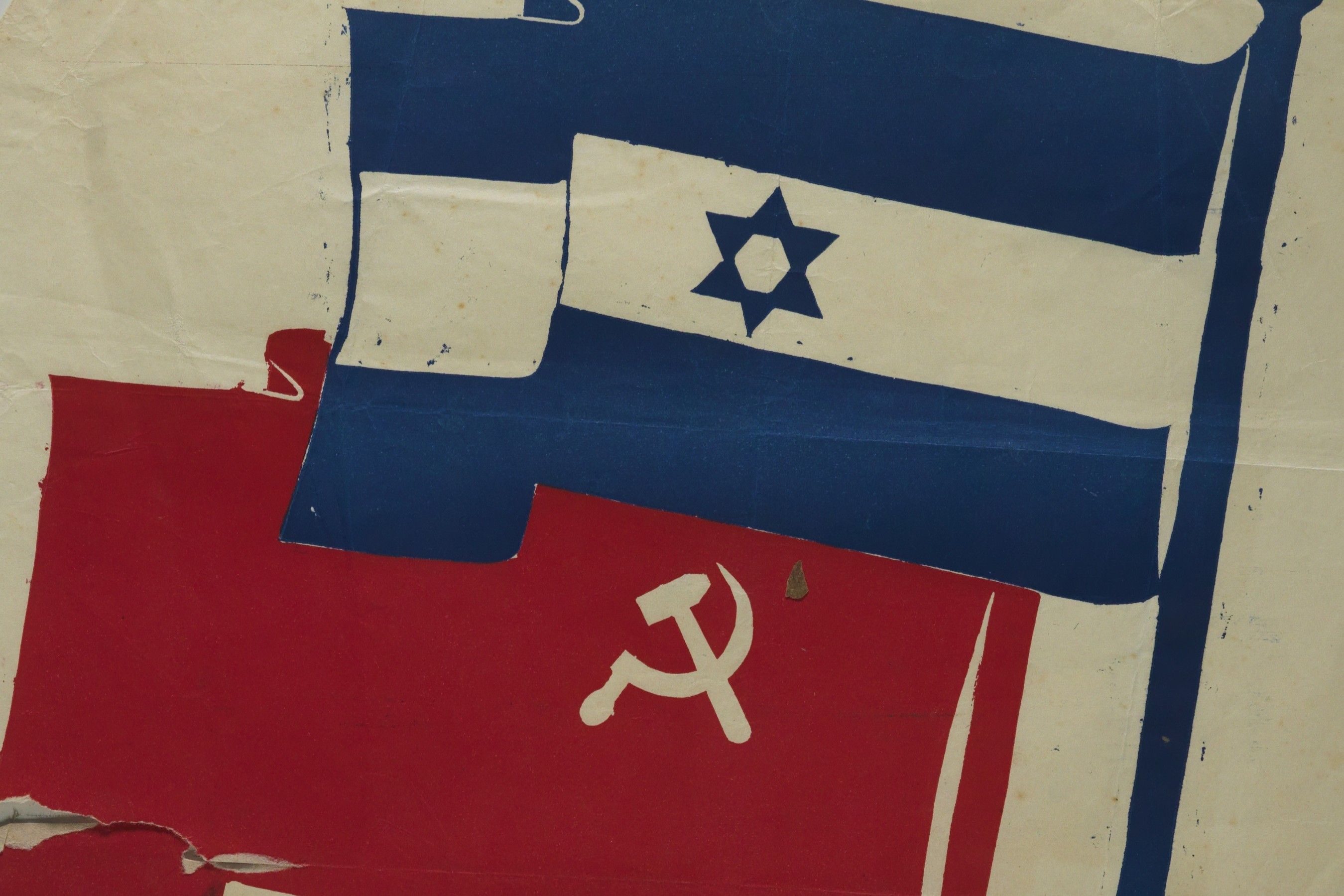
How bad did official Communist policy on the Zionist colonization of Palestine become? This bad. And well before there was even a United Nations. The official Communist movement’s abandonment of opposition to Zionist colonization and its defense of Arab self-determination accelerated immediately with the end of the Popular Front inaugurated by August 1939’s Soviet-German Non-Aggression Pact. A shift several years in development from the Comintern’s original and consistent hostility to Zionism and its colonization, under British guns, of Palestine, began in the mid-1930s. Influenced by events such as the victory of Nazi barbarism and growth of fascism elsewhere; a new wave of European pogroms and anti-Jewish persecutions; The U.S. and others closing the doors of asylum to fleeing Jews; decades of immigration and increased Jewish population in Palestine itself; escalating Arab resistance to Jewish colonizers; the Communist Party’s move to the ‘Popular Front’ which sought alliances with liberal forces; and lastly the British ‘White Paper’ of 1939 which sought to gain Arab support in the coming war by curtailing Jewish settlement. With the end of the Pop Front, however, England went from a ‘democratic’ power to again an enemy imperialist power, with Zionist hostility to England’s new policy now seen as a manifestation of ‘anti-imperialism,’ becoming a legitimate struggle whose anti-British colonization potentially—in theory–reopened a possible alliance with pro-German (by virtue of being anti-British) Arabs. Comintern policy had become almost entirely a manifestation of the needs of Soviet diplomatic foreign policy and was the opposite of what it was a decade previously.
‘After the Liquidation of the Balfour Declaration Palestine’ by M. Welner from The Communist. Vol. 18 No. 8. August, 1940.
(Correspondence from Palestine.) THE Jewish settlement in Palestine has just been living through bitter, painful days—in the very midst of the spring month of May. And who knows whether, as a result of this, the future days will not be even more difficult and painful?
On the night of May 17, the Jewish settlement received, in deep sorrow, through the Jerusalem radio, the official “White Book” of the Chamberlain-Halifax-MacDonald government. The Balfour Declaration, which pointed toward Palestine as a National Home for the Jews, has passed away to the other world, where lie many documents and “National Homes” that sprang into being with the first World War and that have now disappeared with the newly approaching world war.
ZIONISTS BETRAYED BY CHAMBERLAIN’S “WHITE BOOK”
The blow for the Jews in Palestine did not come of a sudden. For many days beforehand, the Jewish people knew that it was inevitable, that all the springs put into motion by the Zionist leadership in London, in Washington, as well as in Paris, to help in avoiding the decree, would not help as they had helped on previous occasions. The present rulers in England, heavily enmeshed in their own entanglements, could not continue any longer with their twofaced game, with all its hypocritical words and promises for Jewish Zionists. In the dangerous situation that threatens the British Empire in the Mediterranean, the Chamberlain government, under pressure of the Arab masses in Palestine and of the Arab governments in the surrounding countries, has attempted to alleviate its predicament by throwing into the river all of its fake pledges and declarations, with their exaggerated hopes and dreams, including the Balfour Declaration. This plan of liquidation, born in London over half a year ago during the Munich days, has now come to light through the “White Book,” given forth on the night of May 17.
The new “White Book” contains no less of hypocrisy, and perhaps even more, than all the former pronouncements with regard to the Palestine question. The only difference is that here we have everything in reverse form; instead of promises to the Jews, there are here pledges to the Arabs foggy pledges in the style of “If it please the Lord.” The only thing clear in the document is that all former promises to Jews have now become null and void, that the Jews must forever remain a minority in Palestine, and that they will be provided with—minority rights.
The inhabitants of the Jewish settlement in Palestine and the broad Jewish masses, who until now have been lulled with sweet dreams inspired by the myopic Zionist leaders, have now seen their real situation. The “White Book” has aroused the Jewish population in Palestine as never before. Also, the three years of bloody events in the country, with the accompanying economic ruin and embittered passions, have contributed toward depressing the spirit of the people. Nevertheless, the majority of the people have been thinking unanalytically that there was reason in their sufferings, that soon the hindrances would be overcome—that the British power would help. For did not Britain lean upon Zionism, and is she not interested in it?
However, with the approach of a new World War and with the various factors likely to determine the fate of the British Empire, it appeared that the Arabs too were a matter to be reckoned with, since they are concentrated in millions around the Mediterranean; that apro-Zionist policy in Palestine, by antagonizing the Arabs, could only handicap the British Empire in the coming war. Thus, the British government has turned away from Zionism, and the hopes of many Jews throughout the world have suddenly been seen in their true light as dreams that have passed away! Now people are reflecting, they are looking around to see where they are, what they have accomplished, and what prospects they can now expect in Palestine! Now they are considering the hundreds of victims, the dead and the maimed, the ruined economy, the adverse environment of an embittered Arab population, at a time when a terrible war is threatened by fascist Italy!
ANTI-BRITISH PROTEST AMONG THE ZIONISTS
Stormy waves of embitterment, of hatred and scorn for the London extortionists, are now rising in all corners of the Palestine Jewish settlement, among the adult and the young—regardless of party and line. This time, even the officials of the Jewish Agency, the Zionist leaders, have not attempted to restrain expressions of excitement and disillusionment on the part of the Jewish population. At a closed conference of the narrow Zionist Action Committee,1 it was decided recently to organize a campaign of protest and certain forms of passive resistance, because, as everybody, with the exception of the fanatical Revisionists,2 understands, it is futile to speak of an active struggle of the Jewish settlement through an armed uprising. Such a course would mean the complete destruction of the settlement.
The present leaders of the Jewish Agency3 have tried and are constantly trying to come to terms with the Revisionists, so that the latter may not destroy their plans. It was expected that on the proclaimed day of protest, May 18, there would be a united action on the part of the entire Jewish settlement against the British policy. But the Revisionist wolf (Vladimir Jabotinsky) cannot rid himself of his skin. At the very last moment it was decided, according to Jabotinsky’s telegraphed order, to break the united action. His telegram meant: “No aid to Weizmann, no helping him get out of his tangle…” And his followers from the wild and backward strata of the Eastern communities sought to turn the day of protest into an attempt to secure their own domination over the settlement. There occurred various hooligan attacks on workers and even on representatives of bourgeois and reactionary Zionists, e.g., the attack on the mayor of Tel-Aviv, I. Rokeakh. Such disruption was for the Revisionists the main object on the day of general protest.
Unfortunately, part of the guilt for this ruffianism falls upon the official leaders of the Histadruth4 who constantly try to conciliate the Revisionist camp of internal fascism.
In the negotiations, the Revisionists demanded that no red flags should appear in any of the demonstrations, no slogan that might give any expression to Left Zionism, but that only the blue-white banner should be borne and only the “Hatikvah” be sung. The representatives of the Histadruth in the National Council5 and in the Jewish Agency yielded to this demand, and they, together with the reactionary-bourgeois Zionist representatives, ordered that no labor organizations should on that day raise the red flag. The Histadruth leaders also ordered that, if the Revisionists should attempt any actions, there should be no resistance and that clashes with the Revisionists should be avoided at all cost.
After their demands were accepted, the Revisionists, with characteristic demagogy, declared, at the eleventh hour, that they did not wish to march together with the beaten troops of Weizmann’s camp, that they did not want “to perform any Purim-plays.” They declared that they would protest in their own manner.
One must say that, inasmuch as these wild Revisionist youth wanted to show their influence, they did show their numerical inconsequence. Only a few hundred people, mostly youngsters of the most backward Eastern communities, participated in their demonstration. But they also showed that with their wild arrogance and unchecked hooliganism they could bring about bloodshed amongst Jews —with impunity!
The tremendous confusion of the Histadruth leaders has its effect upon the broad masses under their influence. Thus the many workers witnessing the behavior of the Revisionist hoodlums on the streets did not give them the answer they deserved.
In the meantime, the Revisionists won their demands. On the day of protest there were no red flags on the streets, although some workers, even from Zionist labor groupings, did not, as a result, participate in the general demonstrations.
On the day of protest, in spite of certain comical features, to be mentioned later, there was expressed a mood never before felt in Palestine. The disappointment in England found its outlet! Feelings of wrath and the humiliation of a deceived people were manifested.
By eight o’clock in the evening of May 17 all public amusement places, all movie houses, theatres and cafes were closed. The electric lights in the show windows of the cities were extinguished. The streets, wrapped in darkness, depressed even more the gloomy spirits of the people. The entire settlement listened with deep emotion to the radio broadcast. Afterwards, the masses of people who streamed into the streets, especially in Tel-Aviv, began reviling the British government and its principal figures—Chamberlain, Halifax and MacDonald—who were responsible for the burial of the Balfour Declaration. Never were heard such bitter and sharp words or such imprecations as were heaped in a veritable torrent upon the British swindlers and world robbers by the Jews that night in Palestine.
The organized expression of protest took place the next day, during the afternoon of May 18. On the streets of the cities, Haifa, Jerusalem, and especially Tel-Aviv, there marched in wide rows many tens of thousands of Jews of all strata and ages. In Tel-Aviv alone, about fifty thousand people participated in the march.
Unfortunately, however, these demonstrations did not give expression to the hatred of the British government that actually burned in the hearts of the people and that was privately expressed in the sharpest terms. Those who arranged the street parades, the official leaders of the Agency and of the National Council, as well as the leaders of the Tel-Aviv municipality, evidently tried to show “delicacy” toward the governmental power in the country and in London. They had applied beforehand for a permit, and it seems that they had pledged themselves to be well behaved.
Thus, the big demonstration parades were actually like funeral ceremonies. Not a sharp word throughout the march, not even one song of struggle, no placard against the government, against the British imperialist fakers. But there were many slogans taken from sentences in the Bible, in the Hagadah of Passover, and partly from prayers. One could have believed that it was a religious procession. In Jerusalem, as in Haifa, scrolls of the Torah were carried at the head of some parades. In Jerusalem the rabbis marched with the Zionist leader, Usischkin, at their head, carrying in their hands the scrolls of the Torah, unrolled at the sentence: “And this land I shall give unto thee.” Before them, they carried a stand on which the Torah was being read, and they also carried ram’s horns, on which they blew…One can hardly say that the British lion would get terribly frightened by such “weapons.”
Generally, in all of the cities, also in Tel-Aviv, the rabbis marched at the head, followed by the Histadruth representatives and the entire people. But still, here and there, one could hear among the demonstrators single fierce outcries that rent the heart.
Generally, at the final points of gathering, one did hear a certain number of sharp speeches, something one was unaccustomed to hear from the mouths of Zionist speakers and leaders in regard to the British government. In Jerusalem, Chief Rabbi Herzog publicly tore up the “White Book,” and Usischkin declared that the Jewish people had survived Torquemada of the Inquisition and the tsarist government and would also survive the present British rulers.
Usischkin also addressed the Arabs in a message that was not particularly sage. But the simple fact that a person like Usischkin did find it necessary to address a word to the Arabs shows the change that is now taking place in the camp of the Zionists. Usischkin said:
“To you, the Arab population of the country, we send our word in this difficult moment. Until now in the course of twenty years the British government has deceived us Jews. Now it announces ten years of cheating you. The British government takes everything away from us, but it will give nothing to you. We understand your position and your National movement, which you serve, but your conduct against us is bad. You have enough room in other neighboring countries. Then let us remain the owners of this country that belongs to us as an inheritance from our ancestors, and we shall remain good neighbors.”
For a leader like Usischkin it should have been clear that the Palestine Arabs, who struggle with so many sacrifices for their rights in Palestine, will not, at a moment when they are seeing their struggle bring achievements, all of a sudden depart from Palestine into the deserts. It would have been much more logical if his address had advocated that both peoples should find a way for a common life in Palestine! But it would be too much to expect such a conclusion from Usischkin. Nevertheless, the mere fact that there is an understanding that one must begin to talk to Arabs will perhaps lead the Zionists to a still clearer comprehension of their status in Palestine.
Quite characteristic was the attitude of the Palestine government to the protest day of the Jewish settlement. It seems that the government authorities have decided to carry through the publication of the decree liquidating the Balfour Declaration as a “kiss of death.” The organs of the administration called together the representatives of the leading organs of the Jewish settlement and told them in so many words: “We know and understand how excited you are over the ‘White Book,’ and we understand that you wish to express your protest by getting it off your chest. Well, why not, we have nothing against it, but only on one condition, that you let us know in advance against what and how you want to protest, and that you take upon yourselves the full personal responsibility that everything will be in order. It is understood that the government must be informed in advance of everything you plan to do.” Thus, the government officials “reasoned” with the Zionist representatives and offered them aid in calmly swallowing their bitter pill.
WEAKNESSES OF THE PROTEST
Consequently, if one wants to summarize the protest campaign, one must regard it as a huge failure for its organizers and for the Jewish settlement. First, the fact that the official Jewish representatives accepted the government’s advice to request a permit and to notify it of the entire protest proceedings, to a great extent deprived the protest of its weight. Secondly, the Jewish organs that organized the general strike exempted in advance all the Jewish government officials from strike duty, and thus imposed a limit upon the scope of the activity of the Jewish settlement in general. True, the government would not have legalized the strike unless it remained within the limits of the purely Jewish enterprises. True, also, the government took signed pledges from its Jewish officials that if they did not report for work on the Jewish strike day they would be “released” from their positions. Nevertheless, that the government dared to put such demands to Jewish officials and to give warnings to Jewish representatives is explainable by the fact that, with the exception of a certain number of immigrant Jews, especially in the settlements of Emek, who are permeated with Zionist idealism, there are widely prevalent—among the officials in particular—strong tendencies toward careerism. The government was aware that it could demand from its employees signatures to no-strike pledges, and the Zionist leadership knew that it would be futile to appeal to them to strike! The strike day of the Jewish population on May 18 was felt only in purely Jewish enterprises (and even then not everywhere; in the rural sections, work was continued in some orchards). All the city business places, cafes, restaurants, ice cream stands, etc., were closed. But the railroads, the post offices, the telegraph stations, the courts, and the ports were active as usual. An entirely different form is assumed by an Arab strike, which first of all hits all the government enterprises and institutions. This shows the relative positions occupied by the Jews and the Arabs in the country. Hence, the Jewish day of protest was essentially a failure.
The requested legalization caused the parades to appear like funerals, notwithstanding the fact that large numbers of people participated. There was no battle-cry, no sharp word against those who had deceived this protesting mass; there was no placard with a slogan against the government. This had the reverse effect of restraining the mass storm, the urge for a tempestuous outbreak of protest.
Last and most important, there were no slogans, no pointing to a way out, no prospect for the day following the protest demonstration or for the future in general.
This conciliating attitude toward the government, this helplessness, this refusal to face reality and to look for the only possible way out through making peace with the Arab population enabled the Revisionist gangs to raise their heads. In spite of their small number, the Revisionists dared to attack the general demonstration in Tel-Aviv, to beat up several dozens of workers, and also to lay hands upon a number of the Histadruth activists (two contributors to the Davar6 were taken to the hospital; also the leader of the Left Poale-Zionists,7 Erem). Thus encouraged, the Revisionists on several occasions staged their own adventurist demonstrations under the slogans: “Down with Weizmann!” “To Hell with the Workers!” and “Jabotinsky, Save Us!” after the fashion of the Nazi “Heil Hitler’ and “Sieg Heil.” Unrestrained, the Revisionists on the evening of that May 18 day of protest felt sufficiently sure of themselves to make an attack on the Brenner House (Histadruth Building) in Tel-Aviv and to shower stones on the workers who guarded the House.
Briefly, the day of protest passed with vast numbers of the Jewish masses gnashing their teeth in anger, but with an undermined will, with an unclear road taken by the official leaders of the settlement and of the Zionist movement. The government is aware of this, just as it is aware of the Revisionist plague in the settlement, and, therefore, it tolerates its hooliganism, which helps the government to split the Jewish settlement and thus to carry out its plans more easily.
PROGRAM OF COMMUNIST PARTY FOR UNITED ACTION WITH THE ARABS AGAINST THE FASCIST DANGER
The Communist Party of Palestine is working in the best way possible to serve the interests of the Jewish settlement through its endeavor to establish peaceful relations with the Arab population. At the present moment, the Palestinian Communist Party is devoting all of its energies toward calming the mutual anger of both peoples in the effort to direct their attention against the fascist menace from without and from within.
The attitude of the Communist Party of Palestine finds its expression in its published appeals, in its illegal press, as well as in all the organizations where its members and sympathizers are active.
In the Arab neighborhood, the Party points out that Hitler’s and Mussolini’s agents are now interested in aggravating the relations between Jews and Arabs in the country, and that, in spite of the incomplete realization of the Arab demands, there is no sense in furthering the revolt movement, because, in the present moment, the partial yielding and promises of the British government to carry out a gradual reform in the country constitute a certain accomplishment, which may eventually, under a proper political vigilance, lead further toward realization of the full right of self-administration. The Party points out that one has to consider the international situation, that the fascist agencies are far from being interested in improving the conditions of the Arab masses, but, on the contrary, are interested in crushing every movement for liberation and independence in all colonial lands, as one can learn from the example of Albania.
In the Jewish neighborhood, the Party calls for struggle against the adventurist appeals of the Revisionists, those under their influence, and other Zionist groups who are seeking to organize armed revolts, which would result in the complete destruction of the Jewish settlement.
The Party points out that, for many years, it has warned the Jewish settlement not to rely on British imperialism and its promises, foretelling that under each changed situation the settlement would be betrayed and all promises forgotten. Now, “White Book,” the Chamberlain government confirms the correctness of the Communists, and especially of the Palestine Party, in their warning that only in an understanding reached with the Arab people is there to be found a way out for the Jewish settlement, a prospect of a life of security and peace, and a partial solution to the problem of the refugees.
But the Communist Party does not wish to take advantage of this vindication of its position for narrow party purposes. The Palestine Communists, devoted to the interests of the Jewish settlement and to its advancement, demand the greatest vigilance in the interests of the settlement from all those who have their eyes open to reality. And that reality is a very bitter one: a wall of enmity between Jews and Arabs; open betrayal on the part of the British; an imminent danger of war with the fascist countries, a possibility of Italian attacks, especially of air-raids; and a very hard economic situation intensified by widespread unemployment. Therefore, the Communists appeal for the use of all possible means in the effort to reach an understanding with the Arabs. Although the Communist Party has its own perspective and program for the future shaping of the land, for the collaboration of both peoples, it does not at this moment put forward any program, but only one slogan: Unity, one united front of all those who see the necessity of reaching an agreement with the Arabs. Zionists and non-Zionists, those standing for a form of government built on a parity basis, those standing for the idea that the Jewish minority should reach 40 per cent of the population, and all others, the group of “Mapai” (Right Poale Zionists), adherents of Kaplansky, the Hashomer Hatzoir,8 Poale Zion, Brith Sholom,9 together with all those who understand now the urgency of an understanding with the Arabs, should together form one single front for common work to secure such an understanding.
Finally, the Communist Party, realizing the danger of Revisionism and its senseless attacks upon the Histadruth, as well as upon the Zionist organization, realizing that through such attacks the atmosphere can be poisoned with fascist venom, especially for the backward sections of the population, has decided to call upon all Communist followers and sympathizers to support the present leadership of the National Council and of the Jewish Agency with Weizmann at its head. The Communist Party declares that it does this, not because it considers Weizmann’s course to be correct, but because the progressive workers cannot be indifferent to the fate of the settlement. Of course, a settlement under a progressive leadership would be better than under the leadership of Weizmann, but it is better to have Weizmann than Jabotinsky, because the Revisionists only want to draw the settlement into the entanglement of a bloody adventure.
In spite of the fact that it is necessary to direct sharp criticism against the leadership of the Histadruth, the Communist Party calls for defense of and devotion to the very existence of the Histadruth against the wild Revisionist attacks.
In this most trying moment, the Palestine Jewish Settlement can see more clearly who are its enemies and who its real friends.
NOTES
1. Zionist Action Committee–The inner executive or bureau of the executive of the world Zionist Organization.—The Editors.
2. Revisionists—Members of the New Zionist Organization, Jewish fascists led by Vladimir Jabotinsky, working in the interests of Mussolini. They are called “Revisionists” because of their slogan for a revision of Zionist policies. They contend that the Zionist organization led by Dr. Chaim Weizmann is not militant from the nationalist-chauvinist standpoint. The Revisionists are for an armed struggle against the Arabs and are now conducting a campaign of terrorism in Palestine.—The Editors.
3. Jewish Agency—A body of Jewish leaders, Zionists and non-Zionists, recognized by the British mandate over Palestine as representing the Jewish people—The Editors.
4. Histadruth—Jewish Labor Federation of Palestine.—The Editors.
5. National Council—An elective body speaking in the name of Jews of Palestine composed of representatives of various parties.—The Editors.
6. Davar—Daily organ of the Histadruth.— The Editors.
7. Poale Zion—“Workers of Zion,” Rightwing Socialists.—The Editors.
8. Hashomer Hatzoir (Young Guardians)— Left-wing group within the Zionist organization.—The Editors.
9. Brith Sholom (Pact of Peace)—A group led by the president of the Jerusalem Hebrew University, Dr. J.L. Magnes, which stands for peace and understanding between Jews and Arabs.—The Editors.
There are a number of journals with this name in the history of the movement. This Communist was the main theoretical journal of the Communist Party from 1927 until 1944. Its origins lie with the folding of The Liberator, Soviet Russia Pictorial, and Labor Herald together into Workers Monthly as the new unified Communist Party’s official cultural and discussion magazine in November, 1924. Workers Monthly became The Communist in March,1927 and was also published monthly. The Communist contains the most thorough archive of the Communist Party’s positions and thinking during its run. The New Masses became the main cultural vehicle for the CP and the Communist, though it began with with more vibrancy and discussion, became increasingly an organ of Comintern and CP program. Over its run the tagline went from “A Theoretical Magazine for the Discussion of Revolutionary Problems” to “A Magazine of the Theory and Practice of Marxism-Leninism” to “A Marxist Magazine Devoted to Advancement of Democratic Thought and Action.” The aesthetic of the journal also changed dramatically over its years. Editors included Earl Browder, Alex Bittelman, Max Bedacht, and Bertram D. Wolfe.
PDF of full issue: https://www.marxists.org/history/usa/pubs/communist/v18n08-aug-1939-The-Communist-OCR.pdf
 Revolution's Newsstand