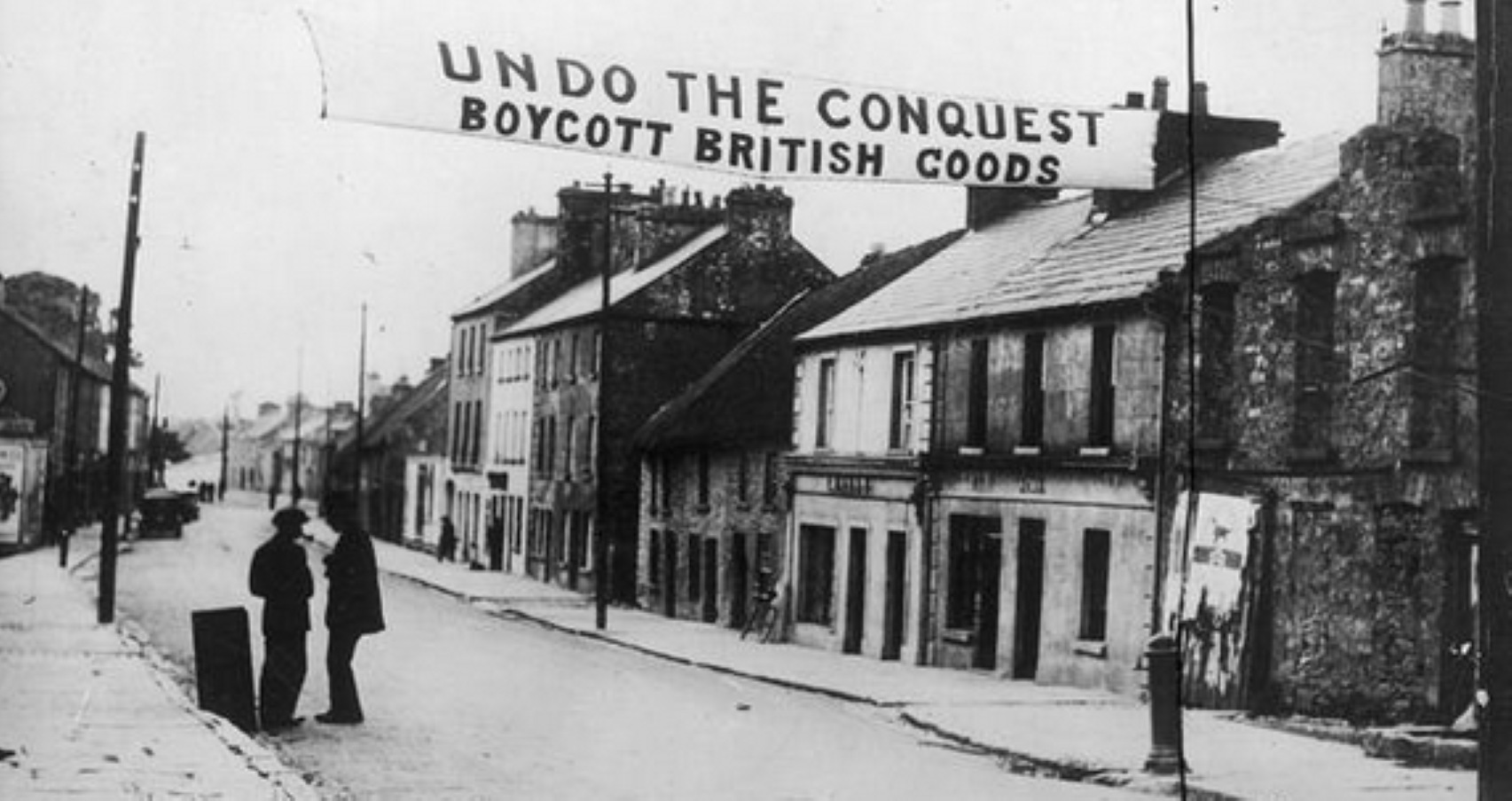
To this day Irish self-determination and genuine sovereignty remain circumscribed by continued British occupation, relations with the U.S., and the many legal dictates of the imperialist European Union. Several years after its 1923 Civil War loss in the Irish Civil War, De Valera led a ‘constitutional’ split from his erstwhile comrades in I.R.A. and constituting itself as the legal, institutional ‘republican’ part christened Fianna Fail—the Soldiers of Destiny. Frustration over Ireland’s woeful poverty, partition, and mass emigration and the country’s subservient ‘Free State status,’ Ireland’s unfinished revolution was not a background background to the 1932 Irish elections, but its preoccupation. Feeling secure in power won in the Civil War, Fine Gael called an election to see off its challenge and ensure their role through increasingly challenging time. Anti-Communist and anti-I.R.A. rhetoric would become vociferous with the beginnings of the emerging fascist Blueshirts ‘Family, God, and Property’ presaging future combats. Running on a populist promise of a ‘Free, Gaelic and Catholic’ Ireland along with national reunification, and mostly empty words pandering to Labour, but appealing to the rank-and-file farmers, workers and artisans that fought the Revolution, Fianna Fail was able achieve an historic win and form the first ‘Republican’ government, with the Irish Labour Party, since the Civil War. The small Communist movement represented by the isolated Irish Workers League, and led by the controversial James Larkin, recently split with the minority constituting themselves the Worker’s Party of Ireland, led by James Connolly’s son Roddy. De Valera’s defeat of the rabidly pro-imperialist party (today’s Fine Gael), its tepid moves to assert Irish sovereignty of what was still very much a semi-colonial country, and its professed neutrality in international affairs, brought swift, even unhinged reaction from its rapacious English imperial neighbor. Even the weakest assertions of self-determination met with unrequited hostility by the donner of the Butcher’s Apron. Policies that caused real economic hardships, with generations in poverty forced into mass immigration until the early 1990s—with the profound statistic that the only European nation to have a smaller population today than 150 years ago is Ireland. Joe Troy reports on the Empire’s revenge.
‘British Imperialism Declares Economic War on Irish Free State’ by Joe Troy from International Press Correspondence. Vol. 12 No. 36. August 18, 1932.
After the general election held during February of this year, Eamonn De Valera, the leader of the petty-bourgeoisie Party Fianna Fail (Soldiers of Destiny), became the President of the Irish Free State, The Cosgrave Party, representative of the bankers, big industrialists, shipping interests and the ranchers, was dethroned, and the national reformist De Valera obtained a small majority of seats for his party.
The rise to power of De Valera, who had led the Republicans in the civil war against the Free State Government, set up as a result of the Treaty of Surrender in 1921, but who of late years had conducted a “loyal opposition” inside the Parliament, was a result of the wide spread discontent, arising from the ravages of the severe economic crisis, among the masses of the workers and farmers, and the lower sections of the petty bourgeoisie. In particular it was an expression of the growing anti-imperialist movement which Cosgrave had tried to exterminate by means of a vicious coercion act.
The new Government immediately it came into office, was faced with two tremendous problems, both of which it had to attempt to find a solution for, within the confines of Capitalist propriety. In the first case it had to attempt to satisfy some of the demands of the masses who had voted it to power, particularly in regard to the 100,000 unemployed and the acute housing shortage, and at the same time to consolidate the position of the small native industrialists, whose interest it particularly sponsored. This De Valera attempted to do by the imposition of high tariffs on almost one hundred different articles and the introduction of a demagogic Budget, which while it failed to satisfy the demands of the masses, aroused the fiercest hostility of the larger capitalists. This failure has, however, been overshadowed, by the extent of the hornets nest which the De Valera Government has succeeded in arousing, in the attempt to solve the second big problem.
This was no smaller a task than a complete readjustment of the relations with British imperialism, in order to free the country from the burdens of imperial tribute and to canalise the growing anti-imperialist movement into constitutional channels.
In this attempt De Valera immediately came into sharp conflict with the British National Government. The points in dispute are as follows:
The De Valera Government passed a bill abolishing the oath of allegiance to the English King which was made compulsory for all members of the Free State Dail, by the Treaty Settlement of 1921. The British imperialists state that this is a violation of a “solemn obligation”.
Secondly, De Valera refused to hand over to the British Government the sum of 3 million pounds sterling, which represents the annual payment of the so-called land annuities. These annuities arose out of the land war at the end of the last century, when the British Government found that, owing to the sharp agrarian class war, the landlords were unable to collect their rents without risking their lives. To save their landlord friends, the British Government advanced some 200 million pounds to the peasants. This was to be paid back over a period of 69 years, plus the interest accruing. While collecting this money from the peasants, De Valera refuses to hand it over to the British government.
Thirdly, the British Government demands 2 million pounds a year for the payment of pensions to the police, judges and court officials, who had been the instruments of British rule in Ireland, prior to the 1921 treaty.
Fourthly, De Valera has raised although in no determined manner the whole question of the artificial boundary between the industrial North of Ireland and the predominately agricultural South. This division of country imposed by British imperialism, means for the people of Ireland the upkeep of two separate Parliaments, between them costing over 40 million pounds a year, for a small population of less than 4% million people.
These are the immediate issues.
In the correspondence that took place between De Valera and J.H. Thomas, the British Secretary of State for the Dominions, De Valera states in reference to the tribute payments:
“They put a greater burden on the people of the Irish Free State, than the burden of the war reparations payments on the people of Germany, and relative to taxable capacity a burden ten times as heavy as the burden of the people of Britain of their debt payments to the U.S.A.”
Further, De Valera pointed out:
“British maintenance parties are still in occupation of some of our principal ports, even in the area of the Free State. The coastal defence is still retained in British hands.”
This statement provoked a reply from Lloyd George in the British House of Commons, which completely unmasks the pretence that the Free State is a “free” Dominion, and lays bare the real attitude of British Imperialism towards Ireland.
“We had the experience of the War”, he stated, when the coasts of Ireland were the deadliest trap for our ships. If the coast of Ireland had then been in the hands of an Independent Sovereign Sate, we might have been done for, and we are not going to take that risk.”
And so, in order to maintain British Imperialist domination of Ireland, especially in view of the importance as a war base, in the preparations for an imperialist war on the Soviet Union, or an inter-imperial conflict, the National Government of Britain, led by the Social Democrats MacDonald and Thomas has declared an economic warfare on Ireland. A 20% tariff has been placed on the import of Irish Free State goods to Britain. The ports of Dublin and Liverpool are at a standstill, so far as Anglo-Irish trade is concerned De Valera having replied by the imposition of a counter tariff British goods.

When it is realised that 90% of the trade of the Free State was formerly done with Great Britain, while the volume of British Imports to Ireland represents only about 5% of Britain’s total trade, it can easily be seen where the advantage lies in this warfare. Meanwhile hundreds of workers are being disemployed on both sides of the Irish sea.
How do the Fianna Fail stand up to all this display of the mailed fist by Thomas and Co.? Do they boldly fling the challenge of the imperialists in their teeth, and call on the wide masses of the workers and peasants to mobilise for action against the aggression of Imperial Britain and for the complete independence of Ireland? No! In this situation they show the vacillation typical of National Reformism. Afraid of setting the masses in motion lest they go too far, they limit themselves to putting on counter tariffs, thus choosing the battle ground most favourable to the imperialists, and so far as the Land Annuities are concerned, have limited the question down to the composition of a Tribunal which is to “sell out” the claims of the workers and peasants. At first demanding an “outside the Empire” tribunal, De Valera now seems willing to submit the question to arbitration by an “inside the Empire” tribunal, if the “principle” of an “outside Tribunal” is admitted.
On the question of the complete independence of Ireland from British rule, De Valera states that he is prepared to accept an Irish State “with some form of association with the British commonwealth, in some circumstances, and for some recognition of the King as head of the Commonwealth”.
In Home Affairs, the De Valera Government shows its reactionary character clearly. The sending of police against the strikers at Kilrush, and to evict a poor peasant at Kinnity in Offaly, and the retention of the secret police brought into being by Cosgrave are only on a par with its impudent demand that the peasants should pay the Land Annuities to the Free State Government to be held in a suspense Account pending arbitration.
And what of the Labour Party? The “Royal” Irish Labour Party that sat at the right hand of Cosgrave while he murdered the workers and peasants of the anti-imperialist movement? They now come forward as “patriots”. While giving slobbering lip service to the struggle of the masses against the Oath and the Land Annuities, Norton, leader of the Social Democrats, runs to and fro from London, and vainly seeks to arrange a compromise along with his allies in the British Labour Party. He is a fitting match for George Lansbury, who with his hands crossed on his breast, calls aloud to the Pope, the Chief Rabbi, and the Archbishop of Canterbury “to stop this senseless squabble” and never even mentions British imperialism. In the Free State Senate the Irish Labour Party failed to vote against a reactionary amendment that suspended the operation of the Oath Bill for eighteen months.
Meanwhile, inside the Irish Free State, and in Northern Ireland the capitalist crisis continues to take its toll among the masses of workers and small farmers. Section after section of the working class is subjected to wage cuts and dismissals. The small farmers are finding the job of getting an existence out of their holdings increasingly difficult. Mass emigration has turned to immigration of those who have lost their jobs overseas. This is reflected in an evident increase in the radicalisation of the masses. The total of days lost through strikes has increased greatly, and the action of the masses against British imperialism and Irish capitalism is being demonstrated in action. Already De Valera has been forced to declare a moratorium on all “arrears” of Land Annuities.
Mass demonstrations of 10,000 at Dublin, and 7,000 at Cork took up the challenge of British Imperialism and declared for “Not a penny for British Imperialism”, “No compromise” and “For an Irish Workers and Peasants Republic”. In Britain itself right in the heart of London, 5,000 British and Irish workers demonstrated to the Police Station, after the arrest of speakers at a meeting in Hyde Park called to protest against the actions of British Imperialism.
The Revolutionary Workers Groups” (preparing for the formation of the Communist Party of Ireland) are fighting for the development of a broad united front of the workers and small farmers, and the revolutionary elements in the Irish Republican Army, for the development of an independent movement of the masses against British imperialism, to counteract the vacillation of the petty-bourgeois leadership and to ensure success in the struggle. Only by a mass movement of the toilers to force forward the struggle on the plane of a struggle for the complete independence of Ireland under a Workers’ and Peasants Republic can success be achieved. Putting forward slogans of “Neither Oath nor Empire”, “Not a Penny Tribute to British Imperialism”, of “Mass refusal of Small Farmers to pay Land Annuities” and “For the Unity and Independence of Ireland under a Workers’ and Peasants’ Republic”, the R.W.G. are giving leadership to the struggle.
All these events have a great significance for the international working class movement for three main reasons:
Firstly, because the conflict between British Imperialism and the Irish Free State, actually taking place during the Ottawa Conference, exposed the real role of Imperialism in relation to the Dominions and Colonies, and gives a tremendous impetus to the National liberation movement, particularly in India. Secondly, because of the tremendous emigrant population of Irish in Britain, in the U.S.A, and in the Dominions which can be won over to Communism. The third reason is best explained in the words of Lenin:
“A blow directed against the British Imperialist bourgeoisie by a rebellion in Ireland is a hundred times more significant politically than a blow of equal force delivered in Asia or Africa. The dialectics of history is such that small nations important as independent factors in the struggle against imperialism act as a ferment, as one of the bacilli, helping to bring to the surface the real force against imperialism, namely, the Socialist Proletariat.”
Such is the historic significance of the present events in Ireland.
International Press Correspondence, widely known as”Inprecorr” was published by the Executive Committee of the Communist International (ECCI) regularly in German and English, occasionally in many other languages, beginning in 1921 and lasting in English until 1938. Inprecorr’s role was to supply translated articles to the English-speaking press of the International from the Comintern’s different sections, as well as news and statements from the ECCI. Many ‘Daily Worker’ and ‘Communist’ articles originated in Inprecorr, and it also published articles by American comrades for use in other countries. It was published at least weekly, and often thrice weekly. A major contributor to the Communist press in the U.S., Inprecorr is an invaluable English-language source on the history of the Communist International and its sections.
PDF of full issue: https://www.marxists.org/history/international/comintern/inprecor/1932/v12n36-aug-18-1932-Inprecor-op.pdf
 Revolution's Newsstand