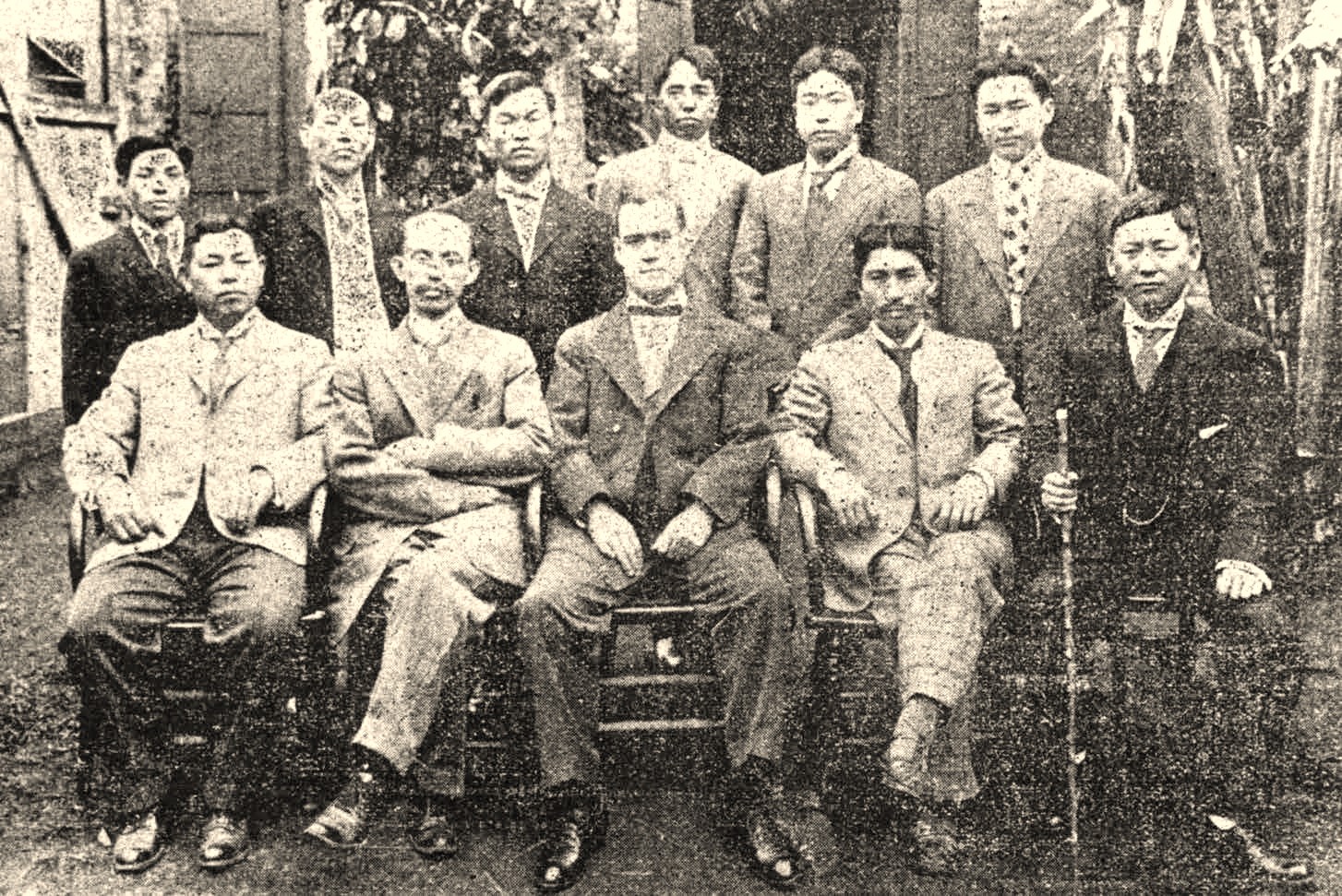
Yasutaro Soga, Kinzaburo Makino, Motoyuki Negoro, Yokiichi Tasaka; back, Yasuyuki
Imai, Tsurumatsu Okumura, Katsuichi Kawamoto, Hidekichi Takemura, Keitaro Kawamura,
Shuichi Ihara. 1909.
Takeshi Takahashi came to America as a teenage “disciple of Denjiro Kotoku,” in 1906 and built a branch of Kotoku’s Socialist Revolutionary Party, established that year, in San Francisco. The S.R.P. and the Bay Area I.W.W. soon held meetings and exchanged papers. By June, 1907 the San Francisco I.W.W. was producing leaflets in Japanese at the same time, the Socialist Party had passed anti-Asian resolutions in California and nationally. While in Chicago Takahashi joined the I.W.W. in 1907, writing articles about Japanese labor in Hawaii and Japan. With the encouragement of Emma Goldman, Josephine Conger Kaneko and others, he launched the Japanese-language I.W.W. paper The Proletariat in 1909. However it was only to last a year for lack of financial support.
‘From a Japanese Fellow Worker’ by Takeshi Takahashi from The Industrial Union Bulletin. Vol. 2 No. 17. June 20, 1908.
Fellow Workers:
Allow me to give you a little information upon recent developments in the Japanese labor movement, although my scanty knowledge of English will not permit a clear expression of what the various tendencies in the movement will lead to.
At the last convention of the Japanese Socialist Party which was held at Tokyo, there was a heated discussion between those who are called “Anarcho-Socialists” and the Executive Committee of the Party.
The faction, termed Anarchists, held the opinion that the political field of action should be abandoned altogether, while the Committee insisted that political as well as direct action should be used in the warfare against the capitalist system of society.
The Committee’s opinions prevailed, although the victory was gained only by a majority of six votes.
But extremes beget extremes. The larger part of the Japanese Socialists have now absolutely abandoned the political field. Direct action and the general strike are advocated as means to the end.
A Federation of Japanese Socialists is going to be formed, but it will not become a part of that “International Socialist Bureau.” which is denounced as a corrupted, old rag-chewing institution, where words, words alone, and no actions are displayed to solve the problems of our age.
But as a matter of fact, as soon as all energies of the Japanese Socialists were centered upon the industrial field alone, the movement underwent a process of regeneration, because the everyday conflicts emphasized the fierce character of the class struggle. Many strikes took place in mills, factories, dock yards, in almost every establishment and every industrial city the industrial conflicts illustrated to the powers that be that the Japanese workers were waking up.
And how have they fought, bravely and undaunted in their spirit, the Ashio and the Beschi Mine Workers, under the red banner against the standards of the Imperial soldiery. These drastic displays were sufficient to awaken the sleeping workingman; and today many industries are in the whirlpool of industrial conflicts and turmoil.
The Industrialists are publishing three papers: “The Himingshinbun” “The Kumanoto Review” and “The Shin Shicho.” Those papers are now energetically advocating economic action, or direct action, among the workers.
The Industrial Unionists also initiated the Anti- Militarism propaganda, a few comrades have already been locked up in jail on this account.
You may be surprised how the propaganda spreads in such military-ruled country like Japan. The soldiers are becoming rebellious, and the commander-in-chief of the Japanese army issued a proclamation last month, appealing to the patriotism of the army, and it is now rumored that drastic measures will be used to stamp out the industrial union movement, the gendarmery is to be increased; a severe vigilance over all known agitators was instituted, but lo and behold! What a shock to all government officials when they learned one day that red propaganda literature had been smuggled in in the dark of night, and that the red leaflets were passing from hand to hand among the soldiers.
Well, you may imagine what our comrades have to suffer under the persecution, continuous imprisonment is the lot of all active Industrial Unionists, confiscation of papers, leaflets and books is a standing order of every day; but pity our masters, these drastic oppressive measures only furnish oil on the fire. The Japanese workers are organizing industrially, for the social revolution, and the government itself is feeling the eruptions under the top of the volcano.
And there are also labor fakirs and traitors—and may our Japanese proletarians learn from the bitter lessons that the American working man had had. Not only arc the fakirs confined to the arena of capitalist playgrounds, but among the Parliamentarian Socialists and Intellectuals arc the most to be feared misleaders.
S. Katayaina, known from International Socialist Congresses, but with no influence whatever among the workers at home, is one of those who would misdirect this awakening spirit of the workers if he could. The most conspicuous person in industrial union propaganda is D. Kotoku. He has wonderful powers to attract young men.
The opponents of Industrial Unionism among the Socialists have denounced D. Kotoku and others as being “spies of the Government” and that they are getting tainted money, but they failed to show any proof, and the workers are beginning to ponder over the fact that the accusers are all agents of capitalist institutions. Katayaina is one of the agents of Okazaki, a capitalist speculation in Texas rice crop, and Katayaina announces that if he gets $100,000 out of that speculation he will give all that money to the movement; (?) but he is engaged also in other capitalist enterprises, and on top of that he is “President of the American Immigration Association.” which is an institution to hoodwink ignorant workingmen.
But, after all, in Japan they are marching on; organizing, lighting and preparing!
But what of the Japanese workers in this country?
The great development of revolutionary ideas in Japan should be reflected also in the American continent among the Japanese. But what do we behold! Dull and indifferent; hardly once a while a glimmer of hope and tire in the eyes of my countrymen! Why that?
The race-problem, material conditions and the despicable attitude of American workers against the Japanese are responsible! Yes, the Japanese in this country are indeed in a pitiable condition, capitalist oppression hangs heavy over their heads, and race prejudices generate in his soul the germ of hatred; they do not know themselves where to go.
If they stretch out their hands to a white brother, even a so-called Socialist included, they are greeted by sneers and stones. True, they may not be as well educated as white laborers are; but they have been so long isolated from the labor movement in this country, that suspicion is still burning in their minds, and it is hard to make him understand that there are white workers who would make comrades of them, who would co-operate and tight with them together.
I can see clearly the fact, as I am one among them.
Now, if a strike or turmoil breaks out they talk about it as if it was a matter of heaven or hell, without knowing that these matters arc closely related to their everyday life. But they must be brought into the movement; and we who understand their life urge them to build up their own movement as a part of the general labor movement.
Some of the American Socialists denounce us as a “backward race!” I have no desire to oppose this flimsy argument, but will our learned intellectuals deny the fact that “a grand awakening” is taking place among these very “backward races.”
I tell you proudly, I am one of the “Coolies of the Orient.” I have no college education, have little experience, as I am young, but the time approached me to wake up, it’s approaching my fellow workers with its command to “Wake up!”
Can American workingmen stop us from rising? True, we have not any unions organized as yet! True, we publish no Japanese labor papers. True, too, we will not let the capitalist class and the authorities of America take us by surprise!
But it’s the time of Germinal. Why do the American Socialists deny it? Not only do they deny it. they preach vicious and brutal antagonism against the Japanese workers!
O, no wonder that the Japanese look more and more over to the other side; that they indulge in the proudness of their own country and seclude themselves as a nation, even a nation in the pangs of revolutionary upheaval.
Just think of that; any worker reaching out his hand to shake with other workers, if he received a stone instead, what would you expect? Is it not human nature to go the other side more and more?
I myself have experienced the stoning and the pouring out of sarcasm on the street by so-called union men. I could not help but have bad’ and bitter feeling at that movement; yet I wanted to be a comrade in the cause.
I don’t know how many Japanese have joined the I.W.W., but you will find, my companions, soon that their influx into the I.W.W. will excel proportionately the vote increase of the Anti-Japanese Social-democratic Party of Milwaukee.
O, may the time soon come, the time when “labor will receive all that it produces.” as then no boundary lines against races and nations will separate comrade from comrade, fellow worker from fellow worker, the time when the Japanese workers, in conjunction with all the world over, will be a citizen of the universe and share in the work and management of the Industrial Commonwealth established by the actions of the Industrial Workers.
Yours for industrial freedom. T. TAKAHASHI. Member I.W.W.
The Proletarian, a bilingual paper published in Chicago by Takeshi Takahashi for ‘Japanese members of the Industrial Workers of the World’, lasted on briefly with a few issues produced in 1909 and 1910. Takeshi came to America as a teenage anarchist, a “disciple of Denjiro Kotoku,” in 1906, and attempted to build a branch of Kotoku’s Socialist Revolutionary Party, established that year in San Francisco. The SRP and the Bay Area I.W.W. held meetings and exchanged papers and by June, 1907 the San Francisco I.W.W. was producing leaflets in Japanese. At the same time, the Socialist Party had passed anti-Asian resolutions in California and nationally. While in Chicago Takahashi’s anarchism developed into anarcho-syndicalism and he joined the I.W.W. in 1907, writing articles about Japanese labor in Hawaii and Japan. With the encouragement of Emma Goldman, Josephine Conger Kaneko and others, he launched The Proletariat in 1909. However it was only to last a year for lack of financial support.
PDF of full issue: https://www.marxists.org/history/usa/pubs/industrialworker/iub/v2n17-jun-20-1908-iub.pdf
 Revolution's Newsstand