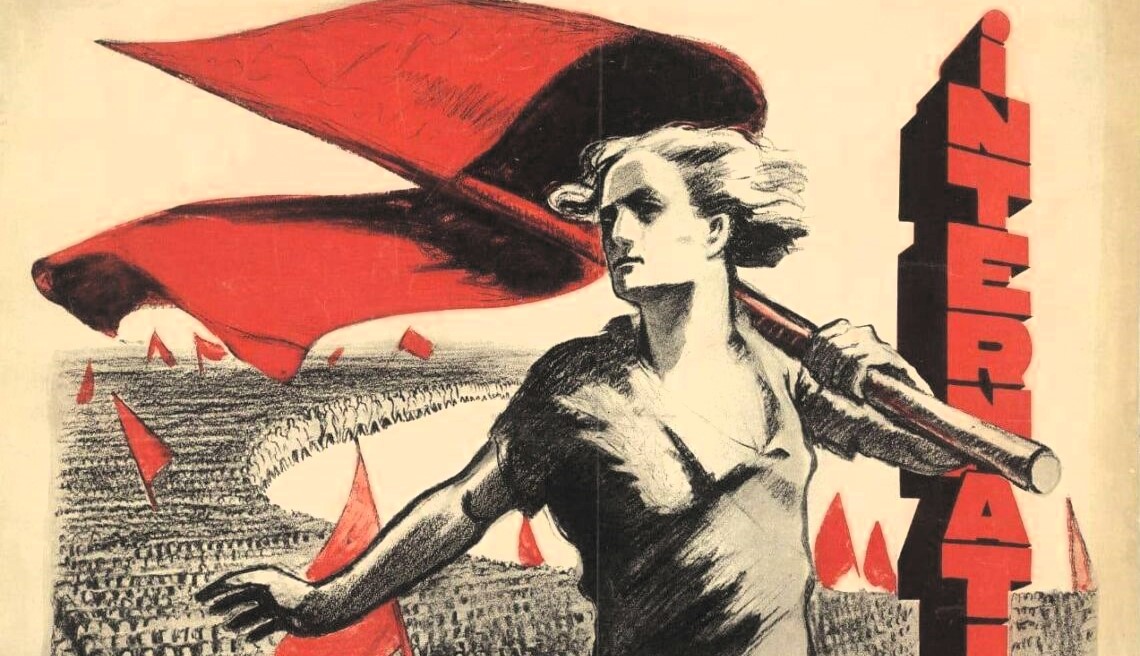
Will be of interest to all students of the Communist women’s movement. The full text of discussions on the main speech of Hertha Sturm, Chair of the International Women’s Secretariat, at the Fourth Communist Women’s Congress in June, 1926, the final genuine one to be held. Below are the interventions from Schwab (Czecho-Slovakia), Kaligina (U.S.S.R.), Sillen (Sweden), Lyubimova (Turkestan), Mortiz (Germany), Olsen (Norway), Kasparova (International Women’s Secretariat), and Billetta (Italy).
‘Discussion of the Report of the International Women’s Secretariat, Part Two’ from International Press Correspondence. Vol. 7 No. 38. July 6, 1927.
Discussion on Comrade Sturm’s Report continued. Fourth Session. Tuesday Morning, June 1, 1926.
Comrade SCHWAB (Czecho-Slovakia): Twenty-five thousand women are organised in the Communist Party of Czecho-Slovakia, constituting 23% of the total membership. Thus our Party heads the way in the Communist International in regard to its women membership. How- ever in the revolutionary Labour Party quality counts for more than quantity. In order to get a clear picture, we must add that quality lags considerable behind quantity. This is greatly due to the fact that the Party which at the time of the split brought 70% of the membership of the Social Democratic Party into its ranks, showed its inability to include the women’s movement, which continued to exist as a section side by side with the Party, publishing its own organs and being relatively independent, into the process of its own development.
The Women’s Section, burdened with Social Democratic traditions, continued to work side by side with the Party without reorganising the forms and substance of its work and without keeping pace with the development of the Party. Neither did the social composition of the women’s movement undergo a change, as before most of the members were women not engaged in production. As before the cadre of functionaries consisted entirely of housewives. The entire activity was limited to the women organised in the Party. There was no linking up with and exercising systematic influence over sections of indifferent women, particularly women employed in factories, who constitute the most important section of the female proletariat.
Reorganisation happened to coincide with the Party crisis, during which the women’s section supported in the fraction strife the liquidators who fought against reorganisation as a “means for the political elimination of women”. Thus organisation progressed very slowly, hampered by fierce strive and accompanied by various deviations. But the Bolshevisation process and the rapid development of the Party had their effect also on this sphere of work. It has been possible to organise in close collaboration with the C.C. of the Party a big network of Women’s Departments on a national scale and to direct the activity of the latter more and more towards the sections of indifferent women.
During the construction of the organisational apparatus for work among women which was to be conducted on entirely new lines, it became evident that there were not enough active workers for this branch of our work. Thus parallel with the construction and improvement of the apparatus, we were confronted with the task of training a cadre of Bolshevik workers for this branch of our activity. Thanks to the energy with which the Central Women’s Department worked in this direction, assisted by the self-sacrifice work of rank and file women comrades, it was possible to organise on a national scale Agitation and Propaganda Schools for women. These schools which, being first attempts in this direction, showed many defects and shortcomings, did nevertheless very useful work and aroused great interest among men and women comrades appointed for work among women, and yet lacking the necessary guidance for this new form of work. The success of theses courses was so great that, when they came to an end, we had at our disposal a cadre of 600 active workers, 40% of whom were women employed in factories.
The first signs of systematic work in this sphere were already visible in the organisation and conduct of the International Women’s Day. The organisation of this campaign which was this time carried on by the Party as a whole and was therefore on a much broader basis than ever before, was much more successful than in the preceding years. Concentration on work among different elements, particularly women employed in factories, had also good results. Meetings at factory gates, big demonstrations and meetings in market places convened under the slogans of the Party and mass attendance at these meetings were a proof that the work was carried on on correct lines.
Another example of the correct policy of women’s departments in connection with their new tasks, was the strike of needle women which lasted five weeks and was carried on on a national scale. During this strike, the Women’s Departments showed much initiative, they got into contact with the most active elements among this section of working women, they organised meetings, had their representatives in the strike committees, spoke at all strike meetings, and the Central Women’s Department participated unofficially in the sessions of the central. strike committee. These were the first attempts at trade union work, which was up till then our weakest point and which since then has been, together with nucleus work, the main task of the Central Women’s Department.
The economic and political situation in Czecho-Slovakia, the ever growing influence of the Party, the united front slogan which is bringing more and more elements into our ranks, together with the successful Bolshevisation process of the Party, constitute the objective and subjective premises for further purposeful work also in the sphere of agitation and propaganda among women masses. How the connecting link between the masses and the Party is to be established, is the question which interests our cadre of active workers most, and the decision and directions of the International Women’s Conference on this subject are anxiously awaited.
Comrade KALIGINA (Soviet Union): Comrade Sturm did not deal with work among peasant women in her report, because our brother Parties have not yet taken this work in hand in their various organisations. Even the delegate from Czecho-Slovakia where Communist nuclei exist in the rural districts, has said nothing about work among peasant women. And yet the time has come for us to tell our Communist brother Parties that this work must be done.
There is certainly a difference between the position of your peasant women and ours. For instance, it is difficult to approach our peasant women, because they cannot read or write, and are mentally backward. In your countries peasant women are not illiterate, but their minds are warped by bourgeois teaching, by the lives of the reactionary and gutter press, moreover they are religious. Conditions of their every day life make it difficult to capture them for the proletarian and peasant movement. But the economic crisis, unbearable taxes and high cost of living are revolutionary peasant women in a number of countries, and they are trying to organise themselves. Nearest to the proletariat are the poor peasants and agricultural labourers. In Russia too, we began our work among these elements, whom we have never left out of account. In Western countries too, it will be necessary to work among these people. Out of the midst of this section of the rural population, will probably come the active workers whom we need for work in the villages.
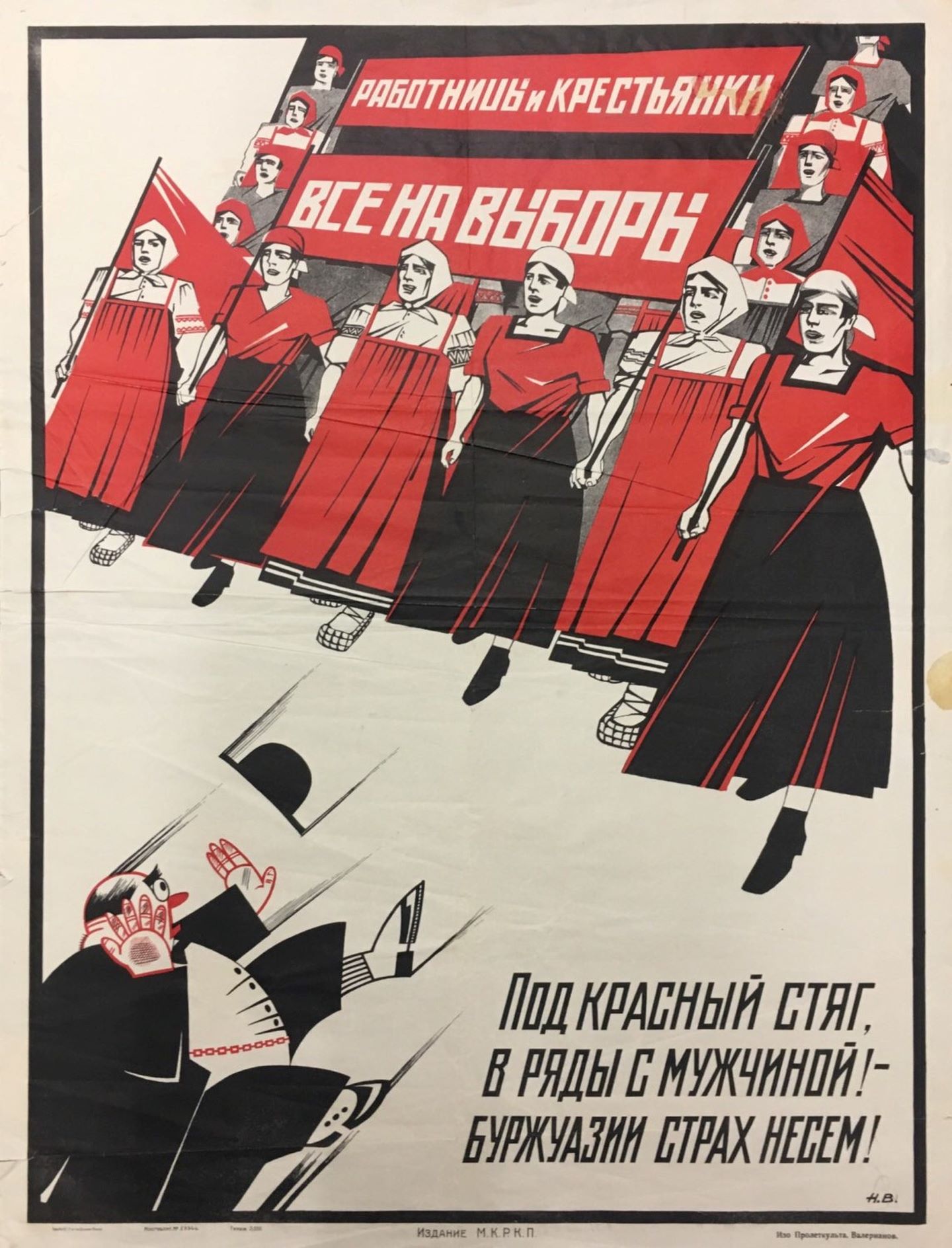
In view of the higher educational level of the population of Western countries, the best agitational means is to introduce good books into the villages, in which, without enlarging on Socialism of which peasant women are very much afraid, the humiliating position of peasant women is exposed. What is the best way for the introduction of books in the villages, and what books do peasant women in your countries want most of all? The bible and novellettes are spiritual poison for peasant women. By supplying the villages with revolutionary literature, this kind of books is to be eliminated. If Communist Parties are to have the masses with them, they must be able to issue slogans capable of rallying peasant women around the Party and of drawing them into the Party campaigns (International Women’s Day, campaign against taxes, high prices, and war, etc.). At present when our opponents are wide awake, and make use of Russian experiences, it is essential for the Party to pay more attention to this question.
Comrade SILLEN (Sweden): During the discussion some comrades said that Sweden’s reply to the questionnaire represents a Left deviation. This way of putting it might create the impression that we in Sweden have not taken the trouble to apply special methods for work among women. This is certainly not the case.
We are fully aware that real mass work must be carried on. Since the Party split in 1924, our Party saw the necessity. of standing up for the interests of working women. Our Party also fully realises the importance of Women Delegate Meetings. That they have not yet been introduced is a matter which I should like to discuss later on.
In spite of the difficulties which we encounter in our work in this sphere, we can report progress. Women Party members are taking now a much more active part in Party work than before, and I can say that we have a small, but select group of comrades who know how to carry on Communist work. The effect of this work is: the greater interest and the greater activity of Party comrades in trade union work. We have succeeded in having several women members elected to the committee in various places. This has never happened before. Women comrades play an important role in the circulation of newspapers and literature and also in individual propaganda. Our women comrades have also taken an active part in fraction work in the Co-operative Women’s Guilds, temperance societies, etc.
I will sum up our progress as follows:
1. Increased activity in the trade union.
2. Increased circulation of our women’s newspaper “Röda Röster (“Red Voices”).
3. The education of women comrades and their class consciousness have reached a higher level.
These are a few factors which show that prospects in Sweden are fairly bright.
During the whole of April the Party carried on a special women’s campaign the main slogan being “One thousand women employed in industry into the ranks of the Party!” It is a pity that this campaign coincided with the tenth anniversary of “Politiken” (Central Organ of the C.P.S.). Final reports on this women’s campaign are not yet to hand. However, the information which has already reached us shows that we have secured 35 new agents for “Röda Röster”, that 600 more copies of it are published and that 151 new members have joined the Party.
The speaker expressed regret at the unsatisfactory connection between the International Women’s Secretariat and the Sections and recommended utilisation of all possible connections. The best thing would be for members of the Women’s Secretariat be given an opportunity to visit themselves the various Parties and to get knowledge on the spot in regard to work among women.
Comrade LYUBIMOVA (Turkestan). The question of work in the East cannot be ignored in the work of the International Women’s Secretariat.
I will tell you of the experiences we had in the course of our work in the Asiatic Republics of the Soviet East. There are four autonomous Soviet Republics in Central Asia: Turkmenistan, Uzbekistan, Kerghisia and the Tartar Republic. These four republics have a population of at least 15,000,000, one-half of it being women.
In Central Asia, the Soviets and the Party work under a feudal-patriarchal regime which although doomed to extinction, has still a strong hold on the country. The economic backwardness there is enormous. Prior to the revolution, Central Asia was a kind of semi-colony of the Russian Empire. Its chief role then was to supply raw material, particularly cotton. No factories were built there, hence the small number of proletarians, among whom are 1000 women. A result of the semi-colonial policy of the czars in Central Asia is the terrible cultural backwardness of the population. Only a little while ago, 1% of the population was able to read and write, and this 1% did not include any women. Two years ago there were 25 women in Turkmenistan who could read and write, and we know them all by their names, and yet the female population of Turkmenistan is 400,000. The influence of the clergy is still very great, religious fanatism, crass superstition and prejudices of all kinds prevail.
The Soviet legislation forbids “Kalym”, i.e. purchase of brides, which still prevails and which reduces women to the position of chattels and slaves. In spite of our legislation and our indefatigable struggle against this abnormity, women are still bought and sold in the villages of Central Asia. The price paid for women today fluctuates between 300 and 6000 roubles, or 12 to 50 camels. Soviet law punishes marriages of minors, but religious law allows them. Little girls of nine are given in marriage, as the “Shariat” (Mohomedan religious code) has fixed nine as the age of consent. It frequently happens that the relations of the husband inherit after his death not only his camels, “Yurta” (tent) and other household goods, but also his wife.
What are we doing to cope with these terrible conditions which threaten the population with complete degeneration? We organise medical consultation centres, playgrounds for children, in fact we do our utmost to raise the cultural level through the women of these countries. We train women teachers and doc- tors from the midst of these women. Over 500 Uzbek women attend pedagogical institutes. For our conditions this is a considerable cultural force, which will soon be ready for action. Altogether we pay much attention to women’s education through the department for work among women and also through the People’s Education Commissariat.
Apart from girls’ schools for the organisation of which the Women’s Department does a great deal, schools for adult women are organised. Two years ago there were only 25 women in Turkmenistan who could read and write, to-day, there are already 7000 literate women, and this is a great step forward.
Moreover, we attach considerable importance to the inclusion of women into the process of production and into the co-operative movement.
In connection with this, another important point must be mentioned: land reform. When “Basmatch bands” (robber bands) were supported by British money, when the sphere of activity of the Soviets and the Party was limited to the Tashkent District, such a reform could not be thought of. It was only in 1923 that the Party began to turn its attention to peaceful economic cultural work. Land reform was decided upon and carried out only in the current year. The reform applies also to women, for not only is women’s right to land and water recognised by decree, over 1000 farms managed by women had land allotted to them. Allotment of land proceeds in Central Asia not as in Russia according to the number of members in the family, but per family. Thus, widows’ families who hitherto had no land, have been given land.
Another important question is that of support for the various home industries and trades. In some branches of agriculture the system of money advance has been introduced. For instance peasants who cultivate cotton, receive an advance on the cotton they have planted and are under the obligation to deliver their harvest from which the advanced money is deducted. The same system has also been introduced in the carpet weaving industry, which employs over 7000 people. The advance system is also applied in the silk industry. Prior to the revolution 200,000 peasant farms were employed in this branch of industry, carried on mostly by women labour.
We have been able to get into close connection with the work of the “Kishlaks” and “Auls” (villages) and have begun to draw the population into industry. It is only under the Soviet government that factories and works are beginning to spring up. Over 1000 Uzbek women are employed in factories. We have begun to organise the women workers of the most important enterprises in our co-operatives.
I should like now to deal with that portion of our work with which the International Women’s Secretariat should help us. We have to meet the resistance of the reactionary section of the population. The traders in the towns, the “bais” in the villages, the clergy in the urban and rural districts, all these groups offer stubborn resistance to us and are piling up obstacles. Our own slogans are turned against us by the “bais” (village elders). Our delegates always run the risk of ill-treatment. The Women’s Secretariat could help us by informing us what the states of affairs is in respect to this in the countries of the foreign East, in Turkey and Afghanistan. Quite casually, during the translation of the Persian minutes of the Great Assembly, we have learned that the national assembly has issued a marriage law.
I am not going to deal with Women’s Clubs and Women’s Schools. In this respect we can say: Every form of work done by the Communist Party is good in as far as it leads to an increase of Party influence in the direction of women’s emancipation. Although in the East clubs are the main form of work we have side by side with them discovered women’s shops and markets which have always been the meeting places of women. There we can always get into conversation with women. We do not depise “chaichans” (tea rooms) either which women employed in the home industries frequent. There we read to them our newspapers. We visit women’s baths, teach women there the use of soap, the washing and bathing of children.
I think that in view of the variety of conditions existing in the East it is difficult to talk about stabilised methods. Methods of work should be adapted to existing conditions, provided they can achieve our main aim women’s emancipation and consolidation of the influence of our Party. The fact that in spite of all difficulties we are able to overcome the obstacles in our way shows that one can do useful work under any conditions. Clara Zetkin says that also in her letter when she is advising us to create an elastic apparatus capable of functioning also under difficult illegal conditions. No matter how difficult the situation, work can be done by us.
Comrade MORITZ (Germany): In regard to Comrade Malm’s attacks on the International Women’s Secretariat and Comrade Sturm: The comrade said that she suspected the International Women’s Secretariat of sabotaging delegate meetings and not considering them essential.
We German comrades must say that this is not the impression we got. On the contrary we must declare on behalf of the German Party that the International Women’s Secretariat has continuously pointed out to us the necessity of delegate meetings. In connection with this I will remember the last National Conference in Germany. When Comrade Sturm explained the idea of delegate meetings, some objections were raised. The German comrades said that they were not against the idea, but that there was the risk that it would not be fully understood in the districts and that confusion might arise. It was precisely Comrade Sturm who opposed these conceptions with the full authority and in the spirit of the International Women’s Secretariat.
I think that the Comrade from Finland should have been at least a little more definite in her arguments. She should have told us where exactly the International Women’s Secretariat caried on an erroneous policy and when the International Women’s Secretariat sabotaged. The comrade proposed that the theses brought forward by the Women’s Secretariat should be altered. I however must declare that I agree with the theses. One should not make use of generalities in connection with such a matter, one should rather definitely say where the theses are wrong, and what in them is unacceptable.
I believe that after the exchange of experiences at this conference progress will be made in all countries in regard to delegate meetings. In Germany progress has already been made with the help of the trade unions. The women comrades’ influence in the trade unions is increasing slowly but surely. We have succeeded in getting working women belonging to our Party as trade union delegates. They have also participated in discussion at meetings and have stood up for the interests of working women. This can be considered a great success.
On the whole the comrades who have come here from all countries must say that the International Women’s Secretariat has endeavoured to do good work and, if it has not always succeeded in this, this was partly due to inadequate information by the various countries. Anyhow we must declare that the Women’s Secretariat adopted the right policy for the capture of the mass of working women.
Comrade OLSEN (Norway): Norway is a small country with only two and a half million inhabitants. This number includes 288,000 working women, which means that women constitute one-third of the total number of workers. However, only two-thirds of these women are wage-earners, and again only one-quarter of the latter, viz. 46,500 are women employed in industry. Of this number only 9,000 are organised in trade unions. On the other hand 565,524 of the adult women in Norway are employed as housewives in domestic work. To these must be added about 100,000 domestic Servants. This means that 665,000 women are employed in housework against 46,500 women employed in industry. We must pay due attention to this important fact, if we are to adopt a correct policy for our work. I must say that the work of our Party has been based on a correct appreciation of these conditions.
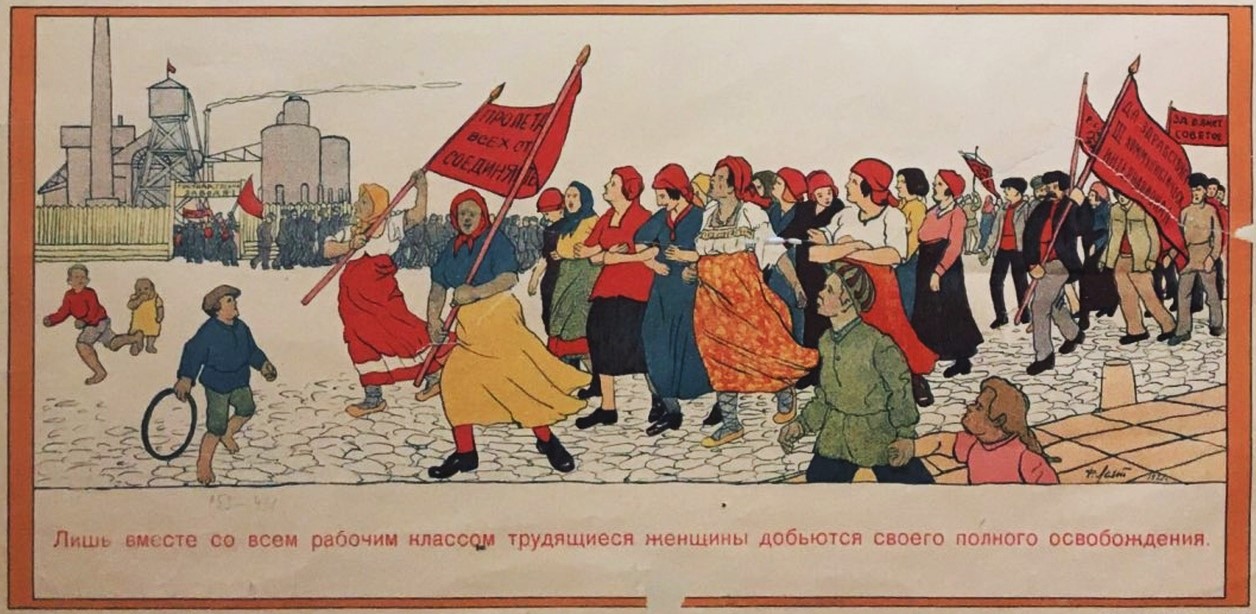
Our Party has 7,000 members, 1,500 or 21% being women. Of these women members only 1% are women employed in industry, the remainder being housewives. Our Central Committee has a Women’s Secretariat, and we also have special Women’s Committees in 89 local groups of the Party. We have Women’s Committees in 9 of our 11 district organisations, but 5 of them are under the management of women comrades and in 2 districts the secretary of the committee is a man.
The Norwegian Party is only 2 1/2 years old. It came into being in the autumn of 1923 through a split in the Norwegian Labour Party (N.A.P.). At the time of the split about 60 of the women’s leagues of the N.A.P. came over to us, the Com intern Section. The N.A.P. was mainly a party not of individual but of collective membership, and the women too were affiliated to it through their special Women’s Leagues. Thus Our women members were accustomed to work in separate organisations, to regulate their affairs themselves, etc. This caused a great many difficulties when our Party was reorganised on a factory and street nucleus basis.
This preliminary history explains partly why we have at present in Norway, the so-called “Husmorlag”, which means non-Party housewives leagues. We had to form them at that time. Moreover these housewives leagues have been very useful, they have played a very important role in the economic and political struggles of the workers. I want only to remand you of the work done during the metal workers’ strike and the lockout in 1924. We had several big meetings in Oslo, and the people who attended these meetings went out into the streets and even to the factories in order to drive away the strike-breakers. The housewives leagues were very active during the wage struggles of the workers particularly in Oslo, Bergen and Trontheim. We did very good work in Bergen where a tramway strike took place.
But the housewives leagues are organisations outside the Party, and I fully understand that if we are not careful, there is the risk of them going over to the Social Democrats. But at the time when they were formed there was no help for it, and I think that it will be possible to develop them into delegate meetings. We could have done more progress in this direction if we had been quite clear about the delegate system. But we did not know how to approach this matter.
I agree with the previous speaker in regard to the difficulties of our work among the women employed in factories.
In conclusion I should like to say that we should consider here the question of the establishment of a better connection with the International Women’s Secretariat. For instance over two years ago we drew up a plan for the housewives’ leagues and sent it to the Secretariat, but received no reply to it. Perhaps it would be better to establish direct connection with the land comrade who is to be in charge of women’s work. Many matters could and with less delay if they had not to go via the International Women’s Secretariat before reaching the respective land secretariats.
It would be much better if we could send our material direct to the land secretariat, but if this is to be done, all the land Secretariats should appoint comrades whose special business will be to keep in touch with the International Women’s Secretariat.
Comrade KASPAROVA (International Women’s Secretariat). I will not keep your attention long as I merely want to point out that work among the women in the East is in a bad way. I am compelled to say that in Women’s Departments of imperialist countries, such as for instance, France, Great Britain, etc., which have colonies and which should certainly turn their attention to work among the women of the East, there are no signs of this work and hardly anything is even done to arouse public interest in this question. Our comrades in the Communist Parties of a number of West European countries must bring up the question of work among women in the colonies at their Party conferences, they must draw the attention of the Party to this question.
I invite comrades in countries with colonies–Great Britain, France, etc. to include at last work among the Eastern women into their programme and to pay due attention to it.
It has been decided lately in the International Women’s Secretariat to transfer the experiences collected during work among the women of the Soviet East to the foreign East in as far as they can be adapted to conditions prevailing there. This will enable comrades working in the apparatus of the I.W.S. to concentrate all their energy in this work.
Why is the exchange of experiences still so inadequate? Because the I.W.S., is still minus an instruction-apparatus and also minus an international periodical. It is impossible to give exhaustive information and publish the necessary articles in the “Communist Woman” or “Woman Worker” and “Peasant Woman” or in the Russian press in general, considering that their space is hardly sufficient to do full justice to questions concerning the life of Russia and to give a certain amount of in- formation about life abroad. There is great need for an international women’s periodical to be published in four languages in which work among women of the Soviet Union, of the foreign and Soviet East, of western Europe and America can be brought forward and in which the theory and practice of the women’s movement in these countries problems of women’s work, women’s life, the economic and juridical position of women, their position in society and in the family, can be discussed. With the help of such a periodical, through an exchange of delegations in local, central and international East-conferences, an adequate exchange of experiences, mutual information and solidarity can be effected.
End of Discussion on Comrade Sturm’s Report. Fifth Session. June 1st, 1926, (evening).
Comrade BILLETTA (Italy). The speaker described first of all the special conditions created by Fascism in order to show under what difficult conditions the Italian comrades have to work, for instance, compulsory adherence of all workers to Fascist trade unions, spy system factories, terrorism.
Lately a law has been passed prohibiting trade union agitation and strikes. Women were the first to break this law. In Milan 100 women went on strike, and they are being tried now. The result of the trial is a subject of speculation and excitement.
The economic position of workers is truly appalling. Wages are continually reduced, and prices soaring. There is an acute housing crisis. Very few lodgings are available and rent is so high that it swallows up one-third of workers’ wages. All this creates an anti-Fascist atmosphere, and even women begin to understand that they must organise themselves against Fascism.
I will deal now with the women’s movement itself. During the International Women’s Day women published and distributed thousands of leaflets. In this work they were especially assisted by the Young Communist League. Moreover, thousands of copies of the Lenin pamphlet “Lenin and the Women” were circulated during Women’s Day. Their method of procedure was: to collect small groups of working women and women Party members as they could not have the public meetings.
The women wanted to keep the Anniversary of Lenin’s Death together, and our women comrades perambulated Milan for two hours on the electric railway in order to get the detectives off their track and to prevent them discovering the flat where the memorial meeting was to be held.
As to the Party apparatus, the Party Executive has not only fully understand the importance of work among women, it has also supported and furthered it in every possible way, although there are still many rank and file Party comrades who have no proper understanding for this work.
In factories and workers’ tenements sympathisers grouped themselves around the nuclei, particularly in Turin, Milan, Genoa and Triest. These circles of sympathising women turned their attention mostly to factory and special women’s questions. The Party is now engaged in forming mixed agitation committees with Social Democratic workers employed in factories, for the purpose of defending the trade unions and to make preparations for wage struggles. Women are also represented in these agitation committees.
Another important work, which has been initiated is that of working women correspondents. It frequently happens that in the “Unità” (formerly a legal organ of the Party) two columns are filled with working and peasant women correspondence. The first meeting for the co-ordination of women correspondents was held in Milan a week ago. The illustrations given by these women’s letters are highly interesting.
The comrade then described the appalling exploitation and conditions of the workers. In one factory girls receive, beside their wage, board and lodging, they are under the supervision of “sisters”, they must come home at 8 p.m. and if they are late, they are fined. They live in dark rooms and are given bad food on which they have to spend almost their entire wage. All correspondence is controlled by the “sisters” who also control their going out and coming in.
We hope to be able to develop our circles of sympathisers into Delegate Meetings. However, this work this work will be very arduous, a great caution will have to be used because of the widely spread detective system.
Women are very active wherever struggle against Fascism takes place. For instance, in Reggio-Emilia a strike was carried out entirely by Communist women.
The Party has a special apparatus for work among women, but the work of the Women’s Departments cannot be continuous. It is sporadic, for if men Party comrades are arrested somewhere, women comrades have to carry on the whole Party work and cannot devote themselves entirely to women’s work.
But I must say that the women comrades are well able to do justice to the work, they have succeeded to divert into right channels the numerous discontented ‘elements who carry on a disorderly struggle against Fascism. In all struggles, women stood side by side with their men comrades. In Parma women erected barricades and supplied the men with ammunition and food. In Como women set free the imprisoned workers and rang the bells to call out all workers into the struggle. In another town a woman comrade who participated in the preceding Congress, was attacked by Fascists in the factory. The women factory workers left their work immediately, came to her rescue and saved her from the clutches of the Fascists.
Comrade SCOTT (Great Britain): The British Delegation is not in agreement with Comrade Malm’s statement on delegate meetings. After the Fifth Congress there was considerable opposition to the idea of delegate meetings, and it was only through the pressure of the Women’s Secretariat and the letters received from them that the Women’s Department of the British Party has begun this work. After the report of our first delegate meeting had been sent to the Secretariat, we received very helpful suggestions and criticisms on the work.
International Press Correspondence, widely known as”Inprecorr” was published by the Executive Committee of the Communist International (ECCI) regularly in German and English, occasionally in many other languages, beginning in 1921 and lasting in English until 1938. Inprecorr’s role was to supply translated articles to the English-speaking press of the International from the Comintern’s different sections, as well as news and statements from the ECCI. Many ‘Daily Worker’ and ‘Communist’ articles originated in Inprecorr, and it also published articles by American comrades for use in other countries. It was published at least weekly, and often thrice weekly. A major contributor to the Communist press in the U.S., Inprecorr is an invaluable English-language source on the history of the Communist International and its sections.
PDF of full issue: https://www.marxists.org/history/international/comintern/inprecor/1927/v07n38-jul-06-1927-inprecor-op.pdf
 Revolution's Newsstand