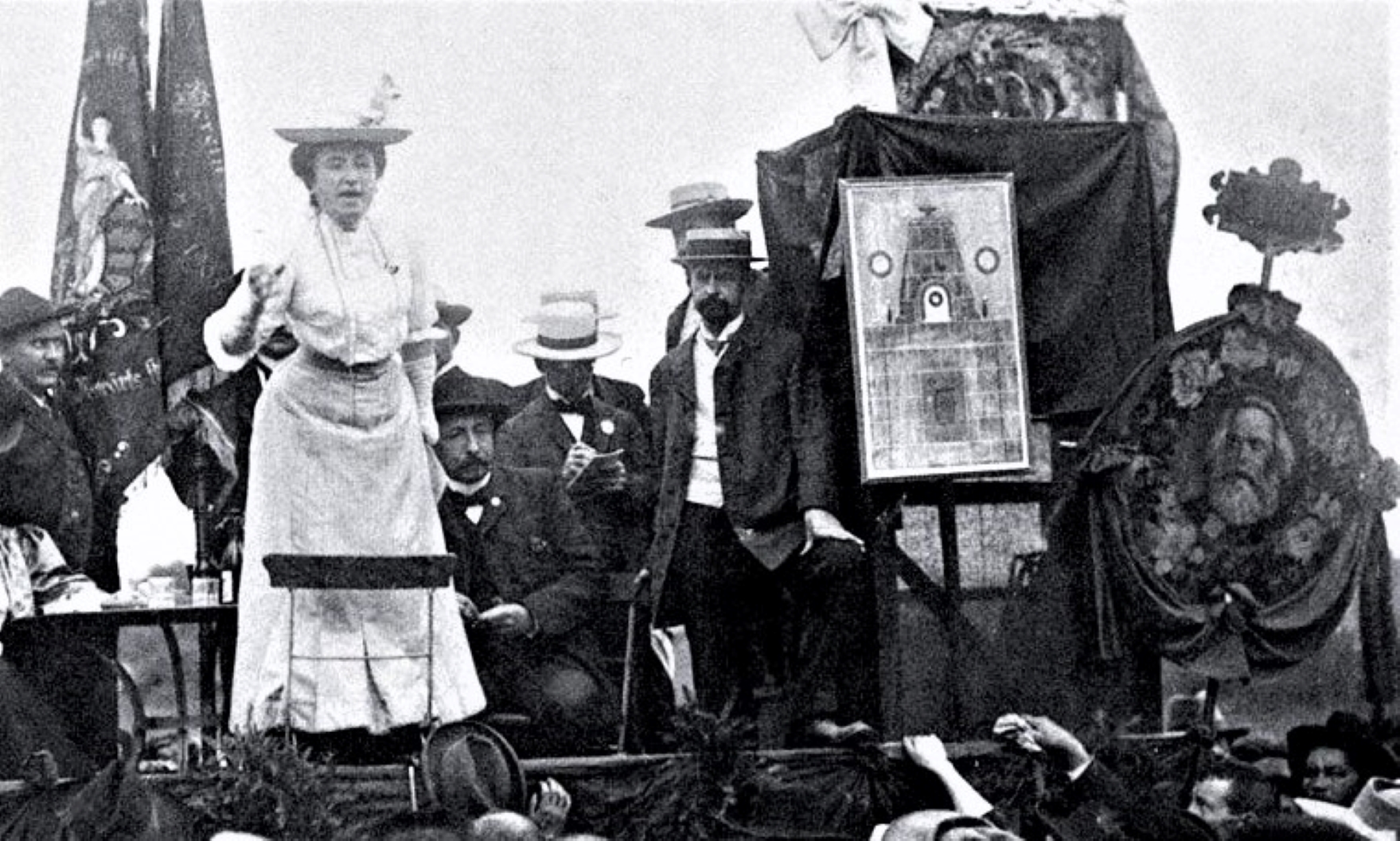
At the end of 1905 Rosa Luxemburg left Berlin for Warsaw to participate in the Revolution then sweeping the Czarist Empire as a leader of the Social Democracy of the Kingdom of Poland and Lithuania where she was active in the underground until her March, 1906 arrest. Below are three letters that could only be written by Rosa Luxemburg as she relates events in Warsaw and asks after comrades in Prussia. Wonderful.
‘Letters from Warsaw (January, 1906)’ by Rosa Luxemburg from Letters to Karl and Luise Kautsky from 1896 to 1918. Robert M. McBride and Company, New York. 1925.
Warsaw, 2.1.06.
My best beloved:
I am writing quite briefly, because I have very little time. Until now I have been trying to get my bearings on the position of our work and on the general situation, but now I am plunging into active work. To characterize the situation in two words (but only for yourselves): the general strike has just about failed, most of all in St. Petersburg, where the railway men made no real effort to carry it through. (The information supplied by Deutsch1 was therefore fishy. Everywhere people are hesitant and in a state of expectancy. The reason for all this is the simple circumstance that the mere general strike alone has ceased to play the role it once had. Now nothing but a direct, general fight on the street can bring about the decision, but for this the right moment must be prepared more carefully. This expectant condition of affairs may therefore continue for a while, unless indeed some “accident”—a new manifesto, etc.—brings about a spontaneous and sudden uprising.
On the whole the work and the spirit are good; one must explain to the masses, however, why the present general strike ended without any visible “results.” The organization is growing by leaps and bounds and every-where, and yet it is in rather much of a mess, because everything is in a state of flux. Chaos is worst in Petersburg. Moscow stands its ground much better and the fight in Moscow has advanced the general tactic to a new position. There is no thought of leadership from Petersburg; the people there localize their point of view in a most ludicrous manner (this, by the way, finds expression in the line of argument developed by D. [Deutsch] when he asked for material aid for Petersburg alone. From their own standpoint this was most unwise, as I had to say to myself afterward: in St. Petersburg alone the revolution can never triumph; it can now succeed only in the country as a whole.)
And now I turn to you with the following requests: 1. Please send me the article by Mehring at once by registered mail addressed to Dr. J. Goldenberg, Wierzbowa 9 (for me in an inside envelope), direct to Warsaw without routing it via Thorn as intermediary. 2. Louise dear, speak at once to Freythaler of the Vorwarts and have him send me two copies of the V. daily as printed matter addressed to: Redaktion der Biblioteka Naukowa, Warsaw, Nowy Swiat 37. I am under the impression that he gave instructions to that effect once before, but, owing to the strike of the postal workers, only one number has arrived; besides, I now need two copies, both to be sent as printed matter. 3. Be so good as to give this same address with a similar request for two copies to be sent as printed matter to Mehring, so that I may also receive the L.V.2 To the same address please send me every week the Korrespondenzblatt of the General Committee, together with Soziale Praxis. We need these for the trade union organ that is to appear now. I need the latter immediately; please send the last numbers if you can still find them. 5. Be so good, Louise dear, and look for a little paper bag with blue stars in the drawer of my writing desk, right in front; it contains various printed items. Send it to me as a sealed registered letter to the address given above (Nowy Swiat), by express post, addressed to me. 6. On top of the writing desk, next to the bust of Voltaire, among the heap of papers there is a longish little paper bag with a Russian manuscript, containing 116 numbered pages of writing. If you don’t find it there, you will probably discover it higher up, next to the marble head, or else in the drawer. If you find it, send that also as a sealed registered letter care the Nowy Swiat address, for me. If it is too heavy, break it up into two letters.
I have again loaded you up with requests, but I know that you will cheerfully do all this. My dear, it is very nice here. Every day two or three persons are stabbed by the soldiers in the city; there are daily arrests; but aside from that it is quite gay. Despite martial law we are again publishing our daily Sztandar, and it is sold on the streets. As soon as martial law is abolished, the legitimate “Trybuna” will appear again. For the present, the printing of the Sztandar must be accomplished in bourgeois print-shops by force, with revolver in hand. The meetings, too, will begin as soon as the condition of martial law is ended. You will then hear from me! It is savagely cold, and one travels about solely by means of sleds.
I must close. Many kisses to both of you and to the boys. Heartiest greetings to Granny, Hans, Mehring, and Singer and my colleagues. Write at once how you are and what, in general, is happening—how things are faring in the V., and whether August hasn’t scolded. Address ordinary letters to Goldenberg, with an envelope addressed to me on the inside.
Cordially, your
R.
Warsaw 11.1. 1906.
Dearly beloved:
Hearty thanks for your two (alas! so short) letters, which I awaited with longing. I did not telegraph you, because M. [Marchlewski] was just then to leave for Berlin; his journey, however, as is wont to happen, was delayed for several days. I hope that he brought you my greetings and that he asked you to send me the things requested as registered commercial papers. Everything can then be easily sent in two envelopes. We have received one issue of the V. (the “red” issue, two copies), but since then—nothing! The gods and the cossacks may know the reason for this. The thing I am most impatiently waiting for is Mehring’s article, which prevents us from publishing that by Karl. Can it be that M. hasn’t even written it? I am writing him with this same mail; please, Louise, stir him up also. During the last few days a member of the O.K. (of the Menschinstwo)3 was here. I squeezed all sorts of information about the situation out of him and shall use it for the V. As for the rest, I have the praiseworthy intention of writing regularly for the “Neue Zeit,” but more along the lines of interpreting the events, for which purpose the V. is not well adapted. If one only had a little more time!
From the Moscal4 I learned, by the way, that Parvus5 has given up both the chairmanship and his seat in the Council of Delegates6 after he found himself in the minority in a question during the course of the last general strike. The question under discussion was as to how the unsuccessful strike might be infused with new life. P. suggested to follow the example of Moscow and proclaim an armed uprising to save the situation. All were agreed to the idea, but the majority was convinced that for the moment it was impossible of execution. P. declared that he realized that he had over-estimated his knowledge of the situation; he was anxious above all to learn more about it and therefore resigned, in order to devote himself to his paper, which is tremendously successful. At this moment, by the way, not a single newspaper of the Social Democracy appears in all Russia; likewise all democratic and even colorless and reactionary papers are forbidden! (That our Sztandar nevertheless appears daily and is sold on the streets, you know from Marchlewski.) Momentarily the situation is this: On the one hand it is generally felt that the coming phase of the fight will be that of armed rencontres. About Moscow I have learned much and the most encouraging things imaginable. (As soon as I have detailed and reliable reports, I shall write you.) Suffice it for the present to say that in Moscow one may record a victory rather than a defeat. The whole infantry was inactive, as were also the cossacks! Cavalry and artillery alone are still “capable of fighting.” There was a minimum of losses to the revolutionaries, the whole of the tremendous sacrifice was borne by—the bourgeoisie, i.e., by people wholly unconcerned in the affair, inasmuch as the soldiery simply fired blindly and destroyed private houses. Result: the whole bourgeoisie is furious and in revolution! Money is being contributed by it in quantities for arming the workers—of leading revolutionaries almost nobody perished in M. The Social Revolutionaries bungled the job right at the beginning with a “closed” conference. The whole fight was conducted by the Social Democracy. On the other hand the douma and the elections are on the program. You know the execrable election law. Added to this is the circumstance that martial law is not to be abandoned for the duration of the elections! One would think that under such circumstances participation in the elections would be even more self-prohibitory than at the time of the Bulygin7 douma.
Well, there you are: the S.D. in Petersburg has voted to participate in the elections, and that, too, with a crazy, artificial plan. People are to vote in all classes (as you, know, there are four classes of voters in the province!). But on the basis of (universal (not existing) suffrage. Moreover, only the candidates up to the highest class are to be elected, but these are not to choose representatives for the douma, but * * * to seize the power of government in the province. The devil take it, I can’t even repeat this nonsense. That is the victory of the “Iskra,” faction over the “Lenin” faction, about which they are very proud. Unfortunately I could not go to Petersburg in time, otherwise I should have peppered this “victory” for them. Now we other “peoples” are in a foolish position. As a matter of fact this artistic plan, too, will simply break down in practice, since a general mix-up must ensue even at the first rush to the voters’ meetings, in the course of which the whole electoral campaign will change over into a direct fight. But out of consideration for our solidarity with Petersburg it won’t do very well to offer a separate and different solution, yet we cannot be a party to such nonsense. Well, I suppose we shall, after all, stick to simply declining to participate in the elections on the grounds of the four-class system and of the continuation of martial law.
I shall go to Petersburg several weeks hence. Early in February the two factions will hold their first joint constituent party convention. Of course I want to go there. In this connection it occurs to me that it might be advisable for the German S.D. to be represented at this convention, in order to establish the connection of the German party with the revolution more firmly. That would also have a wholesome effect upon the factions and their possible frictions. In as much as nobody will go to Petersburg from Germany under existing conditions and nobody knows Russian, the executive might possibly commission me to represent Germany at the same time. I shall be there anyway, so that no expense would arise for the executive. If you, Karlchen, think well of this, please talk to the fathers about it, for I don’t like to do it myself; I don’t want them to think that I care personally about it. But you would have to attend to it quite soon; the date has not yet been set and. may easily be advanced.
I have already written a pamphlet, which is now in print, about the general situation and problem. In addition a German weekly is to be started at Lodz, likewise a trade union weekly. I am therefore anxiously waiting for the Korrespondenzblatt and other trade union organs (Austrian).
Personally I don’t feel quite as I should like to. I feel somewhat weak physically, but that is improving a bit already. I see my brothers and sisters once a week. They lament very much about it, but non possumus! How are all of you, my beloved? What are you writing, Carolus? How is Wurmchen? How is it with the V.? Has Block8 been engaged as yet? How are Granny and the boys? In the midst of all the trouble here I must constantly think of all of you, dear Lulu. Please do write me soon. With a thousand kisses and regards to all,
Your R.
Undated, January, 1906. Warsaw.
My beloved:
Your letter, Carolus, with Job’s post concerning Lulu9 reached me only last night. You see, yesterday we had our “hoodoo” from morning on. A search at the printing plant, arrests, the closing of the printery. All in all, though, everything came off pretty luckily. Nobody came to grief. And today a new print-shop has already practically been captured, so that I must sit down at once to write an article for the 22.10
The news about Louise has given me the greatest concern. Gastric fever is no joke. I went to the post office today to ask you for news by telegram, but the damned local post office has no telegraph department. There is only one telegraphic bureau for all of Warsaw and that is located somewhere with the devil, miles away from here! This inquiry by letter will therefore have to suffice. I beg of you most urgently to write me at once and exactly how L. is, what the doctor says, whether the fever is continuing, and how high it is. Dearest Carolus, you don’t have to lose any time over it yourself; Felix and Karli are big enough to write me a letter and to report to me about their mother. Boys, sit down on your pants and write me. In all probability the sudden change from frost to warm weather, which has also taken place here, has been the cause of her taking cold.
Louise is a thousand times right in citing me to Berlin. I should steam there at once, except for the fact that I must first finish several things here and then possibly be present in Petersburg at the family celebration11; that is important and of general interest, for I should like to scold about a number of things there. But what I am willing to do is to write for the “V.” and in that way help it out. Unfortunately one is so taken up here that it is almost impossible to think of anything else. But I’ll do it.
Marchlewski is very enthusiastic about his reception with you and about the spirit breathing in your home. He could not help but observe that there is a different “breath” there than elsewhere with the good, honest comrades in Germany. A propos: hurray for Hamburg!12 I was proud and happy to read that. I hope that won’t be the end of it and things be allowed to go to sleep. I suppose the Fathers are already busy putting on the brakes. * * * The good result of M.’s trip, thanks to your assistance, has pleased me greatly, it is very a propos.
I quite share your opinion about Franciscus’ letter. We shall of course publish only your article. It will do by itself and will render us real service. The Russians, who were told about it, are awaiting its publication impatiently, as they want to use it in Russian. I must go to work, therefore let me close for the present. I am waiting for news. A thousand kisses and greetings for you, poor Lulu, for you boys, for Granny and Hans,
Your R.
M. had reported Luise’s illness as something quite harmless, as a light case of influenza which was already in process of improving. It was your letter that upset me
NOTES
1. Leo Deutsch, Russian revolutionary. L.K.
2. “Leipziger Volkszeitung.” L.K.
3. Organizing committee of the Mensheviks. L.K.
4. The man coming from Moscow. Transl.
5. Pseudonym, of Dr. Helphant, a Russian comrade now living in, Berlin. Transl.
6. The first council of workers’ delegates in Petrograd, operating during the first Russian revolution.
7. Bulygin was minister at the time of the so-called Bloody Sunday (January 22, 1905) on which Father Gapon led the workers before the Winter Palace for the so-called “Water Consecration.” The workers were to present a petition drafted by Gapon, but cossacks and soldiers instituted massacre among the defenseless and unsuspecting paraders. Bulygin proposed the creation of a douma (parliament) with advisory but not legislative powers. His plan was: never realized. The revolution of October, 1905, came and now Prime Minister Witte created a douma with legislative powers and elected upon a much broader basis though not yet (upon the basis of universal suffrage.
8. Hans Block of the “Leipziger Volkszeitung” was to take Rosa’s place on the “Vorwarts.” Transl.
9. I had fallen seriously ill with typhoid. L.K.
10. The anniversary of the great demonstration of the Petersburg workers before the Winter Palace, which ended in a massacre. The demonstration took place on Jan. 22, 1905, and may be considered a forerunner of the first Russian revolution. L.K.
11. The congress of the Socialist Party. L.K.
12. On Jan. 17, 1906, a general strike, combined with a monster demonstration before the city hall, took place at Hamburg in protest against the proposed bill for making the terms of voting less favorable than in the existing law. L.K.
Letters to Karl and Luise Kautsky from 1896 to 1918 by Rosa Luxemburg. Edited by Luise Kautsky, Translated by Louis Lochner. Robert M. McBride and Company, New York. 1925.
Contents: Introduction by Luise Kautsky, Beginnings, 1896-1899, Incipient Friendship1900-1904, From the Imprisonment at Zwickau to the First Russian Revolution, The First Russian Revolution 1905-06, Up to the World War 1907-1914, Letters from Prison During the War 1915-1918, Postscript by Luise Kautsky, Appendix: Biography of Karl Kautsky. 238 pages.
PDF of book: https://www.marxists.org/archive/luxemburg/posthumous/lettersofrosaluxemburg-1922.pdf
 Revolution's Newsstand