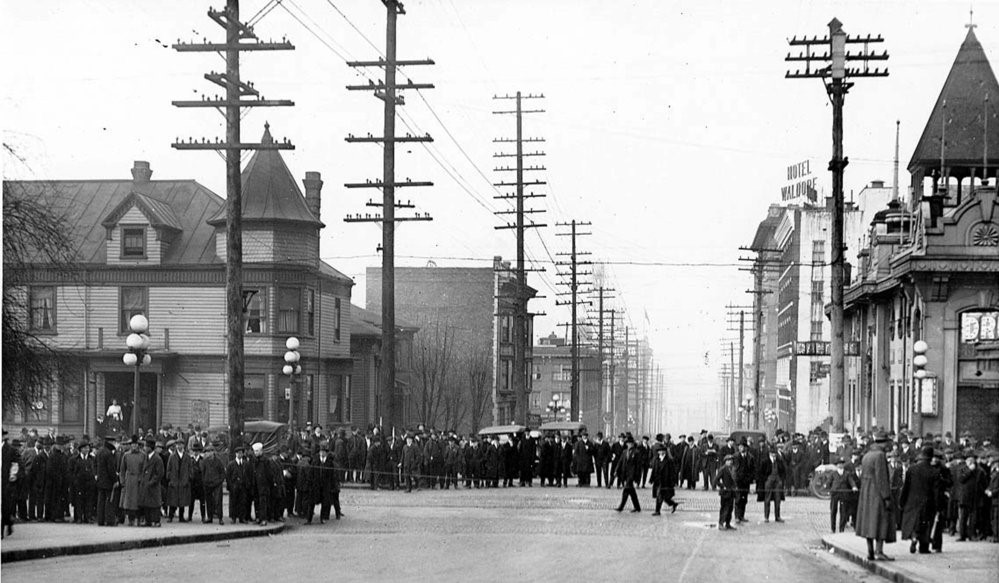
Already at this writing, it was clear that the workers’ struggle in 1919 was unlike what had come before. The strikes in Seattle, Butte, and other cities had a distinctly political tone, and involved wide layers of workers rarely active before. The Iron Heel would be the response of the master class, with extraordinary, even for the U.S., violence–legal and extra-legal–unleashed.
‘Mass Strikes’ by Louis C. Fraina from Class Struggle. Vol. 3 No. 2. May, 1919.
In considering the period of strikes into which the American proletariat—and the proletariat of other nations—has emerged, it is important to remember that the coming of the war occurred during a time of great industrial disturbances. Strikes of great magnitude had shaken Capitalism to its basis—class antagonisms on the industrial field were being sharpened while they were officially being modified in politics; new strikes were developing; everywhere there was potential action against Capitalism. Then war was declared; and the strikes ceased, proletarian energy being directed into the channels of war instead of the class struggle.
But the war, while breaking short this phase of industrial unrest, introduced a new phase—more conscious and definitely revolutionary. The miserable collapse of bourgeois society; the agony of the war; the victorious proletarian revolution in Russia and the developing proletarian revolution in Germany—all these have loosed the initiative and energy of the proletariat.
The epoch of strikes into which we have merged is, on the one hand, a consequence of the revolutionary stimuli of Russia and of Germany; and, on the other, of the problems of economic reconstruction which press down upon Capitalism.
In the United States, there is no program of “reconstruction.” The Capitalist Class, accustomed to a docile proletariat, are not worrying much about the problem; and, moreover, their unprecedented prosperity during the war has developed a fatalistic attitude among them. President Wilson, shortly before his departure for France in December, “put up” the problems of reconstruction to Congress; but Congress did absolutely nothing, was bankrupt and impotent. Soldiers are being demobilized who cannot get jobs; workers are being thrown out of jobs; the employers are trying to lower wages to pre-war standards—and all this is producing protest and strikes.
Outstanding among the recent strikes are the strikes in Seattle and Butte. In Seattle, the strike was forced upon the conservative union officials by an upsurge of the spirit of action in the workers; it developed into a general strike—the first of its kind in recent American labor history; it developed revolutionary sentiments, in the proposals of the strike committee to assume municipal functions while the general strike was on. The strike was crushed by the betrayal of the conservative union officials and by the display of military force by the municipal government.
The Butte strike was equally important and dynamic; it was directed by an actual Soldiers’ and Workmen’s Council; it showed the I.W.W. to be a real industrial force; and again it was the conservative craft unions that broke the strike. In these two strikes there was manifest that primitive initial mass-action which, when developing into the final revolutionary form, becomes the dynamic method of the proletariat for the conquest of power.
The strikes are not over. There is still a mass-strike in the textile mills of Lawrence, Mass. Strikes are breaking out all over the country, are multiplying. This is the peculiar characteristic of the period into which we have emerged; it is the attitude of the Socialist toward these strikes that will hasten or retard the coming of Socialism. Out of these strikes the Socialist must develop larger action, must marshal and direct the proletariat for the conquest of power; and our parliamentary action must be a means of serving the industrial proletariat in action, of developing mass-action.
Out of these strikes, moreover, the Socialist must try to develop the political strike. The political strike is a strike in which the proletariat uses its industrial might to accomplish political purposes, to bring pressure to bear upon the bourgeois state. It is out of the political strike that develops the final mass-action; and the political strike is a supreme form of political action.
There is, at this moment, an opportunity for a political strike of the first magnitude. Union after union has declared in favor of a strike to demand the release of Tom Mooney; some unions have gone further and insisted that this strike should include all political prisoners. But the movement is being sabotaged by the bureaucracy of the American Federation of Labor; and even by men active in the Mooney defense. They decided to call a general strike on July 4—a legal holiday, a day on which it is absurd to speak of a general strike; and, moreover, they decided that it should be a strike for Mooney alone, and not include other of labor’s prisoners. Moreover, this “general strike” itself is being sabotaged by the union conservatives; it is now in a sort of cataleptic state.
In this emergency, the whole forces of the Socialist Party should be concentrated on propaganda for a great mass-demonstration on July 4, and for a general political strike on July 5, to demand the release of all class war prisoners. Large sections of American labor are prepared for such a strike, but they are being baffled by the bureaucracy, by reactionary union officials. It is the task of the Socialist to engage in this struggle, to concentrate on this fundamental issue. Our comrades are languishing in prisons; amnesty cannot reach them, and we don’t want amnesty for them. We want them released by the industrial might of the proletariat, by class conscious action. If this political strike materializes, it will blazon a new trail in American labor history; it will set a precedent for the future; it will mean real class action by the proletariat, an appreciation of the political character of its struggle.
The political strike is new to American labor. But it is indispensable. It must come. It is the function of the left-wing Socialist to develop an intense propaganda in favor of this method of struggle, to develop out of the strikes of the proletariat the concept and the action of the political mass-strike.
The Class Struggle is considered the first pro-Bolshevik journal in the United States and began in the aftermath of Russia’s February Revolution. A bi-monthly often over 100 pages and published between May 1917 and November 1919, first in Boston and then in New York City by the Socialist Publication Society. Its original editors were Ludwig Lore, Louis B. Boudin, and Louis C. Fraina. The Class Struggle became the primary English-language paper of the Socialist Party’s left wing and emerging Communist movement and paid lose attention to the fight in the Socialist Party and debates within the international movement. Many Bolshevik writers and leaders first came to US militants attention through The Class Struggle, with many translated texts first appearing here. Its last issue was published by the Communist Labor Party of America.
PDF of full issue: https://www.marxists.org/history/usa/pubs/class-struggle/v3n2may1919.pdf
 Revolution's Newsstand