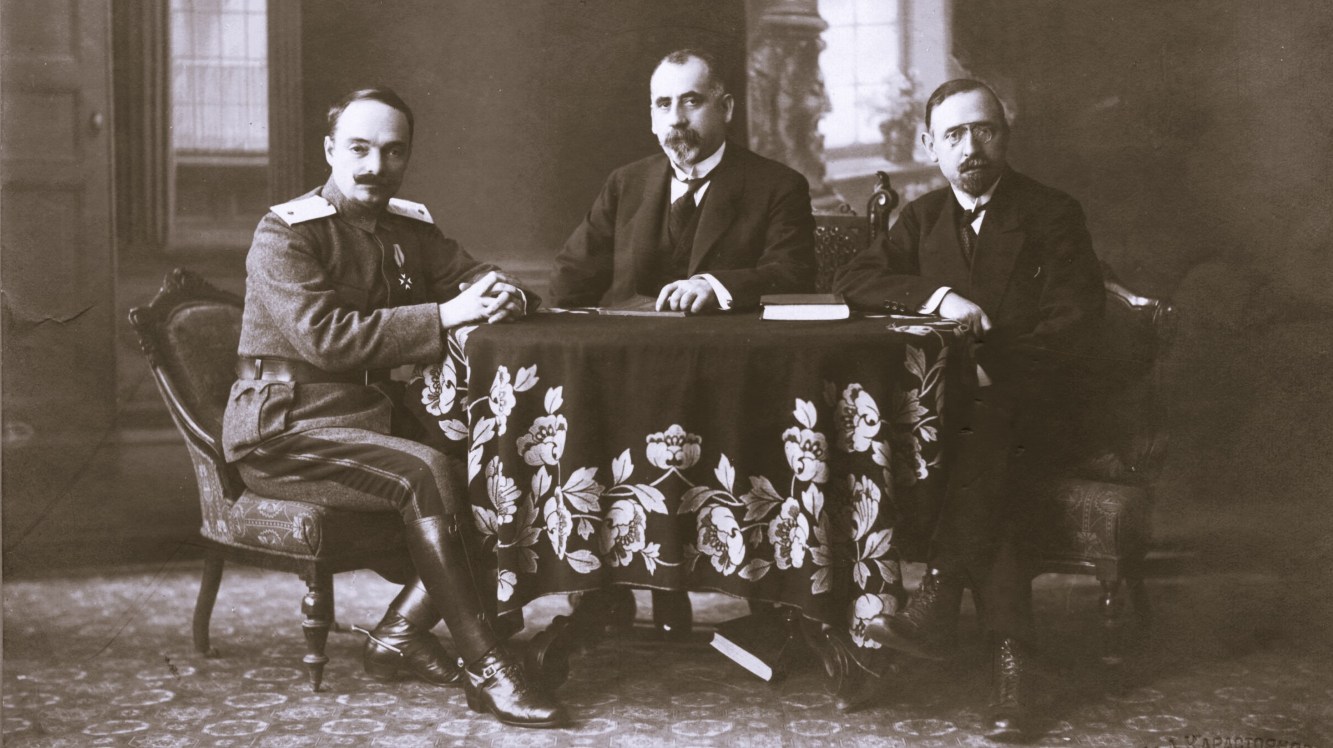
After June, 1923’s coup an the violent suppression of all opposition to the Tsankov regime, international isolation and a brief conflict with Greece led to an new government under Andrey Lyapchev in January, 1926. While a number of repressive measures were relaxed, the ban on the Communist Party and reliance on death squads remained. Khristo Kabakchiev was on the central leadership of Bulgarian Social Democracy since 1905. A member of Bulgarian parliament between 1914-23, he was also a founder of the Balkan Socialist Federation, and in 1919 of the Bulgarian Communist party which he represented at the Second and Fourth Comintern congresses. Arrested before the planned September, 1923 uprising, he was jailed for several years before his release in 1925. Eventually settling in Moscow, Kabakchiev lost his positions in the 1928 power-shift in the Comintern. Working at the Marx-Engels-Lenin Institute writing histories of the Bulgarian workers movement, though arrested during the Purges, he was later released. Dying in Moscow in 1940.
‘The Fight against the Fascist Regime in Bulgaria’ by Khristo Kabakchiev from International Press Correspondence. Vol. 7 No. 26. April 21, 1927.
Immediately after the 9th of June, the fascist Government, having already destroyed the Peasant League, began to make all preparations for the destruction of the Communist Party. In September 1923, it provoked an insurrection on a large scale by the wholesale arrest of 4000 Communists who were workers and peasants, by suspending all the Communist papers, by occupying the workers’ clubs etc. The September insurrection, in which the majority of the masses who took part were peasants, was defeated, and during and after its defeat, more than 10,000 peasants and workers were massacred.
The serious defeat of the workers and peasants in September 1923 did not however break their force. At the elections which took place two months later, in November of the same year, the united front of the Communists and Peasant League, firmly cemented by the common sacrifices of the workers and peasants in September, received more than 300,000 votes, i.e. a third of the total number, in a third of the constituencies, in spite of the terrible election terror and of the refusal to recognise the lists of the united front; they thus sent 200 deputies to Parliament members of the Peasant League and of the Communist Party. The Communist Party which had, as a matter of fact, already been outlawed, began to adapt its organisations to the new illegal conditions.
In answer to this, the Fascist Government passed the barbarous exceptional law for the Protection of the State and dissolved all Labour organisations, trade unions and co-operatives. The newly-founded legal Labour party, which had succeeded, in a short time, in rallying round it the workers and peasants and in leading them into the class war, was also dissolved. When, however, the dissolution of the Labour parties and organisations did not help and when the united front of the workers and peasants recorded new successes at the district elections in April 1924, the Fascist Government introduced the system of permanent White Terror into Bulgaria, i. e. the systematic individual and mass murder of all the active elements of the working class and the peasantry which still remained alive, a system which it is still maintaining.
The groups of partisans which cropped up and the individual acts of terror in the country, are a consequence of the sanguinary terror of the regime of June 9th; the Government of the murderers of the people drove hundreds and thousands of peasants into the mountains by deeds of violence, murder and torture and, to exterminate them, despatches expeditions of military and police who cause whole villages with their population to disappear in a welter of fire and blood.
At the most important moments of the fight against the workers and peasants, the Fascist Government met with the support of all the Right and Left bourgeois parties, including the Social Democratic party. All these parties joined in the Government of June 9th; the Social Democrats however, headed by their Minister Kasassov, took the most active part in the sanguinary suppression of the September insurrection. In April 1925, the bourgeois Opposition and the Social Democrats through the mouths of their respective chiefs, Malinoff and deputies Pastuchoff and Tchernookoff, declared that the Government was in a state of “self-defence” and, relying on the political support of these parties, the Government, in two months, dragged more than 2000 of the most active elements of the Communist Party and the Peasant League from their prisons and murdered them in the most brutal way according to a pre-arranged plan.
The harmony and unanimity between the bourgeois Opposition parties and the Government only exists however in their fight against the workers and peasants, against the “Bolshevist danger” and only as long as this “danger” is acute. After the defeat of the workers and peasants, when the bourgeoisie found its class rule once more established, the internal dissensions and attempts at competition among the bourgeois cliques began afresh.
In recent times, the bourgeois parties which remained outside the Government and which were chiefly supported by the petty bourgeoisie, have under the pressure of the growing discontent of their petty bourgeois cadres and in view of the parliamentary elections increased their attacks on the Fascist Government. The industrial and middle bourgeoisie also longs for “normalisation” and “pacification” of the country as a necessary condition for increasing the purchasing power of the masses and the development of industry and trade; for this reason, it has withdrawn its support from the Government, which came into power through an insurrection, a Government which has remained completely isolated from the broad masses and is the cause of constant internal concussions which make the peaceful development of the country almost impossible. This section of the bourgeoisie is grouped round the National Liberal party which is endeavouring to place the Fascist regime on broader and firmer foundations by following the example of the Italian Fascists and trying to enroll in its organisations the petty bourgeois and Labour masses which are discontented and lacking in class-consciousness.
The fight of the bourgeois Opposition parties is undermining still more the position of the Liaptcheff Government. In order to maintain its shaken position, the Government is directing its reprisals even against these parties. The Social Democratic party, which is trying to gloss over its serious share in the responsibility for the innumerable misdeeds of the Fascist regime, is also fighting against the Liaptcheff Government. The chief demands of the fighting workers and peasants however the abolition of the Law for the Protection of the State, the reestablishment of the Labour organisations which have been dissolved, a complete amnesty etc. have not yet been raised openly and boldly. In this way it is frustrating the formation of a united front with the workers and peasants in the fight against the Fascist regime, the united front which the workers and peasants are proposing.
The workers and peasants alone are carrying on a courageous and obstinate fight against the Fascist regime in Bulgaria, in spite of the enormous difficulties and the serious sacrifices which the fight involves. The united front of Labour, is endeavouring to unite all the other strata and groups of workers: State officials, small tradesmen and artisans, tenants, disabled soldiers etc. It is much to be regretted that the leadership of the Peasant League is in the hands of the Right, which is supported by the Government itself, and which threatens to cause a split in the League. This is a great obstacle to the complete development of the united front. The masses of peasants however go with the Left section of the Peasant League which is decidedly in favour of forming a united front with the workers.
The Communist Party has made enormous sacrifices and its ranks have been seriously decimated. After the defeats it has suffered and in consequence of the confusion of ideas caused by the mistakes it has committed, it no longer possesses the strength and influence it had in former times. The Communist Party is endeavouring, once more to gather the broad masses of workers round its banner in the fight for its minimum demands (in the first place the overthrow of the Fascist Government, the abolition of the exceptional laws, the restoration of the workers’ organisations which have been dissolved, a complete amnesty, support of the unemployed, reduction of the hours of work and increase of wages, a campaign against the rise in prices etc.).
The Communist Party has succeeded in retaining the confidence of the masses in spite of its defeats; for this it has to thank its courageous fight against the White Terror in Bulgaria which has claimed so many victims. The masses still regard it as their true leader, who will lead them to victory. It depends of the C P., on its adopting wise tactics at the present moment and the near future whether it uses this confidence to restore its force and to accelerate the victory of the workers and peasants. The Bulgarian workers and peasants, in their difficult fight against the blood-stained regime, which is part of the fight of the European proletariat against the mad and insolent attacks of Fascist reaction, count on the powerful support of the workers and peasants of all countries.
International Press Correspondence, widely known as”Inprecorr” was published by the Executive Committee of the Communist International (ECCI) regularly in German and English, occasionally in many other languages, beginning in 1921 and lasting in English until 1938. Inprecorr’s role was to supply translated articles to the English-speaking press of the International from the Comintern’s different sections, as well as news and statements from the ECCI. Many ‘Daily Worker’ and ‘Communist’ articles originated in Inprecorr, and it also published articles by American comrades for use in other countries. It was published at least weekly, and often thrice weekly.
PDF of full issue: https://www.marxists.org/history/international/comintern/inprecor/1927/v07n26-apr-21-1927-inprecor-op.pdf
 Revolution's Newsstand