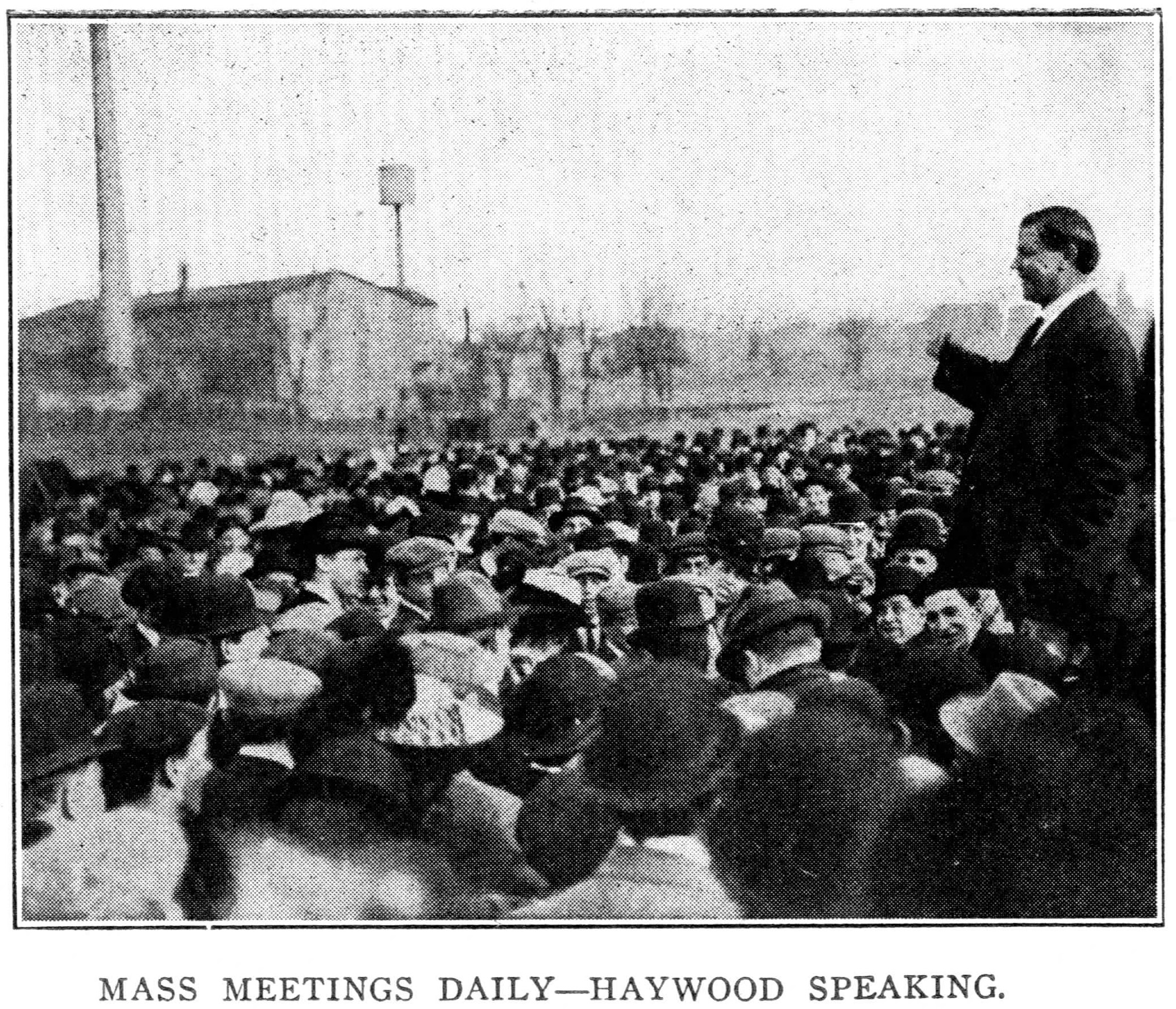
Ewald Koettggen (recorded in a variety of spellings), veteran New Jersey silk worker, I.W.W. organizer and G.E.B. member, reports on what was not just a high-point for wobbly organizing in the East, but what is still a byword for a the best of the U.S.’s radical labor tradition–the months-long struggle 1913 struggle of Paterson, New Jersey’s textile workers.
‘The Great Paterson Revolt’ by Ewald Koettgen from Solidarity. Vol. 4 No. 13. March 22, 1913.
Stops Every Part of Silk Production in that City, and is Spreading to other Silk Centers.
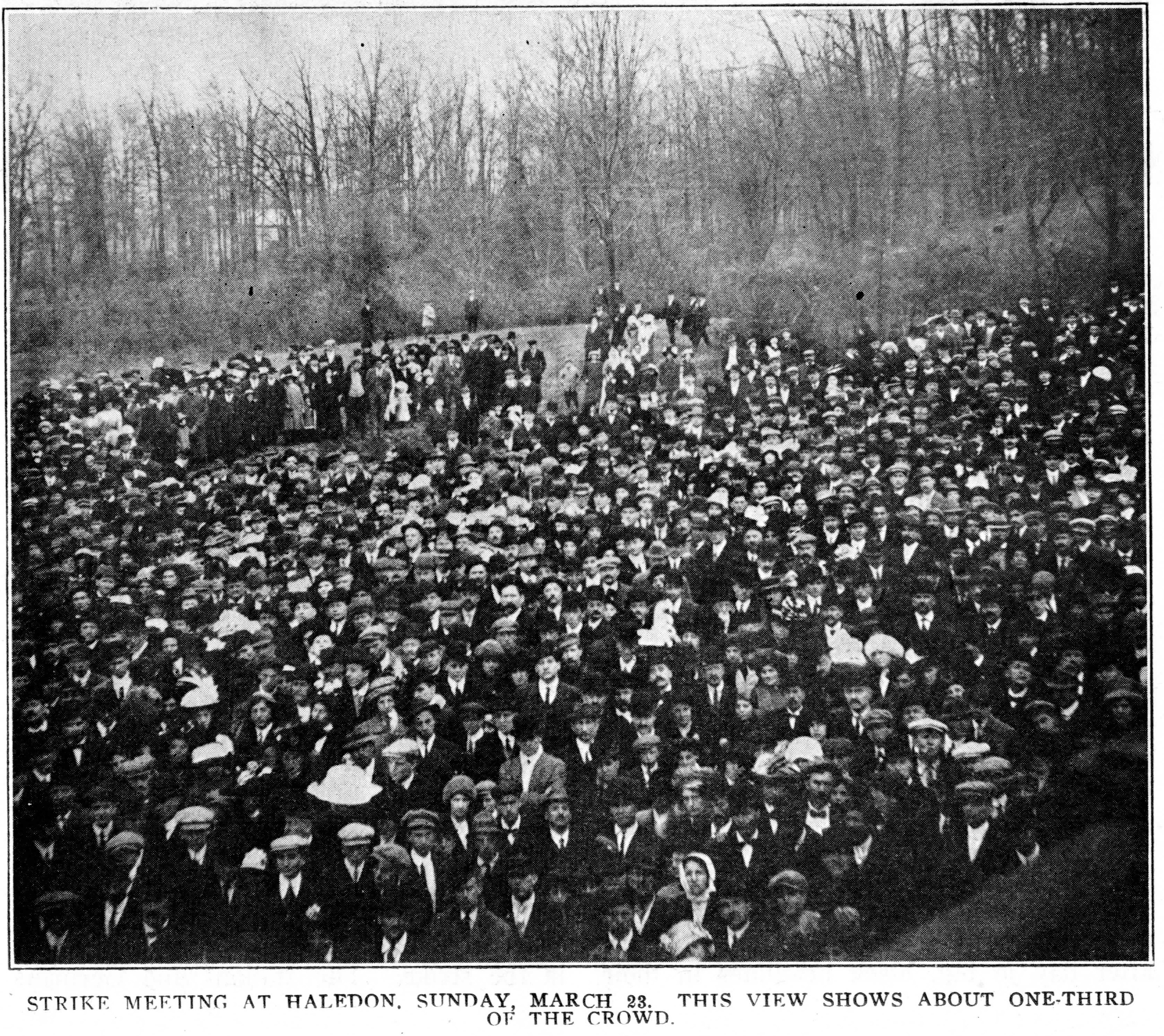
Paterson, N.J., March 16. The third week of the general strike of silk workers of Paterson finds the strike still spreading, with the strikers standing firm and no break in the ranks. Practically every silk mill and dye house in the city is closed down and the bosses are making frantic efforts to break the ranks. Saturday, March 15, the workers in the mill supply factories declared a general strike in all the factories. This will mean about 2,000 more, and will complete the chain from the time the silk reaches the city to the time the finished product leaves the city. The throwing plant workers, the broadsilk, ribbon, dyehouses and the mill supply workers, who furnish reeds, harness shuttles, quills, etc., will make the tie-up complete.
The strike has already spread to Allentown, Pa., where all the workers in the dyehouses are out and in the I.W.W, The mill workers voted to come out on Monday, March 17. The writer was there for several days, the spirit shown was splendid. The strikers demand the same as the strikers of Paterson and refuse to settle until the workers of Paterson settle.
The silk workers of New York are also on the move and, in spite of the fact that the bosses were willing to give the 8-hour day and a substantial increase in wages, they refuse to settle until the workers of Paterson get what they want.
Summit, N.J., sent to Paterson for an organizer yesterday, they also want to come out; also Astoria, L.I., College Point, etc.–in fact in the whole silk industry the workers are anxious to take a hand in getting the 8-hour day.
Workers in the machine shops of Paterson are also talking strike, and 200 from the McNabb have already struck, and others are expected to come out during next week.
The shirt factory workers declared a general strike to take effect on Monday, March 17, at 8 a.m., one mill having come out with the silk workers.
That the bosses are trembling with fear, is putting it mildly. They are making frantic efforts to cause a break, but so far they have utterly failed.
The capitalist press, of course, is doing its best in publishing lying statements of the strike. According to them, the strike was broken a week ago, but, strange to say, the mills are still closed tight. The bosses are publishing daily statements against the strikers, and especially against the I.W.W., and the workers answer them by remaining on strike and joining the I.W.W.
Many facts are brought out by the strikers of which the public was ignorant. Little girls from the Bamford mill testified that they must sign a contract for one year. They are on paid half of what they earn; the other half is kept back, and if they fail to stay one year the firm refuses to give them what they kept back. Then they are fined for every little thing, even though they are not to blame; and one girl testified that she had to work two weeks, and at the end of that time was given five cents. To take these cases to court does no good, as was proven yesterday, when one woman told of her sister who worked for the Hamilton Silk Co. She was promised 88 per week. On pay day she found only $7 and, of course, she complained. She was told that if she did not like it she could quit, which she did. The boss had kept three days’ wages, and when she demanded she was told she could not have it because she had failed to give three days notice before she quit. No agreement was made to that effect. She went to a lawyer, who told her it was not worth while, as he would charge at least $10, but that she could go to court and make a complaint. When she came to court the judge told her that he could do nothing, as that was THE MANUFAC TURERS LAW.
The bosses are rushed with orders and, everything having failed to break the strike, they have taken recourse to the last refuge of the scoundrel-patriotism. Monday, March 17, all the mills will be decorated with American flags, and the workers are asked to come back to work under the protection of the flag. A large flag has been spread across Market street.
On Main street, the principal thoroughfare in the city, the workers strung a large American flag and underneath a banner bearing the inscription: “We refuse to scab under this flag.” Every striker will be furnished with a small flag by the I.W.W, to pin on their clothes, saying: “We will not scab under this flag.” At Turn Hall, the present headquarters of the I.W.W., a large American flag was raised last night while the band played the “Star Spangled Banner.” A large placard was attached to the flag, reading: “We live under this flag; we work under this flag; we fight under this flag, but we refuse to scab under this flag”
The very same bosses who always discharged any worker who tried to organize are bowling now that they are willing to help the workers organize if they only leave the wicked I.W.W. They are willing to furnish them any ball in town free of charge, and the boss of Pelgram & Meyer told his committee that he was willing to give $10,000 to help them form an organization outside of the I.W.W. The bosses promise to abolish the blacklist and give them all they want if they only leave the I.W.W.
Many firms have agreed to comply with all the demands of the strikers, including the eight-hour day, but the workers say that they are not going to settle until all settle. They say we all struck together; we will all go back to work together. This spirit of solidarity is what gets the goat of the mill owners. They never saw anything like it. They sneered and laughed when Local 152 called the strike, thinking that the workers would not respond, but now the laugh is on the other side of the face.
John Golden, the notorious A.F. of L strike breaker, is in town, no doubt sent for by the bosses. Carlo Tresca has been locked up again on two charges, disorderly conduct and inciting to riot. On the first charge he was given 60 days; appeal has been taken and he is expected to be out by the 17th 5,000 bail for the latter charge. This makes two charges against Tresca for “inciting to riot”
The workers are keeping perfect order and all attempts by the police to invite them to start something have failed. Victory is assured. All textile workers should take up this question of getting the eight-hour day. Fall in line with the workers of Paterson and elsewhere and if we will make one big effort we will get the eight-hour day for all the textile workers and have the One Big Union in control of the textile industry.
EWALD KOETTGEN.
The most widely read of I.W.W. newspapers, Solidarity was published by the Industrial Workers of the World from 1909 until 1917. First produced in New Castle, Pennsylvania, and born during the McKees Rocks strike, Solidarity later moved to Cleveland, Ohio until 1917 then spent its last months in Chicago. With a circulation of around 12,000 and a readership many times that, Solidarity was instrumental in defining the Wobbly world-view at the height of their influence in the working class. It was edited over its life by A.M. Stirton, H.A. Goff, Ben H. Williams, Ralph Chaplin who also provided much of the paper’s color, and others. Like nearly all the left press it fell victim to federal repression in 1917.
PDF of full issue: https://www.marxists.org/history/usa/pubs/solidarity-iww/1913/v04n13-w169-mar-22-1913-solidarity.pdf
 Revolution's Newsstand