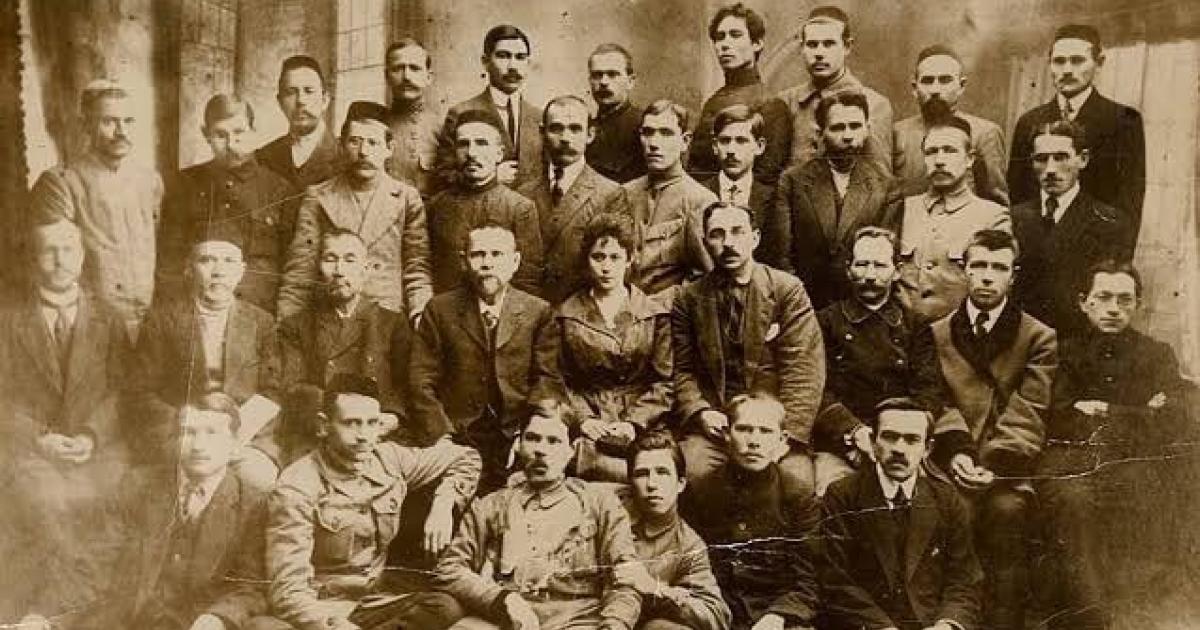
If a comrade could identify the author of this early 30s perspectives and tasks from Turkey I would be grateful.
‘The Political Situation in Turkey and Tasks of the Communist Party’ by Fachri from International Press Correspondence, Volume 13 Nos. 22 & 23, May, 19 & 26, 1933.
In the following article we shall attempt to analyse the fundamental questions now confronting the revolutionary working class of Turkey.
The Class Nature of Kemalism.
The Kemalists are opposing their economic system to both socialism and capitalism. They designate their system as Kemalist etatism. This must be thoroughly exposed. Kemalist Turkey is a capitalist country in the full sense of the word, albeit a backward capitalist country with feudal remnants.
Kemalism has promoted the capitalist development of Turkey, which the old regime of the Sultan, aided by world imperialism, attempted for a long time to hamper. To-day the commencement of the development of monopolist-finance capital can already be observed, although at present capitalism in Turkey is still very weak.
The position of the exploited classes in Turkey is still worse than in the advanced capitalist countries, because labour legislation is entirely lacking. For instance, a worker who has been incapacitated for work owing to an accident in the factory, is simply dismissed without receiving any compensation whatever. And still the Kemalists assert that there is no capitalist exploitation in Turkey.
The propaganda of etatism carried on by the Kemalists is at bottom nothing else but a masking of their policy of granting government subventions to the backward capitalist undertakings of the Turkish bourgeoisie at the cost of the majority of the people and by their increased exploitation.
The Nationalism of the Kemalists and their policy towards the Imperialists.
The Communists of Turkey have written in a declaration:
“In a period of extreme intensification of the struggle for raw material sources and markets, in a period when the general crisis of capitalism has enormously sharpened and relative stabilisation has come to an end—in such a period the realisation of economic independence on a capitalist basis is impossible for a backward country like Turkey, which is economically and financially dependent upon other countries.”
The Communists must incessantly demand of the Kemalists that they conduct a real fight against imperialism, and for the independence of Turkey. But what value can be attached to this demand of the Communists, if our comrades at the same time continually repeat that this is “impossible.”
The Kemalists themselves pose before the masses as genuine anti-imperialist fighters. The C.P. of Turkey denies this, and is perfectly right in doing so. But they must not represent the Kemalists merely as tools of world imperialism. In Turkey there exist direct agents of world imperialism—the feudal landowners and the bourgeois compradores, who are reinforced by a continual influx from the ranks of the Kemalists. It would, however, be incorrect to lump the Kemalists together with these elements. As representatives of national bourgeois Turkey, the Kemalists are conducting a double policy against the imperialists: at one time they capitulate to the imperialists, at another time they offer resistance to them. It must be realised that in each case they act in the class interests of the national Turkish bourgeoisie. We must not be afraid of openly admitting that the Kemalists are nationalists.
There exist certain objective contradictions between the interests of the national Turkish bourgeoisie and those of the imperialists. The imperialists are conducting a policy of expansion, of subjecting Turkey to their hegemony. It is French imperialism in the first place which is endeavouring to subject Turkey to its influence, to compel the Turkish bourgeoisie to be satisfied with playing the role of compradores, or agents of French imperialism.
The Turkish national bourgeoisie is defending its role as an independent exploiter of the toiling masses of Turkey, without, however, objecting to the participation of foreign capital in the exploitation of the toiling masses. It is even seeking to obtain favourable conditions of agreement with the various imperialist countries, thereby making use of the antagonisms among the various capitalist countries themselves; as well as between them and the Soviet Union. This bourgeois class character of Kemalist nationalism must be correctly exposed.
But in their criticism of Kemalism the Communists must not simplify this question. The masses will not trust them if they indiscriminately lump the Kemalists together with the venal agents of imperialism and deny that there exists any antagonism between them. It is the duty of the Communists to dissociate themselves from the agents of imperialism. They must show their independent features by criticising the Kemalists precisely for evading a determined fight against these elements and against the penetration of foreign capital, which constitutes a basis for reactionary movements of revolt. If the C.P. of Turkey thus exposes the Kemalists, their fight against the Kemalists and the reactionaries will be understood by the masses and they will be able to mobilise these masses for the anti-imperialist struggle.
The Kemalists systematically and consistently defend the class interests of the Turkish bourgeoisie. However, the conditions are not favourable for this class policy, and are becoming more and more difficult. The basis of the Kemalists is being undermined from two sides: on the one hand by the penetration of imperialism, on the other hand by the development of the class struggle and the revolutionary movement of the toilers. Foreign capital, in particular French capital, is penetrating the country more and more (before all under the cover of joint stock companies) and is developing into a great danger for the independence of the country.
If it were not for the existence of the Soviet Union and its support of the independence of the Turkish people, the Kemalists would have been compelled long ago completely to capitulate to world imperialism, Then the revolutionary movement in Turkey would be faced with the chief enemy in the shape of world imperialism, which is a far more formidable enemy than the Kemalist bourgeoisie.
The Dictatorship of Violence of Kemalism.
After the upheaval the Kemalists established the rule of the bourgeoisie not in the form of a peaceful bourgeois democracy, but in the form of an open, undisguised violent bourgeois dictatorship. The Communists must sharply expose this character of the Kemalist regime and must raise again and again the demand for the most elementary democratic rights for the workers and peasants: freedom of the press, of elections, freedom of assembly, right of combination, etc. If the Communists do not give prominence to this fight against the dictatorship of violence of the Kemalists, they will lose one of the most important weapons in their hands in the sphere of revolutionary mobilisation of the broad toiling masses who have not yet clearly realised the anti-democratic character of Kemalism.
The Communists must fight against the anti-democratic regime of Kemalism not from the standpoint of bourgeois democracy, but from the standpoint of a workers’ and peasants’ democracy. In this respect it must be emphasised that here it is a question not only of the formal rights of the toilers, but of the possibility of the masses really utilising these rights. It must be shown to these masses, on the basis of concrete facts, what a genuine proletarian democracy means under the conditions of the proletarian dictatorship in the form of the Soviet Power.
The Agrarian Policy of the Kemalists and the Tasks of the C.P. of Turkey in the Peasants’ Movement.
The Kemalists do not possess any fascist organisations; their party relies on the police and the army, the overwhelming majority of which consists of peasants. In the rural districts, where the Kemalists are supported by the big peasants, they are carrying out the original capitalist accumulation by violent means, by ruthlessly expropriating the small and middle peasants. As a result, a sharp class differentiation is taking place in the rural districts, which is bound to have an effect upon the soldiers. Hence the peasant question is the weakest spot of Kemalism.
In a number of districts in Turkey we are witnessing a mass movement of the peasantry. In numerous localities the peasants refuse to pay taxes, as a result of which their land and property are seized. In their work the Communists must give prominence to the slogans of the C.P.T. in the sphere of agrarian policy, in particular to the demand for cancellation of all debts. The general slogan of “refuse to pay taxes” would be premature at the present moment. It would be better to attempt to put forward concrete demands on the tax question separately in each district, making use of every concrete case of refusal to pay taxes or of distraint in order to mobilise the peasants against the tax collectors and representatives of the authorities.
The Communists, by exposing the peasants’ policy of the Kemalists, must sharply oppose the employment of troops and gendarmes for crushing the revolutionary peasants’ movement.
Mass Work of the C.P.T. in the Labour Movement.
The main task of the mass policy of the Party is the correct struggle for the partial demands, which help to establish living contact with the masses. It is very important to react quickly to events which rouse the masses to indignation, and to link up the slogans and demands of the Party with these events in every factory and every locality. The Communists must develop their own strike strategy. The strike movement, the unemployed movement and the peasant movement are the main forms of the mass movement in Turkey. In addition to the partial demands, the question of central slogans of action must be put forward.
It would not be advisable to demand that all workers should join the Kemalist trade unions, for this would involve the danger of many workers coming under the influence of the class enemy. We must, however, strive to get these trade unions converted into real revolutionary trade unions by setting up opposition groups, which fight for winning the majority of the workers and removing the Kemalist leadership of the Kemalists. If, however, we possess a sufficiently strong opposition group in one or the other local organisations, and if we have the prospect of capturing this organisation with the help of the workers, then it is advisable to call upon the workers to join this particular trade union.
In general the Communists must propose to the workers that they set up independent revolutionary mass trade unions.
In striving to win the legal mass trade unions, the Party must not fall into the illusion of legalism. The Kemalists are afraid of the mass organisations of the working class and the conversion of the trade unions into free class organisations. If strong pressure is exerted the Kemalists will probably be compelled to make certain concessions. But the Communists must not neglect the task of setting up their own illegal trade unions or illegal trade union opposition groups. Of course, the illegal organisations will not be able to draw in numerically broad masses. But the most important thing is that they are closely connected with the working masses and develop a constant activity among the masses.
Questions of Party Construction.
The C.P. of Turkey must consolidate its local organisations and the local committees in the most important places in the country. The existing Party cadres must reinforce these Party committees. The local committees must learn to develop their own initiative and to work independently whenever there is no connection with the Central Committee; then the class enemy will not be able to destroy the organisations of the C.P.T.
Particular attention must be devoted to the struggle against provocateurs and spies. Conspiratory methods must be adopted. The Communists must not cherish any legalist illusions.
Precisely at the present moment, when we are witnessing a revolutionary upsurge in Turkey which is expressed in a number of mass actions of the workers and of the revolutionary peasants, it is the main task of the C.P.T., in the course of these mass struggles, to prepare the toilers for the great revolutionary fights.
International Press Correspondence, widely known as”Inprecorr” was published by the Executive Committee of the Communist International (ECCI) regularly in German and English, occasionally in many other languages, beginning in 1921 and lasting in English until 1938. Inprecorr’s role was to supply translated articles to the English-speaking press of the International from the Comintern’s different sections, as well as news and statements from the ECCI. Many ‘Daily Worker’ and ‘Communist’ articles originated in Inprecorr, and it also published articles by American comrades for use in other countries. It was published at least weekly, and often thrice weekly. A major contributor to the Communist press in the U.S., Inprecorr is an invaluable English-language source on the history of the Communist International and its sections.
PDF of issue 1: https://www.marxists.org/history/international/comintern/inprecor/1933/v13n22-may-19-1933-Inprecor-op.pdf
PDF of issue 2: https://www.marxists.org/history/international/comintern/inprecor/1933/v13n23-may-26-1933-Inprecor-op.pdf
 Revolution's Newsstand