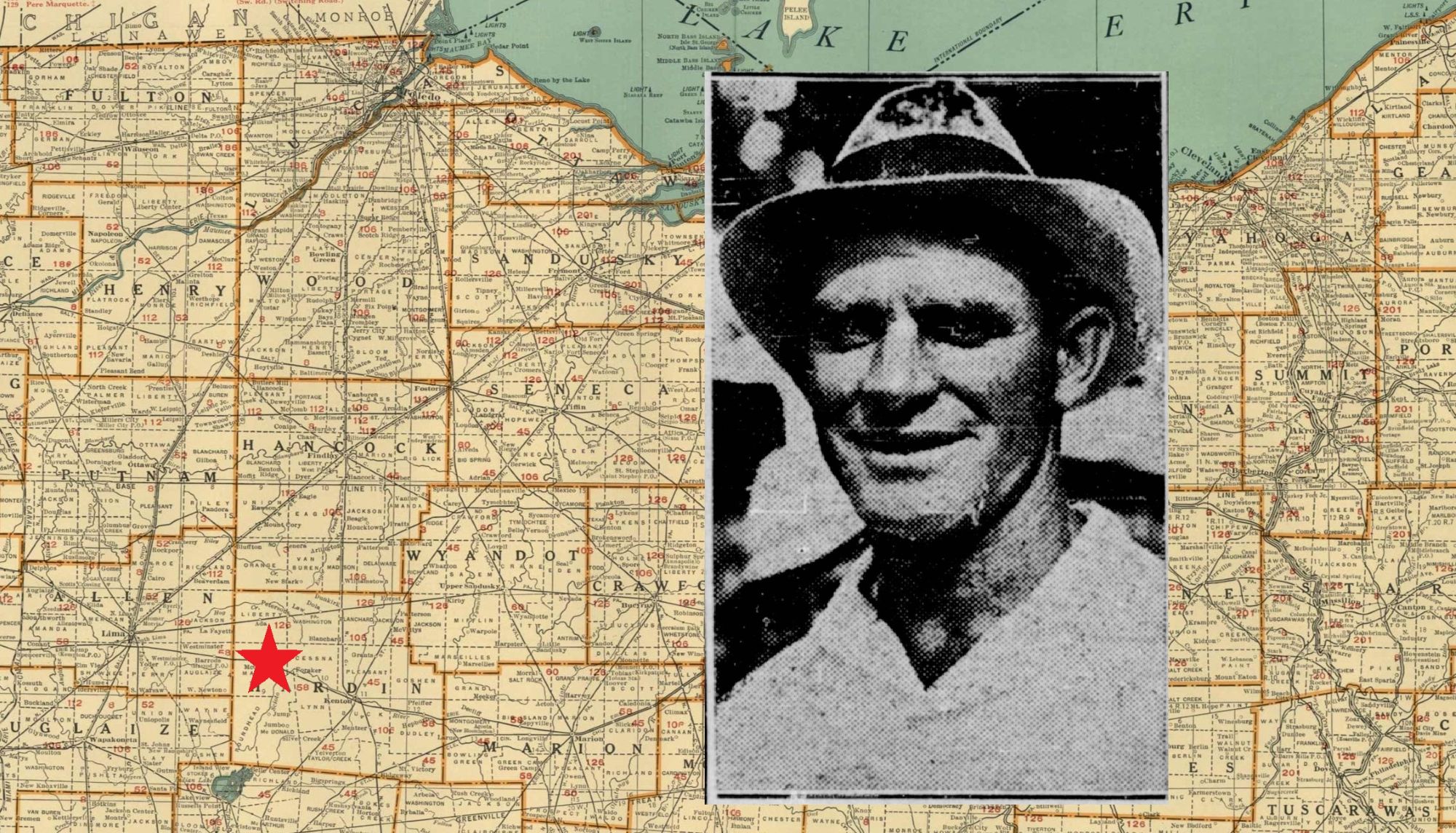
Brave fight of workers laboring on the 17,000 acres of onion fields in Hardin County, Ohio led by the National Unemployed Leagues and the Agricultural Workers’ Union with aid from the nearby union hotbed of Toledo.
‘Onion Strikers Guard O’Dell: Farm Workers’ Leader Defies Scab Lynch Mob’ from Labor Action (A.W.P.). Vol. 11 No. 16. September 1, 1934.
Growers’ Trucks Used in Kidnapping of Union Head in Ohio Town
POLLOCK JAILED
Unemployed League Aids Marsh Hands’ Fight For Higher Wages
BULLETIN
McGUFFEY, Ohio. Okey O’Dell received telegram from American Civil Liberties Union offering $1,000 reward for conviction of any of his abductors on federal charge of kidnapping.
Hearings on charges against Sam Pollock and strikers will be held Sept. 4 in Kenton. Pollock’s bail reduced to $500.
Latest reports prove conclusively growers planned mob action against O’Dell before bombing of Mayor Ott’s home. Plans were laid at meeting of growers night of Aug. 24.
All trucks used by kidnapping mob belonged to onion growers. In strikebreakers’ parade night after O’Dell kidnapping, sheriff and deputies marched around town with scabs.
O’Dell being guarded in his home by armed strikers.
McGUFFEY, Ohio. With the mob kidnapping of Okey O’Dell, militant strike leader, and the jailing of Sam Pollock, a district vice president of the Ohio Unemployed League, the bosses’ attempt to break the nine weeks’ old strike of the onion weeders has reached a climax.
O’Dell, president of the Agricultural Workers’ Union, A.F. of L. affiliate, was arrested early the morning of Aug. 25 for questioning about the bombing of the home of Mayor Ott of the village of McGuffey, during the night. Although O’Dell explained he had spent the previous day in Columbus and had been in bed since his return a few hours before his arrest, he was turned over by deputy sheriffs to a mob of 200 imported strike-breakers, beaten into unconsciousness and driven in a truck to the Hardin-Allen county line. Saved from lynching only by the caution of one of the mob, O’Dell was dumped into a field and warned to stay out of town.
Returns To Defy Them
The intrepid strike leader, who has worked night and day to raise the 750 strikers from conditions of peonage, hitch-hiked back to town, forced the village doctor to bandage his smashed ribs and injured nose at the point of his gun and defied the strikebreakers to attack him or carry out their threat to harm his three-year-old son.
One group of the mob also threatened Willard C. Wies, vice-president of the union and father of the town marshal, who barricaded himself in his home.
When reports that O’Dell had been lynched reached McGuffey, Mayor Ott’s wife told reporters, “I know O’Dell is alive. I hope he’s dead, though.” Mayor Ott, owner of a filling station, was considered a strike sympathizer at first; the growers even refused his offer as a mediator, calling him an instigator of the strike. Then a deputy sheriff friend of his got hurt in an outbreak–and the extent of the mayor’s “sympathy” was shown up. Now he’s openly with the bosses.
Sam Pollock
Pollock, arrested the day before O’Dell was kidnapped, on a charge of inciting to riot, is held in the vermin-infested Hardin county jail at Kenton, under $1,000 bail His wife and two friends were refused permission to see him the day after his arrest.
Here’s the story of the “riot”:
The Riot
At daybreak the morning of Aug. 24, Pollock and 25 strikers went to the far side of the 17,000-acre onion fields, into Allen County, to picket. When several truckloads of strikebreakers, attempting to push through the mass picket lines, tried to run down a striker, a fight was precipitated. Bricks were thrown; windshields on trucks were broken.
On the way back to McGuffey, the car in which Pollock was riding was ambushed by armed deputies from Kenton, and Pollock was arrested. In jail with him are ten other strikers, arrested during the past few weeks in the campaign to break the strike. O’Dell, too, has spent time in this jail–convicted of breaking the usual bosses’ injunction. This one prohibits the strikers to have more than two pickets at farm entrances.
The reason the bosses are after Pollock is clear. He offers a new threat to their power–a threat of cooperation between the employed and the unemployed.
N.U.L. Helps Strikers
Pollock whose home is in Toledo had been in the onion marsh territory about a week before his arrest, organizing the unemployed and helping the strikers. An agreement of cooperation between the Ohio and the National Unemployed Leagues and the Agricultural Workers’ Union was signed. Organization of the League is to continue during the strike. The League, in turn, is to take an active part in picketing and other strike activities. This sort of cooperation is getting to be almost routine in Ohio–and the bosses don’t like it.
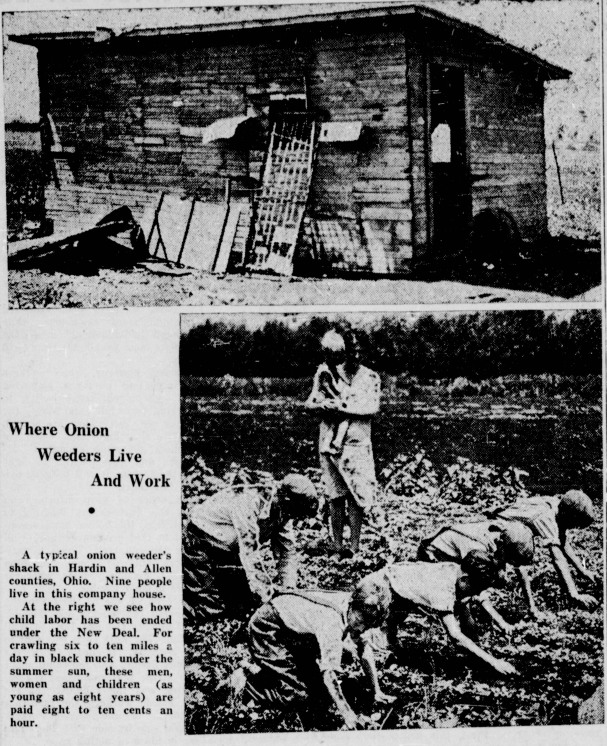
The strikers gained renewed strength. They had been getting discouraged. New to strikes, they had watched, with dismay as the government, the officials elected to serve them, lined up behind the growers to defeat the strike. They had seen deputy sheriffs brought in to protect the scabs–deputy sheriffs recruited from the ranks of the National Guard, many of them fresh from strike-breaking (but unsuccessful) work at the Auto-Lite plant in Toledo in June. They had seen a barn on the farms of the Scioto Land Company, largest and most arrogant of the onion growers, turned into an armed fort to house these deputies.
Sidelights on the Strike
Mayor Ott of McGuffey, a filling station operator, was sympathetic to the strike at first. His wife, daughter of one of the large growers, opposed it and separated from the mayor over this issue. After this–and after a deputy sheriff friend was injured–Mayor Ott about-faced and now openly sides with the growers.
Village doctor refused to dress O’Dell’s wounds, until strike leader forced him to at point of gun.
About 50 cases bound over to grand jury; prosecutor dismissed last grand jury without acting on these cases. Most of those held are strikers.
Mayor’s sister, wife of an onion grower, is out on bail bound to grand jury for threatening with intent to kill.
One grower is held to grand jury charged with kidnapping a striker’s children and putting them to work in onion swamp while striker and his wife attended union meeting.
Growers are paying for booze, gasoline and other expenses incurred by strikebreakers and vigilantes.
So proud of their A.F. of L. union charter are these onion weeders that during the past few days some of the strikers have stood guard with shotguns over the charter–ready to risk their lives rather than allow scabs to seize this emblem of their rights.
There are a number of periodicals with the name Labor Action in our history. This Labor Action was a bi-weekly newspaper published in 1933-34 by AJ Muste’s American Workers Party. The AWP grew from the Conference for Progressive Labor Action, founded in 1929, and Labor Action replaced the long-running CPLA magazine, Labor Age. Along with Muste, the AWP had activists and writers James Burnham and Art Preis. When the AWP fused with the Trotskyist Communist League of America in late 1934, their joint paper became The New Militant.
PDF of full issue: https://www.marxists.org/history/etol/newspape/laboraction-cpla/v2n16-sep-01-1934-LA-Muste.pdf
 Revolution's Newsstand