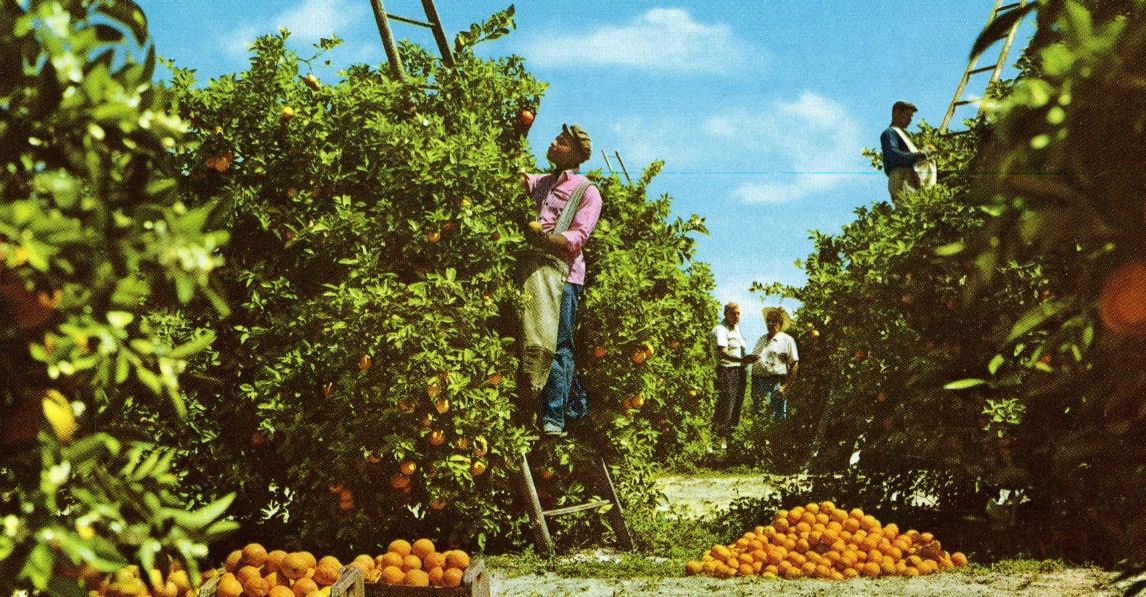
Frank Norman was a working class white man from Chicago, but long a resident of Florida. He was a husband and a father. He was a Communist, a labor organizer with the Citrus Workers Union, and an anti-racist building a common organization of Black and white workers in a state where white supremacy and the most primitive forms of accumulation were, are, its reasons for being. Taken by the Klan from his Lakeland home and murdered on April 11, 1934, Frank Norman’s body has never been recovered. Bruce Minton traveled to the Florida to investigate conditions in the state and the circumstances of the “unsolved” killing a year after. Minton would later name the Klansman calling himself ‘Sheriff Chase’ as Fred Bass. A brutal and heroic story.
‘The Klan Turns to Murder’ by Bruce Minton from New Masses. Vol. 7 No. 11. December 10, 1935.
LAKELAND, FLA.
WHEN several men stepped on the porch of their house and knocked
at the door, Frank and Ethel Norman were mildly surprised. But now that the citrus union was functioning, it wasn’t unusual to have visitors even so late as nine o’clock in the evening. Workers often came to Frank Norman for advice; in the dark, they could visit without being spotted by the deputies.
It was mild outdoors, a typical Florida spring night, the kind that makes Lakeland a splendid resort, and more important, the center of the citrus industry. The Normans had almost finished their letter writing. In the front room, Mr. and Mrs. Surrency, boarders and friends, had already turned out the light. Four-year-old Frankie was long ago in bed.
Frank Norman rose and went to the door. Mrs. Norman could hear the low voices of men intent on what they were saying. She looked at the paper in front of her, not writing, not listening to the murmuring drone from the porch, thinking of how much it meant to have Frank back after three months at the training school for workers. He had returned with such energy, talking with a new fluency about things he had always felt. Life wasn’t any bed of roses in Lakeland despite the circulars put out by the Chamber of Commerce. Work remained difficult to find; Mrs. Norman sighed–at least, she had her cannery job. Frank couldn’t land anything that would allow him to practice his trade as electrician. Formerly, he had belonged to the Citrus Workers’ Union, the same as she, and for a short time had held the position to which she had also been elected, secretary and treasurer of the Lakeland local. Now, Frank must accept work relief–at six dollars a week. The owners refused to hire him–called him an “agitator,” a “Red.” He talked about organizing the grove workers and packing-plant men; he favored treating Negroes like human beings. Imagine, the moneyed men were saying, treating a “n***r” like you would anyone else, when everyone knows a “n***r” has no soul! Frank Norman, “furrener” from the North (eight years in Florida and married to a Georgia girl made no difference), Frank Norman refused to accept such distinctions between white and black. He continued to talk about Negro rights, even met with Negroes just as if they were equals and that sort of action, said the big growers and business men, was calculated to stir up the Negroes and put ideas into their heads.
When the United Citrus Workers’ Union came to Lakeland from Haines City, forty miles down the road, Frank Norman took the lead in organizing the local. The workers trusted him. They began to grasp what he was driving at when he advocated Negroes joining too, white and black sticking together, each refusing to scab on the other. Things aren’t done that way in the South. It’s all very well, the white officials agreed, to have a Negro local–under the strict jurisdiction of the nearby white local. The Negroes would be told what to do, when to strike, what to ask for, how to cooperate with their white superiors. They would get their orders. Frank Norman objected to that arrangement. Well, it was generally conceded in high circles that Frank Norman was a bad influence.
Rumors circulated, rumors that worried Mrs. Norman. She wouldn’t interfere with Frank: he knew best and when he explained to her, she saw his idea as clear as day. But the bankers and growers objected to Frank’s organization, the International Labor Defense. At the meetings, whites and blacks gathered together, and the blacks didn’t stand while the whites sat down, but all sat down together. The owners told each other that the International what-do-you-call-it was “Comoonistic” and wished nothing more than to destroy society by demanding high wages, by having Negroes rape white women and by putting Negroes at the head of the state. As bad, worse, than the Catholics, for the Catholics had a Pope that was white and now the Comoonists came along and no one knew where they’d stop.
Lakeland’s “better class” drew a sigh of relief when Frank Norman went away to school. Then, just as things were looking up, the citrus workers struck in the packing plants and forced concessions. In the wake of this victory, Frank Norman returned. He talked just as much about militant organization and Negro rights as he did before he went away.
Mrs. Norman knew the Southern owners. They prided themselves on patriotism, thought of themselves as happy, carefree altruists who only wanted to make a living. It wasn’t their concern that the search for profit meant starvation for workers. The owners didn’t make the depression, not a bit of it. All they desired was their profit–“building the South” is the way they put it and to live decently. If workers can’t live decently too–well, suh, no one gave the bosses nothin’, they jest got it by sweatin’ work and now they sho’ had a right to what brains done bring ’em. The n***s–Frank Norman had no business fixin’ to stir ’em up. They’d gotten ‘long up to now and no damned Comoonistic furrener’s goin’ to up and tell a self-respectin’ suthe’n gen’leman how to care fo’ his n***rs.
The door slammed. Frank came toward her, thin and tall, his deep-set eyes worried, biting his lip, running his fingers through the mass of brown hair. He stood over her. “Sheriff Chase ‘n two deputies are outside,” he said in a low voice. “They want me t’go down the road toward Haines City to ‘dentify a Negro who’s been lynched.” He stopped, clearing his throat. “I’ll bet it’s one of my I.L.D. members.”
Mrs. Norman stood up. “Well, then, I’m a-goin’ with you.”
“D’you really want t’go?” “Yes.”
She followed him out on the porch, feeling sick, seeing the brown body swaying slowly back and forth at the end of a rope. They’d do anything, the Klan, anything. She glanced at the strangers, one leaning against a post a little way down the porch, the second playing with Frankie’s puppy and the third, evidently the one who called himself Sheriff Chase, smiling, conciliatory, huge in the dim moonlight. Well over six feet and a two hundred pounder. “Mrs. Norman here’s goin’ with us.”
The big man smiled and bowed. “That’s sho’ all right if you want t’go, Mrs. No’man, but it’s no place fo’ any lady.”
Frank shrugged. “Why, she’s seen one Negro lynched an’ I guess she can see another one.”
“Well, come on then.”
Mrs. Norman told Frank to let the Surrencys know where they were going. Perhaps they would look after Frankie. She went into the house. When she returned, Ben Surrency was out of bed, hurriedly dressing, eager to accompany Frank. She decided to stay behind with Mrs. Surrency. “But you can take our car,” she said.
“There’s no need fo’ that,” said the big sheriff, kindly, immense against the dark sky. “It won’t take more’n a couple minutes to go down there and have a look at that body. We done found Mr. No’man’s name and address on a slip o’ paper in the n***r’s pocket. Why take yo’ car when we’ve got a nice car just down here?”
They left the porch. Mrs. Norman looked after them, the huge sheriff lumbering before, followed by the two smaller deputies and then Frank and Mr. Surrency. They stepped into the car–Frank and Ben Surrency in the back seat, with the immense man called Sheriff Chase. The car drove off, down the dirt road, round the bend across the railroad track.
He was never to come back, Frank Norman. She would never see him again. He rode away in the car and out of life.

THAT was a year and a half ago, April 11, 1934. When I came to Florida to investigate the Norman case, it was already too late to do more than talk to people, attempt to ascertain what had happened. The body of Frank Norman has never been found. It is impossible to prove who committed the murder, though it is generally conceded that the method was that of the Ku Klux Klan–whether acting officially or unofficially cannot be determined. The man who posed as Sheriff Chase is known–but as yet he cannot be prosecuted. He is not a resident of Lakeland, that much can be said, but an official of the Klan living in a nearby city and noted for his brutality, his terroristic and anti-labor activity. He is a big man, six foot four in height, weighing 190 pounds. He mentions the Norman case whenever an opportunity presents itself–fondly, a cherished memory.
The case of Frank Norman leads far afield: into Klan activities, into the terror which is so intense in Florida, into the labor movement and the fight of the unemployed for even a subsistence level of direct and work relief, into the treatment and position of the Negro. Florida is one southern state where cotton is not king; here, the orange and grapefruit rule. Sharecropping is rare; the Negro for the most part does not live on ranches and estates of the owners as a chattel slave. In Florida, he is free–free for the most drastic and vicious exploitation that workers can possibly endure.
Mr. Surrency was the last man to see Norman alive-except for the murderers. After the shooting, Mr. Surrency remained in Lakeland. He is a slow, honest, kindly “cracker” and his contact with violence frightened him. The terror and intimidation exercised by the newspapers and the sheriff’s office created in Mr. Surrency a state of extreme panic. Finally, several months ago, he could stand it no longer. He left Lakeland, journeying far to the south, to the wild Everglades, where in the plains a great distance from the main road he and his wife live in a primitive shack, farming, picking up odd jobs here and there. He is almost inaccessible–one must travel along a sandy wagon trail, across swamp and plain, to reach his house that stands on stilts in the middle of nowhere. He was surprised, taken aback to have visitors. He opened up the shack-a square room of ill-fitting boards with daylight showing through and a dilapidated shingle roof. And he repeated what he had already stated in an affidavit signed by him:
“Mr. Norman stepped in the car in the rear seat, I followed in the middle. The supposed Mr. Chase got in with us in the back seat. As we drove off at possible 100 yards from the house, Mr. Norman ask Mr. Chase to show his authority as he did not know whether he was the high sheriff or not. The man answered, “I am not Sheriff Chase but a deputive from Highland City. It doesn’t matter, the Negro has a card with your name and home address on it, and we want you to identify him so we can take him down for an inquest.” Mr. Norman says, “Will you please stop about 100 yards farther down the road so I can pick up another man, as he might be a help to identify the Negro?” The man says “Sure,” and turned on Ingram Avenue instead of following the Bartow Road according to Mr. Norman’s instructions. I judge we drove forty yards when the car came to a sudden stop. The man sitting beside the driver covered Mr. Norman with a gun. Then he asked me my name. As I told him my name was Ben Surrency, he said, “Get out. I don’t want you.” I got out as I was told. As Mr. Norman put up both his hands, asking the man what in the world does this mean. Mr. Norman was saying other words as I was rushed out of the car and I could not understand what he was saying. As I got on the street a gun fired. And an awful thumping noise was heard in the car. The supposed-to-be Sheriff Chase took me by the shoulder and faced me back home and told me not to look back. Another car 40 or 50 feet back of the car I just got out of and facing me stopped with their bright lights on. Both cars remained still until I had passed the second car some distance. Then they both sped on.”
He sat leaning against a post, the gaunt Mr. Surrency, trying to recall more. “Are you able to give any sort of description of the big man?” I asked. “Anything that would identify him?”
“Now, that’s sho’ hard to say,” he answered, poking with his pocket knife at the “I had no rotting wood. cause to look closely at the supposed-to-be Sheriff Chase. So I cannot say who the man was. He was very big-but it was dark…”
Surrency has been under pressure from the authorities; but it is fairly probable that he really does not know the murderer and could not recognize him. “Pretty hard to remember all that way back,” he kept repeating. “Dark ‘n I didn’t know what was a-goin’ to happen so I just didn’t look and when they put me outta the car, they told me not to look back–“
These are the only facts that can be ascertained concerning the murder. Frank Norman has not been seen or heard of since. There are many theories as to what happened to the body. Perhaps, as one man said, it was buried on the property of one of the kidnapers. Or perhaps, some insist, it burned in the mysterious fire that occurred a few days later in the vicinity. Or it was dumped into one of the many lakes that surround Lakeland and Orlando. The head of an unidentified man was found in Maitland by workers cleaning out brush–it might be Frank Norman’s; the sheriff took good care not to ask Mrs. Norman to attempt to identify it. More likely, the body of Frank Norman was thrown into one of the flooded phosphate pits close by. Some day, when the pits are drained, the remains of a skeleton may be found which can no longer be identified. The murderers did a good job.
EVEN the Klan and the grove owners couldn’t prevent at least the gestures of an investigation. When Surrency dashed back to the house, breathless, sick with fright and blurted out what had happened, Mrs. Norman picked up Frankie and with the Surrencys rushed to the nearest telephone at a drugstore down the road. Sheriff Chase could not be reached. Peculiarly enough, his deputies were sitting in a car in front of the drugstore. Mr. Surrency climbed into the car which went off in what proved a fruitless effort to find the abductors. A block away loitered a second police car, so the garage man remarked a few days later, surprised at the turnout of the law in quiet Lakeland. But Sheriff Chase was away and had left no forwarding address: though that same night he stopped for gas about eight o’clock some forty miles outside of Lakeland. He told the attendant to fill up the car and be snappy about it because he had to be in Lakeland within the hour. Yet when Mrs. Norman tried to reach him that night, he couldn’t be located–or at least he wasn’t answering calls that might come from frantic Mrs. Norman.
The “investigation” dragged on a few days. Nothing happened–not surprising to most people. The newspapers were apathetic so far as finding Norman was concerned; they were not apathetic when it came to denouncing him. The Red scare arrived in Lakeland. The Lakeland News announced:
“A pamphlet was given The News yesterday by a citizen of Lakeland who stated that Norman was representative of what was known as promoting Communistic doctrines in Lakeland and had suggested to some the forming of a nudist colony.”
The Lakeland Evening Ledger “scooped” the world with the following:
“In grapevine circles, it is said that he is in New York City. There is little credence here in the theory that he was slain by the small group posing as officers that kidnaped him on the night of April 11. Another story is to the effect that he spent unwisely funds entrusted to him by the communist organization, and paid the penalty, whatever that was.”
A man bribed little Frankie with gum to say that his father was in Chicago. But despite these rumors, no doubt existed in anyone’s mind that Frank Norman had been killed by Klansmen backed by the big owners. Norman was a militant unionist and one of the driving forces in the organization of citrus workers. He advocated the right of Negroes to organize. The growers and bankers feared him, wanted him out of the way. Just before the murder, Sheriff Chase had asked questions of the other workers concerning Norman. The manager of the J.O. Barnes Packing House in Highland City, the head of the biggest concern in the vicinity, Chandler and Davis Packing House, the manager of the Exchange Packing House fulminated against Norman and his activities. The heads of the union resented him, because he was continually exposing their weak- kneed policies, their willingness to knuckle under when ordered to by the packers. When Norman was killed, the workers knew very well who was behind it. Nor were they too astonished that Sheriff Chase did nothing despite a great deal of noisy “investigating,” and that the newspapers covered up the facts with a barrage of innuendoes and Red baiting.
Mrs. Norman appealed to the federal government, to. President and Mrs. Roosevelt, to Governor Scholtz of Florida, to Mrs. Lindbergh whose child had been kidnaped and killed. Stony silence, except for two curt notes from the Department of Justice stating that the federal government lacked any jurisdiction. The case finally dragged to an end when Sheriff Chase reported to Governor Scholtz that because of Mrs. Norman’s unwillingness to help the investigation, because she refused to talk, he could do no more than he had already done. Which was exactly nothing.
Sheriff Chase sat in his Bartow office–nothing of the small country policeman about him. He took a quick look at me, holding my hand a little too long. “How about a Coca Cola?” he asked. “I’ll send out for some.”
“That’s nice of you, Sheriff. You see, I’m from the North and I’ve run across a case which I’d like to ask you about—”
He picked up the receiver, ordered drinks and cigarettes. “Now, we’ll get this straight,” he said. “Your name?”
He wrote down everything I said. He interrupted every few seconds to make a phone call, official, good-natured, a rotund, jovial man behind the desk, with his wide-brimmed hat tilted back and his leather jacket open. About five feet nine–“Where d’you hear of this story?”
“Oh, just here and there. They told me no proper investigation had ever been made.”
“I wouldn’t say that. Not by a long shot. Here, take a package of cigarettes. This the kind you use?”
“Thanks. But this case. I’d like to know more details—”
He leaned close to me, squeezing my arm, smiling. “Oh, you know all about it. You are not so innocent as you look. You know a helluva lot more than you’re telling me. Come on, tell me what you know. I’ll spill my story after you’ve given me yours. There’s nothing in this case. One of my deputies saw this fellow–what’s his name–riding in a car the next day heading north, big as life. I want to get at the bottom of this case just as much as–but no one’s telling me anything. I’ve done everything I could. This fellow’s not dead–you can be sure of that. But who do you represent? What d’you really want? And you might give me your address and where you’re goin’ to be. If you want to make any statement–” pencil poised over the scratch pad, watching me out of the corner of his eye, smiling–
Yes, Sheriff Chase is interested in the Norman case. He has done a good job. He has investigated plenty–always in the direction where he could be absolutely certain he’d run across nothing that might embarrass him, the sheriff of Polk County. It would be unwise to antagonize friends in the Klan and the American Legion. And who cares about a Red anyway?
There the case rests–and has rested for over a year. Frank Norman, electrician, veteran who served two years overseas, militant worker whose father was a militant worker before him, American who believed in the Fourteenth Amendment, Communist–Frank Norman is dead. The murderers go free–to terrorize, to beat and maim whenever they decide it is time for an evening’s outing. One of them can be pointed out any time you get to a little city near Lakeland. He’s a big fellow, six feet four, weighing 190 pounds.
WHEN the Klan came for Norman, it is logical to believe that the intention was to take him out, scare him, beat him thoroughly, see to it that he got out of the citrus belt. But Norman resisted. The gun went off. The bullet killed Norman. The kidnapers had gone further than they had originally planned.
The murder unleashed terror–against the I.L.D. and against the citrus union. Fear and intimidation and the lack of a firm leader temporarily broke up the I.L.D. The Klan’s fiery cross burned before this house and that: workers were beaten.
Norman’s associates bore the brunt of intimidation. Guy Stotts, sign painter, Norman’s intimate friend, was warned not to talk if he valued his life. He wrote a “retraction,” the irony of which evidently escaped the editor of the local paper, for he printed it in full:
“After receiving the second threat on my life for my socialistic propensities, I hereby waive my constitutional right to freedom of speech and beliefs and all socialistic or Communistic proclivities I might have had, and cease to contribute my efforts to bring a universal brotherhood of man and do hereby publicly announce my reversion to the prevalent Democratic principle of “dog eat dog.””
Naturally, the owners did not overlook the citrus union. Picketing is illegal in Lakeland. Workers on strike are considered fair targets for snipers. The owners were aided by the willingness of union officials to break up the organization. A former union president, Mr. Chapman, accepted a job from a big packing company at Haines City to manage the “hotel”–a skyscraper structure in the middle of the plain, erected in boom days and now used to house girls who have been herded into the company union. Two other union officials made a deal with the packers to call a strike toward the end of the season, then call it off immediately before it could get under way, the strategy being to discourage and disillusion the workers in union activity. They were rewarded for this stalwart service with substantial benefits. The rank and file? The officials were not particularly concerned.
The union was busted. Workers–militant and backward, inexperienced in union organization–threw up their hands and once taken in, swore never to be fooled again. They continued to work for 17 1/2 cents an hour, ten hours a day in the scorching fields, earning less than two dollars a day, or twelve dollars a week. They could live by it–just about. Some worked all year round; over half worked less than six months. How did they exist in the meantime? It’s hard to say. That is the answer one hears to this question all over Florida–“It’s hard to say. I don’t know.” Sometimes they got relief; sometimes they picked things out of garbage cans; sometimes they died of starvation. The Negro–his lot is, of course, a great deal worse.
Or if you landed a job hoeing trees, you received 22 cents a tree and a good man, better than average, can hoe fifty trees a day. That nets him $1.25–so long as work lasts. The owners, the big growers, the newspapers, say that a man can take care of a family, feed and clothe them, give them proper medical care and education, meet the hundred and one obligations of everyday life, each of which takes money, on $1.25 a day. The owners and growers haven’t tried it yet themselves.
Five months a year the great canning plants run full blast. They pay “high” wages- yes, suh. Twenty-two and one-half cents an hour for ten hours a day. Or on piece work, four cents a tray of eighteen cans of tomatoes or six cans of grapefruit. If you keep at it and have had a good deal of experience, if there are no delays in the flow of fruit, a hard, fast worker can pack twenty-five or thirty trays a day.
That’s Florida. The citrus industry is the backbone of the economy. That’s why the owners are so bitter in their denunciation of California; rivalry is based not on pride in climate, but on anxiety lest California citrus growers beat them out of the markets. The tourist trade also counts. A saying down here goes, “In the summer, the crackers live off yams; in the winter, they live off Yanks.” The profit on fruit, like that on Yanks, goes into fewer and fewer hands each year. Little grove owners, like small merchants in the cities, are no longer able to exist. They find themselves laboring in groves no longer theirs, groves owned by large banks, by corporations that control thousands of citrus acres.
And the harder workers sweat in the fields, the less they seem to make. Discontent, restiveness leads to organization. They turn to the more alert of their class to lead them. They were beginning to turn to Frank Norman. More and more workers listened to him. There remained only one thing left to do so the big owners decided–get Frank Norman out of the citrus belt. The Klan was tipped off. They went further than they intended. Today a big man, six feet four, weighing 190 pounds, likes to remember the way he disposed of a “Red.”
That Red’s wife and child? They live in Lakeland. Most women would be crushed by the tragedy. Mrs. Norman gets relief–$1.20 a week. But Mrs. Norman understands what Frank was driving at, why he paid for his work with his life. Mrs. Norman feels that she has much to live for.
THE Constitution of Florida reads: “White and colored children shall not be taught in the same school, but impartial provision shall be made for both.” Further on, “All marriages between a white person and a Negro, or between a white person and a person of Negro descent to the fourth generation inclusive, are hereby forever punishable.” It is a crime against the state for a white person to teach Negroes. From his earliest days, the white child is indoctrinated with this deep, unreasoning contempt of the Negro. Thomas Nelson Page, author of that classic of race hatred, The Negro, expresses the attitude of the backward South:
“The Negro does not generally believe in the virtue of women.
“In the next place, his passion, always his controlling force, is now, since the new teaching, for the white woman.
“The urgent need is for Negroes to divide into classes, with character and right conduct as the standard of elevation.
“To say that Negroes furnish the great body of rapists, is not to charge that all Negroes are ravishers. To say that they are ignorant and lack the first element of morality, is not to assert that all are so.”
Page’s ugly conviction of white superiority is echoed by the ruling class throughout the South. The managing editor of The Lakeland Evening Ledger leaned back in his chair, the “kind, southern gentleman,” finger-tips together, twinkling eyes surveying me as he explained, “Yes, suh, the one ambition of every n***r is to sleep with a white woman. When they do, they know what to expect. Now, I likes to see n***rs get ahead, but you sho’ gotta be ca’ful with ’em, else they’d be runnin’ the show. That’s why we don’ let ’em vote, not in the white man’s prim’ry. Now, a n***r’s got a legal right to vote, but just you let one of ’em try it. When a man’s ‘lected on the prim’ry down here, he’s ‘lected fo’ good. If the n***r’s itchin’ to vote, he can in the run off, that is if he’s seen to it to pay his poll tax–that’s a dollar a year and it’s got to be paid up fo’ two years. We don’ want n***s runnin’ us–guess we couldn’t stand fo’ that.”
So the Negro is something apart, something lower. Even the liberals reflect this attitude. A man who prided himself on his socially-minded point of view, prodded me with his finger, saying, “Y’know, I ain’t got no prej’dice ‘gainst the nig–Negroes. I think they’re jest’s good as we are. Trouble is, they’re dirty.”
I visited Negro homes–crude crate-like huts, no running water, no electric light, no toilets, no heat, poor ventilation. Water must be hauled from the pump. No paved streets in the Negro district, but dust, thick dust, that the slightest breeze blows into the rickety shacks with their corrugated iron roofs. An old bent woman showed me through one. “Rain leaks in jest like it was outside,” she told me. “Dust, ev’ry time the wind kicks up a little, blows into everythin’. People says cullud people ain’t clean. Well, I scrubs and scrubs, but the boards ain’t no good and scrubbin’ doesn’t get out the rats ‘n the bugs. How’s we goin’ t’wash decent? And we pays $1.50 a week f’r this. ‘N even if we could afford better, we ain’t ‘lowed to live on’y in this section o’ town. My husband, he’s got work now, skilled work. He gits $12 a week. I takes in washin’-fifty cents a bundle an’ they sho’ are some big bundles. But yo’ can’t live decent in shacks like these—and white folks calls us dirty. I’d like to see some of them live here and see how clean they’d be.”
Frank Norman attempted to organize the Negroes, to preach that they too are human and have human wants and needs and the right to life. That is a crime, the most serious of crimes, in the South. Frank Norman paid for that crime with his life.
THREE white men and a Negro squat at the edge of the lake. The moonlight reflected in the water is pale chromium; on the opposite bank are the street lamps against the background of dark houses, the occupants already asleep. Behind, a row of palm trees rustles in the slight breeze.
We whisper together; a swan sails out of the dark, feeds noisily in the patch of water lilies. The three of us who are white shield the Negro from the glare of the occasional passing automobiles. He talks the slowly, soft-voiced, looking out at the lake, at the path of moonlight on the water. “He was the fines’ white man I ever knowed, Frank No’man was. He was like part of me, part of all of us. He knowed us and he meant what he said. We have so many upsets–when he was takin’, was like my own kid dyin’. That was the way all’n us feel.”
The bank smells fresh, grassy. “And now?” I asked.
“We’s got a hard time organizing. So many upsets for the workin’ man. We don’ get much chanct fo’ organizing, strong like. Cullud folks is afeard. One don’ get and never have gotten since we born, a livin’ wage. Our people’s unstable like, ’cause they’s scared, scared of the fire, scared of the rope. Capitalist organization sho’s is strong. But it ain’t too long a time till people know what we’s comin’ to, what is the way we’s all gotta go.”
He broke off. The swan squawked, made off down the lake. I looked at our companion, watched him roll grass between his fingers. “My kid goes t’school,” he said suddenly. “Only learns devilment, that the black man ain’t no good. He thinks that right, hears it so much. When I tells him, ‘How come you believin’ such things?’ and I ‘splains to him that the Negro’s got t’ know, he says, ‘Well, mebbe. Reckon could yo’ get by wit’ that without you getten killed?’ “
Again he paused, clearing his throat. “Sho’,” he added. “Times are we c’n make twelve, fo’teen dollars a week. But we can’t live decent. We must lie down and let it rain in yo’ face. We should have bathrooms. We try to live decent, but yo’ sho’ can’t do that without finance. I get two dollar a day. I pay $1.35 for a sack of flour, $1.50 fo’ rent, twenty-seven cents fo’ a pound of meat. All the cheapest–fifty-five cents fo’ lard. Cullud people gotta eat heavy food. If it wasn’t fo’ the fear, we’d all do sumthin’, but the fear–we’s pow’less now. But if a bridge ‘cross a lake get worse ‘n worse and you must cross it, pretty soon yo’ goin’ t’do somethin’, fix it. Frank No’man, he knowed. We ain’t fo’- gotten what Frank No’man say.”
He stood up, looking out across the lake. “No,” he repeated, his voice low, almost to himself. “We ain’t fo’gotten Frank No’man. He was the fines’ white man I ever knowed.”
***
“Every revolution was first a thought in one man’s mind, and when the same thought occurs to another man, it is the key to that era,” said Emerson.
The New Masses was the continuation of Workers Monthly which began publishing in 1924 as a merger of the ‘Liberator’, the Trade Union Educational League magazine ‘Labor Herald’, and Friends of Soviet Russia’s monthly ‘Soviet Russia Pictorial’ as an explicitly Communist Party publication, but drawing in a wide range of contributors and sympathizers. In 1927 Workers Monthly ceased and The New Masses began. A major left cultural magazine of the late 1920s and early 1940s, the early editors of The New Masses included Hugo Gellert, John F. Sloan, Max Eastman, Mike Gold, and Joseph Freeman. Writers included William Carlos Williams, Theodore Dreiser, John Dos Passos, Upton Sinclair, Richard Wright, Ralph Ellison, Dorothy Parker, Dorothy Day, John Breecher, Langston Hughes, Eugene O’Neill, Rex Stout and Ernest Hemingway. Artists included Hugo Gellert, Stuart Davis, Boardman Robinson, Wanda Gag, William Gropper and Otto Soglow. Over time, the New Masses became narrower politically and the articles more commentary than comment. However, particularly in it first years, New Masses was the epitome of the era’s finest revolutionary cultural and artistic traditions.
PDF of full issue: https://www.marxists.org/history/usa/pubs/new-masses/1935/v17n11-dec-10-1935-NM.pdf
 Revolution's Newsstand