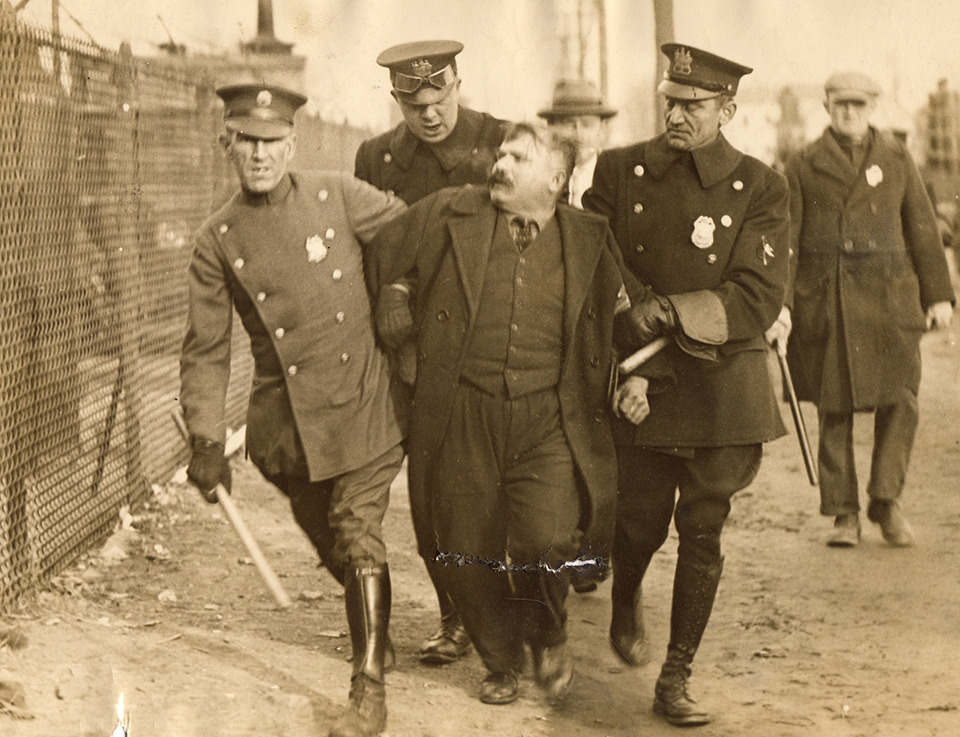
The dignity, and, joy of common struggle.Legendary labor reporter Mary Heaton Vorse on the solid defiance of the Passaic strikers as the bosses attempt to split their ranks months in to the epic strike
‘Passaic Strikers’ Reply to Mill Bosses’ by Mary Heaton Vorse from The Daily Worker. Vol. 3 No. 200. September 4, 1926.
LAST week the mill-owners of Passaic defied public opinion throughout the country by refusing to deal with either the Lauck committee or the American Federation of Labor. They threw a challenge to the 16,000 striking textile workers of Passaic and to every conscious working man and woman of this country. To the letter sent by the plenary committee proposing negotiations toward a strike settlement, Charles F. Johnson, vice-president of Botany Mill a, stated arrogantly, “as far as we are concerned the strike is over.”
Early in the evening the streets near the mills were full of people going in one direction. These were the striking textile workers going to Belmont Park to give their answer to Johnson of the Botany Mills as to whether or not the strike is over. The streets are full of people. Women walking in couples, heads up, stepping out in wide springy footsteps. Streets full of people walking with purpose. They are gay and they laugh. These are happy people walking toward Belmont Park. It gets to be a procession. Thousands on thousands of people are coming together to tell the mill owners what they think of this new carefully planned offensive. It was a move calculated to break strike morale. Let the workers believe that there will be a settlement. Indicate that if their leaders will step aside that the mill owners will deal with the American Federation of Labor.
Bring the striking textile workers to a high pitch of hope and enthusiasm, then as victory approaches snatch it away. Snatch it away just as they are about to change leadership. Separate them from the leaders they love and trust on the pretext of settlement and don’t give them a settlement. That ought to break the workers’ spirit, especially workers who have been on strike seven months. So the bosses thought.
The crowd going toward Belmont Park does not look as if its morale had been shaken. Thousands on thousands of people are there and more are coming. They stand quiet behind the high palings that shut the Park from the street. The tall trees spire above them. Dark trees form a background for the thousands of strikers’ families gathered there.
A car drives up, the speakers are getting out. A murmur runs through the children, “Elizabeth Gurley Flynn.” When the children here have grand children her name will still be a beloved name among the textile workers of New Jersey. The children who meet here every night to cheer the speakers, and especially to wait for Albert Weisbord, set up a shout. The crowd opens to let the speakers through. Women put beautiful bouquets of flowers, zenias and dahlias, into their hands. On the platform are the leaders the waiting people know and trust. They have been with them all the long months of the strike. Alfred Wagenknecht, relief director; Robert Dunn of the Civil Liberties; Elizabeth Gurley Flynn. Rank and file leaders from the Botany Mills, from the Forstmann & Huffmann Mills, are talking to the crowd. They catch the mood of the calm, assured thousands, the young local speakers laugh at the Botany offensive.
The listening crowd stands there, easy as on top of the world. Their laughing calm is more formidable than the grey powerful picket lines. They have victory in their eyes; they have victory in their step: They laugh. Their faces have lost the anxious look. There has never been a strike like this. Never in the history of this country or any other, can you find a strike where the workers would stand secure and laughing in face of an offensive like today’s, made after seven months. They have the serenity of the invincible.
What a sight to look down on! Literally a sea of faces. Every one is here; not part of the people, but everybody, mothers, fathers, children carrying on the strike together. Not just the men, with the women sitting at home scabbing in their hearts, strikebreaking in their hearts. The women in this fight have matched the men. They stand here quiet, clear-eyed. They have lost the mill pallor; they are people of defiance, they have the security that comes from strength.
The sky grows darker, the electric lights are lit. A shout echoes through the town. It rises and swells. The young leader is being carried to the platform by his fellow workers. Elizabeth Flynn has just finished speaking. She has brought word that Miss Wilkinson, representing the striking miners of England, will bring their greetings to their striking brothers and sisters in Passaic.

She finishes and her place is taken by Weisbord. What a jolly crowd, they take active part in the meeting, shouting out full-throated answers to the speakers’ questions. There is a constant response, a give and take between the speaker and listeners that is unlike the usual stolid passivity of the average audiences. These thousands of people standing here so quiet and assured, so alive, send up a stream of affection and trust toward their leaders.
Weisbord is explaining that tomorrow the registration for the United Textile Workers will begin. Another shout goes up. The workers of Passaic are not alone in their fight against Mr. Johnson’s “new policy.” It is as though side by side with this great crowd stood invincible the other workers who made this sight possible.
Who said you can’t buy health? Who said happiness couldn’t be bought? No, maybe you can’t buy it, but you can give it. Did you go down in your pocket for Passaic? Did you give up something you needed for Passaic? Look at the Passaic workers, then you will see that the strike money can buy health and high courage to laugh at this last and most vicious attack of the bosses. The strikers answer to them is a shout from the thousands of throats of “Union! Union! Union!
The Daily Worker began in 1924 and was published in New York City by the Communist Party US and its predecessor organizations. Among the most long-lasting and important left publications in US history, it had a circulation of 35,000 at its peak. The Daily Worker came from The Ohio Socialist, published by the Left Wing-dominated Socialist Party of Ohio in Cleveland from 1917 to November 1919, when it became became The Toiler, paper of the Communist Labor Party. In December 1921 the above-ground Workers Party of America merged the Toiler with the paper Workers Council to found The Worker, which became The Daily Worker beginning January 13, 1924.
PDF of full issue: https://www.marxists.org/history/usa/pubs/dailyworker/1926/1926-ny/v03-n200-supplement-sep-04-1926-DW-LOC.pdf
 Revolution's Newsstand