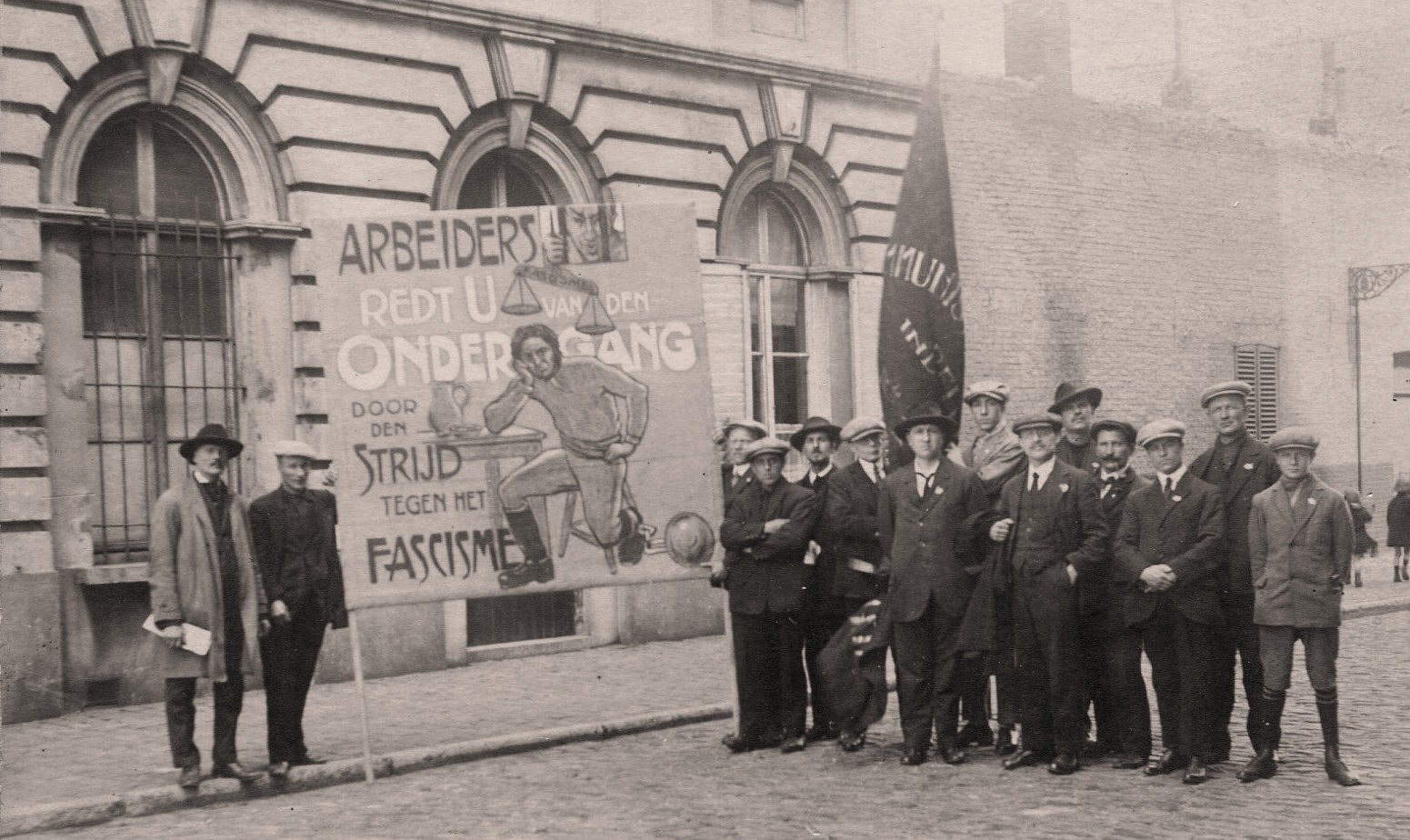
The report from Belgium to the Sixth Comintern Congress looks at that country’s economic and political situation, the role of the Social-Democrats in government coalitions, the decline in the trade unions, and the state of the relatively small Communist Party after a factional fight over the Left Opposition caused a change in leadership in loss in membership.
‘Report of Belgium’ from The Communist International Between the Fifth and the Sixth Congresses, 1924-28. Published by the Communist International, 1928.
POLITICAL AND ECONOMICALLY SITUATION
THE present situation in Belgium is the result of the stabitisation of the franc, which was carried out at the expense of the masses by the Jaspar-Vandervele government, i.e., by the alliance of industrial and finance magnates and their supporters, the Social Democratic and Christian Socialist leaders. This stabilisation marked the culmination of a crisis which had lasted since 1920, when the economic crisis began. The elections of January, 1925, resulted in an increase in the Social Democratic vote and that of the Flemish Nationalists and the Communists: the Liberals lost eleven seats, the Catholic two. But it was impossible to form a National Government of the “Union Sacrée” with a view to stabilising the franc. After a ministerial crisis of 73 days a Socialist-Catholic ministry was formed of the “Belgium Democracy,” which was to save the franc and introduce democratic reforms. But matters turned out differently. The Poulet-Vandervelde government was not able to realise any of the promised reforms; the Belgium bankers torpedoed the attempt at stabilisation and the value of the franc fell still lower. Thus the Poulet-Vandervelde government was only able to make the necessary preparations for a “National” government, which would accomplish stabilisation at the expense of the masses.
In May, 1926, the “Democratic Government” retired and a “National” government Was formed composed of four Catholics two Liberals, and four Socialists. The “Union Sacrée” was resurrected on this occasion to save the franc. Jaspar, a prominent representative of bank capital, became Prime Minister, the banker Franki and later Baron Hautart, one of the leading forces in the Banque Nationale, became Finance Minister, de Brocqueville, who has considerable interests in the iron industry, Minister of War; in this ministry of bank magnates Vandervelde, Huysmans, Wauters and Anseela were destined to play the role of pacifying the masses. On July 15th Parliament passed the law giving the ministry full powers to undertake all the necessary measures to “save the franc.” The Labour Party Council acknowledged this dictatorship of the banks by a vote of 30 to 10. Vandervelde made the pathetic declaration in Parliament that, “there are moments in the history of a country when action is necessary. The present is such a moment. Have confidence in us and we shall do all that the situation demands, as we did ten years ago.”
The stabilisation of the franc finally became an accomplished fact with the help of a 150 million dollar loan from American and British Banks under very difficult conditions. The railways were handed over to a private company and mass dismissals of the employees ensued. Taxes were imposed which were to bring in a revenue amounting to hundreds of millions. The stabilisation crisis was succeeded by a rise in the cost of living and consequently by demands on the part of the workers for increased wages. The State and municipal workers demonstrated early in 1927 for wage increases. Discontent grew and with it the distrust of the masses in the Social Democratic ministers and also in the reformist Trade Union leaders. The Labour Party took a vote on whether the Party should continue to participate in the government, with the result that 26 per cent. voted against it. The opponents to participation in the government got the majority in the Brussels and Antwerp Labour Party branches. From this it became clear that the Social Democrats could no longer remain in the banker-government without greatly undermining the prestige of the leaders. Therefore, in view of the approaching elections the Social Democrats considered it advisable to make a temporary change in their role and become a parliamentary opposition. With this in view a dispute was staged on the military question, a question which was outside the government programme.
The Social Democrats set about the revival of their old demand for six months military service and before the parliamentary recess they introduced a draft proposal to this effect. The Social Democratic press started a campaign in support of this demand. But it should be pointed out that the Social Democrats had never attempted to carry through this demand whilst they were in the government, because they knew quite well that their demand was in complete contradiction to the secret military agreement which Vandervelde made with France in 1921; an agreement which the defenders of the Fatherland would never jeopardize. The “Echo de Paris” came out immediately with an attack on the Belgium Social Democrats and accused them of “disarming Belgians, betraying France, and selling their country to Germany,” although the reduction of the military service to six months would not weaken the military strength of Belgium. The leaders of the Labour Party attained what they wanted and broke with the coalition government and retired from office in November. Then Jaspar formed a new ministry composed of Catholics and Liberals in which two catholic democrats participated.
A survey of the activity of the Social Democrats in the interests of the bourgeoisie gives the following picture:
(1) Beginning with the “Union Sacrée” in August, 1914, until the “Union Sacrée” in May, 1926, to “save the franc,” they continuously sacrificed their own programme, betrayed and sabotaged every attempt at opposition on the part of the workers, delivered up the petty bourgeoisie, the small peasantry and the workers to the tender mercies of finance capital; furthermore, there was the rationalisation of industry, the handing over of the State railways to private capital, suppression and imprisonment of the Flemish Nationalists, sabotage of the Nationalist and Communist amnesty campaigns.
(2) Complete support of the foreign policy, of the Belgian capitalists, of the Treaty of Versailles, the League of Nations, the invasion of the Ruhr, the Belgian-Dutch agreement, of the joint work with French Imperialism, the interests of Belgian capital in Czecho-Slovakia, Poland, China, and in other countries, the Belgian Colonia! policy and the exploitation of the Congo together with the constant agitational campaigns against the Soviet Union.
(3) Surrender of the military programme and the demand for the six months period of service; agreement to the state of war and “defence of the Fatherland” even in the post-war years. The advancement and conclusion of the Franco-Belgian secret military agreement and support of the disarmament swindle.
(4) Simultaneously, ruthless struggle against the opposition in the Labour Party and the Trade Unions, a policy of expulsions and splits (Mertens resolution), veto on membership of the I.R.A. and the I.W.A.
And yet notwithstanding all this betrayal of the interests of the workers the Belgian Labour Party, thanks to the Trade Unions and the strongly developed co-operatives, has still strong roots amongst the masses of the workers. This fact may be explained by the inadequate influence both of the Flemish Nationalists and the Communist Party, which are not equal to the task of taking over the leadership of the masses of the workers and the poor peasants. Neither has the increasing discontent in the ranks of the reformist workers developed sufficiently to form a definite opposition to the social traitors within the Labour Party. The development of a Left wing is still only in its infancy. In December, 1926, the first number of the “Bataille Socialiste” was published and in January, 1927, the Flemish paper (“Sozialistische Striyd”); these weeklies are published by the opposition. The “Bataille Socialiste” is published by some members of the Brussels Federation (Mathieu), who also work in the I.R.A. and the I.W.A. The “Bataille Socialiste” does not adopt any definite policy or organised opposition to the Vandervelde-Wautirs regime. The editorial! board of the “Bataille Socialiste,” composed of intellectuals, gave way to the party executive when threatened with expulsion at the end of 1927. The paper ceased publication, but the editors of the Flemish “Sozialistsche Striyd” refused to submit and were therefore expelled from the Party in April, 1928.
THE SITUATION IN THE TRADE UNIONS.
In Belgium there are 1,800,000 industrial workers, 300,000 employees, and 200,000 agricultural workers; in 1927 about 520,000 of these were organised in the reformist “Commission Syndicate,” 200,000 in the Catholic unions, 45,000 in neutral organisations and 5,000 in the “Chevaliers du Travail,” which is affiliated to the Profintern. In 1924 there were 129,000 workers in the reformist unions and in 1920 (when the membership was at its height) there were 718,000 workers organised. But in spite of the decline in membership, Trade Unions of the heavy industry and the transport trade continue to be mass unions.
The Left wing movement is still very weak; this is particularly the case in the miners’, metal workers’, textile workers’ and civil servants’ unions where the reformists employ the most severe measures against the revolutionary elements. The position is much better in the clothing industry and amongst the employees and tram workers in Brussels. Generally speaking the opposition in Flanders enjoys greater freedom than in other parts of Belgium. This state of affairs may be explained by the contrast that exists between the reformist leaders of the Flemish local organisations, who have to take into consideration the Nationalist tendencies of the membership, and the majority of the Belgian Nationalist bureaucrats of the “Commission Syndicale.” This difference showed itself at the congresses of the “Commission Syndicale” in the mutual hostile demonstrations of the Flemish and Walloon delegates and in the opposition of the Flemish and Walloon Provincial Federation of the Metal Workers, etc.) to the demand of the Commission Syndicate to expel the Communists. Already, in 1924, the Commission Syndicate adopted a resolution of the chairman Mertens to the effect that Communists should have no leading positions of any sort in the unions or in the local branches, and, if at the time they held any such official positions, they should be removed from them. After the elections the matter was developed further: in Brussels and in the Walloon districts several Communists were expelled for being in the Communist candidate lists at the municipal elections. Our comrades, mainly in the Flemish districts, were able to put up a fairly successful opposition to these expulsions. The Commission Syndicale thought that it would now be possible to annihilate the Communists by making a general attack. Early in April of this year the Commission Syndicale convened an extraordinary session, which decided that the Clerks’ Union must be forced to expel our comrades Jaquemotte and Van den Heuvel. Should the union fail to do so within two months then the Commission Syndicate would consider the clerks’ union as automatically expelled. It was also decided that the Mertens resolution should be carried out to the letter. All unions were to be warned that it was their duty to ensure that their locals obeyed the instructions in the resolution. Even Liebaers, the leader of the clothing workers, union, was in agreement with this decision. This lapse on the part of the former apostle of unity must undoubtedly have made it easier for the reformists to carry out their attack. Since November, 1926, the conflict within the “Unité” group has been acute; this organisation was originally intended to become the basis of the Left wing within the reformist unions, but now the editors, Liebaers and Geerts, came out openly as the declared enemies of Communism and became the accomplices of the reformists. This change was effected on account of the Trotsky opposition. In September, 1927, Liebaerts and Geerts began to publish all the documents of the Trotsky opposition in the “Unité” and got into close contact with the Dutch renegades Sneevliet, the chairman of the N.A.S., and Roland-Holst.
The Chevaliers du Travail, a revolutionary organisation formed by a group of miners who were expelled or seceded from the reformist miners’ union and the metal workers’ union after the 1923 strike, has suffered from too great decentraiisation and is consequently greatly handicapped in the performance of its main task; the struggle for the revolutionisation of the miners and the re-establishment of the unity of the Trade Unions. At a congress held last March it was decided to centralise this organisation by May 1st.
THE POSITION OF THE COMMUNIST PARTY.
The fact that the C.P.B. was able to secure about 70,000 votes at the elections in 1925-1926 proves that the Party could extend its influence. But the Party has never gone beyond the stage of being a purely propaganda organisation. The leadership of the Party was obliged to admit at the Fourth Party Congress in September, 1926, that “there were great shortcomings in the political leadership of the Party from top to bottom, the relations between the various Party organs, the general organisation, the re-organisation of the old sections on the basis of groups, Trade Union work, the Party activity in the I.R.A. and I.W.A., the attitude towards the youth and the control of their work, the penetration into the Flemish Nationalist movement, the ideological training of the Party, all organisational work, and the establishment of a lasting, daily contact with the masses in the factories and the Trade Unions and the other organisations of the working class.” The Congress report further points out that the Party leadership is weak and inadequate, that the work of the centre suffers on this account, that discussions are badly prepared, that the analyses of the political situation are made in a superficial manner and consequently the directions issued by the centre are weak and inadequate. The report goes on to enumerate the flaws in Party work in the Trade Unions, in the Flemish movement, in respect of the contact with the opposition in the Labour Party, in mass organisations and in anti-Fascist activity. It further points out:
“Several tasks laid down at the Fourth World Congress and at our Third Congress have either not been carried out at all or only in an inadequate manner. This especially applies to Cooperative work, which is of exceptional importance in Belgium. The preparatory commission for this work has done nothing. The activity amongst the peasantry has been restricted to rather negligible work in the Huy Warenne district. The work in respect to the Colonies has also been very weak, only the press campaign on this subject was of any importance. The establishment of contact with the Congo colony was limited to the despatch of a small quantity of literature, the “Drapeau Rouge,” and the “Roode Vaan,” which resulted in having this latter paper banned in the colony. Attention must also be drawn to the weakness of our educational work. The Party has no paper for the study of the problems of revolutionary doctrine, tactic and strategy or the analysis of current political questions. The organisation of courses and educational conferences is weak and practically negligible.”
ln reviewing the work of 1927 it must be admitted that almost all the weaknesses enumerated in the 1926 report still exist. The Trade Union movement alone shows that the Party has been able to put up an active fight against the reformist offensive. In Flanders the Party was successful in the amnesty campaign and increased its membership; at the same time the subscribers to the weekly organ “de Roode Vaan” were increased to 4,000. The Parliamentary fraction has been active and has helped to unmask the reformist leaders. But otherwise the old errors and weaknesses remain as before. Demands for a practical programme of action formulated by the Party were made a few times in the paper, but then disappeared; a similar lack of stability was displayed in respect to the China campaign and the protest against intervention in Soviet Russia.
The Internal Situation.
A serious fractional struggle began in the C.P.B. at the same time as the struggles in the C.P.S.U. In 1926 Van Overstraaten began active fraction work. At the end of November, 1927, he succeeded in having a resolution passed protesting against the expulsion of Trotsky and Zinoviev from the C.P.S.U. The resolution stated that the Party leadership did not adhere to the views of the Opposition, and that it would observe the discipline of the Comintern and of the Party. This resolution was adopted by 15 to three votes. Early in January the voting on a resolution of the Van Overstraaten supporters, in which they “conditionally” adopted the Trotsky Opposition plank, resulted in a tie: 13 votes for and 13 for a resolution of solidarity with the C.I. and the C.P.S.U. It was then decided to launch a widespread discussion both in the press and the Party organisations, including the groups, in preparation for a final decision to be made at a Party Conference. During this discussion Van Overstraaten’s supporters openly declared themselves Trotskyites. District conferences at which the delegates were elected for the Party conference were held after the discussion. The result of these conferences was: 70 per cent. of the votes for the C.I. and 30 per cent. for the Opposition. The Opposition suffered the greatest defeat in the large districts; in Brussels it secured 7 delegates as compared with 20 for the Executive; in Luettich 3 as compared with 15; in Borinage 1 as compared to 12, and in the country taken as a whole 33 as compared with 75 for the Executive. When the Party conference met in the middle of March, the leaders of the Opposition decided to provoke their expulsion from the Party by declaring their complete solidarity with the Trotsky group. They thought that they would thus rally their supporters and by means of a split form a new Party. The Party conference, however, avoided this and declared that although circumstances fully justified the expulsion of the opposition leaders, it deemed it advisable for every Party member to get to know the nature of the Opposition and consequently suspended the leaders, with Van Overstraaten at the head, for six months from any position of responsibility and made the special demand that Van Overstraaten resign his seat in Parliament. At the same time the resolution called on the new Party executive and the Polit-Bureau to proceed with the greatest severity against all branches of Party discipline and if necessary to expel the delinquents. While the conference was in session an incident took place which quickly showed up the nature of the Opposition leaders. The Party headquarters were broken into and important material and Party property stolen. Three days after the Conference the Polit-Bureau decided to expel Van Overstraaten from the Party because he refused to resign his seat in Parliament. One day later three Party members, including the former Organising Secretary, Hennaut, were expelled as a result of the investigating commission’s findings. They were found guilty of direct participation in the robbery at the Party headquarters.
The leaders of the Opposition formed an “Opposition Group” outside the Party. This group publishes a weekly paper, “The Communist,” in French and Flemish. Since Van Overstraaten’s plan to split the Party failed this group will shortly lose all significance. Only the typical opportunists directly connected with Van Overstraaten will remain, and it is these elements that have always impeded the Party work in every respect.
The chief task of the new Party Executive is to overcome the organisational weaknesses of the Party. Before the Party conflict the membership was about 1,500. The re-organisation of the Party in districts, wards and factory groups has only taken place on paper, no really active factory groups exist as yet; street groups have taken the place of the former local organisations. The circulation of the daily paper “Le Drapeau Rouge” is about 5,000, and that of the Flemish weekly “de Roode Vaan” about 4,000. The general contents of these papers has greatly improved during the past year.
The Communist International Between the Fifth and the Sixth Congresses, 1924-28. Published by the Communist International, 1928.
PDF of full book: https://archive.org/download/comintern_between_fifth_and_sixth_congress_ao2/comintern_between_fifth_and_sixth_congress_ao2.pdf
 Revolution's Newsstand