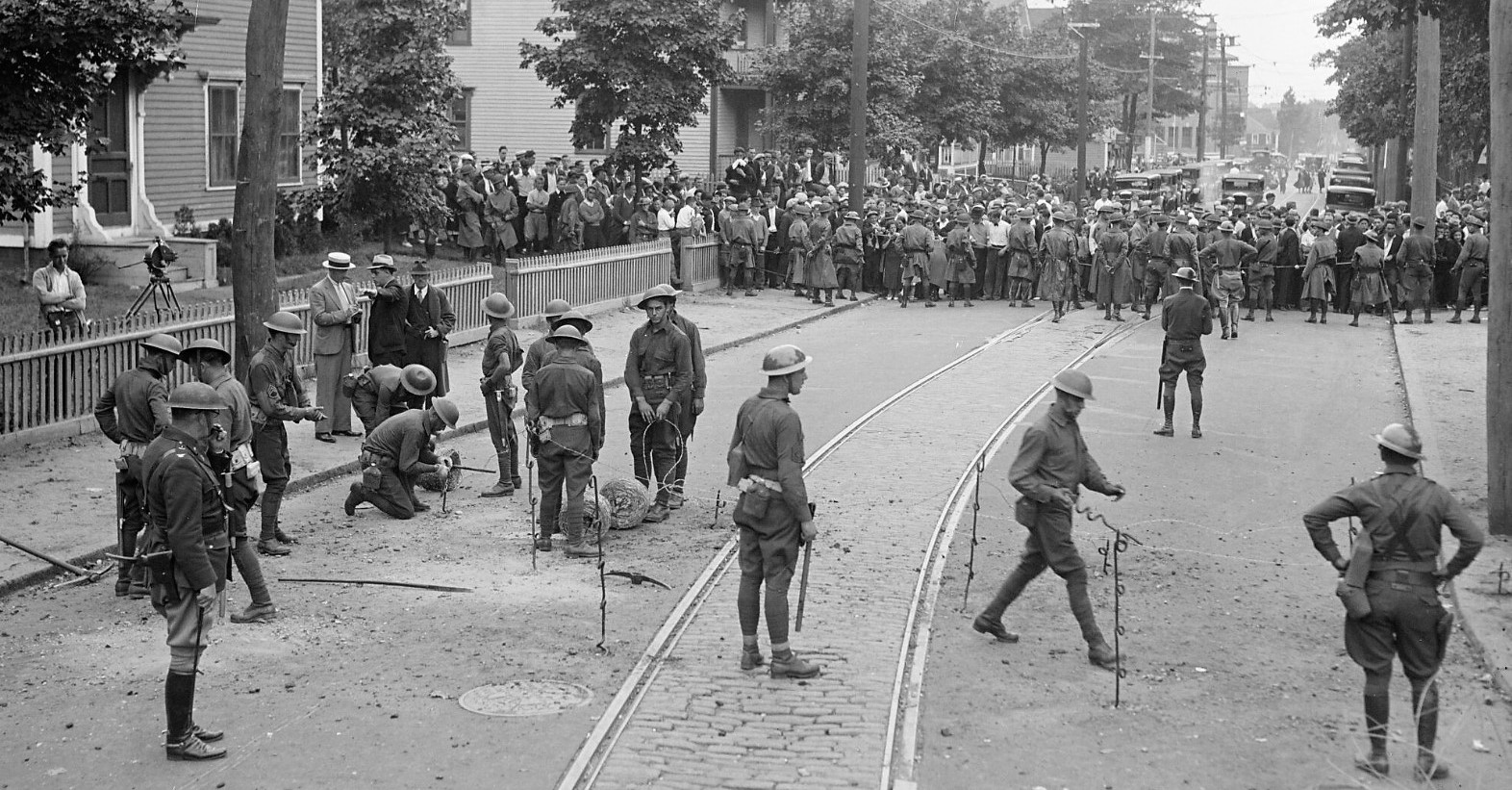
What police abolition sounded like in the 1920s. The origins of many constabularies and state guards in the United States are rooted in policing labor; either to control the enslaved or break strikes and unions. Manuel Gomez’ six-part series on the creation of State Constabularies, ostensibly to ‘protect’ rural areas, but in reality to discipline and and terrorize workers and their organizations. As it was, so it is.
‘State Police to Create Permanent Martial Law’ by Manuel Gomez from The Daily Worker. Vol. 2 March 20-April 1, 1925.
I. State Police Series: State Police Wanted Only by Capitalists to Crush Strikes; Newspaper Campaign Exposed.
“Protection for all; justice for all.” That, we are told by extremely well protected recipients of more than their share of justice, is the idea that suggests to them why Illinois should have a state police force.
It was expressed with all due solemnity at a luncheon given by the Illinois Chamber of Commerce and the Illinois Bankers’ association in honor, of Major Lynn Adams, superintendent of the state police of Pennsylvania, popularly known as “American cossacks.”
But alas, nobody will believe it. Since when, workers want to know, have the chamber of commerce and the bankers’ association been interested in justice and protection for all?—let alone Major Adams, whose official protection of workers has been entirely confined to scabs.
Always Are Strike Breakers.
Labor sees the proposed Illinois state police force as a heavy club in the hands of the bosses to be used in breaking strikes. That is what similar police armies have proved to be in every state where they have been created.
The Dunlap bill providing for a state-wide anti-labor constabulary of 195 to 455 armed troopers is being pushed hard for passage in the state legislature. The wealthy capitalists are pouring out their dollars in support of it. Propaganda is on full blast.
Suddenly, in every capitalist newspaper throughout the state, there appear editorials, special articles, cooked-up “news stories,” all tending to convey the idea that Illinois needs a state police to preserve its people in peace and security.
Are workers people? The whole inspired agitation behind the Dunlap police bill shows that its capitalist sponsors do not think so.
What Is the Dunlap Bill?
Workers will want to know just what this Dunlap bill is. It bears the same stamp as similar bills being urged in Missouri, Rhode Island, Ohio and other states. It provides for the establishment of a military police force entirely removed from all local responsibility and with power to swoop down upon and invade any community in the state, even against the protest of local authorities.
The force is to be organized on strictly military lines in from three to seven troops officered by captains, lieutenants, sergeants and corporals. The commanding officer, to be known as “superintendent of the Illinois state police,” is to be appointed by the governor and may be removed only for certain specific constitutional reasons.
Every individual member of the force is to have full police authority in all parts of the state. He may make arrests and searches upon warrants, and also without warrants. He may arrest any person against whom he may have “suspicion.”
Large sums of money have mysteriously accumulated for a systematic publicity campaign in behalf of “more effective policing of rural highways,” and some farmers have been misled into believing that the purpose of the Dunlap bill is to furnish rural police protection. Even a casual reading of the bill shows this to be a shabby pretense.
For Armed Force Against Workers
The Illinois State Federation of Labor exposed the falsehood of their claim some time ago. Instead of providing for a rural police, spread out in the rural communities and permanently stationed in these communities, the bill offers a heavily-armed military force organized for quick mobilization in military units. It is an army for service against the workers.
Proof that the state constabulary is not an innocent rural welfare scheme, but something quite different, is, the fact that it did not originate with farmers. Its backers are manufacturers, mining companies, bankers and investment firms. In the forefront of the campaign is the Illinois chamber of commerce, which collected $100,000 for prosecution of the miners in Herrin.
Not a Rural Police Body.
Moreover, the proposed military force, which would not number more than 455 officers and men as a maximum, could not under any circumstances be sufficient to patrol the approximately 95,000 miles of rural highway in the state. Except in one paragraph where the subject is mentioned in four words having little or no specific meaning, the bill does not provide for rural highway patrolling. But there is plenty in the bill permitting the constabulary to be thrown into industrial communities and mining towns when a strike is on.
The claim that the state constabulary would be a simple rural police for farm and highway protection is absolutely false. The main purpose in establishing any highly centralized state police force anywhere in the world has been to enforce upon the working people of local communities conditions to which those people were opposed.
Not Intended to Prevent Crime.
The primary motive in the organization of any such state police system has never been that of “preventing crime” or apprehending “ordinary criminals.” No single exception to this can be produced anywhere in the world where a highly centralized state police system has existed sufficiently long to leave something of a history.
The Cossacks.
It is particularly significant that the guest of honor at the previously mentioned chamber of commerce luncheon was the superintendent of the state police of Pennsylvania. The Pennsylvania constabulary has been the most notorious of all. It originated as an anti-labor militia and from the time of its inception, has gone on breaking strikes, clubbing and jailing workers, disrupting labor meetings, breaking up demonstrations. During the steel strike of 1919, the anti-labor reign of terror of the “American cossacks” was particularly bloody, and was repeated in the 1922 coal strike.
In czarist Russia, mothers used to frighten their children into obedience by admonishing: “The cossacks are coming!” So it is actually today in the industrial and mining regions of Pennsylvania, where the children tremble with fear when they hear the word “constabulary” muttered in their presence.
Unless the Illinois labor movement succeeds in preventing the establishment of an Illinois state police, as it did in 1919 and 1920, the above situation will inevitably be duplicated in Illinois.
Want Cossacks to Crush Miners.
Miners and other workers in the mining areas will be the first to feel the heavy hand of the cossacks. These especially are the “rural communities” which big business has in mind. The chamber of commerce, bankers, and mine owners have not forgotten Herrin, nor the great fights which the miners have sustained on behalf of their union and a decent standard of living. What S. Glenn Young and his ku kluxers failed to do, the Illinois Cossacks would bend all their energies toward accomplishing: The destruction of the miners’ union.

Labor is a unit against the monstrous Dunlap bill for a capitalist owned state police force. That opposition must be made vociferous and immediately effective. Labor defeated similar bills in 1919 and 1920. It must now make the bosses feel once for all that the workers of this state are determined never to allow any American cossack system to be fastened upon them.
II. State Police Always Used to Break Strikes and Are Never on Rural Patrol as Claimed.
Some woman is writing a series of romantic fairy tales for the Chicago Daily News glorifying the “American cossacks.”
It is part of the propaganda referred to in these columns yesterday. Big Business admits openly that the state police force which it is trying to set up in Illinois thru the medium of the Dunlap bill is patterned after the mounted constabulary of Pennsylvania (known to all workers as “American cossacks”), and it therefore becomes necessary for the prostitute publicity agents of capitalism to spread the word that the Pennsylvania troopers are the epitome of honor, integrity, kindness, courage and gallantry. But the workers do not call them “cossacks” for nothing.
Constabulary Don’t Protect Farms.
The DAILY WORKER has proof–accumulated by labor organizations over a long period—that the Pennsylvania state constabulary is a machine for strike breaking and terrorization of labor. As a rural police “protecting farms and firesides” it does not function at all. Because the wealthy Illinois “law and order gang” declare that they have gone to Pennsylvania for their model in drawing up the Dunlap state police bill, and because Pennsylvania is in fact the classic example in the United States of the workings of a state constabulary, it is worth while for workers to look a little into the record of the “American cossacks.” Here it is:
The Pennsylvania state police is an outgrowth of the notorious “coal and iron police,” an industrial, private police organization maintained by the corporations to suppress and intimidate the workers in the steel mills and the coal mines. The activities of this force against the workers brought it into such evil repute that the industrial barons began advocating the establishment, of a regular state constabulary which would have a brighter gloss of respectability and decency, while being maintained and used in the selfsame manner as the old “coal and iron police.”
A Private Army Legalized.
Thus, shortly after the great miners’ strike in the anthracite coal fields in 1905, the bill creating the Pennsylvania state constabulary was enacted. John C. Groome, a wholesale liquor dealer who was appointed first superintendent of the state police, testified several years later that he got his plan of organization from the royal Irish constabulary—going to Ireland and spending three weeks in barracks to study methods, organization and rules and regulations.
The royal Irish constabulary was, as everyone knows, a force used by England to keep the Irish in subjection; it was a frankly brutal weapon for use against a colonial people.
What has been the history, from that day to this, of the mounted state police of Pennsylvania?—those “220 hard-riding, hard-headed and straight-shooting officers, all proud of their jobs and of their organization,” to quote Major Adams’ fervent speech to the guests of the Illinois chamber of commerce.
Signed affidavits of police brutalities and interference with workers’ rights cover Pottsville, Allentown, West Chester, Hazleton, Erie, Wilkes Barre, McKees Rocks, Philadelphia, Mt. Carmel, Reading, as well as the coal strikes in Westmoreland county and in the Ligonier and Allegheny valleys. They were set forth in a 141-page book issued ten years ago by the Pennsylvania State Federation of Labor, entitled “The American Cossack.” Evidence has been accumulating rapidly since then.
Examining a map of the state of Pennsylvania, one finds at the western end, the city of Pittsburgh and numerous steel centers, and also coal mines. In the east there are Wilkes Barre and Scranton, the center of the great anthracite coal fields and also several important steel centers. The great agricultural sections are located to the north and down through the center of the state.
No Cossacks in Farming Districts
Where do we find the police barracks and the sub-stations from which the Pennsylvania troopers travel? In the great steel and coal mining sections of the west and east. Along the northern border of the state there is no sub-station in a space of about 200 miles. Most of the farmers of Pennsylvania have never seen a state policeman in their lives, but every industrial worker—every steel worker and coal miner—has had plenty and bitter experience of them.
It is obvious that the 220 troopers whom Major Adams speaks of as making up the constabulary in Pennsylvania at the present time are not sufficient for any rural highway patrolling. The farmers early discovered that the state police was not intended for their protection in any sense of the term.
Reading the following paragraphs and bearing in mind the large territorial extent of the state of Pennsylvania, as well as the small number of men in the force, the reader will see that the cossacks had little or no time for rural policing.
A Few Among Money.
Practically the entire state police force was on strike duty for three months, from March 15 to June 9, 1918, in the anthracite and bituminous coal regions during the miners’ strike of that time. During the street carmen’s strike at Chester, 143 members of the constabulary were on strike duty for six weeks, from April 18 to May 26, 1908. During the strike at the Standard Steel Car Works, McKees Rocks, 41 of the constabulary troops were on strike duty for two months, from July 15 to Sept. 14, 1909, and 44 additional troopers were on strike duty from Aug. 23 to Sept. 13, 1908. During the strike at the plant of the Bethlehem Steel Co. of Bethlehem, Pa., 91 troopers were on strike duly from Feb. 27 to April 18, 1910—eight weeks.
Always On Strike “Duty.”
During the strike of the miners in the Westmoreland district, which lasted sixteen months, 101 troopers were on duty for a period of three months, 84 were on duty for four months and 57 for 16 months—from March 9,1910, to July 1, 1911. During the anthracite coal strike of 1912, 205 troopers were constantly on strike duty from May 7 to May 21. During the strike of the molders at Erie, Pa„ 40 troopers were on strike duty from Aug. 22, 1913, to March 9, 1914, and 22 were on duty from Aug. 22 to Nov. 16. During the strike of the Wilkes Barre Street Railway employes in 1916, 228 troopers were on strike duty for a considerable length of time.
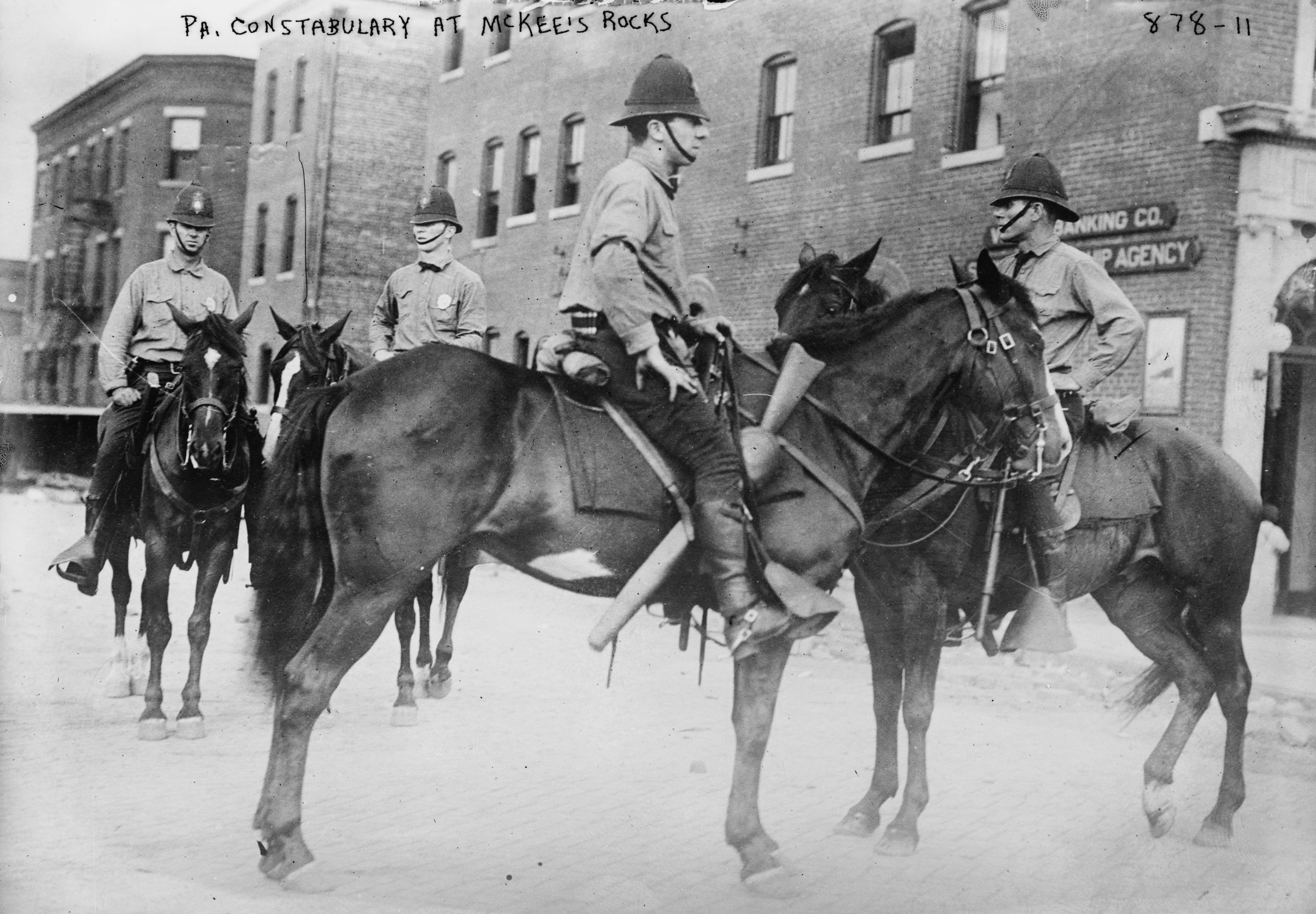
The above are just a few instances which will serve to show the purpose for which the state police is used in Pennsylvania. They suggest a totally different kind of troopers from the constabulary of the fairy tales in the Daily News.
Tomorrow I will write of the crimes against the workers perpetrated by the Pennsylvania cossacks in the great steel strike and the miners’ strikes.
III. Strikes to be Crushed by Permanent Martial Law, Is Meaning of State Police.
State police means perpetual martial law. It means what amounts to military intervention in every strike. It means government by irresponsible and heavily-armed troopers, free to invade any community in the state with or without the permission of local authorities, and to interrupt meetings, make arbitrary arrests and tyrannize over the workers and poor farmers.
As I pointed out in former articles, the wealthy backers of the Dunlap police bill in Illinois and similar bills in other states are far more interested in the workers than in the farmers—at any rate when it comes to this matter of “police protection.” The state constabulary would be a mobile police force which they could throw into industrial communities in addition to the police already there and which “would not have the disadvantage of being held in check by local organs of government.”
Permanent Martial Law.
That this is equivalent to permanent martial law must be obvious to anyone who stops to think about it for five minutes. Military and police rule—the rule of clubs and bayonets—is the latest product of capitalist “democracy” which the bankers and businessmen of Illinois are trying to force upon the workers.
How do the workers of Pennsylvania look upon the state constabulary, the original and model force? Are they overjoyed, at the thought of a visit from the “cossacks”? Do they feel that this half-disguised system of permanent martial law is for their protection?
Condemned by Pennsylvania Labor Unions.
Well if they do, they have a queer way of expressing it. There is not a bona tide labor organization in Pennsylvania which does not denounce the state police as an agency for oppressing the working class in the interests of organized plutocracy.
Up to a few weeks ago Pennsylvania newspapers were full of news of the new barracks which were to be established for the state police in Berks county. But the workers of Reading and other Berks county communities raised such a storm of protest that Governor Pinchot was forced to countermand the order. The workers of Berks county do not want any of the cossacks quartered upon them.
The brutalities and assaults against workers committed by the Pennsylvania state police have already become household stories in every industrial town in the state.
Foster Cites Brutality of Cossacks
During the great steel strike of 1919 the anti-labor reign of the Pennsylvania constabulary was particularly bloody. William Z. Foster, leader of the steel workers in that titanic struggle, cites example after example to show that the state troopers acted virtually as hired gunmen of the steel trust, stopping at nothing to interfere with the successful course of the strike.
Foster’s testimony is confirmed and supplemented by the report of the commission of inquiry of the Inter church World Movement, headed by Bishop F.J. McConnell.
State Police Condemned Even by Church
The interchurch report which contains hundreds of affidavits showing constabulary violence states on page 178:
“In Monessen, where the strikers held out solidly for a long time, with the exception of the arrest of many Russians on vague charges of ‘radicalism’ the policy of the state police was simply to club men off the streets and drive them into their homes…In Braddock, however, where some of the mills were partly operating, the state police did not stop at mere beating.”
An interchurch commissioner spent half an hour talking with strikers in a little room in Braddock used as union headquarters. A moment after his departure, state troopers rushed into the place demanding “that speaker” and threatened to close the headquarters because “a meeting” had been held.
Charges of assault brought against the state police in Butler, declares the report, come not only from strikers, but from non-strikers and businessmen as well. And in Clairton, on the Sunday before the strike, numerous men and women were attacked by the state constabulary and arrested while they were attending a mass meeting for which permission had been given by the local authorities; workers in the uniform of discharged soldiers were among those at the meeting ridden down by the state troopers. State Police Assault War Veterans Capitalism respects no uniforms which are not directly in its service! Discharged soldiers no longer form part of the capitalist state machinery. And when they attend strikers’ meetings they even become “un-American.”
Affidavits charge that men were thrown into cells and kept there several days before they were given a hearing. This occurred in practically every strike center. In Donora the constabulary rode into the headquarters of the strikers, drove the men out and placed the 98 men present, including the local organizer, under arrest, refusing to release them on less than $500 bail each.
Still later evidence comes from the coal strike of 1922, during which the reckless anti-labor exploits of the Pennsylvania troopers attained such notoriety that Governor Pinchot was obliged to appoint an investigating commission.
Union Organizer Against State Police
William Broad, a union organizer of Indiana, Pa., swore to the following story before the commission:
“On April 16, 1922, at Marion Center, Pa., while engaged on my work as organizer for District No. 2 U.M.W. of A., I was halted by three state policemen as I was about to call a mass meeting on an isolated piece of ground away from the mines. These troopers went from house to house and prevented men from attending the meeting. The troopers refused to arrest the drunken men who were interfering with the citizens on the street, after I had requested them.”
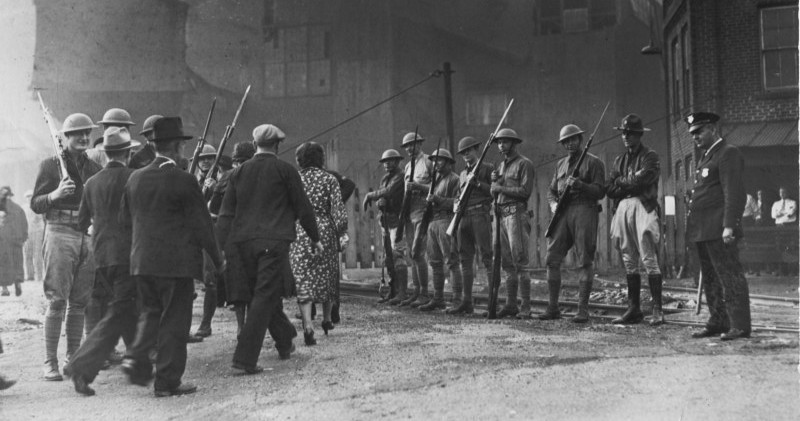
This testimony could be swelled by a multiplicity of affidavits covering all sections of the state affected by the strike. Every scrap of evidence goes to show the troopers usurping all authority and acting as Judge Gary’s private army. There are no instances of the constabulary favoring the workers.
Martial Law Disguised.
That is the way the undeclared martial law of the cossacks expresses itself in the concrete issues of the class struggle. All government under capitalism is anti-labor government, but the worst excesses of all take place when a system of martial law established. Pennsylvania presents example of permanent martial law. Constabulary rule in Illinois would produce the same effects.
IV. Record of State Police of Violence and Terror Against Labor Organizations.
Organized upon a strictly military basis, it (the state constabulary) appears to have assumed in case of strikes that the strikers are its enemies and the enemies of the state, and a campaign should be waged against them as such.”
So concludes the report of the United States Industrial Relations Commission regarding state police.
This report was published in 1916. Since then strikes have been broken, union men clubbed and jailed, and radical meetings assaulted, more than ever before. It is not strange, because there are more state policemen now. The political power of the capitalist class is becoming more and more highly centralized. Raw force has become the favored method of dealing with working class opposition.
Seventeen States Under Martial Law
Seventeen states of the United States now have armed troops of state policemen. The bankers and businessmen back of the Dunlap bill want to add Illinois to the list and they will succeed unless the workers and poor farmers of the state take active steps to prevent them.
Previous articles in this series have exposed the consistent anti-labor tactics of the Pennsylvania state constabulary, the original and model force.
It has been proved beyond the shadow of a doubt that in the 20 years of its existence the Pennsylvania constabulary has been purely and simply a militant instrument for use against the workers.
But perhaps Pennsylvania is an exception? How about the other states in which constabularies have been established? Is there a single instance in which the toilers are benefited instead of regularly beaten up by the state troopers? There is not. Notwithstanding all the flamboyant propaganda paid for by chambers of commerce and rotary clubs, the facts prove that these state police have in no sense been used to “protect rural communities” but merely to protect the ill-gotten gains of the rich against the efforts of workers demanding increased wages and improved conditions of labor.
The form of organization and the numbers of the state constabularies vary from state to state. Some are called “departments of public safety,” some “rangers,” some “state detective bureaus.”
Some sort of state police laws are found In the following states, passed in the years indicated: Arizona (1913), Connecticut (1921), Delaware (1915), Idaho (1921), Kentucky (1921), Maine (1916), Massachusetts (1922), Michigan (1919), Nebraska (1913), Nevada (1919), New Jersey (1921), New York (1917), Pennsylvania (1919–revised), South Carolina (1912), Tennessee (1919), Texas (1920), West Virginia (1923).
Cossacks Not An Exception
It is impossible to go into detail here, but instances can be cited showing that the Pennsylvania cossacks are the type and not the exception.
The state constabulary in New York has only a short history thus far but that history is black with crimes against the workers who move the wheels of industry in the great empire state. Stories printed in the capitalist press itself show that the state troopers sent to Buffalo “to head off expected violence” in the street railway strike of 1922, behaved so outrageously that they were opposed even Mayor Schwab and all the city councilmen. A petition signed by 265,000 names called upon the governor to withdraw the troops and stated that the troopers committed “unmanly and brutal actions,” that they “maliciously attacked” peaceful citizens and that they “have Irrationally ridden on sidewalks, dispersing…innocent pedestrians.”
Those “Rural” Communities
Buffalo Is not exactly a rural community—nor is Utica, nor Rochester, nor Schenectady; but these are the places where the New York state police appear to be most needed. West Virginia is another state in which a state constabulary has been just recently set up. The West Virginia force is only a few years old and every class conscious worker in the state looks upon it as a deadly enemy. It Is in fact a mere auxiliary of the private gunmen and Baldwin-Felts detectives employed by the business interests.
Constabulary Protects Company Killers.
Bloody indeed is the anti-labor record of the West Virginia troopers. Five of these state troopers were on the scene when C.E. Lively, company stool pigeon, shot Sid Hatfield and Ed Chambers on the steps of the Welsh court house in the summer of 1921, because Hatfield and Chambers had shown themselves to be staunch friends of the mine workers. None of the troopers moved to arrest the murderers who walked calmly away under the noses of the representatives of capitalist law and order.
While playing the role of mildly amused spectators when company gunmen committed outrages, the state troops regularly arrested and clubbed workers. Even as I write, dispatches show that the West Virginia state police are “framing up” miners suspected of union sympathy at Fairmount, endeavoring to use the fact that the known disregard of safety laws rules in the open shop Bethlehem mines caused an explosion, to accuse union miners of destroying the mine and killing their fellow workers.
The chief work of the state troops in West Virginia for the year ended June 1922, was to prevent the organization of the miners. An indication of this is seen in the fact that the overwhelming majority of the 4,804 arrests made were in Logan and Mingo counties, the seat of the most vicious anti-union efforts.
State Police Enforcing “Law and Order.”
On June 2, 1922, the state troops raided the strikers’ tent colony at Lick Creek, wrecking property, cutting the tents, destroying the miners’ stock of food, pouring kerosene In the milk, etc. Hundreds of affidavits show that during strikes in states having state constabularies, the troopers broke up strike meetings and conducted a systematic warfare against the strikers. Free speech, freedom of assembly and other “rights” guaranteed by the constitution were ignored in the districts under their control.
Rockefeller’s Little Army.
The experience with the “rangers” in Colorado during the great coal strike of 1922 is worth calling to mind. The rangers were ordered out by Governor Shoup in November, 1921, even before the miners had declared a strike and when there was not the slightest indication that violence might ensue. The man in charge of the troops was none other than Pat. J. Hamrock, the same who led the Rockefeller-bought militia in the notorious massacre of the miners and miners’ families in Ludlow tent colony, in 1914. The results resemble those described In Pennsylvania, West Virginia and other states. So brutal were they in their conduct, and so great was the pressure of working class protests, that the succeeding governor, William E. Sweet, was obliged to disband the rangers soon after he took office.
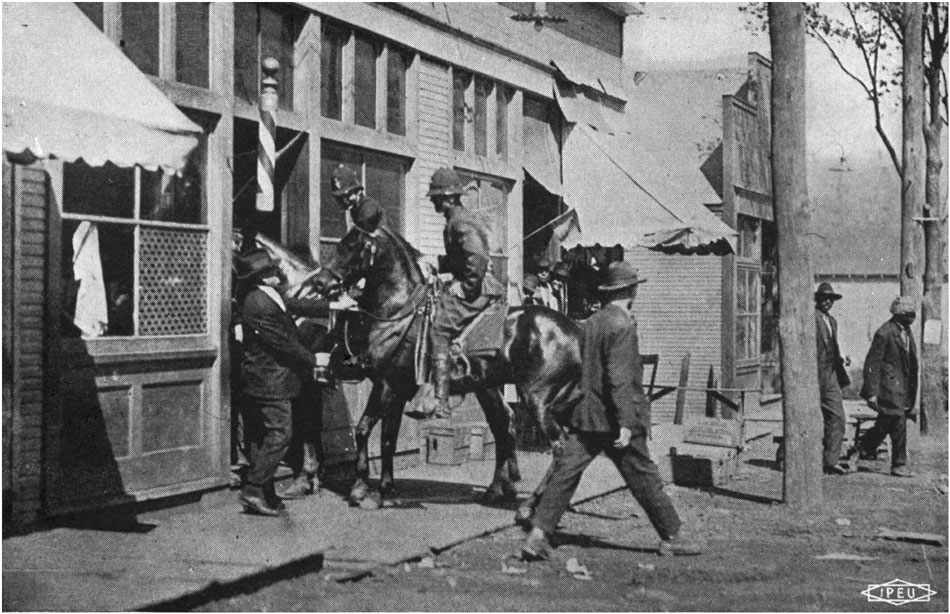
Why then, this pretense that the “law and order” gang of Illinois want a state police here for any different motive? The workers do not want more police of any kind. They have had too much experience of policemen’s clubs already
V. Noble “Mounties” of State Police Strong for Romance of Breaking Wage Strikes.
Facts and figures brought out in these articles prove conclusively that state police are not “rural police” but industrial police for use against the workers in Industrial disputes.
But the police have their secondary rural purpose too—and in rural communities it is the poor farmers who suffer from their depredations. The bankers and big business elements are the ones who profit. That is why the La Salle street financial district is such a unit behind the Dunlap bill for a state constabulary in Illinois. It is why Wall Street is behind similar police bills in various states throughout the country.
The Romance of Strike Breaking
To see what a military police force will mean for the poor farmers and rural workers one need only study past experiences. In this article I propose to tell some of the history of the Royal Northwest Mounted police of Canada which Is singularly not revealed in the magazine stories and movie reels dealing with these famous troopers which play such a role in the inspired “mammonart” dished out to American flappers and schoolboys.
The stories of romance and adventure which have been written around the Royal Northwest Mounted police have built up a legend among the unsuspecting that this force is an ideal organization established for the sole purpose of protecting the sanctity of home and fireside. The cold pages of history tell a different story.
It Runs Something Like This:
During the early sixties the Hudson Bay company, which then owned “by grant” a considerable slice of northern and western Canada, had become engaged in bitter competition with its rival, the Northwest company. Both concerns flagrantly violated the rights of the poor squatters scattered thru the region. In 1867 the Hudson Bay company sold great tracts of its land to the Dominion government. Less than two years afterward, the inhabitants of the northwest territory were actually forced into open rebellion, as a protest against the new land regulations which the prostitute politicians and landgrabbers at Ottawa sought to enforce upon them—regulations which meant nothing more nor less than the break-up of their homes. The rebellion was suppressed by the military forces of the crown.
Permanent Martial Law
The commanders of the troops advised that permanent military details be stationed in the territory. Sir John MacDonald, head of the Canadian government then conceived the idea of a military police force, and upon his recommendation, a law was enacted establishing the Royal Northwest, Mounted police, which began the performance of its unenviable duties in 1873—being sent immediately to the disaffected district of the northwest for use against the poor farmers. But industry reaches out even into the farmlands and into the unploughed wilderness. Strikebreaking became a feature of the activities of the Northwest Mounted police from the very beginning.
In The Canadian Pacific Strike
At this time the work of surveying for the building of the Canadian Pacific railway was started. The workers were poorly paid and poorly treated in every respect. Their only protection—as Is everywhere the case under capitalism—was in their own organized resistance. And the Northwest Mounted police was on hand to prevent that if it could. Strike after strike among the construction workers was broken by these mock heroes of story and screen, who acted as out-and-out agents of the profit-hungry railroad magnates.
Reporting to the inspector-in-chief, Captain R.B. Deane (appointed to command part of the force) wrote:
“I instructed the men in charge of the detachments to use the severest measures to prevent a cessation of the work of construction.”
A year later, 1886, found the police active in suppressing another land law rebellion among the poor farmers. When it was all over Louis Riel, leader of the rebellion, was taken to a police barracks and executed there.
Since that time, the history of the Royal Northwest Mounted police has been replete with stories of strike-breaking activities at the behest of the big capitalists who hold Canada in their grasp. Every miner, lumber jack and railroad worker in the Dominion has learned to fear and hate the mounted police. And the farmers have learned this lesson too. Workers and poor farmers are united against the oppressive power of capitalism. In the United States as in Canada, these two elements must be brought closer and closer together.
Every extension of the police power, every attempt of the financial interests to get more clubs and more bayonets in their service, constitutes a new menace. Its purposes may be camouflaged by pretenses of “protection of life and liberty,” “safety for rural communities,” “road policing,” etc., but the plain facts of history cannot be swept aside.
VI. State Police in Fact are Far from Romantic Fiction of “Protectors” of People.
There is steady pilgrimage of fat bellies to Springfield these days. Several thousand bankers and manufacturers have made their way to the capitol thus far, for the exclusive purpose of Jamming the Dunlap bill through the state legislature and setting up a state constabulary in the face of the workers and poor farmers.

Five hundred capitalists from all sections of Illinois descended upon Springfield in a single day, the Chicago delegation of 150 being led by no less a personage than W.K. Dawes, president of the Chicago Association of Commerce and a members of the famous Hell and Marla faintly. Among the various organizations represented were the Illinois Chamber of Commerce, the Illinois Manufacturers’ Association, the Illinois Bankers’ Association, rotary clubs, kiwanis clubs, automobile clubs, etc. All suddenly interested in protecting rural communities!
The Line Up.
Opposed to these mighty ones are the poor farmers themselves, as well as every labor organization in the state worthy of the name.
What this important struggle is about the readers of the present articles must now thoroughly understand.
In this concluding article, I intend to sum up briefly everything that has been brought out before relative to the scheme to establish a state police and to draw a few conclusions.
In my earlier articles I have shown: (1) That the Dunlap bill now before the Illinois legislature provides for the establishment of a heavily armed, military police force, free to invade any community in the state at will, with or without the sanction of those communities.
(2) That a vast and expensive campaign of propaganda is on foot to deceive the workers as to its real purposes and to bring about the acceptance of the measure.
A Business Man Bill.
(3) That although it is pretended that the state police bill is for “rural protection,” it did not originate with the farmers, but with bankers and wealthy business men, who are at present its chief backers.
(4) That its purpose is industrial, to break strikes and to interfere with every organized effort on the part of the workers to better their conditions.
(6) That insofar as its purpose touches the lives of rural communities it is as an enemy of the poor farmers, in the Interests of landsharks, money-lenders, monopolists and railroad magnates.
To Suppress Exploited.
(6) That a state police force means a system of permanent system of international law, with complete disregard of constitutionally guaranteed rights, such as free speech, free press, freedom of assembly, etc.
(7) That the scheme is simply a development of the present tendency of American capitalism to build up a powerful centralized governmental machine to protect its monopoly profits from the “encroachments” of those whose labor power produced them.
(8) That all the above is proved not only by the conditions surrounding the agitation for the Dunlap bill in Illinois, but by the actual experiences of military police establishments in Pennsylvania, West Virginia. New York, Colorado, etc., and by the depredations of the notorious Royal Northwest Mounted Police of Canada.
The continued pretenses of the capitalists that they want to protect the poor farmer are revealed as a miserable hypocrisy. What could three or even the maximum of seven troops of 65 police thugs do to suppress “crime” in the rural sections of Illinois, a state with an area of 55,000 square miles?
Concentrated Suppression.
Nothing. They will be used against the workers and poor farmers, concentrated in special areas (as in Pennsylvania) and shipped into an industrial center whenever a conflict is on between the boss and the workers.
And the people of the state will be obliged to support and maintain this private army of capitalist gunmen. Seven troops at a very conservative figure would involve a first direct cost of from 1,000,000 to 1,200,000 a year.
Add to this the cost of equipment—guns, pistols, uniforms, motor cycles, ammunition—and the poor farmers, already taxed to an unendurable degree would suffer another serious blow.
Sign of the Intensified Struggle.
The class struggle intensifies. The state police force is for use in that struggle, on the side of the bosses. But the workers are not idle. They are putting up a militant resistance.
The most class conscious section of the workers, under the leadership of the Workers (Communist) Party, is alive to the realization that the power of government is always the power of the ruling class in society (and in the United States that means the capitalist class!): it knows that when the bosses agitate for an extension and centralization of state power they are only forging a new weapon of their own to protect their stores of ill-gotten wealth. The present scandalous campaign for a capitalist-owned state police force in Illinois should serve to convince every worker who has ever been in a struggle, who has ever been on strike, to understand that what the Communists have been exposing is true.
For a United Front.
A united front of all labor elements, together with the poor farmers, will put the fear of proletarian might into the hearts of the puffy legislators in Springfield. It is the only way in which the Dunlap bill can be defeated.
The Workers (Communist) Party is lending Its full support to the establishment of such a united front. The Chicago and District 8 organizations of the party have already made themselves felt In the fight against injunctions now being waged in this state; they were instrumental in bringing the call to action before hundreds of local unions and fraternal organizations throughout the state. An even mightier effort is needed if the workers are to defeat big business in the attempt of the Dunlap bill to put them under perpetual martial law.
The Daily Worker began in 1924 and was published in New York City by the Communist Party US and its predecessor organizations. Among the most long-lasting and important left publications in US history, it had a circulation of 35,000 at its peak. The Daily Worker came from The Ohio Socialist, published by the Left Wing-dominated Socialist Party of Ohio in Cleveland from 1917 to November 1919, when it became became The Toiler, paper of the Communist Labor Party. In December 1921 the above-ground Workers Party of America merged the Toiler with the paper Workers Council to found The Worker, which became The Daily Worker beginning January 13, 1924.
 Revolution's Newsstand