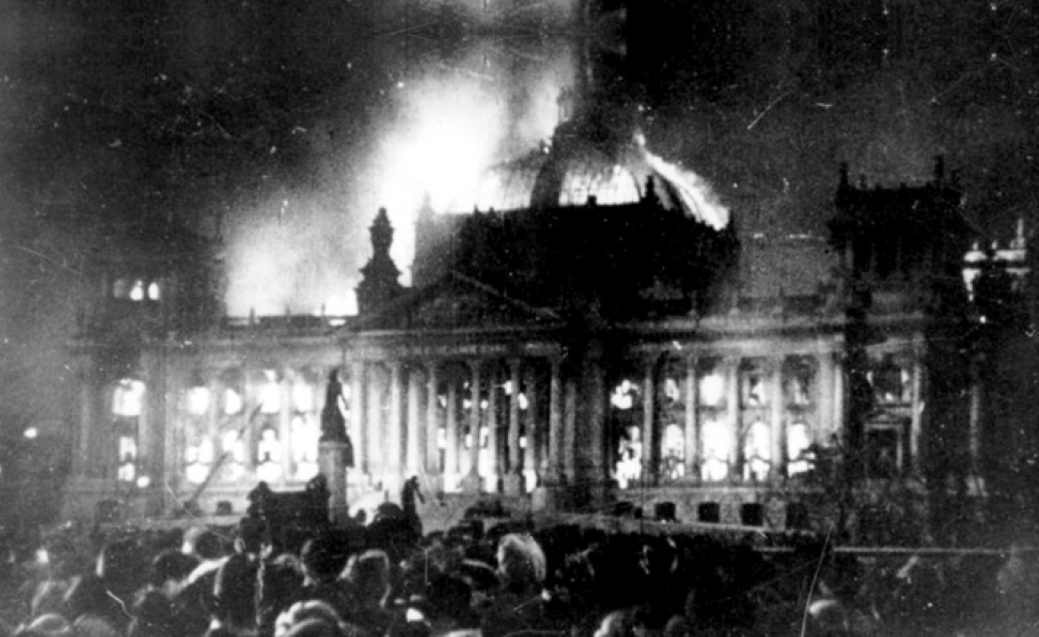
All of the left and all of labor were required to think deeply about their roles by the debacle of Hitlerism coming to power over the broken body of the strongest workers’ movement in the capitalist world. Kantorovitch, of whom it might be said was on the far left of Social Democracy, scores the Socialist failure, through its fetishism of bourgeois democracy, to offer workers a way out of the impasse.
‘Towards Reorientation’ by Haim Kantorovitch from American Socialist Quarterly. Vol. 2 No. 4. Autumn, 1933.
I.
THE victory of Hitlerism in Germany, and the growth of fascism in other countries has raised anew the problem of democracy in the socialist movement. For a meager few years it seemed that this problem had been settled once for all. The proletarian movement all over the world seemed to have accepted, as final, the division of socialism into democratic and dictatorial. Of course there was no absolute unanimity, either among democratic socialists, or among dictatorial socialists on all points. Democracy, as well as dictatorship, is amenable to wide and varied interpretations. Nevertheless, in broad outlines, the problem seemed to have been settled.
We are democratic socialists. The victory of Hitler has not changed our views in this regard. We can not imagine socialism without democracy. Democracy for us is the most essential part of socialism. While it is true that the aim of socialism is to reorganize society on a new economic basis, the hope of socialism, its source of inspiration, is the human liberty, equality and universal happiness that will result from this economic reorganization. With the exception of a handful of socialists, the democratic socialists never confused socialist democracy with bourgeois democracy. We all know, very well, that real democracy is incompatible with capitalism. No socialist has ever believed that what is now called democracy is really democracy. We know and realize all its defects and limitations, but, since the time of Marx and Engels, we have come to look upon bourgeois democracy as the best and most important weapon in our fight for real socialist democracy. Together with Engels we can still say, even now after the victory of Hitlerism, “with the successful utilization of the general franchise, an entirely new method of the proletarian struggle has come into being.” And this “new method” is still one of the most valuable of assets for us.
The advent of Hitlerism has changed nothing in our ideal of social democracy, but it has revealed a serious defect in our reasoning on bourgeois democracy. It has revealed to us that we have for long years put the entire problem of democracy on a wrong and non-Marxian basis. Instead of being objective our premises were really subjective. We asked ourselves: do we want democracy? and answered: of course we do! We asked ourselves: do we want to achieve socialism by democratic means? And we answered: certainly we do. We asked ourselves: do we want to travel the democratic road? and answered: yes we do! And it seemed to· many of us that everything was settled, because all we had to do was to determine what we wanted. Ask any German or Italian socialist whether he would prefer to get socialism by democratic means only, and he will surely answer in the affirmative even now. But, of what avail is his preference for democracy if he is not even given a chance to voice his preference freely for the democratic way?
The question must be put objectively instead of subjectively. Instead of asking ourselves what we want, we ought to ask, what will our enemy compel us to do. The question is not whether we prefer the democratic way; the question should be, whether our enemy will give us a chance to travel the preferred way. Will not our enemy block the desirable way? We are not the only party in the class-struggle, and we are not the only party to decide what forms the class struggle shall take. Socialist tactics are more often forced upon socialists by their enemies than chosen by themselves.
This mistaken emphasis on the subjective aspects of the problem of democracy is directly responsible for the development of the tendency to make a fetish of democracy, a tendency that has brought great harm to the socialist movement. This tendency took root more firmly in our German party than anywhere else, and it is now paying the penalty for it.
What is this socialist fetishism of democracy? it consists in overlooking two cardinal facts. It overlooks the fact that bourgeois democracy neither abolishes the class-struggle nor softens the class-distinction in capitalist society. It overlooks the fact that bourgeois democratic governments never hesitate to use any undemocratic, extra-parliamentary and illegal means in the protection of capitalist interests. It overlooks the fact that democracy does not make the use of force obsolete, but is itself a constant clash of forces. It simply confuses force with violence which, of course, are not the same, though bourgeois democratic governments use both. It seems to these fetishists that once we had democracy all our troubles would be over, all our problems solved, if only we had sufficient patience. They confuse bourgeois democracy with social democracy. Instead of accepting democracy as a means in the fight for socialism, they accept it as a substitute for the fight. Once we had democracy, no real fighting would ever be necessary. It never occurred to them that a time might come when the democratic way would be blocked, when they would be fought against and would have to fight back by resorting to undemocratic means. Bourgeois democracy is a valuable weapon in the hands of the working class, but it is also an instrument of class domination for the bourgeoisie. As yet the power is in the hands of the capitalist class. They can use democracy for their purposes, or abolish it if it becomes dangerous for them.
We do not agree with communists that fascism is a necessary, unavoidable stage through which every capitalist society must pass on its way to socialism. We deny the inevitability of fascism, but if it is not inevitable, it surely is probable, and for this probability every socialist party must prepare. Those socialists who would try to localize the “German tragedy” are not only wrong, they are also dangerous to the movement. The German tragedy is the tragedy of social reformism all over the world.
II.
If not social reformism then what? Revolution? Insurrection? Barricades? Is that what we are to prepare for, we are asked? Our reformist comrades think that there are only two ways out, either reformism, or artificial revolutions. But, we are reminded that “revolutions are not made at will”, and to make the argument stronger Lenin is cited to this effect. But these arguments are really not necessary. We know, and would not dream of denying, that “revolutions are not made at will”. Neither are fascist counter-revolutions made at will. Both grow out of an impasse in which capitalism finds itself, and both may take on different aspects under different circumstances. We know very well that artificial revolutions, the armed uprisings about which the communists love to talk, are in advance doomed to failure. No proletarian party, no matter how strong and well organized it may be, can be successful in an armed uprising against a modem state with its modern military technique. Long ago Engels wrote in his preface to Marx’s “Civil War in France” that “the rebellion of the old style, the street fight behind barricades which up to 1848 had prevailed, has become antiquated.” He even warned his readers that “the ruling class, by some means or another, would get us where the rifle pops and the saber slashes.” The tragic experiences of the “revolutionary uprisings” which were artificially engineered by the communists have proved the truth of Engels’ words. The Bolshevik revolution in Russia is no proof to the contrary. The Bolsheviks fought, not a capitalist state, but a shadow. Besides, the Bolshevik revolution in Russia was the result of such unique, specifically Russian circumstances that they can not and will not be repeated elsewhere. To say, as did the international conference of the communist opposition parties, that now when social reformism is dead the only way to socialism is “the Russian way” is either to reveal a gross ignorance of the forces that made the Russian revolution possible, or simply to play with words which at present are fashionable. The Russian way is purely Russian, so specifically Russian, that it can not be imitated.
Our criticism of social reformism is not because it made no revolutions; because it did not organize armed uprising. That would not have been revolutionary socialism but pure adventurism. Our criticism is that it did not use the opportunities that revolutions afforded it, to fight for socialism. The German socialists did not make the German revolution, but they could have utilized it. The revolution thrust power into their hands. They could have deepened the revolution; instead they hastened to liquidate it. Instead of using their power to demolish whatever capitalist forces were left, they used their power to build up and strengthen capitalism. The business of a socialist party is to be so prepared that it will take advantage of every difficulty in capitalism to further the interests of socialism.
There is no one way in which the proletariat may get political power. It may get political power as a result of the utter collapse of the existing state power as in Russia; as a result of a revolution brought about by a defeat in war as in Germany; as a result of a successful revolution as in Spain; or as a result of an electoral victory as in Great Britain. The way to political power in democratic countries will, in all probability, be the way of an electoral victory, if fascism will not intervene and make an end to democracy. The problem is not so much how to get power as how to hold it, and how to use it. Social reformism has shown that it is afraid of power; but whoever is not ready to use power, can not make a bid for it.
What was in the way of the parties which had power and refused to use it? It was a false conception of democracy. A socialist party in power can begin its socialist work only when it has an absolute majority behind it. Not less than 51 per cent of the votes are necessary for it. This was really a subterfuge. It is impossible to imagine that any socialist could take this “51 per cent” philosophy seriously! We can, of course, very well imagine a situation in which a socialist party should be called upon to take over the reigns of a capitalist state without having the slightest chance of even beginning to realize its socialist program. What should a socialist party do under such circumstances? It is clear that under such circumstances it can do only one thing. It can help capitalism out of its difficulties, but in so doing it betrays socialism. The resolution submitted by the minority at the International Socialist Conference at Paris held in August of this year declares: “…It is not the task of the socialist parties to attempt to straighten out the capitalist world or even to collaborate in such attempts.” There is nothing either new or original in this declaration. It is simply a return to the fundamental principles of socialism, which the tragic experiences of the last years have proved to be more true than ever.
III.
When a German social democratic leader is asked: Why did not you strengthen the position of the working class in Germany so that the reactionary forces could not rise again, the usual answer is: But that would have been dictatorship! The fear of dictatorship has become so strong in some parts of our movement that it has led them to abandon all thought of revolutionary transformation of society of any sort. But what is the dictatorship of the proletariat? Why it is communism; the best example of it is Russia! Is Russia really the “best example” or an example of any kind of proletarian dictatorship? No socialist will admit that. Due to the specific and unique circumstances under which the Bolshevik party acquired state power, the proletarian dictatorship there has taken on a form and content that is especially adapted to Russian conditions. The Bolshevik party has acquired power in a country that had neither a well organized working class nor a well organized bourgeoisie, a country which had no democratic traditions, a country that was economically undeveloped and culturally backward. It is natural that a dictatorship in such a country should be quite different from what a “proletarian dictatorship” would be in any other country. What we have in Russia at present is not a dictatorship of the proletariat, but a dictatorship over the proletariat, not even a dictatorship of the communists over the proletariat, but rather a dictatorship of a bureaucratic clique over the communist party as well as over every one else. Is this the ideal of proletarian dictatorship? Decidedly not. No socialist will accept this ideal of dictatorship and the numbers are growing even among the communists who refuse to take Stalinism as anything even near the ideal of proletarian dictatorship.
Any socialist party which will, in one way or another, acquire state power, and will proceed to use it for the building of socialism, will inevitably meet with opposition from the die-hard supporters of the present order. It will have to defend itself against open and concealed warfare and sabotage. It will then either suppress these oppositions through its state power, or submit to them. If it will suppress, it will use dictatorial measures (which in reality every bourgeois democratic state uses). If it will submit, it will simply give up its fight for socialism. A socialist government that will proceed to use the state for the building of socialism will meet many obstacles in its way, such as obsolete capitalist institutions, reactionary officials and outlived but nevertheless powerful traditions. It will have to abolish these institutions, replace these officials, break these traditions, or submit to them. If it submits, it is giving up its fight for socialism. Some one has once said, that what socialists must be prepared for is not a revolution but a counter-revolution. Once socialists will gain power, even in the most legal and democratic manner, if they will try to use this power to abolish capitalism they will be faced with a bourgeois (or fascist) counter-revolution. They will have either to suppress this counter-revolution, or be suppressed by it. In the former case, they will use dictatorial measures to clear the way for the upbuilding and growth of a real social democracy; in the latter they will prepare the way for fascism. This is the choice before the socialist movement. On this choice depends the further development, the future successes or failures of the movement.
Socialist Review began as American Socialist Quarterly in 1932. The name changed to Socialist Review in September 1937. The journal reflected Norman Thomas’ supporters “Militant” tendency of the ‘center’ leadership. Beginning in 1936, there were also Fourth Internationalists lead by James P. Cannon as well as the right-wing tendency around the New Leader magazine also contributing. The articles reflect these ideological divisions, and for a time, the journal hosted important debates. The magazine continued as the SP official organ through the 1940s.
PDF of full issue: https://www.marxists.org/history/usa/pubs/socialist-review/v02n04-aut-1933-ASQ.pdf
 Revolution's Newsstand