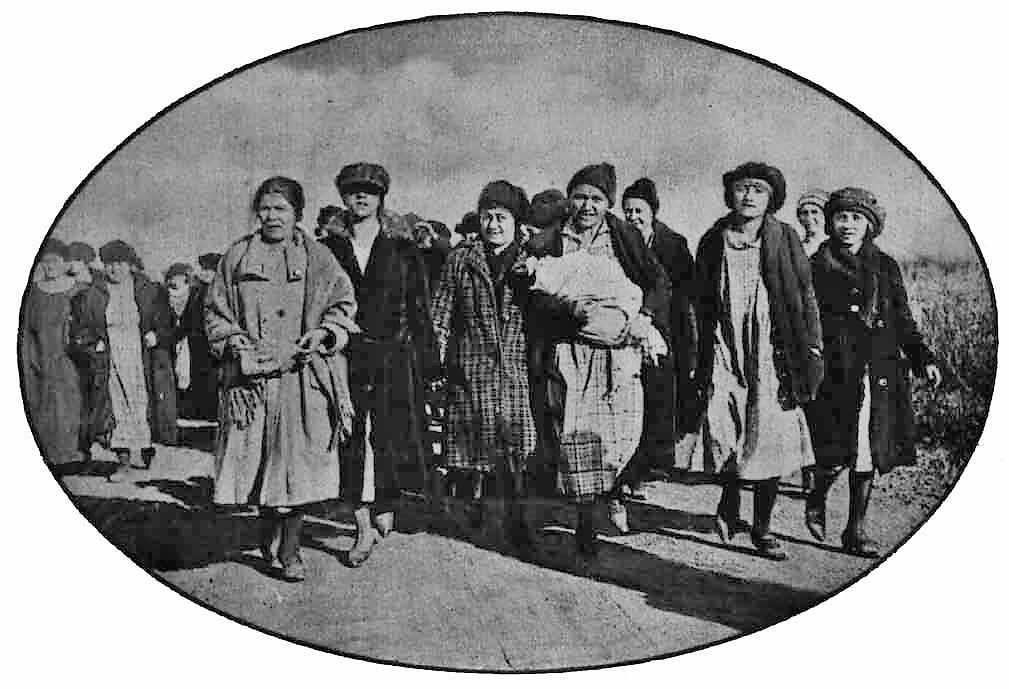
The militant Kansas miners led by Alexander Howatt waged a long battle to win and keep union recognition in the fields. Women being particularly active in the fight.
‘Scabs Strike Snags When Women Hit Picket Line’ by Art Shields from Truth (Duluth). Vol. 4 No. 51. December 23, 1921.
PITTSBURG. Kans. There is joy and laughter in the coal fields of Kansas, for the strikebreakers are on the run before the militant ladies of their Sunflower State.
The fun began before daylight Monday when the 120 men who have helped themselves to the vacant jobs in the big Jackson-Walker Mine No. 17, near South Franklin, began to get off the two interurban cars and to get into hot water all at once.
They say there used to be some excitement in the old Amazon days, but it was nothing to the action out there on the Kansas prairie that blue Monday morning. Seven hundred and fifty lively ladies gave the travelers the liveliest reception they had ever experienced. Young women, old women, blondes, brunettes, and every kind, began swarming into those wishers for unhallowed work and began ruffling their feelings.
In the midst of the charming host were the forces of the law, Sheriff Could and his deputies, to see that nothing happened that oughtn’t happen, and all they could do was to look on while the cause of the trouble was removed by the visitors rushing pell-mell back into the cars and begging the motormen to drive on.
What could the sheriff do against such a crowd of lovely femininity, all in their best bibs and tuckers, flying the stars and stripes from a dozen poles and laughing and singing?
One stalwart woman wrapped her country’s banner around the sheriff and gave him three cheers, and then they all joined in and gave him three cheers, and gave the interurban cars a salvo of hurrahs as they went on with the men who tried to break the strike for the a release of Howat and Dorchy.
Now the Jackson-Walker mines are again enjoying the vacation that began September 30 and which was interrupted a couple of weeks ago when the bosses began slipping men one by one into the largest of their five mines, till finally it was working to one-third of normal, and the managers were boasting that the entire five would soon have their full complement of 800 men.
There are some 500 more strikebreakers in other parts of the district and the upholders of the Industrial Court Act are wandering what the ladies are going to do next. But the ladles are making no promises; they just say, well, that they like to get up at 4 a.m. and work up an appetite before breakfast.
It is all very annoying to the coal operators, who have brought these strikebreakers from other States at great expense, but they are up against willful women who must have their way.
Just the day before the South Franklin picnic there had been an enthusiastic mass meeting of women in the town of Franklin, and at the same time in the nearby mining camp of Gross was another, larger mass meeting, at which William Howe, the secretary of the Kansas Federation of Labor, spoke, and urged everyone, men and women, to get up early in the morning and picket.
“You’ve got a right to picket according to Federal law, and it’s necessary to picket in order to win this strike,” he said. “Don’t be afraid of these scabs. They won’t do you any harm; they’re too much ashamed even to look at you. Just meet them early in the morning and persuade them to go back home.
“Down in Franklin we’re going to picket as long as the Western Coal Company, the largest mining company in the district, which has a number of strikebreakers at one of its eight mines.
“This fight has to be won. If Allen and those fellows are going to dictate to you what your working conditions are going to be, you might as well tear up your charters, they’ll be no good to you.”
Several local speakers and two representatives of the Illinois miners also spoke at the meeting. The
Illinois men denounced the provisional government which President John L. Lewis of the United Mine Workers had set up in the district, charging that his representatives were aiding the coal miners in bringing in strikebreakers.
Truth emerged from the The Duluth Labor Leader, a weekly English language publication of the Scandinavian local of the Socialist Party in Duluth, Minnesota and began on May Day, 1917 as a Left Wing alternative to the Duluth Labor World. The paper was aligned to both the SP and the I.W.W. leading to the paper being closed down in the first big anti-I.W.W. raids in September, 1917. The paper was reborn as Truth, with the Duluth Scandinavian Socialists joining the Communist Labor Party of America in 1919. Shortly after the editor, Jack Carney, was arrested and convicted of espionage in 1920. Truth continued to publish with a new editor J.O. Bentall until 1923 as an unofficial paper of the C.P.
PDF of full issue: https://www.mnhs.org/newspapers/lccn/sn89081142/1921-12-23/ed-1/seq-1
 Revolution's Newsstand