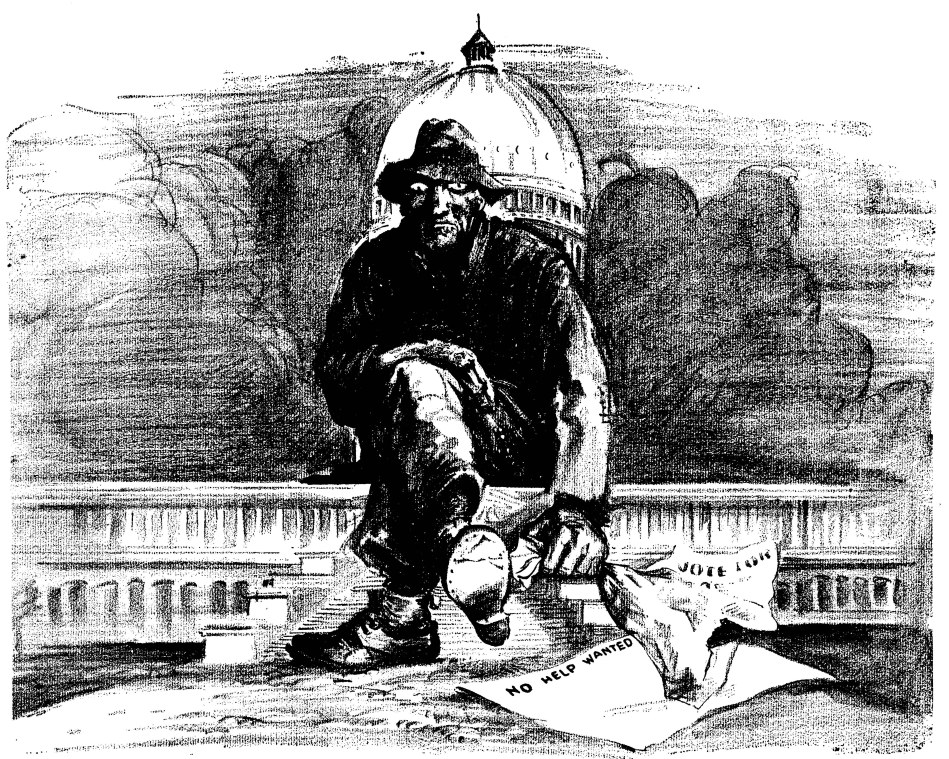
After the post-war recession U.S. unemployment hovered at around 5% (officially) throughout the 1920s. While relatively low, that constituted millions of workers and often concentrated itself in particular industries. It’s persistent, ingrained nature playing a role in the conditions of all workers, requiring a working class redress. A Communist program from just before the 1929 Stock Market Crash and subsequent mass unemployment.
‘Program on Unemployment’ from The Communist. Vol. 7 No. 6. June, 1928.
Policies adopted by the Central Executive Committee of the Workers’ (Communist) Party
I. Unemployment Insurance
1. A Federal system of unemployment insurance should be established. A Federal law must be enacted immediately by Congress, providing for unemployment insurance for all wage-earners without any exceptions or disqualifications.
2. The amount of compensation shall be full wages for the entire period of unemployment, the maximum to be $30. per week. Payment shall be due from date of unemployment.
3. No worker shall be disqualified from receiving unemployment insurance because he refuses work at wages below what he was formerly receiving or below the prevailing trade-union rates, or because of strikes.
4. An unemployment insurance fund shall be created, fifty per cent to be contributed by the employers and fifty per cent by the State. The amount contributed by the State shall be raised by special taxes levied against inheritance, high incomes, and corporation profits.
5. The administration of unemployment insurance shall be carried out by Federal, State, and City unemployment insurance commissions composed of representatives of trade unions, organizations of the unemployed, and factory, mill, and mine committees.
6. Abolition of private employment agencies, which exploit the jobless, charging high fees. Provision of government funds for the establishment of free employment agencies, through which all jobs shall be distributed. The agencies shall be managed by the trade unions and unemployed organizations.
II. Working Hours, Women’s and Child Labor
1. Immediate enactment of a Federal law providing for a general 44-hour week, 5-day week working time, and forbidding all overtime, as a means of absorbing the unemployed in industry.
2. The law shall provide for an especially short working day in especially dangerous industries.
3. Abolition of the speed-up system and equal division of work in all factories and shops.
4. Immediate enactment of a Federal law providing for one day of rest in seven for all wage-earners.
5. Prohibition by law of night work and over-time for working women.
6. Compulsory abolition of child labor under the age of 16 and State maintenance of all children at present employed.
7. Abolition of underground work, night work, over-time, and work in dangerous occupations for all young workers.
8. Six-hour working day for all workers between the ages of 16 and 18.
III. Immediate Help
1. A Federal law should be enacted providing for immediate emergency help for all workers who have been unemployed two months or more, consisting of eight week’s wages for each worker. The average wage received during the last four weeks of employment shall serve as the basis. The costs should be covered by special taxes on high incomes, inheritance, and corporation profits.
2. Immediate enactment of State laws providing for the abolition of the right of eviction by landlords against tenants who are unemployed. Immediate establishment by municipalities of homes to shelter the unemployed. Compulsory repair by the landlords of all working-class homes in bad condition.
3. Establishment of public kitchens by municipalities to provide free meals for all unemployed workers, and their families. It is inadvisable to establish such unemployment kitchens at the present time.
4. Municipal provisions for supplying free medical treatment, medicine, and hospital care to all unemployed.
5. Immediate utilization of schools as feeding centers for children of unemployed workers, whether of school age or below it. These stations should be under labor-parent control. Free clothing and free medical treatment by the schools for the children of the unemployed.
IV. Public Works
1. The immediate development of Federal, State and Municipal schemes of employment to absorb the unemployed in their own trades at trade-union wages, hours and conditions.
2. The Federal, State, and City governments should devise schemes for: improving the roads and bridges of the country; improving the rivers, canals, docks, and harbors; setting up electric power supply stations; forestation, land drainage, and land reclamation; extension and electrification of railways. On all public works, trade-union wages, hours and conditions must be guaranteed by law.
3. Immediate recognition of the Soviet Government. Stimulation of trade with the Union of Soviet Socialist Republics by the granting of sufficient credits by the Federal Government as a means of absorbing the unemployed.
V. Organize the Unemployed and Unorganized
1. The direct mass action of the working class against the ruinous effects of capitalist rationalization, speed-up, and unemployment is the basis for all unemployed demands. It is imperative that the Party should set up Councils of Unemployed everywhere. These Councils should secure as broad a mass basis as possible. The unemployed movement must be linked up on a national scale as early as conditions allow. In addition to affiliating trade unions and other labor bodies, the Councils shall enroll the unemployed workers as individual members and shall issue membership books and establish a nominal dues system.
2. It is vital to secure the joint action of the trade unions and unemployed workers, as well as the organized and unorganized workers. The trade unions must set up everywhere Unemployed Committees, and must initiate without delay organizational drives on a large scale, admitting all workers without initiation fee.
3. The trade unions shall take measures for retaining their members during periods of unemployment. The trade unions shall recognize the membership cards of the Unemployed Councils for the purpose of transfer without initiation fee, when such workers obtain employment.
4. The treachery of the labor bureaucracy, the general crisis in the labor movement, and the pressure of unemployment makes the organization of the unorganized imperative. The Unemployed Councils, as well as the T.U.E.L. organizations, should take the initiative in organizational drives.
5. Relentless struggle must be conducted against the infamous system of injunctions and against all laws which hinder or prohibit the organization of the workers. The struggle for freedom to strike, organize, and picket, for free speech, press, and assemblage for the working class, must be increased and intensified.
6. Immediate abolition of all vagrancy laws. Protection of unemployed workers from arrest under charges of vagrancy.
VI. Unemployment and Capitalism
1. We must always emphasize that neither unemployment insurance nor public works nor shortening of the working day can abolish unemployment. There is no cure for unemployment in a capitalist society. Unemployment is inseparable from capitalism. The constant industrial reserve army of jobless is growing and is one of the most important props of capitalist wage slavery.
2. Unemployment can be permanently abolished only in a Communist society which must be based not on profit but on labor. The first steps towards a Communist society are:
a. Independent political action of the working-class; every union shall affiliate to the Labor Party; every individual worker should join the Workers (Communist) Party.
b. Organize the unorganized.
c. The proletarian revolution; a Workers’ and Farmers’ Government; the expropriation of the capitalists; the nationalization of all industries and land; and workers’ control.
VII. Our Methods of Agitation and Propaganda
1. The main emphasis must be laid on the organization of the masses.
2. The work of the Unemployed Councils must be strengthened, additional party forces assigned to this work. The contradictions between the various slogans and demands of the various districts must be eliminated. Our propaganda and agitation must be unified and based on the above demands.
3. In our agitation and propaganda, the relative value and effectiveness of all immediate and partial demands must be pointed out clearly, as well as the basic causes of unemployment and the need of revolutionary struggle against capitalism.
There are a number of journals with this name in the history of the movement. This ‘Communist’ was the main theoretical journal of the Communist Party from 1927 until 1944. Its origins lie with the folding of The Liberator, Soviet Russia Pictorial, and Labor Herald together into Workers Monthly as the new unified Communist Party’s official cultural and discussion magazine in November, 1924. Workers Monthly became The Communist in March, 1927 and was also published monthly. The Communist contains the most thorough archive of the Communist Party’s positions and thinking during its run. The New Masses became the main cultural vehicle for the CP and the Communist, though it began with with more vibrancy and discussion, became increasingly an organ of Comintern and CP program. Over its run the tagline went from “A Theoretical Magazine for the Discussion of Revolutionary Problems” to “A Magazine of the Theory and Practice of Marxism-Leninism” to “A Marxist Magazine Devoted to Advancement of Democratic Thought and Action.” The aesthetic of the journal also changed dramatically over its years. Editors included Earl Browder, Alex Bittelman, Max Bedacht, and Bertram D. Wolfe.
PDF of full issue: https://www.marxists.org/history/usa/pubs/communist/v07n06-jun-1928-communist.pdf
 Revolution's Newsstand