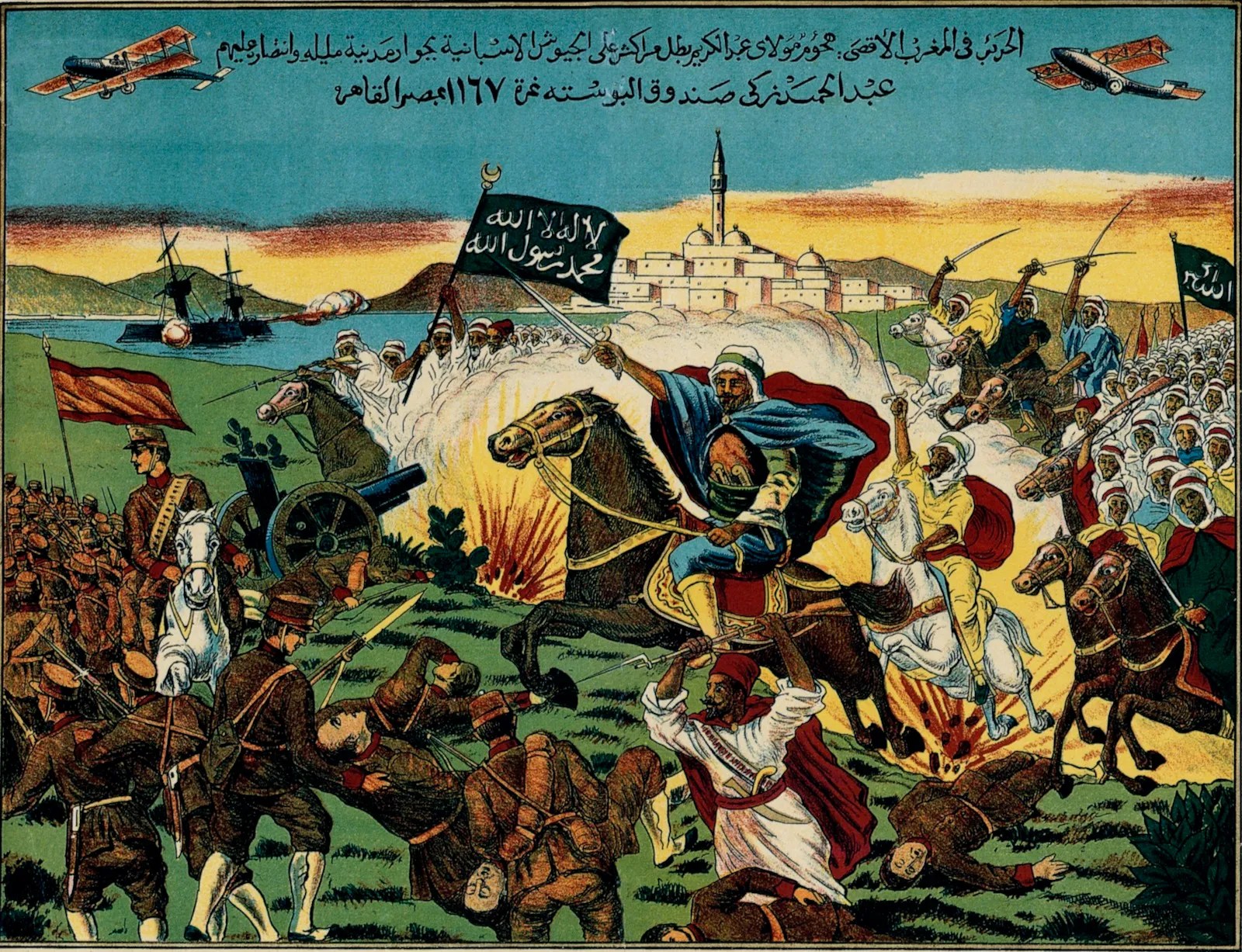
Semard on French imperialism’s Social-Democratic support for the war against the Riffians of Morocco. Rebelling against Spanish colonialism, the Rif Republic fought a tenacious years-long independence war against Spain and its French Allies. Hundreds of thousands died in a campaign which saw the large scale use of chemical and biological weapons against North African civilian populations, particularly by Spain.
‘The War in Morocco’ by Pierre Semard from Communist International. Vol. 2 No. 12. March, 1925.
THE renowned death-trap of Morocco, where in 1907 the first flames were lit of the conflagration that devastated the world for four years, is once again the theatre of war! Following on the Spanish imperialists, it is now the imperialists of France who are bringing civilisation to the Riff tribes by means of artillery and rifle fire. The “Left bloc” which had promised peace to the world, is making war in Morocco. The well-known London Agreement and the Geneva Pact were just so many “symbolical gestures” of peace, which made it possible to deceive public opinion, while the occupation of the Ruhr was being maintained, and the war against the Riffs was being prepared.
The “Left bloc” has followed faithfully in the track of the “Bloc National.” Both of the two “Left bloc” governments are equally responsible for the present events; Herriot’s government prepared the attack on the Riff, in full accord with Lyautey, the Resident-General, and Painlevé’s government let loose the conflict.
Herriot and Painlevé, in this war, continually boast of peace and proclaim the pacifism of France-while they affirm that “his government deserved honour for having (being warned in time by Marshal Lyautey) foreseen the Riff offensive and taken every measure to withstand it” (Herriot) and “he had done nothing but continue the Moroccan policy of his predecessor, and the events which are occurring arise out of the measures taken by Herriot” (Painlevé).
“A defensive war,” say the pontiffs of the “Left bloc,” No; it is an offensive war that has been skillfully prepared.
For more than a year the Riff has been blockaded. It is admitted by the reactionary press as well as by that of the “Left,” that there is no frontier between French Morocco and the Riff. “A paper frontier,” says the democratic Europe Nouvelle. “A hypothetical frontier,” writes the Matin. “There is no frontier, in the economic and international sense of the word,” confirms the reactionary Eclair. But during the last six months the whole of the neutral zone which borders on this “hypothetical” frontier has been covered with blockhouses, placed to cover each dissident tribe. The tribes of this neutral zone, in which is the fertile valley of the Wergha, have been brought to submit more or less to the French protectorate, through the buying of their chiefs with money and honours. They have, thereupon, been armed to fight, at the right time, against Abd-el Krim.
Lyautey has refused with scorn the proposals to negotiate, made on several occasions by Abd-el Krim.
The blockhouses which he has scattered in the lowlands of the Wergha, where the Riffs are forced to come to provision themselves with cereals if they do not want to die of hunger, were supplementary to the peaceful diplomacy which it was stated, was being employed in Morocco.
Lyautey didn’t care a damn for the negotiations which were proposed to him; he was busy preparing a trap in the Wergha valley, letting the Riffs filter through the line in order to attack them later.
But things have not gone as he would have wished; Abd-el Krim scented the danger and raised the tribes that Lyautey had armed against him! These tribes, like that of the Beni-Zeroual, are today fighting side by side with Abd-el Krim, and using Lyautey’s rifles and machine guns against the French troops.
A captain in command of the French post at Aoulay, which was besieged for twenty-two days, attempts to e plain this action of the rebel tribes by declaring that “it is under the pressure of the most atrocious terrorism that they have had to go over to the enemy’s side.” “For,” he says, “they prefer the French to the ‘savage’ Riffs.” But further on he states that the Riffs themselves took part in the siege of his output, which out of 34 men had only, at the end, sixteen left, almost all wounded–so vigorous had been the Riff attack.
This war is, therefore, costly in lives, according to the admission even of military leaders, and it is known that it will be long–“it threatens to last many long years,” writes the Matin, always well-informed.
So that the government is completely hiding the truth; it speaks of light losses, and of a rapid ending of the conflict, while knowing that the reverse is certain. Its declarations are completely in contradiction with those of the military leaders in Morocco; this shows to what a pitch the deception of public opinion is being carried in order to get the public to accept this new butchery, which will not profit anyone except the sharks of finance and industry, who covet the Riff mines and are using their influence on the government.
The Bank of Paris and the Low Countries, the Parisian Union Bank and the Credit Foncier of Algeria, which have already shared between them the riches of French Morocco, dream of getting hold of the resources of the Riff, and the newspapers in their pay demand the complete crushing of Abd-el Krim by war to the bitter end, or by a pitiless blockade.
The Painlevé, Briand, Caillaux Government, a flexible instrument in the hands of high finance (as was Herriot’s government also), is carrying on “their” war by means of the double game that has been so successful in peace time. In the daylight of public opinion the government states that it wishes to treat with Abd-el Krim, in the dark of the Chancelleries, it organises reinforcements for the war. It is with this intention that it has sent its emissary, Matvy, to negotiate with the Spanish dictator, Primo de Rivera. It is in order to seek for an agreement aimed at intensifying the struggle against the common enemy that their approaches have been made.
Will Spain, advised by England (who wishes to avoid at all costs France having her own Gibraltar on the coasts of a conquered Riff territory), accept the proposed bargain. There is little likelihood, for France is her competitor in Morocco, and she is more inclined to follow the advice of England, of which country she has need.
These are the international complications that arise between France and England, and they are complicated by Italy’s Imperialist designs on Tunis. A world war is simmering; the Moroccan death-trap threatens once more to inflame it suddenly. In this terrible situation, what are the leaders of the Socialists doing–the “leaders” of the two “Left bloc” governments? Their official participation in power, through the policy of supporting the government that they are practising, does not allow them to turn a blind eye to any side of policy.
They prepared the war with Herriot, they are carrying on the war with Painlevé!
It is in order to cover up their grave responsibilities that Pierre Bertrand of the “Quotidien,” asked recently in their name (pretending ignorance of what was happening in Morocco), in a great headline in his paper, “Let us know the truth about Morocco!”
Painlevé replied to this demagogic demand by saying dryly, “that he had done nothing but continue the policy of his predecessor, and that it was to the latter that they should go to know the truth.” In this way, he made them realise that they must not be too insistent, for their little manœuvre against his government might hoist them with their own petard!
The Socialists did not insist. Renaudel, who had made a great deal of fuss over his demand for a debate on Morocco, asked for its postponement. The Socialist opposition, all a sham, put up to deceive the workers, fell to pieces of itself.
And so the Socialist group in Parliament went on to agree with the other groups of the “Left Bloc” to ask for the postponement of the debate on Morocco for a week, only declaring that their intention, as Socialists, was to
“Take away all the spirit of conquest from the military operations in Morocco, to have it announced by the government that the annexation of the Riff would not even be considered, and that ways and means to end the conflict would be sought as rapidly as possible.”
In these worn phrases, there is no question of an immediate and unconditional peace, or of the evacuation of Morocco–measures that any Socialist still worthy of the name ought to demand. Once again, the treachery of the Socialist leaders is absolutely complete.
The agreement with the other parties of the “Left bloc” was even so solid that it was decided to adopt a common resolution of confidence in the government, to be put forward in the name of the whole “Bloc.”
Thus without waiting to know “the whole truth about Morocco,” as had been demanded fiercely a few days before, the Socialist leaders agreed to rest their confidence still in the triumvirate–Painlevé, Briand, Caillaux–even before it had explained its policy!
At the same moment, the reformist General Confederation of Labour, by the pen of its secretary, Jouhaux, took up the defence of the government. “The government,” he said, “has had to face a situation of which it is impossible to ignore the dangers.” Jouhaux next showed his confidence in the government by writing that it “would not, for its part, repeat the duplicities from which the country has suffered so much before the war and after.” Jouhaux defended the government against the reactionary press “who were bolstering up the legend of France’s adventurous and militaristic character, a France that sought for surprise blows and that thirsted for new conquests.” Jouhaux also wrote: “there exist extremist demagogues who are occupied with stirring up trouble everywhere, under the cover of the International they practice the narrowest nationalism.”
In conclusion, Jouhaux, like his friends the Socialist leaders, asked the government to proclaim that it was not out for adventure or conquest”–and this in terms that cannot be suspected of secret reservations (arrivè persées).
The Socialists and the reformist trade union leaders, who in 1914 displayed themselves as patriots, and in favour of war to the bitter end, who declared that their country was in danger, and therefore joined in sacred union with their bourgeoisie these again find themselves united, in 1925, in treason to the proletariat.
They use the same “democratic and Chauvinist arguments, and as in 1914, use lies to deceive the workers–in order to make them accept the war in Morocco, first step towards a new world war.
They say that they work together with the government in order to be able to work for peace with it–but for what peace?
All the papers of the “Left bloc” speak of the necessity for guaranteeing “our” frontier against the invasions of the Riffs, and after “our” territory has been cleared, they mean to propose peace to Abd-el Krim.
Jouhaux, following Renaudel, has come out against the extension of military operations into what used to be the Spanish zone–and thus shows himself to be in favour of continuing the war until the Riffs are thrown back to the other side of this famous frontier, which only exists on paper. It is the formula of the “fatherland in danger, which must be defended,” that is being supported by the Socialists.
The resolution on Morocco worked out by the “Left bloc” is not yet published (at the moment of writing), but we know that it will amongst other things declare the pacifism and the will to peace of France. It will also contain a proposal to negotiate with Abd-el Krim, but on condition that the latter accepts as definite the French frontier, until now purely hypothetical.
It is known beforehand that Abd-el Krim will refuse to isolate himself in the barren mountains of the Riff, and cut himself off completely from the fertile valleys without which his compatriots cannot live.
“Abd-el Krim refuses to negotiate,” the soldiers and rulers will then say; and this will serve as a pretext for continuing the war either by arms or by blockade.
Reactionaries of the “Bloc National” and Democrats of the “Left bloc” are also agreed in saying that this war will be a long one, and that it will have to be waged “to the bitter end.” For it is impossible to make peace on terms that are advantageous to Abd-el Krim; that is, to leave to him the valleys which grow grain.
They are equally unwilling for Abd-el Krim, who more and more appears as the champion of Islam facing the Christian robbers, to have even a semblance of success. For the echoes of this might be so loud that “our” Moslem empire would be menaced by them.
The reactionary press, and that of the “Left” is unanimous in saying that even the driving of the Riffs to the other side of the “hypothetical” frontier will not end the war.
Reactionaries, Democrats and Social-Democrats know that the only way to finish Abd-el Krim is to send out there an army strong enough to drive the Riffs into the sea that is to say, to engage upon a war that will cost thousands of millions of francs, and thousands upon thousands of victims. The reactionaries say this straight out, suggesting it to the government. The Democrats and Social-Democrats also believe in it, but they are afraid of difficulties within France and international complications outside.
They do not draw back–but they employ a ruse. They have promised peace–opinion must not be in a position to accuse them of making war. They have promised better living–they must not be liable to the accusation that they have made living dearer and taxes heavier. They think it more skillful to carry out a war of attrition by means of a strengthened blockade.
How long will they be able to deceive the wide masses of the workers?
They have a good set of trump cards in their game of forming opinion, in the Socialist and reformist trade union “heads” who accept the war.
Yet already serious protests are to be heard in the ranks of the reformist unions, the departmental confederal unions (district trades councils) of the Haute Garrone of the Rhône, of the Gironde, and of Meurthe et Moselle, ask that it should be recognised that there is, among the masses of the people, a current of opposition to the Moroccan war; and they denounce the criminal designs of the capitalists in this new butchery.
The proposals for a united front against the war, made by the Communist Party and the Unitary Confederation of Labour (C.G.T.U.) to the Socialist Party and the reformist Confederation of Labour (C.G.T.) have been repeated to every group of these bodies from top to bottom. At the top they have been left without an answer. But the reformist rank and file has answered, and the common struggle of the non-party and reformist workers with the revolutionary workers is going to increase in vigour and in scope.
The agitation undertaken by the Communist Party and the C.G.T.U. is based on the following slogans:
“Fraternisation of the soldiers of France and of the Riff.”
“Immediate and unconditional peace with Abd-el Krim,” and
“Evacuation of Morocco!”
In spite of the “pacifist-warrior” poison pumped into the opinion of the people by the “Left-bloc,” this agitation is beginning to bear fruit.
The opposition to the war is going, in the days that are coming, to increase in strength. It is the proletariat of the towns and fields that is going to impose peace in Morocco. It is the proletariat that has got to force the French imperialists to respect their own democratic phrases, and to apply the “right of all peoples freely to dispose of their own lives, in virtue of which Morocco ought to belong to the Moroccans.”
The French working class, faithful to its revolutionary traditions, will be able to impose its will to peace on the bloodstained politicians and charlatans of the “Left Bloc” who bear the responsibility for the butchery in Morocco.
PIERRE SEMARD,
(Secretary of the Communist Party of France.)
The ECCI published the magazine ‘Communist International’ edited by Zinoviev and Karl Radek from 1919 until 1926 irregularly in German, French, Russian, and English. Restarting in 1927 until 1934. Unlike, Inprecorr, CI contained long-form articles by the leading figures of the International as well as proceedings, statements, and notices of the Comintern. No complete run of Communist International is available in English. Both were largely published outside of Soviet territory, with Communist International printed in London, to facilitate distribution and both were major contributors to the Communist press in the U.S. Communist International and Inprecorr are an invaluable English-language source on the history of the Communist International and its sections.
PDF of full issue: https://www.marxists.org/history/international/comintern/ci/new_series/v02-n12-1925-new-series-CI-grn-riaz.pdf
 Revolution's Newsstand