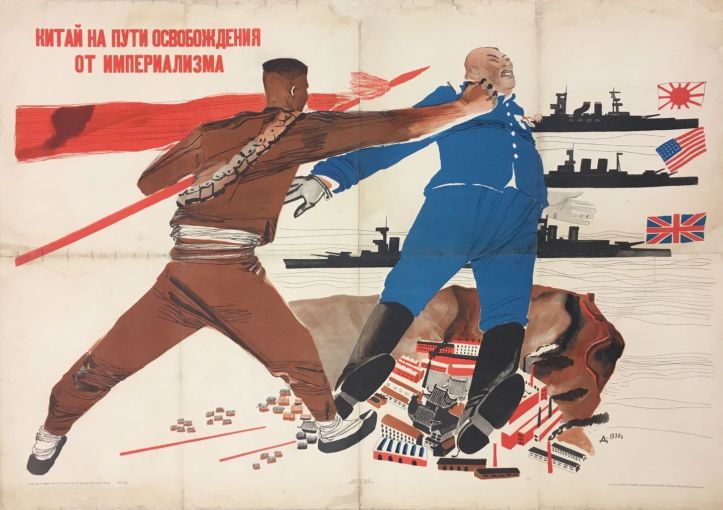
Gomez reports on the founding conference of the League Against Imperialism held in Brussels during February, 1927. Called by the Communist International, the meeting gathered 175 delegates, the majority from the colonial world and its liberation movement. Aside from Communists, representatives from the Kuomintang (soon to violently leave the alliance with the CCP), The Indian National Congress (including Nehru), the African National Congress (by its President, Josiah Tshangana Gumede), and Albert Einstein. The League never attained its aspirations and did not survive the Popular Front, however its efforts remain a milestone in the international struggle against imperialism.
‘The Brussels Congress Against Imperialism’ by Manuel Gomez from The Communist. Vol. 6 Nos. 3. May, 1927.
I.
MARX’S slogan: Workers of the World Unite, was a war-cry, M and much more than a war-cry. The action of the workers here and there in different parts of Europe soon gave it the force of prophecy. The formation of the International Workingmen’s Association was the guarantee of fulfillment. It was the appearance of a conscious international army of working-class struggle, massed as a fact of history behind Marx’s slogan of labor unity on a world scale. Thenceforward it was only a question of how long. That the First International died only meant that a Second International would be formed. Betrayal by the Second International meant the creation of the Third.
Lenin’s slogan: Workers and Oppressed Peoples Unite, is still new in our ears. Yet we have already been able to cite no end of events indicating its prophetic import: the Soviet alliance with Kemal Pasha in 1920, the long-continued and developing Soviet-Chinese liaison, the entire experience of the U.S.S.R. in dealing with the question of nationalities, the support of the Riffian tribesmen by the French Communist Party against imperialist France, the protest of the Indian National Congress against the service of Gurka and Sikh police in China, etc., etc. We can now point to something else. There was held at Brussels, February 10-15 of this year, the first World Congress Against Imperialism, resulting in the establishment of the International League Against Imperialism and Colonial Rule.
What the 1864 gathering in St. Martin’s Hall was to Marx’s famous slogan, the Brussels Congress is to Lenin’s slogan.
The congress brought together upwards of 180 delegates representing workers and oppressed nationalities in 37 different countries. More than 100 of the delegates came from colonial and semicolonial lands. They were no mere collection of individuals but leaders of the anti-imperialist struggle, including representatives of the National Revolutionary Army of China, the All-China Federation of Trade Unions, the executive committee of the Kuomintang, the Indian National Congress, the Egyptian Nationalist Party, the Syrian National Assembly, the South African Trade Union Congress, the Natal Native Council, the Persian Revolutionary Republican Party, the “Perhimpounan” of the Dutch East Indies, the nationalist movement of Korea, the two leading nationalist parties of French Indo-China, and the Negro movements of north and central Africa.t
Latin America, where the movement for unity against American imperialism is growing by leaps and bounds, furnished one of the largest bodies of delegates. Mexico alone was represented by delegates of the National Peasants’ League, the Mexican Confederation of Labor (CROM), the Associated Trade Unions of Tampico, the Mexican Students’ Federation and the Mexican Section of the All-America Anti-Imperialist League. Representatives were also present from Cuba, Haiti, Porto Rico, Nicaragua, Panama, Venezuela, Colombia, Peru and Argentina.
Hammering out anti-imperialist policy at Brussels in conjunction with the delegates from Asia, Oceania, Africa and Latin America, were the representatives of working class organizations in the industrial countries. That they represented no inconsiderable force is indicated by the fact that seventeen trade union organizations with a total of 7,962,000 members had delegates there. Among them were the Miners’ Federation of Great Britain, the British Minority Movement, the C.G.T.U. of France, the Belgian Clothing Workers’ Union and the International Federation of Teachers.
Combination of the diverse movements of the colonies and semi-colonies, and the linking up of these movements with the working-class movement in the imperialist countries: this was the essential union forged at Brussels. There were, however, other elements at the congress, such as the Women’s International League for Peace and Freedom. It was a concentration of anti-imperialist forces of the world.
Quite as significant as the list of those who were present at the first World Congress Against Imperialism is the list of those who were not present. No one will be surprised to find the official “socialists” of the Second International foremost among the latter. Our readers need only remember that although the organization referred to was meeting in convention during the French imperialist drive against the Riffians, it could not find a place for the Riff question on its agenda. Not only were these people among those missing at Brussels, but one of their outstanding figures, “Comrade” Emile Vandervelde, refused, as Minister of Foreign Affairs in the Belgian government, to allow the congress to proceed at all until a pledge was extracted that the delegates would not touch upon the question of the Belgian Congo!
It might have been supposed, however, that the socialist leaders would have the decency to refrain from open attack upon the congress, particularly as the executive committee of the Second International, meeting at Paris simultaneously with the anti-imperialist gathering at Brussels, was just sending forth a platonic statement in support of the Chinese revolution. Such a supposition would no doubt appear naive indeed to Vandervelde and his friends. Without warning, the Second International issued a bitter tirade against the congress, which it labeled as “Communist.” Friedrich Adler, secretary of the International, wrote an official communication along similar lines to the congress itself. Mr. Adler’s organization was undeterred by the fact that participating at Brussels were the representatives of every responsible unit of the Chinese revolution, as well as of the other important organizations of the colonial and semicolonial countries.
The method revealed here is characteristic: empty statements on behalf of national liberation, combined with sabotage of every attempt of the subject peoples to free themselves from imperialism. Nothing could more completely indicate the imperialist and counter-revolutionary role of the Second International than its cynical policy with regard to the Brussels congress.
What was accomplished at the congress? With remarkable directness, the delegates went about their serious business of preparing concerted action against imperialism. Delegates from a given country would form themselves into a committee to consider their national problems; then they would meet with the delegations from contiguous territories having overlapping immediate problems; finally, the delegations primarily concerned with the struggle against a given imperial system (British, French, Japanese or American) would come together. In this way, despite innumerable difficulties, the beginnings of a practical anti-imperialist strategy was worked out.
Many important resolutions were adopted, the temper of which is indicated by the following general resolution on imperialism:
“The World Congress Against Imperialism is of the opinion that capitalist foreign policy, by its very essence, can only end in the enslavement, forced labor, and extermination of the native population of the colonial territories.
“Imperialism is not an accidental phenomenon from which capitalism can rid itself of its own volition, it is the logical sequence of historical development. But finance capitalism which is economically and politically dominant in the capitalist mother countries, is attaining direct profits through the exploitation of the native workers on the one hand and colossal profits through its domination of the sources of raw materials on the other.
“The overwhelming majority of the working class in the imperialist countries does not participate in these extra profits, only small portions are thrown away by the capitalists to corrupt a small section of the working class. The situation of the working class in the mother countries is tremendously affected by the unlimited exploitation of colonial territories.
“At present we are faced with two principal kinds of exploited colonial territories:
“1. Completely subjected countries which are governed by the motherland through its colonial bureaucracy.
“2. Countries nominally independent, but which have been brought into actual dependence upon the imperialist powers through treaties forced upon them, and which represent a state of equal exploitation.
“In direct opposition to the various forms of colonial suppression and exploitation, this congress demands that the national right of self-determination which is only piously professed by the so-called League of Nations, should be realized. through the complete liberation of all colonial nations and the immediate abrogation of all treaties not founded on the basis of equal rights.
“In support of this demand the congress also rejects any new acquisition of colonial countries by imperialist states as well as any new distribution of colonial mandates amongst states which at present do not possess any colonies, and amongst states which have lost their colonies; neither can any state or private capitalist derive special rights out of the fact that the capitalists of a foreign state have invested capital in the countries which are nominally still independent.
“The most eminent representatives of the progressive European and American colonial world support this demand.
“The Congress Against Colonial Oppression and Imperialism is called upon to cement the alliance of the struggling workers, peasants, small proprietors and intellectuals on the one hand, and a more comprehensive alliance between these sections of society and the class-conscious workers of the whole world on the other.”
In the discussion on the various points of the agenda, perhaps the most significant remarks were those which related to the coordination of the national liberation movements of the colonies and semi-colonies with the labor movements of their own countries. It was emphasized repeatedly that the forces of national liberation must base themselves more and more upon the mass movements of workers and peasants. That general agreement could be reached on this point, in a gathering representing such widely divergent social strata as the one at Brussels, is a tribute to the revolutionary metal of the congress. It would have been impossible, of course, before the practical experiences of national revolution in Turkey, India, Java and, above all, China. This means that it would have been impossible before the present general “awakening of the East.” But then the congress itself would also have been impossible.
That the congress was meeting in the midst of the world-shaking events in China was decisive from many points of view. The congress itself became a part of those events. They gave it its quite unexpected drawing power, determined not only the size but the calibre of the delegations participating, influenced the course of the deliberations, inspired many of the important resolutions, set a revolutionary stamp upon all the proceedings. The Chinese delegation, numbering 21, was the largest of any. China was at all times a dominant consideration in the debates. Thus the delegates could not confine themselves to abstractions but were forced to speak in terms of one central, urgent, practical problem. In the methods of approach to the central problem were created methods of approach to other problems. Finally, the League Against Imperialism and For National Independence, formed at Brussels, takes on the attributes of struggle which the Chinese revolution gave to its birth-congress.
The time may come when the Chinese revolution will reckon as not the least of its achievements, its contribution to the success of the Brussels congress.
In no instance was the influence of the Chinese revolution more apparent than with respect to the British delegation. The congress met during the period when Austen Chamberlain was engaged in his exchange of notes with Foreign Minister Eugene Chen over the sending of British battleships to Shanghai. The reader will recall the atmosphere that surrounded them. The English newspapers talked of only two things: the Gladstone libel suit and China. The working class was deeply agitated over the prospect of war with China. Such intense interest in foreign affairs would be impossible for American workers. It was extra-ordinary even in England. Huge mass meetings and demonstrations, resolutions of local Labor Party organizations, the insistent pressure of the rank and file, had forced Ramsay MacDonald to reverse his policy on the Chinese situation overnight.
It is only in the light of the foregoing circumstances that one can fully explain the make-up of the British delegation at Brussels. It represented more solid strength than the delegation from any other imperialist country, and it was a real united front, extending all the way from Robert Bridgeman, brother of the British Admiralty head, on the one hand, to MacManus and Crossleigh of the Communist Party on the other. Old George Lansbury, vice-chairman of the Labor Party, was there. A. Fenner Brockway, secretary of the Independent Labor Party, was there officially representing his party. The other included John Stokes of the London Trades Council; S.O. Davies of the executive committee of the Miners’ Federation; John Beckett, Labor M.P.; Ellen Wilkinson, M.P.; Harry Pollitt, representing the Minority Movement in the trade unions; Helen Crawfurd of the International Workers’ Aid, and R.W. Postgate, representing the Plebs’ League.
British reformists are fundamentally no different from those of any other country; conditions force them to act differently; the whole disintegrating process of the British Empire, and, immediately, the acute Chinese situation.
The following joint declaration was made to the congress in the name of the British, Indian and Chinese delegations:
“We, the undersigned, members of the British, Indian and Chinese delegations consider that the task of all working-class forces in imperialist countries is:
“1. To fight for full emancipation side by side with the national forces in oppressed countries in order to secure complete independence wherever such national forces so desire. 2. To oppose all forms of coercion against colonial peoples. 3. To vote against all credits, naval, military, and air, for the maintenance of armed force to be used against oppressed nations. 4. To expose the horrors of imperialism to the civil and military populations. 5. To expose imperialistic policy in the light of the working-class struggle for freedom.
“In Relation to the Immediate Situation in China.
“1. We demand the immediate withdrawal of all armed forces from Chinese territory and waters. 2. We urge the need of direct action, including strikes and the imposition of the embargo to prevent movements of munitions and troops either to India or China and from India to China. 3. That estimates relating either to warlike preparations or to war shall be voted against. 4. That in the event of armed intervention or open war, every effort shall be made within the labor movement to use every weapon possible in the working-class struggle to prevent hostilities. 5. We demand the unconditional recognition of the Nationalist Government, the abolition of the unequal treaties and of extra-territorial rights and the surrender of foreign concessions. 6. Finally in the interests of the trade union and labor movements in Britain, India, and China, we pledge ourselves to work for their immediate, close and active co-operation.”
There are a number of journals with this name in the history of the movement. This ‘Communist’ was the main theoretical journal of the Communist Party from 1927 until 1944. Its origins lie with the folding of The Liberator, Soviet Russia Pictorial, and Labor Herald together into Workers Monthly as the new unified Communist Party’s official cultural and discussion magazine in November, 1924. Workers Monthly became The Communist in March, 1927 and was also published monthly. The Communist contains the most thorough archive of the Communist Party’s positions and thinking during its run. The New Masses became the main cultural vehicle for the CP and the Communist, though it began with with more vibrancy and discussion, became increasingly an organ of Comintern and CP program. Over its run the tagline went from “A Theoretical Magazine for the Discussion of Revolutionary Problems” to “A Magazine of the Theory and Practice of Marxism-Leninism” to “A Marxist Magazine Devoted to Advancement of Democratic Thought and Action.” The aesthetic of the journal also changed dramatically over its years. Editors included Earl Browder, Alex Bittelman, Max Bedacht, and Bertram D. Wolfe.
PDF of full issue: https://www.marxists.org/history/usa/pubs/communist/v06n03-may-1927-communist.pdf
 Revolution's Newsstand