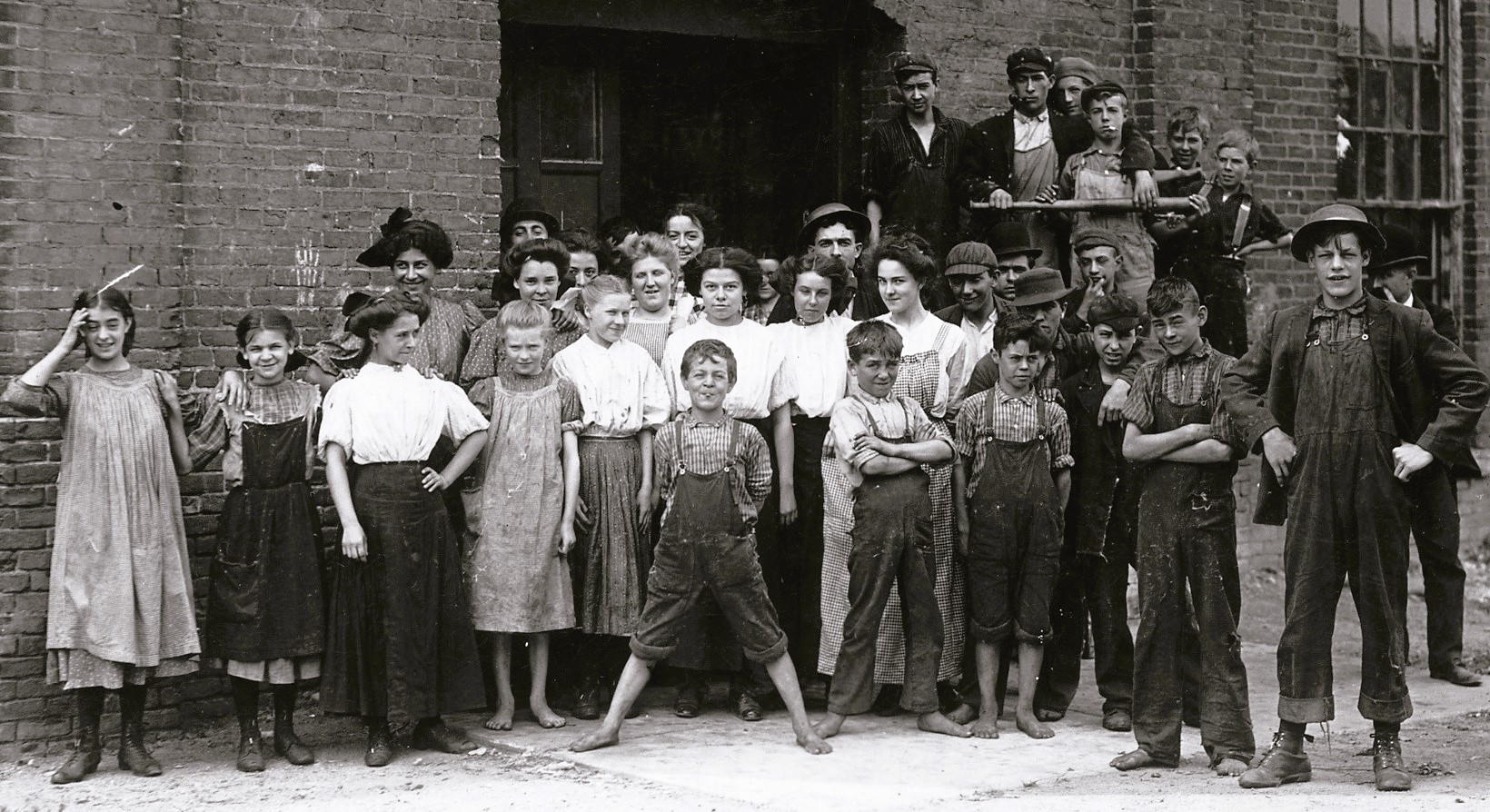
Currently plotting child labor’s return, capital is accumulated and profits made at the cost of (someones else’s) tiny hands and lost lives. A look at its historic practice in the U.S. and early, largely ignored, laws to curb it.
‘A Study in Child Labor’ by David Areinoff from Young Worker. Vol. 2 No 6. June, 1923.
Many years ago it was said, “Jesus called a little child unto him and said, ‘Whose shall offend one of these little children, it were better for him that a millstone were hanged about his neck, and that he were drowned in the depth of the sea.” For ages the great masters and philosophers of humanity have taught the sublime mission of childhood, the infinite potentialities of youth and a developed manhood. The child is the father of the man, and wide, unbounded prospects are before man; he can reach unto the skies and be the master of happiness, life and earth. Such are the functions of childhood the cultivation of all the faculties of man, mental, spiritual and physical.
Yet, one has but to make a superficial study to realize that the history of child labor is a unique record of horror and misery, a sordid and revolting tale of the enslavement of human flesh and soul at the altar of Mammon. Many books have been written on the subject, but to read the early factory reports in England or Paul Lafargue’s The Right to be Lazy, or Dunlop and Denman’s English Apprenticeship and Child Labor or Frederich Engels’ Condition of the Working Class in England is to realize the indescribably and unthinkable frightful history of juvenile labor in capitalism.
In America the history of child labor has gone the gamut of horror as in other countries. This modern Herod has been as unmerciful as his prototype 2,000 years ago. One needs the savage irony of Swift or Hugo to describe the history of child labor, the great industrial cancer, in this country. Emerson cried, “Give us worse cotton, but give us better men!” But the rising tide of industry did not follow this dictum, willy-nilly it flowed in the direction of profit and expansion. William L. Chenery, industrial editor of the New York Globe, tells a most interesting and instructive story of child labor in the United States in his recent book, Industry and Human Welfare. Industry, the methods of production and distribution of wealth has vital grips on life and determines the social structure of humanity.
Child labor did not begin with capitalism, but capitalism paved the way for an organized employment of child labor and higher profits. The children for the first time in history entered the giant automatic machines and went thru their mechanical notions. The levelling of skill and the destruction of labor inequalities provided the necessary background for the use of child workers, and capitalism reached into the home and placed the children into the factory. As Edwin W. De Leon has pointed out, “child labor grew out of the sordid desires of employers to secure labor at the lowest possible cost, regardless of the law of nature or the laws of man.”
The first cotton factory in America was established in Rhode Island in 1790 by Samuel Slater. By 1830, the beginning of the railway era, the system of industrial capitalism was firmly entrenched. Vast hordes of women and children left the home and entered the industrial world. In Slater’s mill the operators were exclusively children from seven to twelve years of age. The Committee on Manufactures in 1816 estimated that 24,000 boys under 17 and 66,000 women and girls were included in the total calculation of 100,000 operatives in cotton mills. No questions of health, fatigue, accident, morality, unemployment and education were asked; the mill owners were interested in profits and further production only. Their philosophy of life was wealth and they used children to acquire it. In Niles’ Weekly Register on October 5, 1816 the greedy mill promoter estimated that there were 317,000 unemployed children whose time could be spent in the textile mills grinding out cloth and profits. The capitalists of those days taught the Puritan principle that work was the mother of virtue, and they knew that it was a source of profit. In a petition sent to the Congress in 1815 (only property-holders voted then) it was said, that “more than eight-tenths of the persons employed in the manufactories in the U.S. are women and children by whom the latter are trained to industrious habits earlier than they would otherwise be.” Work (profit), not life, became the gospel of industrialism. The poverty and unemployment among the masses, “the Tartar hordes of our large cities,” as a governmental official referred to them in 1898 supplied the home stimuli to juvenile labor.
It was in Rhode Island, the place where the largest number of children toiled, that the first sign of revolt appeared. In 1818 the governor of that state pointed out, that children could not work and learn at the same time; that Rhode Island was a state where great ignorance and poor citizenry existed. In 1824 a resolution was introduced into the state legislature providing for the establishment of schools for the 2,500 children between the ages of 7 and 14 employed in Rhode Island factories, the employers to bear the expenses. The resolution failed. However, the children worked twelve and thirteen hours a day, and went untutored and unlettered through life. In 1842 Massachusetts passed the first school law, an epoch in the history of child labor, though the state did not provide adequate opportunities to do real studying. Moreover, there were frequent violations of the law and still children worked in the mills. In 1848 the children in Pittsburg, Pa., went out on strike, for a 10 hours day; during the strike riots, a number of girls were arrested, one of them, a child of 13 years, went to jail; thirteen were found guilty and fined. The strikers won the ten hour day, but lost 16 per cent of their wages. The states for a long time refused to deal with the evils of child labor, and allowed the nation’s childhood to be destroyed.
After the civil war, a determined effort was made to reduce child labor. The pleas were made in the name of education and of patriotism, and sometimes of humanity. Horace Mann, of the Massachusetts Board of Education, led a brave fight against juvenile labor in those early days. The business man fought all along the road and tried to stop legislation; how well they succeeded is seen by the present day conditions of child labor.
Childhood was sacrificed that profit might flow into the coffers of the industrial magnates.
The question of child labor has not been solved. The war, the unconstitutionality of the child labor law of 1919 and the census of 1920 have shown the extent to which child labor exists in this country and what its effect are. When 1,060,858 children (8,5% of all the children) from 10 to 15 years old are gainfully employed according to the 19120 census, when large number of children below 10 years of age are employed also, when the census itself, because of shifting the census date from April 15 to Jan. 1, 1920, shows only an apparent decrease, no one can say the child labor is a dead issue. It is a vital question, and concerns the entire proletariat.
The Southern states lead in the total amount of child labor, but a large proportion of their children pick cotton, as in Mississippi where one out of every four children in the state are in the cotton fields.
Twenty-one present of all the negro children in the United States are working in mills, factories and plantations. This is significant in view of the fact that the negro is the worst paid worker in the country. Poverty, fear of want, has always sent the children to the places of toil.
Of the 2,133 working children in New Bedford, Mass., from 10 to 15 years of age, 1,296 were employed in the cotton mills in 1920. In Fall River, Mass., out of a total of 2,660 children employed in all activities, 1,775 were at work in the cotton mills. The textile magnates were declaring enormous rates of profit at this time. Yet, Fibre and Fabric the textile journal in Boston, declared, “If the child labor reformers would definitely state what they propose to do with the children of laboring people, we could look upon this question from a different viewpoint. But prohibiting them from work is about as far as they go, and it seems immaterial if the boys become loafers and the girls prostitutes.” This in face of the fact that in Mass, in 1920 there were 1,691 reported industrial accidents to children under 16, of which 10 were fatal and 62 resulted in permanent partial disability and that a great number of child tubercular cases were traced directly to cotton mill work. This when in 1916-17 there were in Mass. 1,416 industrial accidents to children under 16 years of age, of which 7 were fatal and in the following year it increased to 1,730 with 5 fatalities. From 2 to 3 times as many accidents occur to boys and girls under 16 working about dangerous machines as to adults.
There is also an intimate connection between child labor and illiteracy. According to the 1920 census there are 4,931,905 (6%) illiterates in the U.S., of which 3,084,733 (82%) are native born. Included in the 13 states having the largest percentage of child labor are 11 of the 13 states having the largest percentage of illiteracy. Moreover, the proportion of foreign born population in the U. S. is 14.7%, the average foreign born population in the 16 most illiterate states is only 2.9%, with the Southern states having the smallest foreign born population. As Scott Nearing said, “Cotton and ignorance go together.” Also only 7% of all the children in the U.S. who enter the public schools graduate from our high schools, while 17.8% of the children of school age are not enrolled in any school, according to the U.S. Bureau of Education. The children are too busy working. In New York City 49,291 children secured work permits in 1920.
The war showed America the actual facts about child labor and military service. The Boer War shocked England, as much as the World War statistics shocked America. Twenty-nine percent of the men in the first draft were rejected by the local board as physically unfit. In Pennsylvania, the percentage was 55, John A. Ladd, a noted publicist, says that this high rate was due to Pennsylvania’s not having had a adequate child-labor law for some 25 years, reports the National Child Labor Committee. One Southern town (with a great number of child mill hands) had 60% of its men physically unfit for military service in the first draft. Furthermore, ten per cent of the first 2,000,000 men drafted during the war could not read their orders or understand them when delivered, or read the letter sent them from home, according to Owen R. Lovejoy.
In 1921 in an investigation made by the Maryland Bureau of Statistics and Information in Baltimore of 100 boys who averaged 15 years of age and who have been employed in factories for an average of 2 years each, it was found that their average height was nearly 1/2 inch lower than the standard for 15 years of 5 ft. 1 in., their weight was nearly 92.53/100 lbs. as again.st a normal weight average of 106% lbs. and 58% were of public age. In the near future America will have a replica of the famous English “bantam regiments.”
This is the history of child labor in America; it is a record of greed and inhumanity. The proletariat is no longer docile; it is beginning to feel its power and its strength. Here and there solitary fires are springing up and when they meet a great conflagration will result and momentous deeds will be done. The shackless and trammels of capitalism will be burst asunder and man will stand forth free.
The Young Worker was produced by the Young Workers League of America beginning in 1922. The name of the Workers Party youth league followed the name of the adult party, changing to the Young Workers (Communist) League when the Workers Party became the Workers (Communist) Party in 1926. The journal was published monthly in Chicago and continued until 1927. Editors included Oliver Carlson, Martin Abern, Max Schachtman, Nat Kaplan, and Harry Gannes.
PDF of full issue:
 Revolution's Newsstand