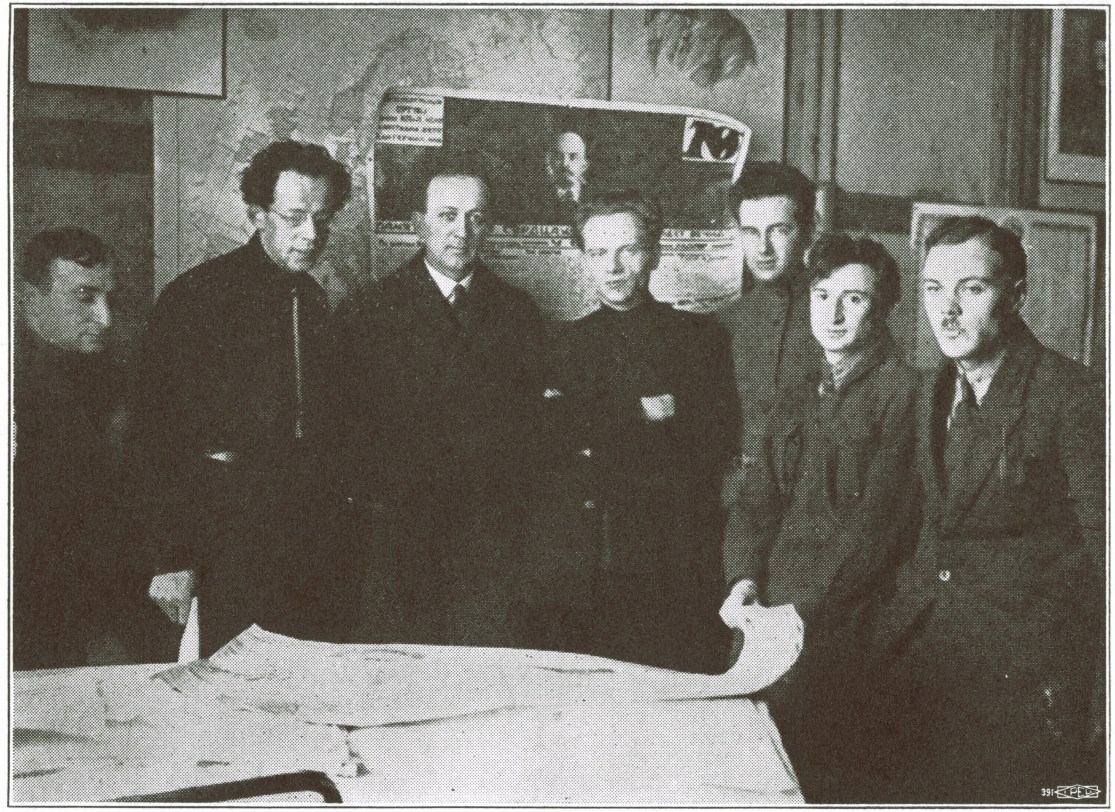
The working class must have our own media. The immense possibilities newly opened for a working class with power, with many such remarkable projects in the first years of the Soviet experience. William Z. Foster reports on his visit to the editorial offices of ‘Gudok’ (‘The Whistle’), exemplary daily newspaper of the Soviet railway workers union.
‘Gudok’ by William Z. Foster from The Workers Monthly. Vol. 4 No. 7. May, 1925.
WHEN the Communist Party came into control in Russia, upon overthrowing the reactionary Kerensky regime, one of the tasks that it saw clearly before it in laying the foundations for a real workers’ society was that of building a system of proletarian journalism. Tremendous strides have been made in this direction, and many new methods have been worked out which are of the utmost importance to the working class of the world.
Among the many splendid proletarian journals that have been developed since the revolution, the Gudok (The Whistle) takes high place. This daily paper is the official organ of the railroad workers. The union, which is industrial in character and numbers 815,000 members, has various other publications, including a Siberian daily with 22,000 circulation, and several monthly and semi-monthly journals. But its pride is the Gudok which ranks along with the Pravda and Isvestia as the greatest papers in Russia. Its circulation is 274,000 daily and it is constantly rising. That of the Pravda is 600,000 and the Isvestia about the same.
The Gudok was founded in 1920. At first it was subsidized by the government and issued free of cost to the subscribers. Its circulation was about 25,000. It ran up to 75,000 in 1921, but with the introduction of the New Economic Policy, when the Gudok, like so many other institutions, was put on a self-sustaining basis and the subscribers had to pay for it, its circulation dropped off about 50%. But since then it has rapidly picked up until it has reached its present gigantic figure. It is steadily extending its mass of readers, who are found not only among railroad workers, but in the ranks of the working class generally. Last year it produced a financial surplus after paying all expenses.
The Gudok is one of the most popular papers in Russia. Its organization, both in respect to the make-up of the paper itself and its connections with the masses, is magnificent. Labor papers of the world, especially dailies, would do well to adapt themselves, so far as is practicable under capitalism, to its revolutionary methods. The paper is not a mere trade union paper, though it is issued by the railroad workers’ union. Its scope of activity covers the wide world of economics and politics. It informs the workers of the greatest political events and problems of the world, and it also digs down deep into the everyday life that they live.
The paper is thoroughly departmentalized. Ordinarily it has six pages, except once a week when it has a special double page in the Ukrainian language. Each of the pages is devoted to certain specific subjects. It will be well for us to glance at them briefly. The first page is devoted to news of the general social and political life of Russia and the world at large. The items are brief and to the point. The yellow journalism of capitalist papers finds absolutely no place in the Gudok. Page two is devoted to special articles on the general political situation, economic life, and Party affairs. This might be called the intellectual page of the paper, using the term intellectual in a strictly proletarian sense. Many of the most brilliant Russian writers contribute to it constantly. There is also a splendid staff of foreign correspondents, 15 in number, who contribute on an average 60 articles per month dealing with every phase of world development.
Page three is devoted primarily to the trade problems of the railroad workers. These are handled in the most simple manner. This page is a very popular one. Like the others, this page is conducted as a distinct department. Page four is one in which the most strikingly revolutionary feature of proletarian Russian journalism comes to the fore. It is the page of the Workers Correspondents, or “Rabkor”. Here is where the voice of the workers is heard on their daily life and problems. The Gudok has 10,000 of such correspondents, and letters come pouring in from them at the rate of 400-600 daily. They cover every imaginable subject. They are boiled down and re-stated briefly. They are the life blood of the Gudok, and as we shall see further along, are of great political importance. Such of them as are used are paid for.
Page five is another “Rabkor” page. Its special feature is to deal with the economic problems of the industry, with the actual running of the railroads. From all over Russia the workers pour in their suggestions as to how improvements can be made. Problems are posed on this page and the workers are asked to give their solutions for them. Valuable suggestions constantly come in. Sometimes these are of the very greatest importance. The technical experts of the industry watch this page closely. It is the mass of the railroad workers taking an actual part in the technical direction and development of the railroad and they have much of value to contribute.
Page six is the most famous page of the Gudok. This is the page which the editors say is the real making of the paper. It is another “Rabkor” page and it is based upon the mighty flood of letters that constantly pours in from the workers in the shops and on the roads. It is the so-called “Life Page.” It is devoted to criticism. In this criticism the sky is the limit. All that is necessary is that it be true. Here all the worst features of the railroaders’ life are brought forth. It is the sensation page of the Gudok. If there is a tyrannical foreman he is bound sooner or later to see his name in the Gudok and to have his conduct condemned. If he is a Communist who by his conduct fails to lend credit to the Party he will be called to order by a “Rabkor” in the Gudok. If he is an old time specialist who is still inclined to sabot- age the operation on the railroads his actions will soon see the light of day in the Gudok. If he is an engineer who takes more liquor than is good for him a fellow worker will check him up in the Gudok. about it. In fact every abuse on the whole railroad system, no matter from what source it comes, is criticized scathingly by the workers in their beloved paper. The effect of such criticism is tremendous in eliminating sabotage and petty tyranny of all sorts. Many of the letters which contain criticism of importance or of a humorous character are turned over to expert writers who play them up in cartoons, poems, jokes, articles, and every conceivable way to make them readable and effective. The workers are intensely interested in the “Rabkor” system in general, but they follow the “Life Page” of the Gudok with special avidity.
The “Rabkor” system is not only the foundation of modern Russian newspapers—the Pravda, and other leading papers also use it to a greater or lesser extent—but it also has profound political significance. It is one of the many marvelous institutions that the Russian Communist Party has developed to sink its roots deep into the masses of the proletariat. Through the “Rabkor” system the masses hitherto voiceless, give some degree of expression to the deep social currents that are surging among them. All the Russian leaders follow carefully the workers’ letters in the newspapers. These show them what the masses are actually thinking and feeling. Often they get the most valuable leads to political policies. The “Rabkor” system is also playing a highly important part in raising the efficiency of Russian industry. The valuable suggestions of the workers and the feeling of responsibility for the operation of the industries which the “Rabkor” gives them, has done marvels for increasing production. And the merciless exposure of sabotagers by the workers’ correspondents has been decisively effective in eliminating these pests from Russian industry. It is a bold individual indeed, who, surrounded by workers who will “write him up” if he goes wrong, dares to venture upon a campaign of sabotage. Within recent months, realizing the Nemesis-like character of the “Rabkor” system, counter-revolutionary elements have embarked upon a campaign of murdering workers’ correspondents who have either exposed them or are likely to do so. A number of such cases have been reported especially from the villages. The “Rabkor” system connects up the masses with the newspapers and enables the Communist Party to bring its message all the more forcefully to them. It is a great connecting organ between the Communist Party and the masses, through which the Party receives vitally necessary impulses from the proletarian masses, and through which it communicates to them its own revolutionary spirit and intelligence.
The editors of the Gudok, like the leaders of the Russian Party in general, are keenly aware of the tremendous importance of the “Rabkor” system and they spare no effort to develop it. In January of this year the Gudok held a national convention of its “Rabkors”. There were 321 delegates. They came from the “Rabkor” committees, which exist at all the 208 division points on the 28 railways of Russia. Some came all the way from Siberia. All the railroads are covered with the network of committees, which bring the paper to the masses most effectively. The convention elaborated plans for the still further extension of the “Rabkor” system in all its ramifications and to make the Gudok more than ever the real mirror of the aspirations and experiences of the railroad workers. Elaborate charts were presented the convention showing the rapid development of the Gudok and the “Rabkor” system which is its foundation. By the end of 1924 there were 5870 intermittent and 4423 regular correspondents. The most careful analyses are made of the make-up of these correspondents from the stand- point of age, sex, occupation, Party membership, etc.
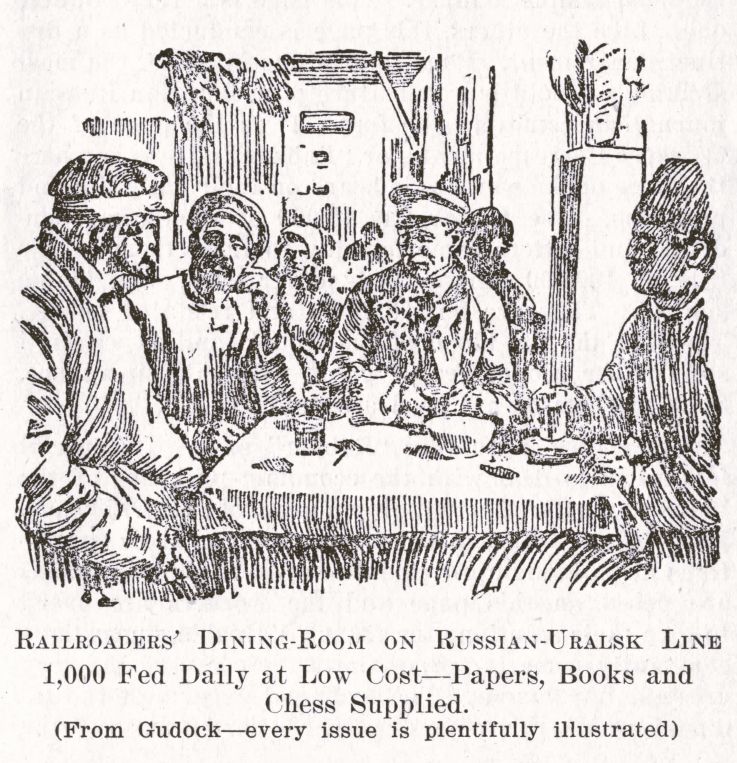
A feature of the workers’ journalism which is common in all industries but especially well-developed among the railroad workers are the wall papers. These are big poster-like affairs containing articles, designs, cartoons, etc., made up by the workers and posted on the shop walls. Many of them are extremely beautiful. The workers are intensely interested in them. They deal with the immediate problems of the factories and the news of the workers’ lives. On the railroads there are 2000 of such wall papers regularly appearing. At the convention of the “Rabkors” prizes were offered for the best specimens of these wall papers. An interesting one was composed by adult workers just learning to read and write. The simple messages composed by these workers just emerging from the darkness of illiteracy were touchingly beautiful.
The Russian railroad workers are very proud of the Gudok. And well they may be. It is a magnificent specimen of proletarian journalism, and it is just entering upon an era of much wider development and effectiveness. It is a type which the workers of the world can well study. When it is compared with the pitiful sheets gotten out by the American railroad unions, it stands out as a mountain against a lot of molehills. Speed the day when the railroad men of all countries will be equipped with as splendid intellectual weapons as the Russian Gudok.
The Workers Monthly began publishing in 1924 as a merger of the ‘Liberator’, the Trade Union Educational League magazine ‘Labor Herald’, and Friends of Soviet Russia’s monthly ‘Soviet Russia Pictorial’ as an explicitly Party publication. In 1927 Workers Monthly ceased and the Communist Party began publishing The Communist as its theoretical magazine. Editors included Earl Browder and Max Bedacht as the magazine continued the Liberator’s use of graphics and art.
PDF of full issue: https://www.marxists.org/history/usa/culture/pubs/wm/highres/v4n07-may-1925-6-gra-WM.pdf
 Revolution's Newsstand