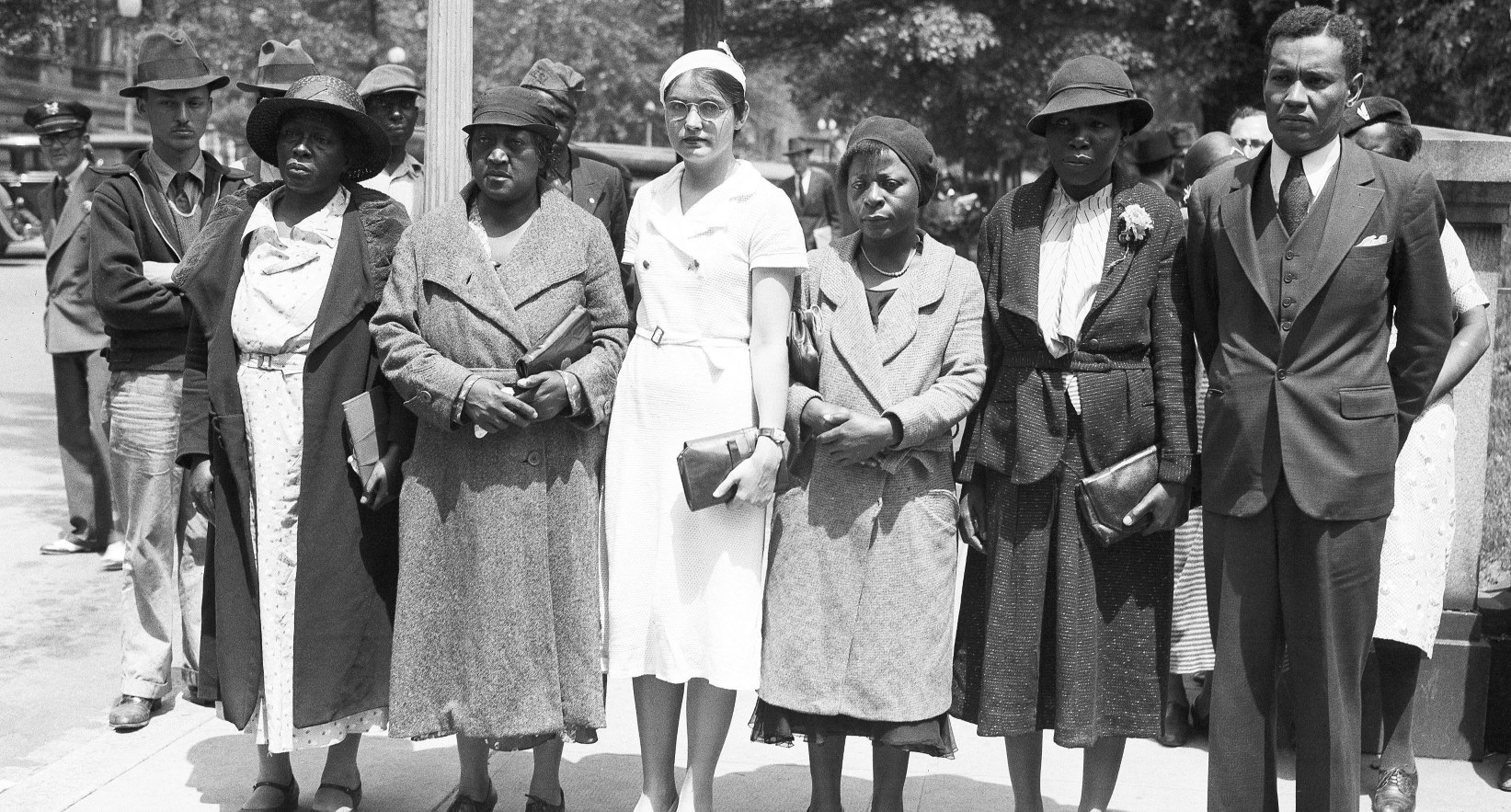
Spector on the experiences, positive and negative, of organizing an I.L.D. tour of Ruby Bates, Mother Patterson, and Richard Moore in defense of the Scottsboro accused, with suggestions for future campaigns.
‘How We Organize a Scottsboro Tour’ by Frank Spector from Labor Defender. Vol. 9 No. 7. July, 1933.
The first portion of the Mrs. Patterson-Ruby Bates-Richard Moore tour showed the scope of interest and response of the masses to the Scottsboro campaign as led by the I.L.D. There was an average attendance of 1400 black and white people in the 14 cities along the Eastern seaboard that comprised the first portion of the tour. For example, Atlantic City had an attendance of 3000, Hartford, Connecticut, 1400, Boston, Massachusetts, 1200, Trenton, New Jersey, 2500, Jersey City, 1400. In some of these cities such an attendance has never been equaled in the past. This remarkable response reveals to us the mounting possibilities for building a mass I.L.D.
Shortcomings of the Meetings: The meetings held revealed at the same time crying weaknesses that must be brought to the attention of all the members of the I.L.D. so that we may eliminate them. Were the preparations of a better sort, doubtless the attendance would have been even greater. Unfortunately the preparations for the meetings as well as the meetings themselves contained weaknesses that on the one hand prevented a still larger attendance, and on the other hand were responsible for unsatisfactory organizational results.
There was no close connection between the local defense issues growing out of the daily struggles of the black and white workers for bread and for Negro and democratic rights and the Scottsboro and Mooney issues which embody these struggles on a national scale.
Not enough efforts were made to bring larger numbers of white workers into these meetings. (30% was the average.) The work of recruiting new members was very poor. In some meetings there was a complete absence of application cards, a most unpardonable neglect, showing the failure to understand that besides the agitational purposes such meetings have, they must result in recruitment of new workers and the building of the I.L.D. as well. The floor committees at some meetings were untrained in their simple duties. There was poor coordination between the platform and these committees. This brought poor results in the sale of literature, signing of membership cards, making the collection, and generally undermining the prestige of the I.L.D. as a working class organization that knows how to work systematically and fruitfully.
There would have been better financial results were it not for the timidity of the comrades towards charging an admission fee, for fear that “workers will not pay.” There was also the failure to visit organizations and churches in advance of the meetings to procure financial support to help cover the expenses of the meetings.
Overcome Weaknesses: In the second portion of the tour now in progress, Lester Carter, the white boy defense witness in the Decatur trial, is replacing Ruby Bates because of her physical inability to stand the rigors of the tour. Mrs. Jannie Patterson, Richard Moore and Carter make up a combination which brings out all the dramatic features of the Scottsboro case the mother of the framed Negro boy condemned to die, the Southern white worker whose role in the case smashes the race barriers built up by the boss class, and Richard Moore, a brilliant, powerful Negro speaker who electrifies the masses by his eloquent presentation of the Scottsboro issue.
The tour may be extended clear out to the Pacific Coast and before us now lies the task of making it a most beneficial one, both agitationally and organizationally. The following are points that must be stressed in making preparations for these meetings:
Publicity and Propaganda: Capitalist and Negro and working class press must be fully utilized for publicity. Free radio announcements and ten to fifteen minute talks can be easily procured. Every inexpensive but effective means of advertising should be devised and utilized. For example: sandwich signs announcing the meeting, a truck or two carrying large signs stating in bold letters the place, the time and purpose of the meeting. On one of these a replica electric chair can be cheaply constructed. A Negro boy impersonating a Scottsboro boy in the chair, with slogans displayed, calling upon black and white to save the boys, is a real attraction for people on the streets. Street corner meetings must positively be held in working class neighborhoods, during the entire week preceding the meeting. Posters must be prominently displayed, leaflets well distributed from house to house, at shop and factory gates, churches, lodges, etc.
Local Issues: There should be a local speaker for about ten minutes at each meeting, connecting local class struggles with Scottsboro, Tom Mooney, deportation, fascist terror. Churches, lodges, unions, should be visited, ask for contributions to help pay the expenses, and their delegations invited to sit on the stage during meetings.
Conduct of Meetings: Floor committees should be trained in advance for the work of the meeting. They should have an ample supply of application cards and literature. Collections must be made systematically and rapidly in plates of empty cigar boxes prepared in advance. The chairman should speak very briefly. Upon him lies the main responsibility for the proper conduct of the meeting. His introductions of the speakers must be brief, his announcements of the literature on sale must be brief and effective. I.L.D. pamphlets, Labor Defenders announced by the chairman must be sold to the audience direct, following the announcement of the chairman. Application blanks should be mimeographed in advance and copies supplied to each person as he enters the hall. Following the appeal for membership in the I.L.D. by the speaker, a committee should quickly furnish pencils to those who need them and assist people in filling in the blanks. The amount of the collection and the number of blanks turned in should be announced by the chairman before the meeting is over.
Space does not permit us to go into many important details. Write to the N.O. about any questions you have.
Labor Defender was published monthly from 1926 until 1937 by the International Labor Defense (ILD), a Workers Party of America, and later Communist Party-led, non-partisan defense organization founded by James Cannon and William Haywood while in Moscow, 1925 to support prisoners of the class war, victims of racism and imperialism, and the struggle against fascism. It included, poetry, letters from prisoners, and was heavily illustrated with photos, images, and cartoons. Labor Defender was the central organ of the Scottsboro and Sacco and Vanzetti defense campaigns. Editors included T. J. O’ Flaherty, Max Shactman, Karl Reeve, J. Louis Engdahl, William L. Patterson, Sasha Small, and Sender Garlin.
PDF of full issue: https://www.marxists.org/history/usa/pubs/labordefender/1933/v09n07-jul-1933-lab-def.pdf
 Revolution's Newsstand