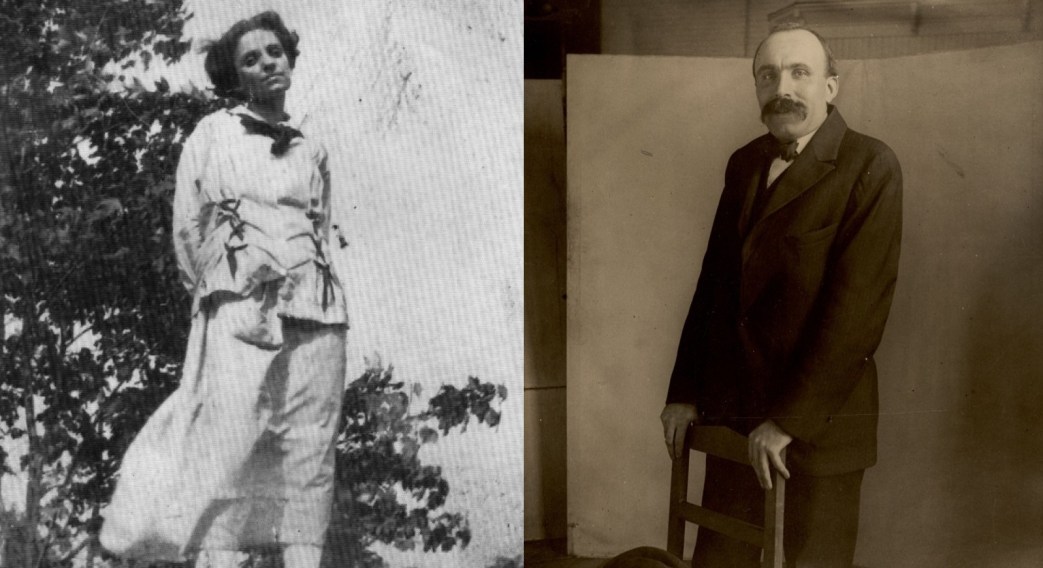
Matilda Robbins movingly writes of seeing Bartolomeo Vanzetti in prison for the first time in three years.
‘One of Our Prisons’ by Mathilda Robbins from The Daily Worker. Vol. 2 No. 99. July 14, 1924.
We waited. The high ceilinged room with iron bars for walls, thru which could be seen the stone stairs leading to tiers of cells, was the prison reception hall. It was June outside, but here the stone floor and the cold stale air coming up thru the grated walls chilled. Keys clanked. Doors opened and shut. Huge doors that were portions of the walls. They were opened by a guard whose sole duty seemed to be the opening and shutting of these doors. Opening and shutting of prison doors. He clanked his keys. They were the only doors. His face was expressionless. The guard at the table in the center of the dim gray hall looked neither to the left nor right of him. He sat rigid, looking straight ahead of him. Into the depths he seemed to look thru the grated wall.
Doors opened and shut. Keys clanked. Children came to see their fathers. Mothers their sons. Wives their husbands. A young prisoner was smiling up at his sweetheart. Looking up into her eyes ingratiatingly. His own eyes were feverish. There were deep marks around them of sleepless nights and torment.
The west wing door opened and shut. The guard shook his keys and stepped aside.
Vanzetti! He came toward us with a quick springy step, his figure taut, his wonderful smile falling upon us like a pale ray of sunlight He shook hands with us: “I am so pleased to see you, comrades!” How soft and vibrant his voice! How his sensitive mouth quivered under his drooping mustache.
I had not seen him in three years. Not since that scorching day in July, 1921, when I saw him and his fellow victim Sacco, in the steel cage in a Massachusetts courtroom. He leaned intently forward, his soft gray eyes full of questioning and of sorrow, while about him was being cast a net of lies upon which the commonwealth built up its. case and found him and Sacco guilty of murder. There was a light in those gray eyes then that could not be extinguished. Four years of the dim cell in the west wing have failed to extinguish it.
We talked. It was hard for me to bring the words up out of my throat. They got mixed up with the tears welling up in it and hurt with their throbbing. Vanzetti has a soft, melodious voice, but charged with the passionate appeal of the dreamer and the social rebel. Except for his comment that his ill ventilated cell hurts his lungs and that he cannot see the sky from the prison workshop where he makes automobile plates, he did not refer to himself again. But he repeated twice that he could not see the sky. He wanted so to see the blue sky!
How eager he was for news of the workers’ movement! How those soft eyes would light up with hope of labor’s triumph; how sadden at labor’s defeats!
Vanzetti has learned English during his four years of prison. He speaks it with the precision of a foreigner acquiring a new tongue. But he invests it with a charm of liquid inflection with which his own Italian tongue is so exquisitely beautiful. When he spoke to his two Italian friends who were with me, it was like music that rose and vibrated thru the prison catacomb. His smile was like a benediction. His eloquent hands play upon the heart.
“You have many friends everywhere,” I said to him, “friends who love you and will continue to work for your liberation.”
I shall always remember the wonderful light of gratitude that came into his eyes as he said, “Ah, I know, I feel. That is why I am still living.”
Still living! This noble soul, this generous heart, this dreamer of human brotherhood and beauty still living under the shadow of the electric chair! There was the night when 20,000 volts of lightning snuffed out the life of one man! What a night of horror! He lies awake thinking of the men killed and the men that kill.
Passionate apostle of freedom and of service to mankind; rebel against a world where men maim their fellow-men in the name of the law; where justice is in the hands of men who cannot hear, who cannot see, who cannot understand the spirit of Vanzetti.
The jailor brought a little piece of yellow paper and slipped it into Vanzetti’s hand. He clutched it. Under his mustache he bit his lips. The prison clock struck four. The visit was at an end. I held his hand for a moment and quickly turned away. Doors were opening and shutting. Keys clanked. I looked back. With head high and quick step Vanzetti was walking thru the grated wall of the west wing.
The Daily Worker began in 1924 and was published in New York City by the Communist Party US and its predecessor organizations. Among the most long-lasting and important left publications in US history, it had a circulation of 35,000 at its peak. The Daily Worker came from The Ohio Socialist, published by the Left Wing-dominated Socialist Party of Ohio in Cleveland from 1917 to November 1919, when it became became The Toiler, paper of the Communist Labor Party. In December 1921 the above-ground Workers Party of America merged the Toiler with the paper Workers Council to found The Worker, which became The Daily Worker beginning January 13, 1924.
PDF of issue: https://www.marxists.org/history/usa/pubs/dailyworker/1924/v02a-n099-jul-14-1924-DW-LOC.pdf
 Revolution's Newsstand