
From shortly before 1924’s peasant uprisings, below are important documents from the Balkan Left; the Declaration of the Communist Party of Roumania, The General Situation in Roumania, The National Question in Roumania, and The Agrarian Question in Roumania .The Balkan Communist Federation began as the the Balkan Social Democratic Federation in 1910, was renamed the Balkan Revolutionary Social Democratic Federation in 1915, and finally named the Balkan Communist Federation 1920. The Seventh Congress was held in Moscow during July, 1924 after the reactionary coup in Bulgaria and the Romania C.P. was outlawed and attended by the Communist Parties of Greece, Yugoslavia, Roumania, and Bulgaria.
Romania at the Seventh Balkan Communist Federation Congress from International Press Correspondence. Vol. Vol. 4 Nos. 26, 27 & 29. April 24, May 1 & 15, 1924.
The C.P. of Roumania to the Organizations of the Workers and Peasants of the World
(*This manifesto was drawn up before the proclamation of martial law and the prohibition of “Socialismul”.)
To all Workers and Peasants!
Comrades!
The reaction of the oligarchy which rules Roumania forces us to turn to you in the moment of the greatest danger for the working class of our land. The first manifesto which we sent to you was confiscated by the ochrana and the military authorities, for it is a crime in Roumania to proclaim loudly to the world the misdeeds of our rulers, and their hateful murderous attacks against the oppressed classes of Roumania society. We have once more received the opportunity to commit this crime and appeal once more to you, comrades of all lands.
Roumania is the booty of an oligarchy of financiers and country squires who rule with force, terror and disregard for every principle of law and bourgeois legality. The oligarchic government which is not even recognized by the bourgeois opposition of the country who declare that they do not recognise the legislation of the government as having legal force keeps itself in power only by these means. But even that is no longer enough. Now, having sent the king and parliament into every land that will let them in, the government has proclaimed an increased state of siege in order to prolong its existence a few months more.
The white terror is now about to make its policy more severe. The persecution of the trade unions will increase although they are now persecuted and hindered with force and red tape from making any complaint even to the League of Nations. The merciless oppression and suppression of the peasant class to a mediaeval slavery will be continued. The wild oppression of the minority languages of the annexed territories which goes as far as assasination will hold new orgies. But the highest points will be reached by the attacks upon the Communist Party. The Communist press is practically prevented by the arbitrary measures of the government. Party meetings and open meetings are long since prohibited. The arrests, maltreatments and even numerous coward assassinations have become a regular habit of the government.
However, before it falls our government wishes to go itself one better. New arrests are taking place. As the Communist Party was the only one that had the courage to stand for demand the right of self-determination which was demanded by the minorities, the oligarchic government this government which has sold the wealth of the nation to the capitalists of all lands and which has renounced the independence of the country for the benefit of the great imperialist states has charged our party with high treason and is preparing to destroy the whole legal existence of the labour movement in the land. The Communist Party of Roumania is collecting into one volume, which will soon be published, all the documents which prove the shameful acts, the assassinations etc. which have been committed by the Roumanian oligarchy against the people.
The working and peasant people of Roumania are certain as they have applied to you, comrades of all lands, that you will be ready to prove by deeds your will to stand by your oppressed brothers.
Long live international solidarity.
Down with the reactionary oligarchy of Roumania.
The Central Committee of the Communist Party of Roumania.
The General Situation in Roumania.
The Sixth Conference of the Balkan Communist Federation states that:
1. The economic crisis which condemns Roumanian production to gradual extinction, cannot be surmounted by the oligarchy of bankers and big proprietors in power. The fear of losing their profits forces this oligarchy to deliver the country up to Entente capital, and thus to subject the proletariat and peasantry to a doubled exploitation. In order to execute this plan, the financial oligarchy is bound to unite with the industrial and commercial bourgeoisie, to cede a share of its booty, and form a united front of the bourgeoisie against the labouring masses of workers and peasants.
2. From the political point of view, the Roumanian government will thereby become a willing vassal of the imperialist capital of the Entente, and will oppose with all its force the movement of the Balkan proletariat as well as the Union of the Soviet Socialist Republics.
The attitude of the Roumanian government with regard to the revolutionary emancipatory struggle of the Bulgarian peasants and workers, and the huge loans realized by the government for the increase of an army already too big, are proofs of the enslavement of the country to the Entente, and show the reactionary and aggressive role which Roumania is destined to play. The dealings of the Roumania bourgeoisie with Entente Capital amount to treason, as they make for the annihilation of the political independence of the country and proclaim the readiness of the bourgeoisie to defend its interests even at the price of the blood and misery of the labouring and middle classes of Roumania.
3. The economic crisis has become more acute recently, parallel with the increase in the degree of class exploitation and class antagonism The offensive of Capital, in spite of the defensive campaign of the broadest strata of the working class, has made great headway. Every where the real wage of the workers has fallen to two thirds, and even less, of what it was last year. A general offensive has been taken up against the eight hour day, and in spite of desperate resistance on the part of men and women workers, has been crowned with success. But these defensive struggles have closed the ranks of the proletariat and strengthened the trade unions. The purely trade union struggle proves itself more and more insufficient. The Social Democratic Party, which shows by its policy that it is lacking the will to fight for the interest of the broad working masses, is helping by its policy of disruption to prevent the organisatory as well as the political strengthening of the workers movement. The working class is also detaching itself more and more from the policy of compromise of the Social Democratic Party.
Based upon this policy of the Social Democratic Party, the liberal government of the financial and territorial oligarchy is trying to hamper the workers campaign by systematic organized repression. The state of siege, the suspension of all civil liberties, the ruthless application of anti-strike and trade unions laws, and Courts Martial, characterise the anti-workers’ policy of the Roumanian government.
4. The burden of taxation and high prices and the pitiless repression does not only affect the actual proletariat, it threatens more and more the life of the whole of the non-capitalist population.
The middle-classes, the petty-bourgeoisie officials, the liberal professions etc. sink still more rapidly than the working class into material and moral misery. With the growth of this misery, these sections ore goaded on to struggle and to organise. A multiple-headed fascist movement is seen to flourish rapidly in the country, the leadership of which rests, nevertheless, in general in the hands of different bourgeoisie cliques, which play off the diverse tendencies against the national minorities and against the militant working class as well as against another. Simultaneously with the setting up of its united front, the Roumanian bourgeoisie is also striving to bring about the united of Fascism.
The non-Fascist elements of the middle-classes of the country are trying to form organizations directed against the bourgeois parties in power, as for example the Tenants Organization and the “Citizens League of Officials”. This movement is also coming into collision with the resolute and clever resistance of the government.
5. In view of the composition of the Roumanian population and the purely agrarian character of the production of the country, the peasants remain the principal object of capitalist and feudal exploitation. Bourgeois economists assert that the condition of the Roumanian peasants, in spite of a partial distribution of the land, is far from reaching its former standard, although before the Russian revolution the misery of the Roumanian peasants was unprecedented, and had already roused revolts followed by bloody repressions. By the methodical fixing of the price of bread and the exportation of cereals, by taxation and service etc., the government renders this misery intolerable. By a well organized terror, it seeks to make these rebellious peasants tractable.
In the countries newly annexed, the oppression increases beyond all measure and takes on national forms. Entire provinces are placed outside the law; executions without any conviction are the order of the day. This oppression extends over the whole of the conquered population, is carried on under the form of cultural and religious intolerance, extends everywhere the economic yoke of the bourgeoisie of original Roumania upon the workers and middle classes, and even upon certain elements of the bourgeoisie of the newly acquired regions.
The great majority of the peasants are still unorganized, either politically or economically, and remain partially under the influence of the bourgeois parties; but the outward conditions inevitably force the peasantry towards the struggle. Nevertheless, the action of the peasants cannot play any decisive role, because the best organized rural party, the Peasant Party, by reason of its alliance with the land owners, by reason of its indecision and lack of principles, as well as by reason of its repeated coalitions with the bourgeois parties, is exclusively a parliamentary party, incapable of conducting a ruthless class struggle against the bourgeoisie and by land owners.
Likewise the national action of the peasant masses and of the petty-bourgeoisie of the conquered provinces fails because of the systematic betrayal of their own bourgeoisie and of the big land-owning class.
6. The constant increase of the misery and oppression of the working class, of the peasants, of the nationalities and of the middle-classes has sharpened the struggle of the masses against the bourgeoisie; but the activities of the various elements of the population remain dispersed and, in consequence of hesitating or treacherous leadership achieve no result. The role of the Communist Party is to place itself resolutely at the head of the class struggle against the bourgeoisie. The Party must show to the masses the only way out of their situation; a united front in the struggle, vanquishment of the bourgeoisie and a workers’ and peasants’ government as the first step towards the dictatorship of the working classes.
7. In pursuit of this aim the C.P. of Roumania must:
a) promote the union of the working class in the struggle against the bourgeoisie, strive to re-establish the unity of the trade union movement, strengthen the revolutionary elements in the trade unions. From the political standpoint: the Party must unweariedly conduct a united front policy against the Social Democratic Party, unite in action the sections of the working class still influenced by the Social Democratics, with the revolutionary mass and seek to draw in the broad masses of the industrially and politically unorganized;
b) adapt and strengthen its organization in order to get into touch with the working class at its places of work;
c) destroy the barriers which the government has set up between the town and country, extend the party organizations into the country, convince the peasants, by adopting a very clear political attitude, of the necessity of a united front of urban and rural workers, develop the activity of the peasantry to its fullest extent, achieve the participation of the Peasant Party itself in the struggle;
d) conduct an energetic propaganda and agitation, in order to show the broad masses that the C.P. is really a vanguard fighting in the interests of the great majority of the population.
e) realize the united front of the workers, peasants, exploited middle classes and oppressed nationalities:
against the ever more threatening danger of war; against Fascism;
against the strangulation policy of the dominant class (increase in cost of living, taxes, housing, social assistance);
against the political oppression through the state of siege; against the reactionary government which is betraying the country;
for the liberation of the workers and peasants of Roumania from the yoke of the Entente;
for the liberation of the peoples oppressed by the Roumanian bourgeoisie through the peace treaties;
for the liberation of the peasants, workers and poor middle-class from the intolerable yoke of capitalist exploitation;
for the Workers’ and Peasants’ Government of Roumania; for the Federation of the Workers’ and Peasants’ Republics of the countries of the Balkans and of the Danube.
The National Question in Roumania.
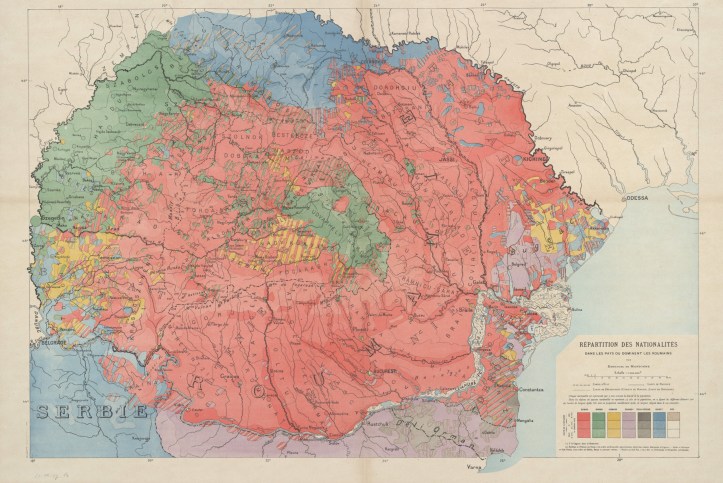
Capitalist Roumania is among those states which have increased in consequence of the imperialist world war. By the “re-union of all the Roumanians”, it has subdued important national minorities, which have a superior political, economic and cultural development. The various nationalities of Great Roumania, in spite of the “guarantees” specified in various peace treaties, are cruelly oppressed by the feudal Roumanian oligarchy. The desperate efforts which have been made by the national minorities of the country to ameliorate their economic, political and cultural condition, have failed up to now because of the treason of their own bourgeoisie and of the political and military terror exercised by the dominant class in Roumania.
The Great Roumanian bourgeoisie which unscrupulously delivers the “unified and liberated Fatherland” up to the Entente capital, at the same time robs the masses of the national minorities of their most elementary rights and deprives them of all possibility of economic, political and cultural development. Among the nationalities in Roumania, only the Germans and the Hungarians (Magyars) have their own political parties, but being under the leadership of the magnates and capitalists of these parties, they are incapable of defending the true interests of these nationalities.
The scandalous oppression of the nationalities from the economic and political point of view explains the resistance of the great popular masses of these nationalities to Pan-Roumanian Capitalism. The labouring classes, workers and peasants of Bessarabia, who experienced the Russian revolution in its first stage and who groan under the Roumanian military dictatorship, every day express their firm national-revolutionary desire to unite with the Union of the Socialist Soviet Republics, thus assuring their future development and guaranteeing their vital interests against all oppression. The Hungarian and German masses of workers and peasants of Transylvania, the German and Ukrainian working population of Bukovina and of the Cadrilaters are suffering not less. The strangling policy of the Roumanian bourgeoisie creates an intolerable situation, drives them to exile, doubles their misery and forces them to regress economically, politically and culturally. The nationalities of Transsylvania, of Dobrudja and of Bukovina are therefore struggling to win back the right to decide their own fate at the cost of heroic sacrifices not inferior to those of Bessarabia.
In view of these separatist movements of the various nationalities of Roumania, the C.P. of Roumania has the following duties:
1. To expose in its daily agitation and propaganda the anti-national character of the dominant Roumanian bourgeoisie, the treason of the Hungarian magnates, of the German manufacturers, of the Russian and Bulgarian big land owners and their alliance with the Roumanian oligarchy; to expose the hypocrisy and incapacity of the Social-Democrats to solve questions of nationalities; to arouse the working classes of all the nationalities against the chauvinism of the national bourgeoisies; to fight ruthlessly against anti-semitism as an attempt to divert the attention of the working classes from social questions; at the same time to emphasize that the C.P. fights Jewish capital as every other and proposes to unite the Jewish labouring masses with those of the revolutionary proletariat; to show the Roumanian labouring population that the struggle of the nationalities against the power of the Roumanian bourgeoisie reinforces the emancipatory struggle of the Roumanian proletariat, and that it is a matter of first importance for the final victory of the revolution and the true independence of Roumania, that the efforts of the workers and peasants of the various nationalities on the basis of the principle of the right of nations to self-determination, up to complete separation from the existing state organism, be strengthened by all possible means.
2. To intervene in favour of all the oppressed and of all the exploited against all manifestations of national oppression and against the principle of the dominant nationality and language; to intervene for the complete equality of nationalities; to fight against all restrictions injurious to nationalities, whether economic, political or cultural (Roumanisation enforced by colonisation, school, church etc.);
to support unconditionally all demands of nationalities in whatever concerns their free participation in governmental and local administration, in the unlimited employment of their national language in the schools and in all domains of public life, as also liberty of the press, of religion and of cultural development.
3. To urge the necessity for the alliance of the revolutionary proletariat and the persecuted masses of national minorities; to emphasize that only the social revolution of the working classes will bring the complete liberation of the nationalities; to concentrate all the combative energies of the popular masses of the various nationalities and of their national-revolutionary organisations, legal or illegal, in a united front against the Roumanian bourgeoisie and its state power for the constitution of a Workers’ and Peasants’ Government and the Federation of the free independent Workers’ and Peasants’ Republics with equal rights.
The Agrarian Question in Roumania.
1. In estimating the general position in Roumania one will determine this position by two cardinal questions (1) the Agrarian Question and (2) the National Question, which, in conjunction with the doubling of the extent of Roumanian territory after the war, has become particularly acute.
2. The Communist Party of Roumania, as the party of the revolutionary proletariat will have no prospect whatever of development, if the whole party, from the Central Committee down to every individual member of the Party, does not see and appreciate the full importance of the Agrarian Question, if it has no clear agrarian program and if it does not put forth boundless energy with regard to agitation and propaganda among the peasants, support of the demands of the peasantry and the creation of a block between the town proletariat and the wide peasant masses.
3. The activity of the C.P. in this sphere is of particular necessity at the present juncture, when an increase of Fascism in this country has already appeared. If the C.P. ignores the Agrarian Question in the future as it did formerly, if it is not prepared to penetrate into the villages, the leadership of the Peasant Movement, which, owing to the lack of ground, the need and poverty of great peasant masses, must inevitably arise, will pass into the hands of the Fascisti, the worst enemies of the working class. The experiences of the Italian movement must serve as a bloody warning to the Roumanian party.
4. The agrarian demands of the C.P. must have as their object the overthrowing (with the aid of the peasantry) of the present political regime, which represents the dominion of a block of the feudal Boyars, of the semi-feudal financial industrial oligarchy, by drawing great masses of the peasantry over on the side of the working class.
5. The basic demand of the Party must therefore consist in the demand for the Confiscation (i.e. Expropriation without any compensation) of the large estates, the handing over of the great agrarian crown and other properties, forests, estates, inventories etc. to the peasants. This demand must form the central point of our propaganda and agitation and must on no account be turned into a kind of Platonic wish.
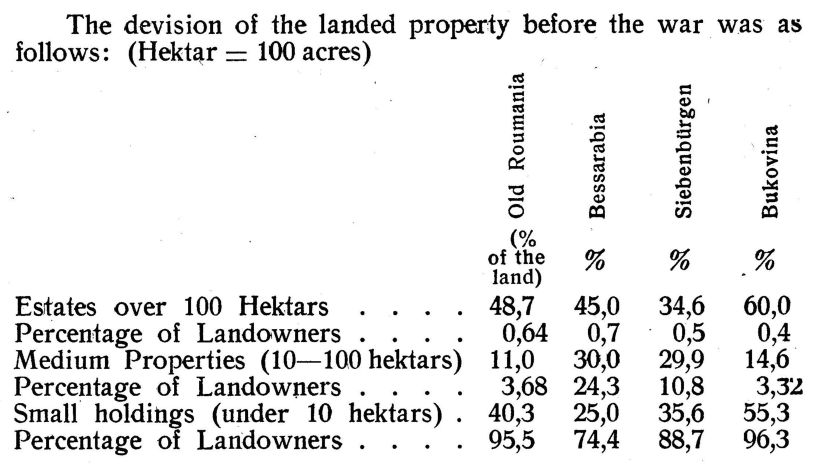
Thus about one half of the total land belonged to the big landowners, a small group of people.
The agrarian population, according to social position, is divided as follows:
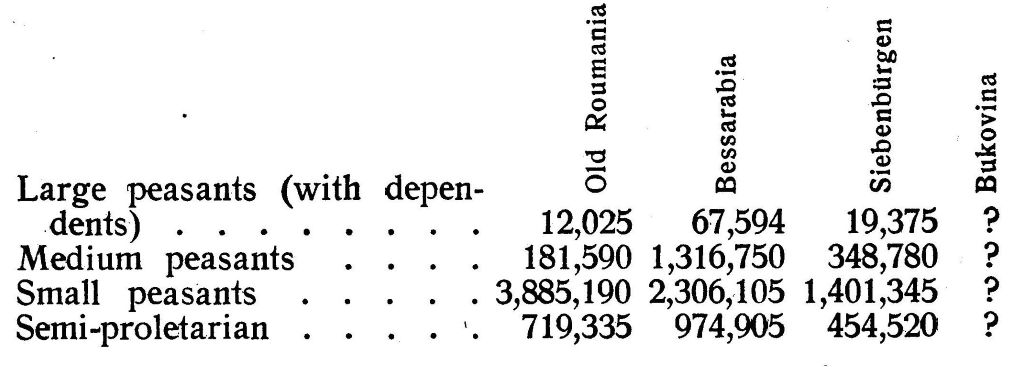
There is not the slightest doubt, that under such conditions, the land is ready for an agrarian revolution, that the C.P. has the duty to seek among the peasants for an ally for the town proletariat, that this is the most important problem of the revolution. The repeated agrarian unrest (particularly in 1907 and further in connection with the Russian revolution of 1917) confirms the correctness of this general estimate.
6. That the agrarian question is the most vulnerable point of the feudal-bureaucratic clique, is evidenced by the so-called “Agrarian Reform” of the “liberal” government. The ruling clique knows very well where its Achilles’ heel is. This “Agrarian Reform” which was undertaken in order to buy off the peasants’ revolution, remained to a considerable extent merely on paper, and became simply a deception of the peasant masses.
1. It was not even carried out to the extent promised.
2. It simply demanded the passing of the landed property into the hands of the prosperous classes of the peasantry.
3. It did not satisfy the land-hunger of the chief section of the poor peasantry.
4. It imposed heavy compensation charges upon those who received land.
5. It left the question of agricultural inventories, of working capital etc. totally untouched.
The exposure of the mendacious character of this reform is therefore the most important duty of the Communist Party of Roumania. The gross neglect which the C.P. of Roumania has shown in the Agrarian Question, consists, among other things, in that the Party has not even taken the trouble to collect particulars of the incidents of the reform. There is neither comprehensive resumé by local correspondents, nor even an approximate estimate of what has been accomplished. That is certainly a most culpable attitude of the leaders of the Party and of the Party writers towards the most important question of public life.
According to the Year Book particulars, 2,700,000 Hektars were divided up in old Roumania alone. The Roumanian comrades deny that categorically. The fact can be regarded as established that compensation reckoned on fifty years’ purchase has to be paid for the land, while the price amounts to forty times the annual rent in 1914 and the big landowners get a government loan.
In Old Roumania the area of the property of the big land owners (5385 owners) amounted to 3,810,000 Hektars, the area of the peasant holdings (4,798,140 souls) to 4,065,000 Hektars (40% and 51%). It must be borne in mind that in the given areas, woods, waters, pools etc. are not taken into account. The woods, however, are of essential importance. There is also to be considered in an estimate of the situation the very great extensivity of the farming (about 80% of the ground is exclusively sown with corn). It is to be assumed therefore that the land hunger of the masses has not been satisfied and that the antagonisms in the sphere of agriculture have not ceased to exist. It is therefore the duty of the C.P. to collect relevant material and analyse it carefully.
7. The C.P. must above all show the peasantry its own political view, that is, it must give an answer to the fundamental questions of the needs of the peasants. In this connection the following fundamental demands are appropriate:
a) Confiscation of the whole of the agricultural inventories, of farm implements, of live-stock and machines of the big land-owners; b) the annulment of all the debts of the peasantry, of all the usurious agreements; c) the prohibition of any dealing or price-driving in land and the assuring of this prohibition by the declaration of the nationalisation of the land; d) the confiscated land will before all be divided among the propertyless and poor peasants; e) Peasant Councils or local Committees will dispose of the land; f) organization of ameliorative help for the peasant economy, largescale arrangements for gratuitous vocational, technical and general education; g) support of the agricultural co-operative trading system; h) struggle against the system of usury etc.
8. The Party must expose the mendacious character of the Government land reform, show that promises are not fulfilled, make use of all the conflicts arising out of the carrying out of this reform, generalise its propaganda, agitation and slogans and bring the peasant masses to the slogan of the confiscation of the whole of the big land-owners’ property as well as to that of the overthrow of the present government of the big agrarians, which is to be replaced by a government of Workers and Peasants.
Only with such prospects can and should partial demands be put forward.
9) These partial demands may be somewhat as follows:
a) Abolition of indemnity payments, propaganda for a boycott of these payments; b) abolition of farm-rents, propaganda for their boycott; c) distribution of the land in the first place among the propertyless and land-poor; d) abolition of the taxes of the peasantry; e) withdrawal of the gendarmerie and police from the villages; f) election of agrarian Committees, who shall dispose of the land; g) amnesty for all peasants who have been sentenced on account of agrarian unrest, and generally, on account of agrarian conflicts; h) complete military amnesty; i) distribution of farm implements etc. for the peasants; j) legal proceeding against the officials who have committed abuses in the carrying out of the land reform; k) legal proceedings against big land-owners, who have given false returns as to the extent of their estates etc. etc.
10) The pre-requisite of any sort of successful work in this direction for the Party is penetration into the villages. The Party must immediately proceed to the organisation of nuclei and party-groups in the villages, to the organisation of a network of its people working in the country and their linking up with one another. The Party must convene periodical Party Conferences of experienced members, which will direct the work in the villages. The Central will appoint a commission for the work on the land with one member of the Central Committee. The Party must work out practical instructions for the organisation of the work on the land. The Party must have information as regards all the conflicts on the land, their character and their progress etc.
11) It is the duty of the Party to prepare special peasant literature. Under this should be included:
a) Works which explain the importance of the agrarian question in the present situation in Roumania, the actual position of affairs, the program of the Party etc. (for the Party itself); b) popular pamphlets for the peasantry; c) leaflets and proclamations to the peasantry, special illegal leaflets on concrete conflicts; d) a popular peasants’ newspaper in thoroughly simple language which can be understood by every peasant. In particular there must be concentrated in the paper collected information from all districts on the carrying out of the land laws and on conflicts. The paper must be a fighting organ of the Party; e) pamphlets, leaflets upon the subject of how the peasants in Soviet Russia have settled the big land-owners.
12) Special attention is to be paid to the propaganda of the alliance of the Workers and Peasants against the alliance of land-owners and capitalists. The slogan of a Workers’ and Peasants’ Government is more appropriate in Roumania than in any other country.
13) For the peasants of the annexed districts, the Party, in addition to the demands already mentioned, has also to put forward the demand for the recognition of their right to complete state separation. Whoever fails to recognise that, delivers the peasantry of these districts over to the hegemony of the opposition-decentralist and separatist bourgeoisie of these districts. The Party must without fail take up a position against the forced colonisation within the country.
14) With regard to the so-called Peasant Party, the C.P. of Roumania has to follow such a policy as will further the development of the left wing of this party and its alteration into a radical-democratic Peasant Party with socialist colouring. Suggestions for a united front can only be made with the object of common activities. The tactics of a united front may in no case be allowed to confuse the natural demands of the C.P. It may in no case put an end to the criticism of the luke-warmness, the inconsequence and sometimes also the betrayals of the Peasant Party against the Peasantry.
International Press Correspondence, widely known as”Inprecor” was published by the Executive Committee of the Communist International (ECCI) regularly in German and English, occasionally in many other languages, beginning in 1921 and lasting in English until 1938. Inprecor’s role was to supply translated articles to the English-speaking press of the International from the Comintern’s different sections, as well as news and statements from the ECCI. Many ‘Daily Worker’ and ‘Communist’ articles originated in Inprecor, and it also published articles by American comrades for use in other countries. It was published at least weekly, and often thrice weekly. A major contributor to the Communist press in the U.S., Inprecor is an invaluable English-language source on the history of the Communist International and its sections.
PDF of issue 1: https://www.marxists.org/history/international/comintern/inprecor/1924/v04n26-apr-24-1924-inprecor.pdf
PDF of issue 2: https://www.marxists.org/history/international/comintern/inprecor/1924/v04n27-may-01-1924-inprecor.pdf
PDF of issue 3: https://www.marxists.org/history/international/comintern/inprecor/1924/v04n29-may-15-1924-inprecor.pdf
 Revolution's Newsstand